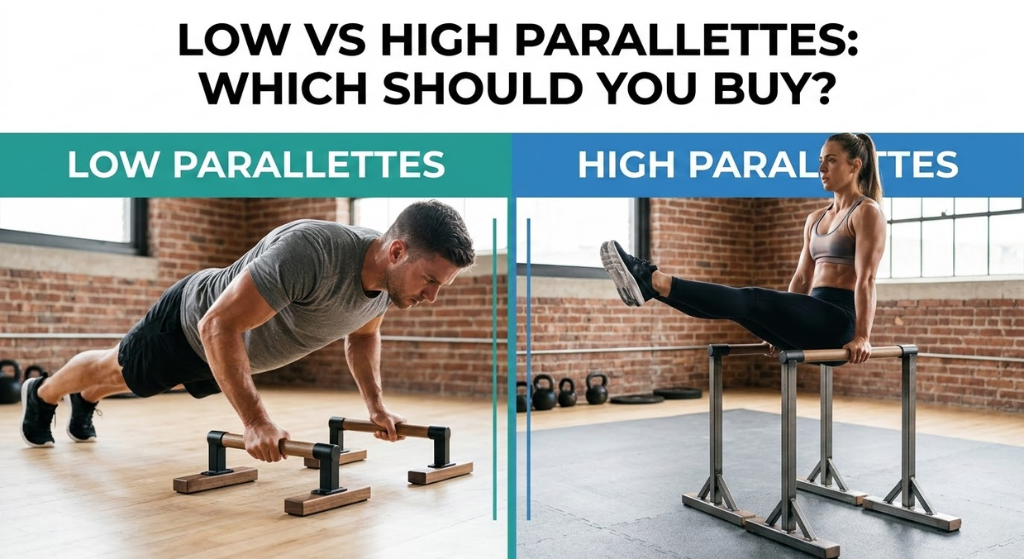
Low vs High Parallettes: Which Should You Buy?
Height is the single most consequential spec on a pair of parallettes. It determines which movements are accessible, how the equipment performs under planche loading, whether dips are possible at all, and how the balance feedback differs across skill work. This is the complete decision guide — what each height range unlocks, where each one falls short, and exactly which type suits your training goals.
📋 In This Guide
- Quick Answer — Which Height for Which Goal
- The Height Spectrum Explained
- What Height Actually Changes in Your Training
- Movement Access by Height Range
- The Full Case for Low Parallettes
- The Full Case for High Parallettes
- Who Should Buy What — Decision Guide
- The Mid-Height Compromise
- Frequently Asked Questions
Most parallette buying guides treat height as a footnote — a spec listed after material and price that gets minimal explanation. That’s a mistake. Height is the primary variable in parallette selection, and buying the wrong height for your training goals is a more costly error than getting the material slightly wrong or overspending on premium wood when steel would have done the job.
The reason height matters so much is that it doesn’t just affect comfort — it determines access. A 10cm parallette enables planche and L-sit work. It cannot do dips. A 35cm parallette can do dips. It is less stable for planche training and changes the balance feedback on floor skills. These aren’t marginal differences; they’re different tools serving different training purposes at different points in a calisthenics progression.
Quick Answer — Which Height for Which Goal
The Height Spectrum Explained
Parallettes are sold across a range from roughly 6cm to 45cm, with some adjustable designs spanning part of that range. The market clusters into three meaningful bands — and understanding where each band sits helps you identify where any specific product actually lands.
- Low (6–15cm): Handles sit close to the floor. The athlete’s body never rises far above ground level even in the most elevated support position. This is the range designed for planche training, L-sit progressions, and handstand push-up depth work. Dip range of motion is blocked by the floor at the bottom position — these bars cannot do full dips.
- Mid (16–24cm): The practical no-man’s land that does most things reasonably well without fully optimising for any single use case. Good push-up depth, acceptable L-sit clearance, marginal dip possibility for taller athletes with longer legs. The default recommendation for someone genuinely unsure of their training direction.
- High (25–45cm): Sufficient floor clearance for full dips — the bottom of the dip range clears the floor. Better deficit HSPU depth. Reduced planche stability as the centre of mass rises. Still fully viable for L-sit work where the extra height actually helps with leg clearance at early training stages.
What Height Actually Changes in Your Training
Four training variables shift meaningfully as parallette height increases. Understanding each one explains why height is not just a comfort variable but a training design choice.
Movement Access by Height Range
This is the definitive reference table for which movements are possible, optimal, or blocked at each height range. Use this to map your specific training priorities to the right height.
| Movement | Low (6–15cm) | Mid (16–24cm) | High (25–45cm) | Notes |
|---|---|---|---|---|
| Push-up (depth) | ✓ 8–12cm depth | ✓ 14–20cm depth | ✓ 22–40cm depth | All heights improve on floor; more depth = more stretch at bottom |
| Planche lean | ✓ Optimal stability | ✓ Good | ⚠ Reduced stability | Stability decreases as height increases; low is the preferred training height |
| Tuck planche hold | ✓ Optimal | ✓ Good | ⚠ Manageable with quality bars | Low bars recommended for high-volume planche work |
| Straddle / full planche | ✓ Optimal | ⚠ Usable, reduced stability | ✗ Not recommended | Advanced planche demands maximum stability — low bars only |
| L-sit (first achievement) | ⚠ Harder — less clearance | ✓ Good clearance | ✓ Most forgiving | More height = easier first L-sit; low bars require stronger hip flexors |
| L-sit (skill development) | ✓ Optimal long-term | ✓ Good | ✓ Good | Once achieved, L-sit trains well at all heights |
| V-sit / Manna | ✓ Optimal | ✓ Good | ⚠ Viable | Advanced compression work trains best close to the floor |
| Dip (full ROM) | ✗ Impossible | ✗ Impossible for most | ✓ 30cm+ required | Legs contact floor before bottom of dip on low/mid bars |
| Pike push-up | ✓ Full ROM | ✓ Full ROM | ✓ Full ROM | All heights work; higher gives more shoulder angle variation |
| Deficit HSPU (wall) | ✓ 6–15cm deficit | ✓ 16–24cm deficit | ✓ 25–45cm deficit | Deficit depth = handle height; advanced HSPU work needs higher bars |
| Handstand (wall) | ✓ Safest — low fall distance | ✓ Good | ⚠ Higher fall risk | Low bars preferred for frequent handstand practice and wrist conditioning |
| Press to handstand | ✓ Optimal | ✓ Good | ⚠ Less stable base | This elite skill requires maximum base stability — low bars optimal |
Head-to-Head Rating: Low vs High
A direct comparison across the variables that matter most for buying decisions — rated out of 5 for each height.
The Full Case for Low Parallettes
Low parallettes (6–15cm) are the choice of most serious calisthenics athletes who have used both heights. The reasons are structural, not aesthetic — they match the biomechanical requirements of the movement families that parallettes are uniquely designed to train.
- Planche training at any stage. From lean to tuck to straddle to full, low bars keep CoM close to the floor and stability at maximum. As the most demanding long-term parallette pursuit, planche training justifies buying low bars on its own.
- V-sit and manna work. Advanced compression skills require a stable, close-to-floor base. The lower the bars, the sharper the hip hinge angle can be without the athlete’s balance being compromised by an elevated support position.
- Handstand conditioning with wrist volume. The close fall distance makes frequent handstand balance attempts and corrections lower-risk, allowing higher practice volume per session with less apprehension about toppling from height.
- Press to handstand. This elite skill — transitioning from L-sit or straddle to handstand — needs maximum base stability. Low bars are the standard training tool for this movement at every level.
- Portability. Low parallettes are the most compact and lightest form of the tool. Most fit in a gym bag or day pack, enabling training in outdoor parks, at a friend’s gym, or while travelling.
- Dips — impossible. At 6–15cm, legs hit the floor before achieving the bottom position of a full-depth dip. This is a hard movement exclusion, not a minor limitation. If dips are a training priority, low bars do not cover this.
- First L-sit achievement for beginners. The reduced clearance means hip flexors must be stronger to hold legs fully horizontal without floor contact. This makes the first L-sit milestone harder to hit on low bars than on high bars — a relevant frustration for beginners who don’t yet have the hip flexor base.
- Deep deficit HSPU. A 10cm bar gives 10cm of deficit depth on HSPU. Advanced athletes working toward very deep deficit HSPU (25–40cm) will need higher bars or stacked alternatives to reach the depth their training demands.
- Psychological comfort for complete beginners. Some beginners find very low bars feel too close to the floor and unstable before they’ve developed basic wrist and shoulder stability. Mid-height bars provide slightly more psychological security at the early stage.
The Full Case for High Parallettes
High parallettes (25–45cm) are the right primary tool for a specific type of athlete — and the wrong tool for others. The case for them is real but narrower than marketing often implies.
- Dips — full range of motion. At 30cm+, the bottom of the dip range clears the floor and the movement becomes fully accessible. High parallettes are the only parallette option for athletes who want dips in their training without purchasing a separate dip station.
- First L-sit achievement. The extra clearance reduces the hip flexor requirement for the first L-sit milestone. For beginners with a specific short-term goal of achieving their first L-sit, high bars make that achievement more accessible.
- Deep deficit HSPU work. Athletes doing advanced handstand push-up training with 25–40cm deficit requirements need bars at that height. This is a legitimate advanced training need that low bars cannot address.
- Taller athletes. Athletes over 190cm often find that low parallettes produce a cramped push-up position where hip clearance in the bottom ROM is limited by their longer torso. Mid-to-high bars (20–30cm) improve the push mechanics for longer-bodied athletes.
- General fitness use with minimal skill ambition. For athletes who want better push-ups, wrist-neutral pressing, and basic bodyweight work without a specific planche or advanced skill goal, high parallettes cover their needs cleanly.
- Advanced planche stability. The higher CoM under planche loading creates a tipping moment that quality bars can partially manage — but cannot fully resolve. Straddle and full planche work is genuinely less stable and more equipment-dependent at high bar heights.
- Balance feedback precision. The increased height from the floor reduces the sharpness of proprioceptive correction during balance skills. Small deviations take longer to detect and correct because the body is further from its natural ground reference.
- Portability. High parallettes are heavier and bulkier than low bars. Some designs do not fit in a bag and require dedicated storage space. For athletes who train outdoors or travel, this is a relevant constraint.
- Long-term planche progression. As planche skill advances past tuck planche toward straddle and full planche — a multi-year progression for most athletes — the instability of high bars becomes more limiting. Athletes who buy high bars for early training often end up wanting low bars anyway when their skill level advances.
Who Should Buy What — Decision Guide
These are the athlete profiles that map cleanly to each height choice. Find the profile that matches your training situation most closely.
- Planche is on your training agenda — at any stage from lean to full, low bars are the correct tool
- You’ve already achieved your first L-sit — the extra clearance of high bars helped you get there but isn’t needed for continued development
- You train in limited space or travel frequently — the compact footprint and portability are decisive advantages
- You’ve been training 6+ months and know your progression direction is toward advanced floor skills
- Rings or a dip station cover your dipping needs elsewhere — no need for high bars to provide dip access
- You’re buying a second pair and already own high bars — low bars are the natural complement
- Dips are a specific training goal and you don’t own or want a separate dip station
- You’re a complete beginner who wants the first L-sit to be achievable in the early months of training
- You’re taller than 190cm and low bars produce a cramped push-up geometry for your torso length
- Advanced deficit HSPU work is your priority — 25–40cm depth requires bars at that height
- You have no specific planche ambition — if skill-level planche training isn’t on your horizon, the stability advantage of low bars is less relevant
- You’re buying a second pair and already own low bars — high bars expand into dip territory you couldn’t previously reach
The Mid-Height Compromise — When It’s Actually the Right Choice
Mid-height parallettes (16–24cm) are often dismissed in buying guides as neither-here-nor-there, but there’s a real case for them as a primary tool for a specific type of athlete. The key is being honest about which training scenarios they actually serve well.
- You’re 3–9 months into calisthenics training and unsure of your long-term direction. Mid bars serve as an excellent exploration tool — you can test L-sit work, planche leans, push-up depth, and pike push-ups without being committed to a height that might feel wrong once your skill priorities clarify.
- You want one pair that handles the most common beginner and intermediate movements without any hard exclusions. Push-ups, tuck holds, L-sit attempts, planche leans, and pike push-ups all work at 18–22cm. Nothing is blocked except full-depth dips, and nothing is destabilised except advanced planche progressions you likely won’t reach for some time.
- You’re a recreational athlete with no competition or advanced skill goals. For someone who wants better push mechanics, basic core work, and some fun skill challenges without a long-term calisthenics progression plan, mid-height covers the full scope of what they’ll ever realistically need.
- You specifically train with taller training partners. Mid-height works better as a shared tool between athletes of different heights — the geometry is more forgiving across different torso lengths than low bars (which can feel cramped for taller athletes) or high bars (which change skill dynamics for shorter athletes).
- You know planche training is your long-term goal. The stability compromise of mid-height becomes increasingly relevant as planche skill advances. Buy low bars and accept the L-sit will take slightly longer to achieve.
- Dips are essential to your programme. Mid-height bars (16–24cm) do not reliably provide dip range of motion. Taller athletes (190cm+) with very long femurs might clear the floor at 22–24cm, but most athletes cannot. Do not buy mid bars expecting dip capability — buy 30cm+ or a dip station instead.
- You’re advanced and training straddle planche or above. At this level, the stability differences between heights are not hypothetical — they are felt in every session. Low bars only at this training stage.
Frequently Asked Questions
One Number That Drives Every Other Decision
Parallette height isn’t a marketing spec — it’s the single number that defines what your bars can and can’t do. Two centimetres either side of the dip threshold (around 28–30cm) is the difference between equipment that covers dipping and equipment that doesn’t. Five centimetres either side of the low-bar planche zone (10–15cm) is the difference between optimal planche stability and equipment that compromises your most demanding skill training.
The decision tree is simple once you strip it back: do you need dips? Go high. Are you serious about planche? Go low. Are you genuinely uncertain about both? Go mid. And if your training evolves — which it will — a second pair at the other end of the height spectrum is a relatively small investment that turns two separate tools into a complete floor-level calisthenics setup.
READY TO START TRAINING?
Every parallette exercise and skill progression from beginner to elite — all in the complete guide.
The Calisthenics Bible →