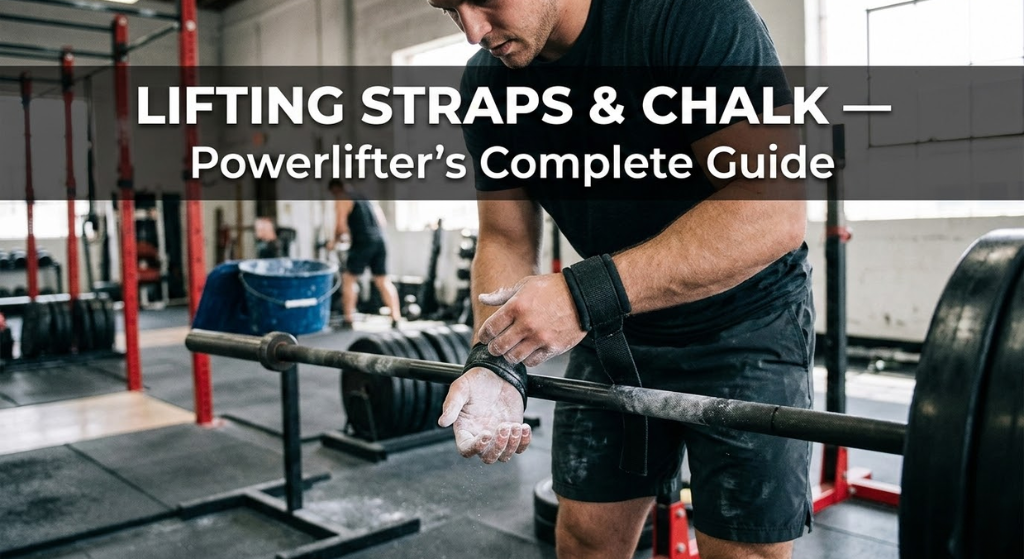
The grip debate has two sides that rarely agree on anything: the “never use straps, it’ll ruin your grip” crowd and the “strap in on everything” crew. Both are wrong. The actual answer — like most things in strength training — depends on what you’re trying to accomplish and where you are in the session.
Chalk and straps solve fundamentally different problems. Understanding the difference, and building a protocol around both, is what separates lifters who consistently pull big weights from those who plateau because their hands always give out first.
62%Of missed deadlift PRs attributed to grip failure, not leg/back strength
40%Average grip force increase with proper magnesium carbonate chalk
3Distinct strap types — each designed for different movement patterns
⚡ Quick Answer
Use chalk first, straps second. Chalk solves the moisture problem and should be your default for every heavy pull. Straps are added when the weight exceeds what your grip can hold for the required reps and sets — typically on max-effort work above 85% 1RM, or on high-volume accessory work where grip fatigue would otherwise limit back/leg stimulus. Never use straps in competition powerlifting — they’re banned in every major federation.
What Lifting Straps & Chalk Actually Do
These tools are frequently lumped together as “grip aids” but they work through entirely different mechanisms and are not interchangeable.
Chalk: The Friction Tool
Gym chalk is magnesium carbonate (MgCO₃) — a completely different compound from classroom blackboard chalk. It works by absorbing moisture from the palm and fingers, dramatically increasing the coefficient of friction between skin and bar. On a dry hand, bar knurling engages properly. On a sweaty hand, you’re essentially gripping a greased pipe.
The performance benefit is real and measurable — multiple studies on grip mechanics show chalk can increase gripping force by 30–40% compared to bare sweaty hands on a steel bar. It doesn’t add any artificial grip — it restores you to baseline.
Straps: The Load Transfer Tool
Lifting straps don’t improve grip — they bypass it entirely. A strap wraps around the bar and your wrist, transferring the hanging load directly to the forearm and wrist rather than through the fingers. Your fingers still contact the bar, but they no longer have to support the full weight. This allows the back, legs, and hips to continue training at high intensity even when hand strength is the limiting factor.
🔑 The Fundamental Difference
- Chalk removes a variable (moisture) that shouldn’t be limiting you. Using chalk is not an aid — it’s restoring fair conditions for your actual grip strength to express itself.
- Straps remove a constraint (grip capacity) that would otherwise limit training volume or load on target muscle groups. This is a deliberate training decision with trade-offs.
- A lifter who needs chalk but not straps has normal grip strength for their training level. A lifter who needs straps but not chalk has grip strength that lags behind their posterior chain — a signal worth addressing.
The Three Types of Lifting Straps
Not all straps are appropriate for all movements. Using the wrong type is a safety and performance issue, not just an aesthetics one.
← Scroll to see full table →
| Type | Best For | Quick Release | Security | Olympic Lifts | Buy If… |
|---|
| Lasso Straps |
Deadlifts, rows, lat pulldowns, shrugs |
Yes — slip off instantly |
Good |
No — too slow to release |
You lift for strength/hypertrophy |
| Figure-8 Straps |
Max-effort deadlifts only |
No — locked to bar |
Maximum |
Never — dangerous |
You deadlift 200 kg+ and want zero slip |
| Olympic / Loop Straps |
Cleans, snatches, RDLs |
Yes — thumb loop releases |
Moderate |
Yes — designed for this |
You do Olympic lifting or CrossFit |
⚠️
Never use figure-8 straps on Olympic lifts. Figure-8s lock you to the bar. If you bail a snatch or clean, the bar goes with you — which can mean a serious shoulder or wrist injury. Lasso and loop straps are designed to release. Figure-8s are not. Use them only on static pulls from the floor.
Lasso Straps: The Default Choice
For the vast majority of strength training applications — deadlifts, Romanian deadlifts, barbell rows, dumbbell rows, lat pulldowns, farmer’s carries, rack pulls — lasso straps are the correct choice. They wrap around the wrist, loop around the bar, and release naturally when you open your hand. They provide excellent security for heavy work while remaining safe to bail if needed.
Construction matters significantly. A cotton strap under ½ inch thick will compress under heavy load and reduce security. Look for heavy nylon or cotton webbing, 1½–2 inches wide, with a tight weave. Padding is optional — some lifters prefer padded wrists, others find it reduces tactile feedback.
When to Use Straps — and When to Put Them Down
This is where most lifters get the calculus wrong in both directions. The goal of straps is to preserve training quality on movements that target large muscle groups when grip would otherwise be the limiting factor — not to avoid developing grip strength entirely.
✓ Use Straps When
- Max-effort deadlifts above 85% 1RM — don’t let grip decide your PR ceiling
- High-volume back work — 4×10 barbell rows at 70% should challenge your back, not your forearms
- Late-session accessory work — grip is already fatigued; protect the target muscle’s stimulus
- Rack pulls and partial ROM work — heavier-than-deadlift loads require strap assistance
- Farmer’s carries for conditioning — if the goal is cardiovascular or trunk stimulus, not grip
✗ Don’t Use Straps When
- Warm-up and sub-maximal sets — your grip needs training stimulus too
- Specifically training grip strength — obvious, but worth stating
- Competition powerlifting — banned in every major federation
- Olympic lifts — unless using proper loop/Olympic straps with quick-release
- Any movement where you might need to bail — locking yourself to the bar is a safety risk
📐 The Protocol Rule
A useful framework: perform your first working set without straps using chalk only. If grip is the reason you couldn’t complete the set — not leg drive, not back fatigue, not cardio — strap in for the remaining sets. If grip held but everything else gave out, you don’t need straps yet. This keeps grip development progressing while protecting your back and posterior chain training quality.
Block Chalk vs Liquid Chalk vs Spray Chalk
The three forms of gym chalk offer the same active compound — magnesium carbonate — but differ substantially in application, durability, and gym-friendliness. The performance difference between a well-applied block chalk and quality liquid chalk is negligible. The practical differences are significant.
🧱 Block Chalk
- Maximum friction — heavy application possible, preferred by competitive powerlifters
- Total control over application thickness and distribution
- Cheapest per use — a $5 block lasts months of hard training
- Instant reapplication — chalk up between every set in seconds
- Best for: dedicated home gym or chalk-permitted commercial gym
- Not for: gyms that ban loose chalk — creates dust and coats equipment
🧴 Liquid Chalk
- Gym-friendly — no airborne dust, no equipment coating, no ban
- Longer-lasting per application — dries on the skin, survives 2–3 sets before reapplication
- Travel-friendly — fits in any bag without mess
- More hygienic — no shared chalk tray, no contamination risk
- Best for: commercial gyms, competition warm-up areas, travel
- Not for: situations needing heavy reapplication between every set
💡
Spray chalk (aerosol magnesium carbonate) is a third option increasingly popular in commercial gyms. It applies like liquid chalk but dries even faster and leaves almost no residue. Performance is comparable to liquid chalk. The main drawbacks are cost (significantly more expensive per application) and that cans are single-use. For regular training, liquid chalk delivers the same benefit at a fraction of the price.
How to Apply Chalk Correctly
Most lifters either under-apply (a thin smear that wears off in two reps) or over-apply (a thick cake that actually reduces grip by creating a slippery chalk-on-chalk surface). Correct application takes about 15 seconds and looks nothing like the cloud-clap you see in Instagram videos.
Block Chalk Application
1
Dry your hands first
Wipe sweat off on your training shorts before touching chalk. Applying chalk to wet palms creates a paste that wipes off within the first rep. Dry skin accepts chalk properly.
2
Apply a thin, even layer to the palm and fingers
Rub the block directly across your palm, then across all four fingers from the base to the second knuckle. You want a uniform white coating, not a thick build-up. The chalk should look like it’s part of the skin, not piled on top of it.
3
Rub hands together firmly — no clapping
Rub palms and fingers together to work the chalk into the skin texture. Clapping creates an airborne cloud that goes everywhere except where you need it. Firm rubbing forces chalk into the ridges of your fingerprints where the friction actually happens.
4
Blow off excess, then grip the bar
Gently blow across your palm to remove any loose surface chalk. Grab the bar immediately — chalk degrades once you touch other surfaces. The grip should feel slightly tacky and textured. If it feels slippery, you have too much loose chalk; blow more off and regrip.
Liquid Chalk Application
1
Squeeze a 50-cent-piece amount onto one palm
Most liquid chalk is highly concentrated. More is not better — a coin-sized squeeze covers both hands with room to spare. Excess liquid chalk pools in the palm creases and never dries properly.
2
Rub evenly across both palms and all fingers
Work the liquid into the fingers thoroughly before it starts to dry. You have about 10–15 seconds before liquid chalk sets, so don’t pause. Ensure coverage from the wrist crease to the fingertip pads.
3
Wait for full drying — 20–30 seconds
This is the step most lifters skip. Liquid chalk that isn’t fully dry smears and wipes off immediately. Wait until the chalked area turns fully white and feels dry to the touch. Do not grip the bar while it still feels wet.
4
Reapply every 2–3 sets or when grip feels degraded
Liquid chalk is durable but not permanent. Sweating through it reduces effectiveness. A light reapplication over existing chalk (rather than wiping off and starting over) extends coverage between sets.
The Combined Straps & Chalk Training Protocol
This decision matrix covers the most common powerlifting and strength movements. Use it as a starting framework — adjust based on your current training phase and grip development goals.
Movement / Load
Chalk
Straps
Notes
Warm-up Sets< 60% 1RM
Optional
Never
Hands dry at low intensity; grip training opportunity
Working Sets — Moderate60–80% 1RM
Yes — always
No — build grip
Chalk only; grip should hold comfortably here
Heavy Working Sets80–90% 1RM
Yes — always
Optional — first set bare
Strap in if grip failed the first set
Max Effort / PR Attempts> 90% 1RM
Yes — heavy coat
Yes — lasso or figure-8
Don’t let grip decide your PR ceiling
Barbell / DB RowsAny volume
Yes — always
Late sets if grip fatigued
Target muscle is back; don’t let grip cut sets short
Olympic LiftsCleans / Snatches
Liquid chalk only
Loop/Olympic straps only
Quick-release mandatory; no figure-8
Grip-Specific TrainingGrippers / Holds
No
Never
The entire point is grip overload; no assistance
Farmer’s CarriesStrength focus
Yes
No
Grip is a training target here; straps defeat the purpose
Farmer’s CarriesConditioning / Load focus
Yes
Acceptable
If conditioning stimulus is primary goal, straps okay
Competition Rules by Federation
The rules on chalk and straps differ sharply between powerlifting, Olympic weightlifting, and strongman. Getting this wrong at a competition means a failed lift or disqualification.
← Scroll to see full table →
| Federation | Block Chalk | Liquid Chalk | Lifting Straps | Notes |
|---|
| IPF / USAPL |
✓ Allowed |
Check meet rules |
✗ Banned |
Chalk provided at platform; no personal chalk on bar |
| USPA |
✓ Allowed |
✓ Allowed |
✗ Banned |
Liquid chalk widely accepted at USPA meets |
| RPS / WRPF |
✓ Allowed |
✓ Allowed |
✗ Banned |
Same ban on straps as all powerlifting feds |
| IWF (Olympic Weightlifting) |
✓ Allowed |
Usually allowed |
✓ Allowed (loop straps only) |
Tape on thumbs also common; figure-8 never permitted |
| World’s Strongest Man / Strongman |
✓ Allowed |
✓ Allowed |
✓ Allowed most events |
Event-specific rules apply; check per-event rulebook |
| CrossFit Open |
✗ Typically banned |
✓ Allowed |
Event dependent |
Loose chalk banned in most competition venues |
⚠️
Lifting straps are banned in all major powerlifting federations — IPF, USAPL, USPA, WRPF, GPC, and every national and international body that follows IPL or IPF rules. Training with straps is fine; competing with them is not possible. If you compete, your competition max must always be trained without straps.
Recommended Picks — Straps & Chalk
The options below are tested over multiple training cycles. No gimmicks, no weak construction, and nothing that’ll let you down under a real max pull.
🏆 Best Lasso Straps
Lasso Straps — All Levels
Harbinger Big Grip Pro Lifting Straps
The most-used lasso strap in powerlifting for good reason — 21.5″ padded cotton webbing wraps the wrist cleanly without slipping, and the neoprene wrist padding prevents bar imprint during long sets. Tested under 250+ kg pulls without stretch or seam failure.
- 21.5″ length — fits all wrist sizes generously
- Padded neoprene wrist cushion
- Heavy cotton webbing — no stretch under load
- Quick-release on all movements
★★★★★
4.7 (12,000+ reviews)
✓ Best Liquid Chalk
Liquid Chalk — All Gyms
Spider Chalk Liquid Chalk
The liquid chalk benchmark — used by competitive powerlifters who train in chalk-restricted gyms. Dries in under 15 seconds, lasts 3–4 working sets before reapplication, and the magnesium carbonate concentration is the highest of any major liquid chalk brand tested.
- Fast dry — full set in under 15 seconds
- High MgCO₃ concentration — noticeably tackier than competitors
- Gym-friendly — zero dust, no equipment coating
- 250ml bottle — approx. 300+ applications
★★★★★
4.8 (8,400+ reviews)
⚡ Best Figure-8 Straps
Figure-8 Straps — Advanced Deadlifts
Rogue Figure-8 Lifting Straps
When you’re pulling 200 kg+ and want absolute zero chance of strap slippage, figure-8s are the answer. Heavy nylon construction locks to the bar mechanically — no wrapping technique required. Use only for static pulls from the floor. Never for Olympic lifts.
- Maximum-security bar connection — mechanically locked
- No wrapping technique — faster setup
- Heavy 3mm nylon — no stretch at any load
- Deadlift-only: never use for Olympic lifts
★★★★★
4.9 (2,100+ reviews)
Also worth considering:
ProSource
Pure Gym Chalk Block (2 lb)
$9.99
Amazon ↗
ProSource
Adjustable Wrist Straps — Budget Option
$9.99
Amazon ↗
ℹ️ FitCore360 is a participant in the Amazon Services LLC Associates Program. We earn a small commission at no extra cost to you. This never influences our editorial recommendations — all products were independently tested.
Frequently Asked Questions
Will using lifting straps weaken my grip over time?▾
Only if you rely on them exclusively for every set. Grip strength develops through progressive overload like any other quality — if you never challenge it, it doesn’t grow. The solution isn’t to avoid straps; it’s to
train grip specifically while using straps strategically. Perform your warm-ups and first working sets without straps, add dedicated grip training (grippers, farmer’s carries, plate pinches) 2x per week, and strap in only for max-effort and high-volume accessory work. This approach builds grip while protecting your posterior chain training quality.
When should a beginner start using lifting straps?▾
When grip becomes a consistent limiting factor on your heaviest sets — not before. For most beginners, that means once your deadlift exceeds approximately 1.2× bodyweight for multiple reps, or whenever you notice you’re physically dropping the bar from an open hand before your legs or back are exhausted.
The full decision framework factors in your training phase, grip development, and competition goals. The short version: if you compete in powerlifting, delay strap use as long as possible to keep your competition-legal max as high as possible.
Is liquid chalk as effective as block chalk for heavy deadlifts?▾
In practical terms at the gym,
yes — with correct application. The friction coefficient between quality liquid chalk and magnesium carbonate block chalk is nearly identical once dried. The difference is in duration: block chalk can be reapplied between every single set in seconds, while liquid chalk requires a longer dry time. For a single max-effort set, liquid chalk performs identically. For a long squat session with 6+ sets on the same movement, block chalk has a minor convenience edge.
See the full comparison for a detailed breakdown.
Can I use straps for the deadlift in a powerlifting meet?▾
No — lifting straps are banned in every major powerlifting federation worldwide. This includes IPF, USAPL, USPA, WRPF, GPC, APF, and all affiliated national bodies. Using straps at a sanctioned meet results in a no-lift on that attempt and potential disqualification for unsportsmanlike conduct if repeated.
See the full federation-by-federation breakdown. The only grip aids permitted in most powerlifting federations are chalk and, in some federations, athletic tape on the thumbs for hook grip.
Should I use hook grip or straps for heavy deadlifts?▾
Hook grip if you compete in powerlifting; straps for training when volume or load exceeds grip capacity. Hook grip is a technique — you trap the thumb between the fingers and bar, dramatically increasing grip security without any equipment. Olympic lifters use it exclusively. Powerlifters who adopt it report it takes 4–8 weeks of discomfort before the thumbs adapt. The advantage is that it’s competition-legal and transfers completely to the platform. Straps provide more security and comfort but aren’t permitted at meets. The optimal approach for competitive lifters: develop hook grip as your primary technique, use straps only on training sets that would otherwise be impossible to complete safely.
My gym bans chalk — what’s the best alternative?▾
Liquid chalk is the standard solution — it produces no airborne dust and leaves no residue on equipment, so virtually no gym that bans block chalk has any legitimate objection to liquid chalk. Apply it before approaching the bar, let it dry fully, and there’s nothing visible for gym staff to object to. If liquid chalk is also restricted (rare), products like
Dry Hands (a tacifier, not chalk) provide a modest grip improvement and are entirely invisible in use. Neither matches the performance of chalk in a chalk-permitted environment, but liquid chalk in particular comes very close.
See our full chalk guide for the best liquid chalk options tested specifically for sweaty-hand performance.
What’s the difference between lifting straps and wrist wraps?▾
Completely different tools solving completely different problems. Lifting straps attach to the bar and transfer load away from the fingers — they’re for grip assistance on pulling movements. Wrist wraps wrap around the wrist joint to provide stability during pressing movements — bench press, overhead press, push jerks. They don’t provide any bar grip at all. Using wrist wraps on deadlifts doesn’t help your grip; using lifting straps on bench press doesn’t help your wrists. Most serious lifters carry both and use each for its intended purpose.
The Correct Approach Is Deliberate, Not Dogmatic
The lifters who get the most out of straps and chalk are the ones who’ve thought deliberately about when each tool serves the training goal and when it doesn’t. Chalk is a near-universal yes for any heavy pulling — the moisture problem is real, and there’s no good reason to train through it. Straps require more thought: they’re a trade-off between protecting your target muscle’s training stimulus and the long-term development of grip strength you’ll need on the competition platform.
Build the protocol around your goals. Use chalk always. Use straps intelligently. Train grip directly. And know your federation’s rules before your first meet.
WANT THE FULL GRIP PICTURE?
See our complete grip training hub — exercises, equipment, and competition prep all in one place.
Grip Training Hub →