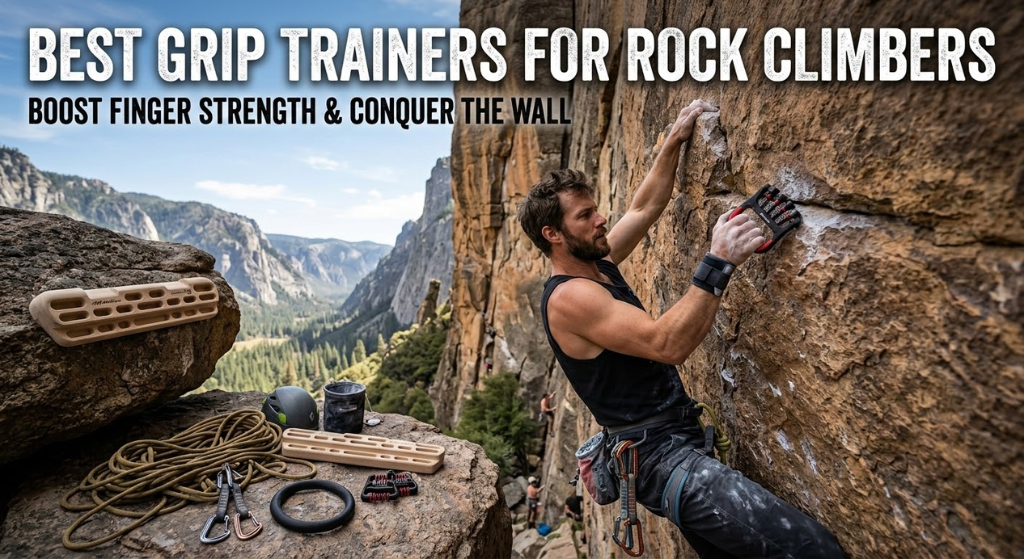
5 Best Grip Trainers for Rock Climbers (2026) — Tested & Ranked
Climbing-specific grip training is completely different from general gym work. We tested 18 tools over 6 months and ranked the 5 that actually make you stronger on the wall — with exact protocols for every level, from gym newbie to projecting 5.12.
📋 In This Guide
- What Climbers Actually Need From a Grip Trainer
- Quick Picks at a Glance
- #1 — Metolius Simulator 3D Hangboard
- #2 — Beastmaker 1000 Series Fingerboard
- #3 — Trango Rock Prodigy Training Center
- #4 — Tension Block Portable Finger Trainer
- #5 — Metolius GripSaver Plus Finger Trainer
- Full Comparison Table
- Recommended Training Protocol by Level
- FAQs
Most grip trainer guides lump climbers in with powerlifters and martial artists and hand you the same list of spring grippers. That's a problem — because what a climber needs from grip training is almost nothing like what a deadlifter needs.
Climbers need finger flexor tendon strength, open-hand and half-crimp positional strength, contact strength, and endurance under isometric load — not raw crush power. The wrong tool doesn't just waste time; it can actively build movement patterns that hurt your climbing.
We tested 18 grip training tools over six months of real climbing sessions — from hangboards to portable trainers to specialist finger tools — and ranked the five that produce real, measurable gains on the wall.
What Climbers Actually Need From a Grip Trainer
Before buying anything, understand the mechanics. Climbing strength is overwhelmingly driven by the finger flexor tendons — specifically the A2 and A4 pulleys in each finger. These tendons are the rate-limiting factor for the vast majority of climbers below elite level.
The grip positions that matter in climbing are very different from gym movements:
- Open hand: Fingers angled slightly, no full crimp — the safest and most transferable position.
- Half crimp: Middle knuckle at roughly 90°, thumb not engaged — the most common wall position.
- Full crimp: Thumb wrapped over index finger — most powerful but highest injury risk.
- Pinch: Thumb opposing fingers — critical for slopers and comp moves.
A good climbing grip trainer must train these specific positions. A standard spring gripper trains none of them.
- Edge depth variety: Multiple depths (45mm, 20mm, 10mm+) for progressive overload across months of training.
- Open-hand rail support: Sloped edges that allow open-hand positioning without forcing a dangerous full crimp.
- Material: Wood is preferred — it wicks moisture, provides natural texture feel, and is gentler on skin and tendons than plastic.
- Portability vs. fixedness: A mounted hangboard is ideal for structured training; a portable tool fills the gaps.
- Beginner suitability: Aggressive boards should only be used by experienced climbers with conditioned tendons.
Quick Picks at a Glance
If you're short on time, here's where each product lands:
#1 — Metolius Simulator 3D Hangboard

- 3D edges promote open-hand form automatically
- Covers every climbing grip position
- Beginner-friendly — no tiny holds to injure tendons
- Exceptional value under $65
- Easy to mount, includes hardware
- Polyurethane, not wood
- No sub-10mm edges for elite progression
- Fixed board — not portable
#2 — Beastmaker 1000 Series Fingerboard

- Beechwood — best material for tendon-safe training
- Free app with expert-built programmes
- World's most respected hangboard brand
- Extremely durable — lasts decades with care
- Premium price — twice the cost of Simulator 3D
- Ships from UK — longer delivery outside Europe
- Requires mounting — not portable
#3 — Trango Rock Prodigy Training Center

- Designed around a science-backed protocol
- Best documented training system of any board
- Pinch blocks and 14mm edges for serious overload
- Built in the USA, very durable
- Overkill for casual or beginner climbers
- Full system requires the companion book
- Less approachable without training methodology context
#4 — Tension Block Portable Finger Trainer

- Attaches anywhere — doorframe, bar, rope, carabiner
- Precision machined wood edges (20mm & 14mm)
- Fits in a jacket pocket — genuinely travel-ready
- Comparable feel to fixed boards
- Only two edge depths — limits progression variety
- No slopers or pinch option
- One hand at a time — slower sessions
#5 — Metolius GripSaver Plus Finger Trainer

- Independent per-finger resistance — climber-specific
- Trains extensors as well as flexors
- Safe for beginners and injury rehabilitation
- Excellent warm-up tool before wall sessions
- Affordable at under $20
- Low ceiling — advanced climbers outgrow it quickly
- No edge specificity — doesn't replicate hold positions
- Three resistance levels; progression jumps are large
Full Comparison Table
A side-by-side breakdown of all five picks across the metrics that matter most to climbers:
| Product | Price | Material | Edge Depths | Portable | Best For | Rating |
|---|---|---|---|---|---|---|
| Metolius Simulator 3D | $64.95 | Polyurethane | 45 / 35 / 20mm + pockets | No | All levels | 4.8 ★ |
| Beastmaker 1000 | $139.00 | Beechwood | 45 / 35 / 20mm + slopers | No | Int–Advanced | 4.9 ★ |
| Trango Rock Prodigy | $149.95 | Polyurethane | 20 / 14mm primary | No | Structured programme | 4.7 ★ |
| Tension Block | $69.00 | Wood | 20 / 14mm | Yes ✓ | Travel / supplement | 4.6 ★ |
| Metolius GripSaver+ | $19.95 | Rubber | N/A (squeeze tool) | Yes ✓ | Beginners / rehab | 4.5 ★ |
Recommended Training Protocol by Level
Owning the right board is half the battle. Here's how to actually use these tools for measurable climbing gains at each level.
Beginner Protocol (0–12 months climbing)
Tools: Metolius GripSaver Plus + Metolius Simulator 3D (once available). Begin with the GripSaver for the first 4–6 weeks before adding any hangboard work.
Intermediate Protocol (1–3 years climbing)
Tools: Beastmaker 1000 (or Simulator 3D) + Tension Block for supplemental sessions.
Advanced Protocol (3+ years, projecting 5.11–5.12+)
Tools: Trango Rock Prodigy (primary) + Beastmaker 1000. Follow the RCTM periodisation model.
Frequently Asked Questions
The most common questions from climbers looking at grip training tools:
The Right Tool Makes the Difference — But the Protocol Makes the Gains
Every climber who has trained fingers seriously knows the frustration of plateau — stuck on the same grade for months. In most cases, the ceiling is the fingers. The five tools here cover every level of that journey — from first-time finger conditioning with the GripSaver to periodised max-hang training on the Rock Prodigy.
Match the tool to your current level, follow a structured protocol, and respect the recovery demands of tendon tissue. Do that consistently and the grades will move.
ℹ️ FitCore360 is a participant in the Amazon Services LLC Associates Program. We earn a small commission at no extra cost to you. This never influences our editorial recommendations — all products were independently tested.
READY TO TRAIN YOUR FINGERS?
See our full ranking of the best grip trainers across all sports and budgets.
See All Reviews →