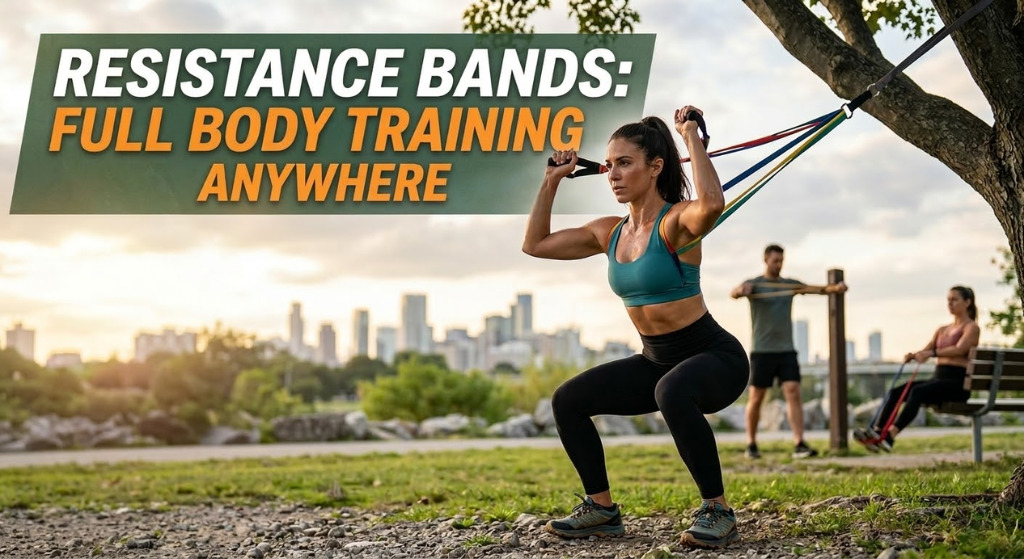
Why Resistance Bands Build Real Strength
The most common objection to band training is that bands feel too easy — that they’re a warm-up tool or a physical therapy aid, not a legitimate strength tool. That objection comes from using bands wrong: wrong resistance, wrong exercise selection, and no understanding of how to make bands progressively harder.
The mechanical advantage of resistance bands is the ascending resistance curve. Unlike free weights, which provide the same load throughout the range of motion, bands increase resistance as they lengthen. This means the band is hardest at the point where your muscles are strongest (full extension) and lightest where you are weakest (stretched position). This variable resistance is a feature, not a limitation — it reduces injury risk at the most vulnerable joint positions and maximises muscle activation at peak contraction.
30+Exercises covering every major muscle group — no gym required
~$20–$60Full band set covering light to heavy resistance — replaces hundreds of dollars of equipment
0 kgWeight in your bag — the full system fits in a zip-lock pouch
⚡ The Honest Case for Band Training
Resistance bands will not replace a barbell for maximum strength development. They will replace a gym for athletes who travel, train at home, are recovering from injury, or want to add training volume without additional equipment cost. Used consistently with proper progressive overload, bands produce real hypertrophy and functional strength gains — the research is unambiguous on this. The limiting factor is almost always programme design and progression, not the bands themselves.
Band Types — Which to Use for What
There are three distinct band types, and they are not interchangeable. Using the wrong band type for an exercise makes the exercise significantly harder or easier than intended, reduces joint safety, or simply doesn’t work at all. Here’s the essential guide — for the full comparison, see Loop vs Tube vs Fabric Bands.
Type 1
Loop Bands (Flat)
Best for: Pull-ups, deadlifts, squats, rows, pull-throughs, mobility. Available in 5 resistance levels. The most versatile band type — usable for both upper and lower body. Also called “power bands” or “resistance bands.”
Type 2
Tube Bands (With Handles)
Best for: Bicep curls, tricep pushdowns, chest press, rows, shoulder exercises. The handles allow a more natural grip for upper body isolation movements. Anchors easily to doors.
Type 3
Fabric / Mini Loop Bands
Best for: Glutes, hip abduction, lateral walks, clamshells, glute bridges. Stays in place on skin without rolling. Not suitable for upper body pulling movements — resistance range is too light and loop diameter too small.
📋 Minimum Band Kit for This Guide
- 1× Light loop band (10–25 lbs resistance) — shoulder work, face pulls, mobility drills
- 1× Medium loop band (30–60 lbs) — rows, pull-throughs, squat assistance
- 1× Heavy loop band (60–100 lbs) — deadlifts, pull-up assistance, hip thrusts
- 1× Tube band set with handles — bicep, tricep, chest, shoulder isolation
- 1–2× Fabric mini bands (light + medium) — glutes, hip abduction warm-up
For reviewed band sets and the best value purchases on Amazon, see Best Resistance Band Systems.
Upper Body — Push Exercises
Seven push-pattern exercises covering chest, anterior deltoid, lateral deltoid, and triceps. Anchor points: door anchor, looped around a post, or held underfoot.
Push Exercises (7 Total)
EX 01
Band Chest Press — Standing
Chest · Anterior Delt · Tricep
Tube Band
Beginner
3–4Sets
12–15Reps
2-0-2Tempo
Anchor the tube band at mid-chest height behind you. Grip the handles at chest level with elbows bent. Press both arms forward to full extension, squeezing the chest at the lockout. The ascending resistance means the band is heaviest when the pec is shortest — the opposite of a dumbbell press. Use a thicker band or step further from the anchor to increase resistance.
How to Perform
- Anchor band at chest height behind you; stand facing away, staggered stance for stability
- Grip handles at chest level, elbows at roughly 45° to the torso (not flared wide)
- Press forward to arm’s length — squeeze chest at full extension
- Control the return over 2 seconds — resist the band’s pull back to start
✓ Key Cues
- Stagger your stance — standing with both feet together makes you unstable against the band’s pull
- The eccentric (return) phase is where muscle damage occurs — don’t let the band snap you back
- Squeeze hard at full extension — the shortened pec position is often rushed through in band training
EX 02
Band Push-Up (Resisted)
Chest · Tricep · Core
Loop Band
Intermediate
Loop the band across your upper back, holding each end under the palms in push-up position. The band adds resistance at the top of the push-up — where a standard push-up is easiest. Transforms the bodyweight push-up into a genuinely challenging chest press.
✓ Key Cues
- Band should cross at mid-scapula level — not at the neck or lower back
- Use a light band first — band tension at lockout is much higher than you expect
- Full lockout every rep to maximise band resistance at the contracted position
EX 03
Overhead Press — Band
Deltoid · Tricep · Upper Trap
Tube or Loop Band
Beginner
Stand on the band, feet shoulder-width apart. Grip the band at shoulder height (palms forward) and press overhead to full arm extension. The band provides ascending resistance — heaviest overhead, where the deltoid is strongest. Drive elbows forward slightly at the top to avoid impingement.
✓ Key Cues
- Widen your foot stance on the band to shorten the band length and increase starting resistance
- Core braced throughout — bands create instability that challenges core differently than a barbell
- Lockout fully overhead — partial reps reduce deltoid loading at the contracted position
EX 04
Lateral Raise — Band
Lateral Deltoid
Loop Band (Light)
Beginner
Stand on the band with one or both feet. Raise both arms out to the side to shoulder height. Bands are particularly effective for lateral raises — the increasing resistance as the arm rises matches the strength curve of the lateral deltoid, which is strongest at 90° abduction.
✓ Key Cues
- Lead with the elbows, not the wrists — elbow height should match wrist height at the top
- Slight forward hinge (10–15°) at the hips increases lateral head activation
- Slow the eccentric — 3 seconds down — for maximum time under tension
EX 05
Tricep Pushdown — Band
Triceps
Tube or Loop Band
Beginner
Anchor the band overhead (top of a door frame). Grip at chest level with elbows pinned to your sides. Push down to full tricep extension, locking out hard at the bottom. The ascending resistance loads the tricep maximally at full extension — exactly where it is strongest.
✓ Key Cues
- Elbows stay fixed — only the forearms move. Flaring elbows recruits the lat and reduces tricep isolation
- Lock out fully at the bottom — squeeze the tricep hard for 1 second
EX 06
Overhead Tricep Extension — Band
Long Head Tricep
Tube or Loop Band
Intermediate
Anchor the band low behind you. Face away, grip the band with both hands, arms overhead. Extend from a bent-elbow position overhead to full lockout. The overhead position places the long head of the tricep in a stretched position — a key advantage over pushdowns for long-head hypertrophy.
✓ Key Cues
- Keep elbows close to the ears — don’t let them flare out during the extension
- Full range: lower as deep as comfortable before extending to full lockout
EX 07
Band Pull-Apart
Rear Delt · Mid Trap · Rhomboid
Loop Band (Light)
Beginner
Hold a light loop band with both hands at shoulder width, arms straight in front of you at chest height. Pull both ends apart horizontally until the band touches your chest, squeezing the shoulder blades together. An essential shoulder health exercise — underused and dramatically effective for posture and rear delt development.
✓ Key Cues
- Keep arms straight throughout — this is a rear delt exercise, not a row
- Pause with the band at your chest — feel the scapular retraction before returning
- Use as a daily shoulder health drill, not just a workout exercise
Upper Body — Pull Exercises
Seven pull-pattern exercises covering the lats, rhomboids, biceps, rear deltoids, and mid-traps. Most require a door anchor or a fixed overhead point.
Pull Exercises (7 Total)
EX 08
Band Pull-Down (Lat Pulldown)
Lats · Bicep · Rear Delt
Loop Band (Heavy)
Beginner
4Sets
10–12Reps
2-1-3Tempo
Anchor a heavy loop band overhead (top of a door, pull-up bar, or high hook). Kneel or sit facing the anchor. Pull the band down to your upper chest, driving the elbows down and back. The lat pulldown is the primary lat mass builder accessible without a cable machine, and a heavy loop band provides sufficient resistance for meaningful hypertrophy when set up correctly.
How to Perform
- Anchor band overhead; grip with hands slightly wider than shoulder width, palms facing you
- Lean slightly back (about 15°) and begin by depressing the shoulder blades downward
- Drive elbows down and back — pull the band to upper chest
- Hold the contracted position for 1 second before slowly returning over 3 seconds
✓ Key Cues
- Think “elbows to back pockets” — this cue engages the lats rather than the biceps doing the work
- The 3-second eccentric return is where most lat training is lost — resist the band’s pull up
- Double the band or use a heavier band when 4×12 becomes easy with a 2 rep in reserve
EX 09
Seated Row — Band
Mid Back · Rhomboid · Bicep
Tube or Loop Band
Beginner
Sit on the floor with legs extended, band looped around your feet. Hold both ends with arms straight in front. Row back by driving the elbows past the hips, squeezing the shoulder blades together at the end range. One of the most complete mid-back exercises available without a cable machine.
✓ Key Cues
- Hinge slightly forward at the start; sit upright as you row — use torso angle to increase range of motion
- Elbows stay close to the sides — don’t flare out, which shifts load to rear deltoid and away from lats
- Full scapular retraction at the end — don’t just pull with the arms
EX 10
Face Pull — Band
Rear Delt · External Rotator · Mid Trap
Loop Band (Light)
Beginner
Anchor a light band at face height. Grip with both hands, palms facing down. Pull toward your face while simultaneously rotating the hands up and out (external rotation) — finishing with thumbs pointing behind you. The most important shoulder health exercise for lifters who bench press or overhead press regularly. Train it twice as often as pushing movements.
✓ Key Cues
- The external rotation at the end is what makes this exercise — don’t just pull and stop at the face
- Elbows should be level with or slightly above the wrists throughout
- Use a very light band — this is a shoulder health exercise, not a max-effort pull
EX 11
Bicep Curl — Band
Bicep · Brachialis
Tube or Loop Band
Beginner
3Sets
12–15Reps
2-1-3Tempo
Stand on the band with both feet, grip at hip width. Curl both hands to shoulder height, supinating the forearm (palms up) during the movement. The band increases resistance at the top of the curl — exactly where the bicep is shortest and most contracted. The 3-second eccentric produces more muscle damage per rep than a standard dumbbell curl.
✓ Key Cues
- Don’t let the elbows drift forward — pin them to the sides throughout
- Supinate fully (rotate to palms-up) during the curl — this maximises bicep activation
- Widen your foot stance on the band to increase resistance without buying a heavier band
EX 12
Single-Arm Row — Band
Lat · Mid Back · Bicep
Loop Band (Medium)
Intermediate
Anchor band at hip height. Hinge forward (45°) and row one arm at a time, pulling the elbow past the hip and fully retracting the scapula. The single-arm variation increases range of motion and allows full scapular movement — superior to bilateral rows for mid-back development.
✓ Key Cues
- Rotate the torso slightly toward the working arm at the top — this extends the lat through its full range
- Hold the contracted position for 1 second before lowering
EX 13
Hammer Curl — Band
Brachialis · Brachioradialis
Loop Band
Beginner
Stand on the band. Curl with a neutral grip (palms facing each other) throughout the range of motion — no supination. The neutral grip shifts emphasis from the bicep to the brachialis and brachioradialis — contributing to arm thickness and elbow joint health more than standard curls alone.
✓ Key Cues
- Palms face each other at both the top and bottom of the movement — maintain neutral grip throughout
- Alternate arms for better isolation and increased time under tension per arm
EX 14
Band Pull-Up Assist
Lat · Bicep · Core
Loop Band (Heavy)
Intermediate
Loop a heavy band over a pull-up bar; place your knees or feet in the bottom of the loop. The band assists the hardest part of the pull-up (the bottom) where you have the least mechanical advantage. The most effective tool for building toward unassisted pull-ups. Progress by using lighter bands as strength increases.
✓ Key Cues
- Use a heavy band initially; work toward a lighter band over 6–8 weeks
- Still perform full range — chin over bar at top, arms fully extended at bottom
- Slow the descent — bands reduce the eccentric load, so you must consciously control it
Lower Body Exercises
Eight lower body exercises covering quads, hamstrings, glutes, and hip abductors. Bands are particularly effective for glute work — the ascending resistance profile matches the glute’s strength curve in hip extension.
Lower Body Exercises (8 Total)
EX 15
Band Hip Thrust
Glute Max · Hamstring
Loop Band (Heavy)
Beginner
4Sets
15–20Reps
2-1-2Tempo
Sit on the floor with upper back against a bench or sofa. Loop a heavy band across your hips, anchoring each end under your hands beside you. Drive the hips up to full extension, squeezing the glutes hard at the top. The band loads the glute maximally at full hip extension — the position where free weights are hardest to load. Bands are arguably the best hip thrust tool for home training.
How to Perform
- Upper back on bench edge, feet flat on the floor, knees at 90° at the top position
- Band across hips, anchored with hands to prevent it riding up
- Drive hips up by squeezing glutes — push through the full foot
- At the top: body forms a straight line from knees to shoulders. Tuck the chin slightly.
- Hold 1 second at the top; lower with control over 2 seconds
✓ Key Cues
- Drive through the full foot — don’t rise onto the toes, which shifts load from the glute to the calf
- The squeeze at the top is where the glute is maximally contracted — don’t rush through it
- Add a mini fabric band above the knees to increase lateral glute (glute med) activation simultaneously
EX 16
Banded Squat
Quad · Glute · Abductor
Loop Band + Fabric Mini
Beginner
Stand on a loop band, hold both ends at shoulder height, and squat. Optionally add a fabric mini band above the knees. The overhead band adds load at the top where bodyweight squats are easiest, while the knee band prevents valgus collapse and activates the glute med throughout. A significantly more effective training stimulus than a standard bodyweight squat.
✓ Key Cues
- Push knees out against the mini band throughout — this activates glute med and prevents injury
- Full depth: aim for hip crease below the knee — bands make this easier by reducing anterior knee load
EX 17
Romanian Deadlift — Band
Hamstring · Glute · Erector
Loop Band (Heavy)
Intermediate
Stand on a heavy band with both feet. Hold the band at mid-thigh. Hinge at the hips, lowering with a flat back until a hamstring stretch is felt, then drive back to standing through glute extension. The band loads the hamstring most at the top position (full hip extension) — complementing the hamstring’s natural stretch loading at the bottom.
✓ Key Cues
- Push the hips back — don’t bend at the knees. This is a hip hinge, not a squat
- Flat back throughout — a rounded lumbar spine under band tension is a sprain risk
- Feel the hamstring load at the bottom; drive back up through the glute
EX 18
Glute Bridge — Banded
Glute Max · Glute Med
Fabric Mini Band
Beginner
Lie on your back, fabric band above the knees, feet flat on the floor. Drive hips up to full extension while pushing knees apart against the band. The floor-based alternative to the hip thrust — more accessible for beginners, effective for both glute max (extension) and glute med (abduction against the band).
✓ Key Cues
- Actively push the knees apart throughout — don’t let them cave toward the band
- Full extension at the top: hips in line with knees and shoulders
- Pause for 2 seconds at the top for increased glute activation
EX 19
Lateral Band Walk
Glute Med · Hip Abductor
Fabric Mini Band
Beginner
Place a fabric mini band above the knees or around the ankles. Bend slightly at the hips and knees (quarter squat position). Step laterally, maintaining tension in the band at all times. A staple glute med exercise in physiotherapy and sports performance programming — critical for knee valgus prevention and hip stabilisation.
✓ Key Cues
- Maintain the quarter squat throughout — standing upright removes glute med tension
- Keep the non-moving foot in place until the stepping foot has landed
- Bands around ankles create a longer lever arm and more glute med demand than bands above the knee
EX 20
Bulgarian Split Squat — Banded
Quad · Glute · Hip Flexor
Loop Band (Medium)
Advanced
Rear foot elevated on a chair or bench. Stand on a loop band with the front foot, hold the band at shoulder height. Descend until the front thigh is parallel to the floor. One of the most demanding lower body exercises possible without a barbell — loaded unilaterally by the band, challenged by the elevated rear foot.
✓ Key Cues
- Front foot far enough forward that the knee doesn’t track over the toes — about 2 feet ahead of the bench
- Keep an upright torso — forward lean shifts load to the hip flexor and away from the quad
EX 21
Pull-Through — Band
Glute · Hamstring · Erector
Loop Band (Heavy)
Intermediate
Anchor a heavy band low behind you. Straddle the band facing away from the anchor and grip it between your legs. Hinge forward, then drive back to full hip extension by squeezing the glutes and hamstrings. The cable pull-through is one of the best posterior chain exercises in existence — the band version replicates it completely.
✓ Key Cues
- The band pulls between your legs — grip with both hands, arms straight
- Hip hinge, not a squat — minimal knee bend, maximal hip drive
- Drive the hips forward aggressively at the top; squeeze the glutes at full extension
EX 22
Clamshell — Fabric Band
Glute Med · Hip External Rotator
Fabric Mini Band
Beginner · Rehab
Lie on your side, fabric band above the knees, hips stacked. Feet together.
Rotate the top knee upward like a clamshell opening, keeping the feet together. The glute med and hip external rotators are primary stabilisers of the knee — this is a PT rehab exercise used for knee valgus, hip pain, and glute strengthening post-injury. See the full rehab band exercise list at
Resistance Bands for PT & Rehab.
✓ Key Cues
- Don’t let the hips roll back — the rotation is entirely in the hip, not the torso
- Pause at the top with the knee as high as possible before lowering
Core & Abs Exercises
Six core exercises using bands for anti-rotation, flexion, and extension work. Band core training applies load at angles impossible with bodyweight alone.
Core Exercises (6 Total)
EX 23
Pallof Press — Anti-Rotation
Oblique · Transverse Abs · Core Stability
Tube or Loop Band (Light–Med)
Intermediate
3Sets
10/sideReps
2s holdAt ext.
Anchor the band at chest height to the side. Stand perpendicular to the anchor, band held at chest. Press both hands straight out in front while resisting the band’s pull toward the anchor — hold for 2 seconds at full extension, then return. The Pallof press is the premier anti-rotation core exercise — it trains the core’s primary function (resisting unwanted rotation) rather than producing it, which transfers directly to athletic performance and spine health.
How to Perform
- Anchor band at chest height, stand sideways to the anchor at arm’s length distance
- Hold both hands at chest, core braced, feet shoulder-width apart
- Press both hands forward to arm’s length — resist the band’s pull toward the anchor
- Hold for 2 seconds, then slowly return to chest. Don’t rotate. Complete all reps before switching sides.
✓ Key Cues
- Harder than it looks — the rotation resistance demands full core engagement from the first rep
- Move further from the anchor to increase resistance; closer to decrease
- Maintain neutral spine — no lateral lean toward or away from the anchor
EX 24
Band Woodchop — High to Low
Oblique · Rotational Core
Tube or Loop Band
Intermediate
Anchor band high. Stand sideways to the anchor. With arms straight, pull the band diagonally across the body from high to low — rotating from the shoulder, through the core, to the opposite hip. The rotational pattern loads the obliques eccentrically through a large range of motion that no crunch or plank variation can replicate.
✓ Key Cues
- The movement should come from the hips and core rotating — not just the arms swinging
- Arms stay long throughout — don’t bend the elbows as the resistance increases
EX 25
Standing Ab Crunch — Band
Rectus Abdominis
Loop Band (Light)
Beginner
Anchor band overhead. Hold with both hands behind the neck (band over the shoulders). Crunch forward and downward by rounding the spine — driving the sternum toward the pelvis. The loaded crunch from overhead removes the cervical spine loading issue of floor crunches and adds genuine resistance at the shortened ab position.
✓ Key Cues
- The movement is spinal flexion, not a hip hinge — think about rounding, not leaning
- Pause at the bottom (fully crunched) — feel the rectus abdominis contract maximally
EX 26
Dead Bug with Band
Transverse Abs · Core Stabiliser
Loop Band (Light)
Intermediate
Lie on your back. Anchor band at floor level overhead. Hold the band with both hands, arms extended toward the ceiling. Lower the opposite arm and leg simultaneously while resisting the band’s pull on the arm — the band challenges the anti-extension core stability that the standard dead bug trains. An essential core stability exercise for athletes with lower back issues.
✓ Key Cues
- Lower back must stay flat on the floor throughout — if it arches, reduce range of motion
- Exhale as you lower the limbs; inhale as you return — this facilitates better abdominal bracing
EX 27
Band Good Morning
Erector Spinae · Hamstring · Glute
Loop Band (Medium)
Intermediate
Stand on the band, loop it over the back of the neck and across the shoulders. Hinge forward at the hips with a flat back until you feel a hamstring stretch, then drive back to standing. The band loads the erector spinae and hamstrings eccentrically through the hinge — an effective posterior chain and spinal erector strengthening exercise.
✓ Key Cues
- Flat back — don’t allow lumbar flexion at any point in the movement
- Use a light band initially; the leverage at the neck creates more tension than expected
EX 28
Bird Dog with Band
Erector · Glute · Core Stability
Loop Band (Light)
Beginner · Rehab
3Sets
10/sideReps
3s holdAt ext.
On hands and knees, loop a light band around one foot. Extend that leg back to full hip extension against the band’s resistance while simultaneously extending the opposite arm. The band adds resistance to hip extension and requires greater core stabilisation against the asymmetric load — a progression from the standard bird dog used in spinal rehabilitation.
✓ Key Cues
- Keep the hips level — don’t rotate toward the working leg
- Slow the return — 3 seconds down — to maximise glute eccentric loading
Full Body Circuit Workouts
These three circuits require only a medium loop band and 20–35 minutes. They’re designed for travel, high-rep conditioning sessions, or days where time is the limiting factor.
Circuit A — 20-Minute Full Body (Beginner)
4 rounds · 40s work / 20s rest · 1 loop band + 1 fabric band
Round 1–4
Complete all exercises, rest 60s between rounds
Full Body
Band Row — loop around feet (EX 09)
40s
Glute Bridge — banded (EX 18)
40s
Band Pull-Apart (EX 07)
40s
Lateral Band Walk (EX 19)
40s / side
Standing Ab Crunch — band (EX 25)
40s
Circuit B — 30-Minute Strength Circuit (Intermediate)
3 rounds · 12 reps per exercise · 90s rest between rounds
Block 1
Upper — Push + Pull superset
Strength
Band Chest Press (EX 01)
3 × 12
Band Pull-Down (EX 08)
3 × 12
Overhead Press (EX 03)
3 × 10
Block 2
Lower body compound
Strength
Band Hip Thrust (EX 15)
3 × 15
Lateral Band Walk (EX 19)
3 × 15/side
Block 3
Arms + Core finisher
Conditioning
Tricep Pushdown (EX 05)
3 × 12
Pallof Press (EX 23)
3 × 10/side
Band Woodchop (EX 24)
3 × 12/side
3-Day & 5-Day Programming Templates
These templates are designed for athletes using bands as their primary training tool — at home, travelling, or transitioning from gym-based training. They follow standard hypertrophy principles: adequate volume per muscle group, progressive overload across weeks, and sufficient recovery between sessions.
Template 1 — 3-Day Full Body Split
Mon / Wed / Fri · 45–55 min per session · All band types required
Day 1
Full Body A — Push Focus
Strength
Band Chest Press (EX 01)
4 × 12
Band Pull-Down (EX 08)
4 × 10
Banded Squat (EX 16)
4 × 15
Overhead Press (EX 03)
3 × 12
Glute Bridge (EX 18)
3 × 20
Pallof Press (EX 23)
3 × 10/side
Day 2
Full Body B — Pull Focus
Strength
Resisted Push-Up (EX 02)
3 × 10
Band Hip Thrust (EX 15)
4 × 15
Tricep Pushdown (EX 05)
3 × 12
Band Woodchop (EX 24)
3 × 12/side
Day 3
Full Body C — Lower Emphasis
Strength
Bulgarian Split Squat (EX 20)
3 × 10/side
Lateral Band Walk (EX 19)
3 × 15/side
Single-Arm Row (EX 12)
3 × 10/side
Band Pull-Apart (EX 07)
3 × 20
Template 2 — 5-Day Upper / Lower Split
Mon–Fri · 35–45 min per session · Rest Sat–Sun
Mon
Upper Body — Push Heavy
Strength
Band Chest Press (EX 01)
4 × 10
Overhead Press (EX 03)
4 × 10
Resisted Push-Up (EX 02)
3 × max
Overhead Tricep Ext. (EX 06)
3 × 12
Lateral Raise (EX 04)
3 × 20
Tue
Lower Body — Quad Focus
Strength
Bulgarian Split Squat (EX 20)
4 × 10/side
Banded Squat (EX 16)
3 × 15
Pull-Through (EX 21)
3 × 15
Lateral Band Walk (EX 19)
3 × 15/side
Wed
Upper Body — Pull Heavy
Strength
Band Pull-Down (EX 08)
4 × 10
Single-Arm Row (EX 12)
4 × 10/side
Hammer Curl (EX 13)
3 × 12
Thu
Lower Body — Posterior Chain
Strength
Band Hip Thrust (EX 15)
4 × 15
Clamshell (EX 22)
3 × 20/side
Glute Bridge (EX 18)
3 × 20
Fri
Full Body — Core & Conditioning
Conditioning
Pallof Press (EX 23)
3 × 10/side
Band Woodchop (EX 24)
3 × 12/side
Band Good Morning (EX 27)
3 × 15
Bird Dog + Band (EX 28)
3 × 10/side
Band Pull-Apart (EX 07)
3 × 20
Progressive Overload with Bands
The most common reason band training stops producing results is the absence of progressive overload. Without increasing the demand on the muscle over time, adaptation stalls after the first few weeks. Here are the five progression methods available with bands — applied in order as each one is exhausted.
1
Increase Reps Within the Set
The first and simplest progression. If your programme calls for 3×12, work toward 3×15 before progressing to a harder band. Add 1–2 reps per session until you reach the top of the rep range, then move to the next progression method.
2
Shorten the Band (Increase Tension)
Stand wider on the band, choke up your grip, or add a loop to shorten the effective band length. Shorter band = more tension throughout the movement. This is the primary progression method before buying a heavier band — you can often double the effective resistance from a single band before needing to upgrade.
3
Increase Tempo (Time Under Tension)
Slow the eccentric phase from 2 seconds to 3 or 4 seconds. Add a 1–2 second pause at the contracted position. A 4-second eccentric with the same band and same reps is meaningfully harder and produces more muscle damage — the primary driver of hypertrophy.
4
Move to a Heavier Band
Once you’ve exhausted reps, band length, and tempo progressions, upgrade to the next band resistance level.
Most good band sets come in 5 resistance levels — light, medium, heavy, extra-heavy, and monster. See
Best Resistance Band Systems for the best-value sets on Amazon.
5
Double the Band
Loop two bands together or use two simultaneously. A doubled medium band provides significantly more resistance than a single heavy band at most anchor points. Doubling also changes the resistance curve — the tension climbs more steeply, which can break through plateaus that a single heavier band doesn’t address.
💡
Track a proxy for load. You can’t note “85kg band squat” the way you’d log a barbell session. Instead, log: band colour/weight, foot stance width on the band, and reps completed. When all three have increased from your baseline session, progressive overload is happening.
⚠️
Band wear and safety: Inspect bands before every session. Any visible cracking, fraying, or thinning means retire the band immediately. A snapping band under tension can cause injury. Quality latex bands typically last 1–2 years of regular use. Store out of direct sunlight — UV degradation is the primary cause of premature failure.
Frequently Asked Questions
Can resistance bands build muscle as effectively as weights?▾
For most muscle groups, yes — with the right resistance and programming. Multiple studies comparing band and free-weight training show similar hypertrophy outcomes when volume and intensity are matched. The mechanical tension and metabolic stress produced by bands are sufficient to drive muscle protein synthesis at the levels needed for hypertrophy. The two areas where bands lag: maximum strength development (bands cannot replicate the peak loading of a barbell at high intensities) and progressive overload precision (you can’t add 2.5kg to a band the way you can a dumbbell). For a home gym context or travel training, these are acceptable trade-offs for most athletes.
How many resistance bands do I actually need?▾
Three to five bands covers virtually every exercise in this guide. A minimum workable kit: one light loop band (shoulder health and warm-up), one medium loop band (rows, pull-throughs, curls), one heavy loop band (hip thrusts, pull-downs, deadlifts), and one fabric mini band (glutes, hip abduction). A tube band set with handles is useful for bilateral upper body isolation exercises. The most common mistake is buying only one band — without a resistance range, progression is impossible and exercise variety is severely limited. For the best-value band sets and a complete buying guide, see
Best Resistance Band Systems.
What’s the difference between loop, tube, and fabric bands?▾
In brief:
loop bands (flat latex loops) are the most versatile — used for pull-ups, rows, hip thrusts, squats, and mobility.
Tube bands (cylindrical with handles) are best for upper body isolation: curls, tricep pushdowns, chest press.
Fabric mini bands (short loop, textile material) are designed exclusively for lower body glute and hip abduction work — they stay in place without rolling on skin. Each type is optimised for specific exercises — owning only one type significantly limits your training options. The full comparison with resistance ratings, durability notes, and purchase recommendations is in our
Loop vs Tube vs Fabric guide.
Are resistance bands good for physical therapy and injury rehab?▾
Yes — resistance bands are one of the most commonly used tools in physiotherapy clinics. Their ascending resistance profile (lighter at the most vulnerable joint positions, heavier at the strongest positions) makes them inherently safer for rehabbing shoulder, knee, and hip injuries than free weights. They’re used for rotator cuff strengthening, ACL rehab, glute med activation, and proprioception training. The fabric mini band and light tube band are most commonly prescribed in rehab settings. For the full PT-specific exercise library with sets, reps, and progressions, see
Resistance Bands for Physical Therapy & Rehab.
Can I use resistance bands as my only training tool long-term?▾
Yes, with realistic expectations about the ceiling. Bands can sustain meaningful hypertrophy and strength development for 12–18 months for most athletes before the progression ceiling (limited maximum resistance) becomes a significant constraint. At that point, adding a set of adjustable dumbbells or a pull-up bar extends the ceiling substantially. For rehab athletes, travelling professionals, or people building a home gym on a strict budget, bands are a complete long-term training solution. For athletes pursuing maximum strength, powerlifting, or Olympic lifting, bands are a supplement to barbell training, not a replacement.
How do I anchor bands safely at home without a gym setup?▾
Four reliable anchor methods that require no gym equipment: (1) Door anchor — a foam or rubber anchor attachment that loops over the top or side of a door; handles loads up to 200+ lbs safely when the door is closed toward you. (2) Loop around a post or banister — wrap the band twice around any fixed structural post; handles heavy bands for rows and pull-downs. (3) Underfoot — standing on the band is the safest anchor for squats, curls, deadlifts, and overhead press; no external anchor needed. (4) Loop through a stair spindle or fence post for outdoor training. Avoid anchoring to door handles (they can snap) or unsecured furniture. A dedicated door anchor ($5–10) is the best single accessory investment for home band training.
✓ The Bottom Line
Resistance bands are not a compromise — they are a legitimate training system with a unique set of mechanical properties that complement or replace free weights depending on context. The 28 exercises and programming templates in this guide cover every major muscle group with sufficient volume, variety, and progression methodology to drive real results. The equipment cost is under $60. The total storage space is a zip-lock bag. The only thing that determines whether bands work is whether you apply progressive overload consistently.
READY TO TRAIN?
Find the best resistance band sets on Amazon — ranked and reviewed.
Best Band Systems →