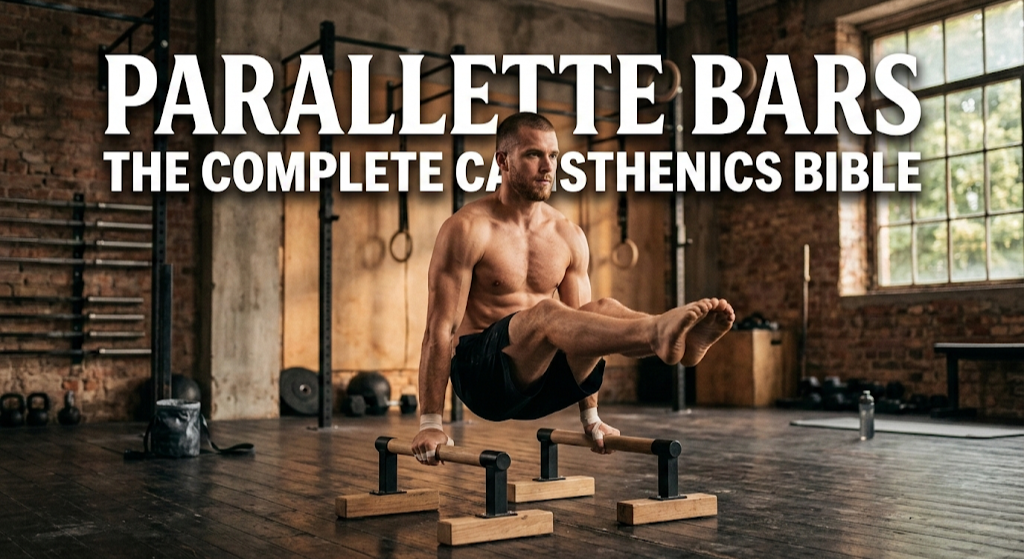
Parallette Bars: The Complete Calisthenics Bible
Parallettes are the single most versatile piece of calisthenics equipment you can own. They unlock wrist-neutral pushing, planche progressions, L-sits, handstand push-up depth, and a skill ladder that runs from beginner push-ups all the way to elite-level press-to-handstand work — in the space of two shoe boxes. This is every thing you need to know: what they do, how to choose them, how to train with them, and how to progress on them from your first session to advanced static holds.
📋 In This Guide
- What Are Parallettes? (And Who They’re For)
- Why Parallettes Outperform the Floor
- Low vs High Parallettes — Which Should You Buy?
- Parallettes vs Dip Bars — Key Differences
- The Parallette Exercise Library
- Skill Progressions: Beginner to Elite
- Parallette Buying Guide
- Sample Parallette Workouts
- Frequently Asked Questions
The barrier to entry for gymnastics-style calisthenics has always been the equipment. Rings require rigging. A full gymnastics floor setup is impractical. But parallettes — two independent handles elevated a few inches off the ground — strip the entry cost down to almost nothing while unlocking an enormous range of movement that the floor simply doesn’t allow.
The elevated handle changes the biomechanics of floor pressing, creates wrist-neutral positioning that reduces injury risk, adds depth range to push movements, and provides the stable base needed for the compression, balance, and inversion work that defines advanced calisthenics. Knowing how to use them well is a skill in itself. This guide covers all of it.
What Are Parallettes? (And Who They’re For)
Parallettes are two independent, low-profile handles — typically 6–30cm in height — used for bodyweight and gymnastics-based training. Unlike parallel bars (which are fixed, full-height, and typically found in gymnastics facilities), parallettes are portable, adjustable in their placement, and designed for floor-level work rather than elevated bar work.
They suit an exceptionally wide range of athletes. A complete beginner uses them to do push-ups with a deeper range of motion and zero wrist strain. An intermediate calisthenics athlete uses them for L-sit progressions and planche tucks. An advanced practitioner trains full planches, press-to-handstand, and straddle planche push-ups. The same pair of parallettes serves all three stages — the equipment doesn’t change, only the exercises loaded on it.
- Beginners with wrist discomfort on floor push-ups. The neutral wrist position immediately removes the wrist extension stress that makes floor push-ups painful for many new athletes. This alone justifies buying a pair.
- Intermediate calisthenics athletes working toward L-sit or planche. Compression and balance skills are essentially impossible to train at the required intensity without an elevated handle. Floor work can approximate but not replicate these positions.
- Advanced calisthenics athletes targeting static skills. Planche, planche push-ups, press-to-handstand, and straddle work all require parallettes or rings. There’s no floor substitute at this level.
- Home gym athletes who want maximum return from minimal equipment. A quality pair of parallettes costs less than a month’s gym membership and adds more programming options per dollar than almost any other purchase at this price point.
- Gymnasts and CrossFit athletes supplementing bar and ring work. Parallette-specific skill patterns transfer directly to bar and ring performance and are more easily loaded and progressed at home.
Why Parallettes Outperform the Floor
Floor-based calisthenics is highly effective, but the floor imposes structural constraints that parallettes remove. Understanding what changes when you elevate onto handles explains why they unlock so much training territory that floor work can’t reach.
- Wrist extension locked at ~70–80° — the floor forces your wrist into extension regardless of technique, creating stress at the wrist joint on every push rep
- No push-up depth beyond chest contact. The floor stops your range of motion the moment your chest touches — you cannot descend past that point and develop end-range strength
- L-sit requires extreme hip flexor strength to clear the floor with both legs — the floor position shortens the available range for leg clearance dramatically
- Planche work requires fingertip or fist positions on the floor to create the wrist angle needed — which increases injury risk significantly at higher training volumes
- Handstand push-up depth is zero on the floor — you cannot descend below head-level because the floor blocks the path
- Wrist is neutral (0–20° extension) throughout all push and support work — structurally the strongest and lowest-stress wrist position for loaded movement
- 8–12cm of additional push-up depth below chest level — accessible range that builds pec, anterior delt, and tricep strength the floor simply doesn’t reach
- L-sit leg clearance becomes achievable at earlier strength levels because handles create 6–15cm of ground clearance the legs can work within
- Planche can be trained with correct wrist loading — the neutral handle position is biomechanically correct for planche lean, allowing high-volume practice without injury accumulation
- Handstand push-up depth scales to handle height — low parallettes give 6–8cm depth; stacked parallettes give pike/deficit work up to 30cm depth
Low vs High Parallettes — Which Should You Buy?
Height is the primary variable that determines which movements are accessible and how the training stimulus shifts across different skills. This isn’t a minor ergonomic difference — low and high parallettes genuinely suit different training goals and skill stages.
| Factor | Low Parallettes (6–15cm) | High Parallettes (25–45cm) |
|---|---|---|
| Best for | Planche, L-sit, handstand push-ups, floor skills | Dips, push-up depth, beginners, home gym general use |
| Planche training | Optimal — low CoM, best balance feedback | Possible but CoM is higher and less stable |
| L-sit clearance | Moderate — legs clear with good hip flexor strength | More forgiving — easier to achieve first L-sit hold |
| Dip range | Cannot perform full dips — too low | Full dip range possible with 30cm+ height |
| HSPU depth | 6–15cm deficit depth | 20–45cm deep deficit HSPU work |
| Stability | More stable — lower centre of mass | Less stable — higher tipping risk under load |
| Portability | More compact, easier to store and travel with | Bulkier, heavier |
| Price range | £20–£80 / $25–$100 | £30–£120 / $40–$150 |
| Ideal buyer | Intermediate–advanced; planche/L-sit focus | Beginner–intermediate; general pushing/dipping |
For a full head-to-head breakdown with specific product comparisons at each height category, see our dedicated guide: Low vs High Parallettes — Which Should You Buy?
Parallettes vs Dip Bars — Key Differences
These two pieces of equipment are frequently confused and sometimes marketed interchangeably. They serve overlapping but distinct purposes, and the differences matter when deciding what to buy for your specific training goals.
- Height: Dip bars are designed to support full-body dip work and are typically 65–90cm tall, with handles at hip-to-chest height. Parallettes are floor-level tools — the athlete is never suspended at height; they work above the floor with handles 6–45cm off the ground.
- Width: Dip bars are fixed at approximately shoulder width for dip mechanics. Parallettes can be positioned at any width the athlete chooses — this matters significantly for planche and L-sit training where handle width affects leverage and balance.
- Movement range: Dip bars do dips, tricep dips, and elevated push-up variations. Parallettes do everything dip bars do (at lower heights) plus planche work, L-sit/V-sit progressions, handstand push-up depth work, and floor-level compression training that dip bar height makes impractical.
- Stability under planche loading: Dip bars are tall and top-heavy — loading them with the forward lean of planche training creates a significant tipping moment. Low parallettes are inherently more stable for planche and lean work because the centre of mass stays close to the floor.
- Portability: Parallettes are significantly more compact and most fold or disassemble for transport. Full-height dip bars are too large to travel with practically.
For the complete breakdown including specific use cases, floor space requirements, and which to prioritise when budget allows only one: Parallette Bars vs Dip Bars — Key Differences.
The Parallette Exercise Library
Parallettes support four distinct movement families. Each family contains exercises that span beginner to advanced, and programming them together creates complete upper body and skill development across all relevant patterns.
Family 1 — Pressing & Pushing
| Exercise | Level | Primary Muscles | Key Technique Note |
|---|---|---|---|
| Parallette Push-Up | Beginner | Pec, anterior delt, tricep | Descend past handle height; wrists neutral throughout |
| Wide-Grip Push-Up | Beginner | Pec emphasis, anterior delt | Handles wider than shoulder width; elbows track 45° |
| Diamond Push-Up | Beginner–Int | Tricep, inner pec | Handles close together; elbows tight to body throughout |
| Pike Push-Up | Intermediate | Anterior delt, upper trap | Hips high; head descends between handles; shoulders drive the press |
| Deficit HSPU (Kipping) | Intermediate | Full shoulder, tricep | Use wall support; control descent below handle height |
| Strict Deficit HSPU | Advanced | Overhead pushing, full shoulder complex | No hip kip; controlled descent to ear level or below |
| Parallette Dip | Intermediate | Tricep, lower pec, anterior delt | Requires 30cm+ height; slight forward lean for chest emphasis |
| Archer Push-Up | Intermediate | Unilateral pec and shoulder | One arm bends, one stays extended; handles shoulder-width apart |
| Pseudo Planche Push-Up | Advanced | Anterior delt, pec, serratus | Hands at hip level; maximum forward lean; protract shoulder blades |
| Planche Push-Up | Elite | Full upper body, core, serratus | Requires full planche hold; full ROM push-up in static balance |
Family 2 — Compression & Holds (L-Sit, V-Sit, Manna)
| Exercise | Level | Primary Demand | Key Technique Note |
|---|---|---|---|
| Tuck Hold (knees to chest) | Beginner | Shoulder depression, wrist stability | Shoulders pressed down (not shrugged); arms locked |
| Single-Leg L-Sit | Beginner–Int | Hip flexor, core, tricep lock | One leg extended horizontal; other knee bent; work both sides |
| Full L-Sit | Intermediate | Hip flexor strength, core compression, shoulder stability | Both legs extended horizontal; toes pointed; hold 10–60 sec |
| L-Sit to Tuck Transition | Intermediate | Dynamic compression control | Move between L-sit and tuck without touching down |
| V-Sit | Advanced | Extreme hip flexor, pike flexibility, core | Legs above horizontal (45°+); requires pike flexibility beyond L-sit |
| Manna Progression | Elite | Full posterior chain compression, extreme shoulder extension | Legs above head level; extreme flexibility and strength demand |
Family 3 — Balance & Planche
| Exercise | Level | Primary Demand | Key Note |
|---|---|---|---|
| Planche Lean | Beginner–Int | Anterior delt, serratus, wrist prep | Forward lean only; no leg lift; builds lean angle over weeks |
| Tuck Planche Hold | Intermediate | Full planche strength foundation | Both knees tucked to chest; hips level with shoulders; hold 10–30s |
| Advanced Tuck Planche | Intermediate–Adv | Planche with extended back angle | Knees tucked but back flat (not rounded); significantly harder |
| Straddle Planche | Advanced | Near-full planche demand; legs wide for leverage advantage | Both legs extended horizontally in straddle position |
| Full Planche | Elite | Maximum anterior delt, serratus, core | Both legs fully extended, together, horizontal — the endpoint of planche training |
| Press to Handstand | Elite | Full upper body, core control, pike strength | L-sit or straddle sit to handstand press — requires years of foundation work |
Family 4 — Inversion & Handstand Work
- Wall-Assisted Handstand: Kick up to handstand with hands on parallettes against a wall. Neutral wrist position significantly reduces the wrist fatigue that limits early handstand practice time — beginners can typically accumulate 30–50% more practice volume before wrist fatigue terminates the session.
- Freestanding Handstand: Both the wrist-neutral position and the ability to micro-adjust by gripping the handles (rather than pressing fingertips to the floor) make parallette handstands a useful bridge between wall-assisted and fully freestanding floor handstand.
- Handstand Push-Up Progression: Pike push-up → deficit pike push-up → wall HSPU → strict deficit HSPU. The parallette handle creates the deficit position that enables this progression ladder.
- Headstand to Handstand: Using parallettes as the base, controlled transition from headstand to full handstand builds the overhead balance and shoulder strength for freestanding handstand presses.
Skill Progressions: Beginner to Elite
Calisthenics on parallettes rewards a structured progression approach above almost any other training style. The skills are interdependent — L-sit strength transfers to planche; planche lean builds the anterior delt base for handstand push-ups; compression strength feeds every static hold. This is the progression roadmap from first session to advanced skill work.
The L-Sit Progression Ladder
The Planche Progression Ladder
Parallette Buying Guide
Material, height, handle diameter, footprint, and maximum load rating all affect which parallettes are right for your training. Here’s what to prioritise at each budget and training level.
Material Comparison
| Material | Pros | Cons | Best For | Price Range |
|---|---|---|---|---|
| Steel (powder-coated) | Maximum durability, heaviest load rating (200kg+), best for dynamic loading | Heaviest, may rust if stored outdoors, cold to touch in winter | Advanced athletes, high-load planche work | £40–£100 |
| PVC Pipe (DIY) | Cheapest option, easy to build to custom height | Limited load rating (~80kg), no grip texture, not stable under dynamic loads | Testing parallettes before investing; light skill work only | £5–£15 |
| Wood (hardwood/birch) | Natural feel, warm in cold environments, aesthetically premium | Can crack with moisture exposure, heavier than steel for equivalent strength, premium price | Home gym aesthetics, light–moderate loads | £60–£150 |
| Aluminium | Lightweight, rust-resistant, good portability | Lower max load than steel, less rigid under very heavy loading | Travel, outdoor training, moderate loads | £35–£80 |
- Handle diameter: 30–38mm is the ideal range for most hand sizes. Thinner handles (under 28mm) reduce grip comfort on longer sets; thicker than 40mm can be fatiguing for smaller hands. Some premium models offer 38mm for grip training crossover.
- Non-slip feet: Rubber or foam feet are essential — parallettes that slide under load are a safety and training quality issue. Test with a loaded L-sit or planche lean before committing to high-intensity use.
- Handle length: Minimum 30cm for comfortable two-hand grip. Longer handles (40–50cm) allow adjustable hand-width positioning within a single bar — useful if you’re unsure of your optimal planche or L-sit hand spacing.
- Load rating: Check the manufacturer’s stated rating and apply a 20% safety margin if your training involves dynamic loading (plyometric push-ups, explosive planche attempts). For purely static work, the rating is more directly applicable.
- Height: Match to your primary training goal — see the low vs high section above. If you’re buying a single pair for general use, 15–20cm is the most versatile starting height.
Sample Parallette Workouts
These three workouts represent the primary training phases on parallettes: a beginner foundation session, an intermediate skill development session, and an advanced static skill session. All assume low-to-mid parallette height (15–20cm).
Beginner: Foundation Session (3× per week)
Intermediate: Skill Development Session (3× per week)
Advanced: Static Skill Session (3× per week)
Frequently Asked Questions
The Equipment That Earns Its Space
Parallettes are one of the very few pieces of training equipment that genuinely deliver more value than their cost and footprint suggest. A quality pair sits in under a square metre of floor space, costs less than a single personal training session, and unlocks a training system that runs from beginner push-ups to elite planche and press-to-handstand work — a progression ladder with years of content built into it.
The key is using them systematically: build the L-sit foundation before chasing planche, build planche leans before attempting tuck holds, build deficit push-up strength before deficit HSPU work. The interdependence of the skill families means that each foundation built accelerates the next. Train the sequence and the equipment will keep delivering returns for as long as you’re willing to put in the work.
READY TO BUY?
See our full parallette comparison — every type, height, and material rated for calisthenics skill training.
Low vs High Parallettes Guide →