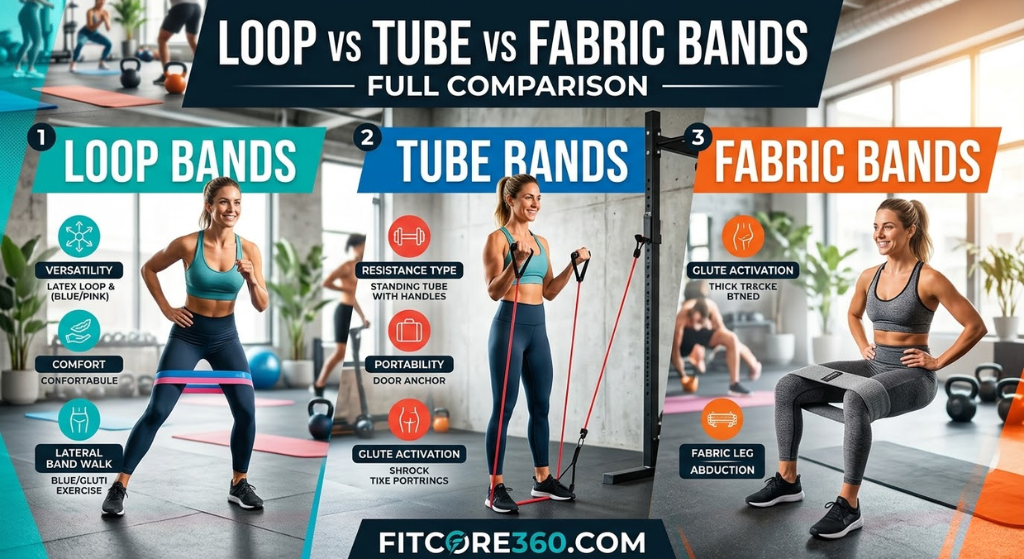
Loop vs Tube vs Fabric Bands — Full Format Comparison
Three band formats. Three completely different use cases. Buying the wrong one is the most common and easily avoided mistake in resistance band training. This guide maps every format to its exercises, its strengths, and exactly who should buy it.
📋 In This Guide
- Format Overview — The 60-Second Answer
- Flat Loop Bands — Complete Breakdown
- Tube Bands with Handles — Complete Breakdown
- Fabric Mini Loop Bands — Complete Breakdown
- Head-to-Head Comparison Table
- Which Band for Which Exercise
- Top Amazon Picks by Format
- #1 — WODFitters Loop Band (Best Loop)
- #2 — Bodylastics PRO (Best Tube Set)
- #3 — Tribe Lifting Fabric Set (Best Fabric)
- Frequently Asked Questions
Format Overview — The 60-Second Answer
Most resistance band buyers don’t realise they’re choosing between fundamentally different products. Loop bands, tube bands, and fabric bands are not interchangeable variations of the same thing — each format was designed for different movements, different populations, and different goals.
Flat Loop Bands — Complete Breakdown
Flat loop bands — sometimes called power bands or resistance loops — are wide, flat continuous circles of layered natural latex. The standard size is 41 inches long (the circumference of the loop), with widths ranging from 0.5 inches on the lightest bands up to 2.5 inches or more on heavy bands. They have no clips, no handles, and no door attachment — they loop around a fixed point directly.
This simplicity is their strength. Without mechanical attachments, there are no failure points. The band is the equipment. That’s why commercial CrossFit boxes and powerlifting gyms use them exclusively — they outlast any tube system under heavy daily use.
What Loop Bands Are Built For
- Anyone working toward unassisted pull-ups — this is the only format that works for this goal
- Powerlifters adding band resistance to barbell lifts — deadlifts, squats, bench
- Athletes wanting one high-resistance band for specific use — no set needed
- Coaches and trainers needing durable, high-use bands — they outlast all other formats
- Anyone wanting mobility and joint distraction work after lifting
Tube Bands with Handles — Complete Breakdown
Tube bands are cylindrical latex tubes — not flat loops — with a carabiner clip at each end. These clips attach to ergonomic handles, an ankle strap, or a door anchor. Multiple bands can be clipped to one handle simultaneously, stacking resistance. This is the format that makes a complete home gym workout possible from a single bag.
The handle system is the key advantage and the key vulnerability. Handles allow you to replicate cable machine movements — lateral raises, chest flies, rows, lat pulldowns, curls, tricep pushdowns — with full directional control. But the clip mechanism is also the primary failure point of budget tube systems. Quality brands like Bodylastics use patented anti-snap clips; generic brands use clips that loosen under load.
What Tube Bands Are Built For
- Home gym users who train 3+ times per week and want full-body variety — the cost-per-session over a year is negligible
- Anyone replacing or supplementing a gym membership — tube bands replicate the most-used cable machine exercises
- Frequent travellers who want a complete portable kit — nothing matches the exercise-per-gram ratio
- Beginners who want one purchase that covers everything for the first year of training
Fabric Mini Loop Bands — Complete Breakdown
Fabric bands are short circular bands — typically 9 to 13 inches in circumference — made from a woven fabric outer layer with a latex or rubber inner elastic core. The fabric exterior creates friction against skin and clothing, preventing the band from rolling or sliding during movement. This is the single feature that separates them from rubber mini loops.
Rubber mini loops — the kind sold in the ubiquitous 5-packs at every price point — work fine for upper body and stretching work where the band stays relatively static. But during lower body exercises like lateral band walks, clamshells, and donkey kicks, a rubber mini loop will roll up the thigh within one or two reps. Fabric bands do not. That distinction makes them an entirely different product for lower body training.
What Fabric Bands Are Built For
- Anyone with a lower body or glute-focused training programme — these are non-negotiable for hip work
- Athletes doing lower body warm-up protocols before squats, deadlifts, or running
- Physiotherapy patients with hip, knee, or glute programmes that include band work
- Anyone who owns rubber mini loops and finds them rolling constantly — fabric is the direct upgrade
- Beginners who want a low-cost, low-barrier entry point to resistance training for lower body
Head-to-Head Comparison
Every format mapped across the dimensions that matter for buying decisions. The winner in each row is highlighted — but “winning” a category means it’s the best format for that specific factor, not that it’s universally better.
| Factor | 🔁 Flat Loop | 📦 Tube + Handles | 🧶 Fabric Loop |
|---|---|---|---|
| Pull-up assistance | ✅ Only format | ❌ Not safe | ❌ Wrong size |
| Cable machine exercises | ⚠️ Possible but awkward | ✅ Purpose-built | ❌ Not applicable |
| Lower body / glutes | ⚠️ Works, but rolls | ⚠️ Ankle strap only | ✅ Non-slip ideal |
| Banded barbell work | ✅ Standard method | ❌ Not safe | ❌ Not applicable |
| Max resistance | Up to 175 lbs each | Up to 310 lbs stacked | Up to 50 lbs |
| Durability | Highest — no clips | Good — clip dependent | Good — fabric protects latex |
| Portability | Excellent — flat, light | Good — kit adds weight | Best — tiny footprint |
| Exercise variety | High | Highest — handle angles | Moderate — lower body focus |
| Entry price (quality) | ~$10–$18 per band | ~$40–$90 per set | ~$20–$30 per set |
| Best for beginners | If goal is pull-ups | For full-body home gym | For lower body start |
Which Band for Which Exercise
A direct reference for exercise-to-format matching. Use this before any purchase to confirm the format you’re buying actually covers the movements in your training programme.
| Exercise | Best Format | Why | Alternative? |
|---|---|---|---|
| Pull-ups (assisted) | 🔁 Flat Loop | Safe bodyweight loading — clips cannot do this | No alternative |
| Lat pulldown | 📦 Tube (door high) | Handle + door anchor at top mimics cable position | Loop over door can work |
| Seated row | 📦 Tube (door low) | Full handle grip, directional control, low anchor | Loop around feet works |
| Chest fly | 📦 Tube (door mid) | Handle + mid-height anchor = full fly arc | No good alternative |
| Bicep curl | 📦 Tube | Handle provides proper wrist alignment | Loop under feet works |
| Tricep pushdown | 📦 Tube (door high) | High anchor replicates cable pushdown exactly | No good alternative |
| Glute bridge | 🧶 Fabric Loop | Non-slip stays above knees through full range | Loop band works if no fabric |
| Clamshell | 🧶 Fabric Loop | Band must stay on thigh — rubber slides constantly | No good rubber alternative |
| Lateral band walk | 🧶 Fabric Loop | Dynamic movement needs non-slip above knee or ankle | Flat loop at ankle works |
| Banded squat | 🧶 Fabric Loop | Fabric above knees activates glutes without rolling | Loop band works at ankle |
| Banded deadlift | 🔁 Flat Loop | Only format that safely attaches to loaded barbell | No alternative |
| Hip mobility / distraction | 🔁 Flat Loop (heavy) | Wide band distributes pressure; safe rack anchor | No alternative |
| Shoulder warm-up | 📦 Tube or 🔁 Loop | Either works — tube for handle control, loop for simplicity | Flat therapy band ideal |
| Face pull | 📦 Tube (door high) | High-anchor handle position needed for shoulder external rotation | Loop at door works |
Top Amazon Picks by Format
One best-in-class pick for each format. These are the products with the strongest combination of material quality, durability track record, and real buyer feedback — not the highest review count or the lowest price.
#1 — WODFitters Loop Band (Best Flat Loop)

- The only safe format for pull-up assistance — 15,000+ buyers confirm it
- Safe Stretch Technology — won’t snap back dangerously if the band slips
- Layered natural latex — not TPE — rated for 500,000+ stretch cycles
- 5 resistance options: covers beginner pull-up assist to powerlifting loads
- US-based small business with a lifetime quality guarantee
- No clips, no handles, no failure points — the band is the equipment
- No handles — not suitable for cable-style exercises without separate attachments
- Sold individually — buying all five resistance levels costs more than a tube set
- Not ideal for lower body above-knee work — rolls like all rubber bands
#2 — Bodylastics PRO Series (Best Tube Set)

- Wirecutter’s top pick — the most independently validated tube set on the market
- Patented anti-snap carabiner clips — eliminates the #1 failure point of generic tube sets
- Inner safety cord inside each tube — prevents dangerous snapback if the outer band fails
- 7 bands stack from 3 lbs (one light) to 310 lbs (all seven) — unmatched load range
- 54-inch band length (PRO) — better range of motion for taller users vs competitors
- Handles, ankle straps, door anchor, carry bag all included — genuinely complete kit
- Premium price — the most expensive option in this guide by a significant margin
- Cannot be used for pull-up assistance — tube bands are never safe for bodyweight loading
- Handles are foam-covered — some users prefer bare grip or rubber handles
#3 — Tribe Lifting Fabric Bands (Best Fabric Set)

- Does not roll — the defining advantage of fabric over rubber for lower body work
- 5 resistance levels in one set — covers warm-up through challenging glute work
- Comfortable against bare skin — no pinching or snapping common to rubber loops
- Compact carry bag — the most portable format in this comparison
- Strong track record across verified buyer reviews for glute programmes
- Lower resistance ceiling than loop or tube bands — max ~50 lbs
- Not suitable for pull-up assistance or cable machine work
- Fabric can wear at the seam with very heavy use over 12+ months
Frequently Asked Questions
Match the Format to the Goal — Then Buy Once
The three formats covered here are not quality tiers of the same product — they are different tools for different jobs. A flat loop band is not an inferior tube set. A fabric band is not a cheaper loop band. Each is the correct choice for its specific use case and the wrong choice for the others.
Use the exercise table and the format overviews to identify which format covers your training. Buy the best available product in that format. That sequence produces better outcomes than buying a multi-format kit hoping to cover everything — which usually results in using one format and storing the rest.
NOT SURE WHICH FORMAT?
Check the exercise table above — find your primary movement, match the format, and buy once.
See Full Sets vs Singles Guide →