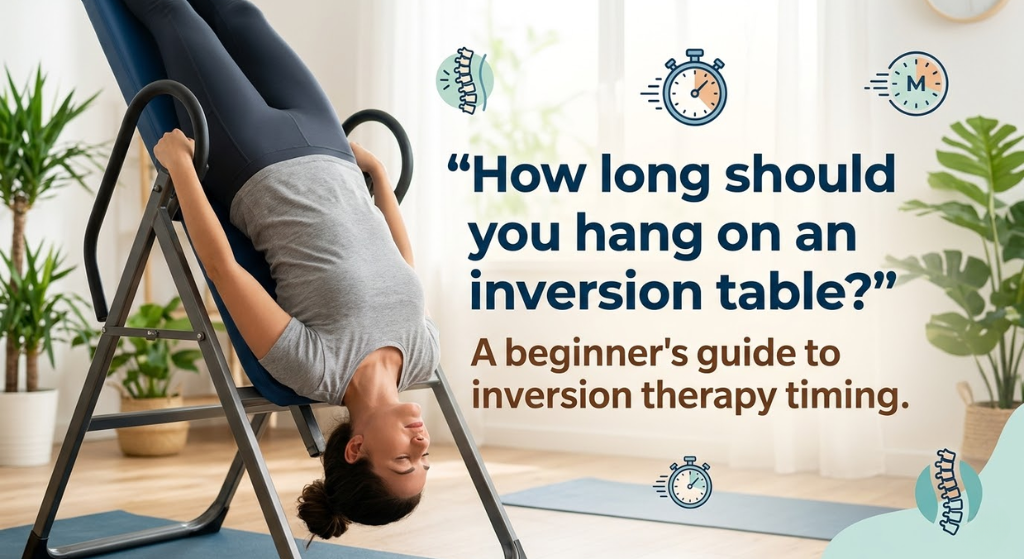
How Long Should You Hang on an Inversion Table?
The wrong duration is the most common inversion therapy mistake — too short produces no benefit, too long produces discomfort and blood pressure spikes. This guide gives exact time targets by experience level, angle, and health condition, with a week-by-week progression plan from first session to full inversion.
📋 In This Guide
- Quick Answer — Time by Experience Level
- Beginner Protocol — Weeks 1–4
- Intermediate Protocol — Weeks 5–12
- Advanced Protocol — 12+ Weeks
- Angle vs Time — How They Interact
- Week-by-Week Progression Plan
- When to Stop — Warning Signs
- Time Adjustments by Condition
- Most Common Time Mistakes
- Frequently Asked Questions
Quick Answer — Time by Experience Level
The most important rule in inversion therapy isn’t how long you eventually hang — it’s how gradually you build to that duration. The body needs time to adapt to increased intracranial pressure, reversed blood flow, and spinal decompression. Starting too long causes discomfort that makes people quit; starting too short produces no measurable benefit.
Beginner Protocol — Weeks 1–4
New inversion table users consistently make the same mistake: they read that inversion therapy requires sustained decompression, assume longer is better, and push too hard in the first sessions. The result is dizziness, facial flushing, elevated eye pressure, and abandonment of the practice entirely.
The first four weeks have a single goal: cardiovascular and neurological adaptation. Your circulatory system needs to learn to manage blood pressure at inverted angles. Your inner ear needs to calibrate to position changes. None of this requires long sessions — it requires consistent short sessions.
- Focus entirely on comfort — if anything feels wrong, come up immediately
- Invert slowly — take 5–10 seconds to reach your target angle, don’t drop fast
- Stay at 20° for the first 3–4 sessions before increasing angle at all
- Have someone nearby for the first 2–3 sessions in case you need to come up quickly
- Only increase angle OR time in a given week — never both simultaneously
- 30° is the threshold where spinal decompression becomes clinically measurable
- Mild facial warmth is normal; headache, vision changes, or tingling in hands is not
- Return time: come up as slowly as you went down — 5 seconds minimum to return to horizontal
Intermediate Protocol — Weeks 5–12
By week five, your body has adapted to inverted positioning and the cardiovascular system handles the blood pressure redistribution without the strong reactions of early sessions. This is when inversion therapy begins producing the outcomes most people are seeking — spinal decompression, disc space widening, and reduction in nerve root compression pressure.
Research published in journals including Archives of Physical Medicine and Rehabilitation indicates that meaningful disc space changes occur between 3 and 5 minutes at angles between 30° and 60°. The intermediate phase targets this window directly.
- 45° is the most commonly recommended angle for back pain relief — balances decompression force with comfort
- Two shorter sessions (morning and evening) often outperform one longer session for disc rehydration
- Breathe deeply and consciously during inversion — diaphragmatic breathing enhances disc fluid exchange
- Gentle spinal movement — small side-to-side rocks — can enhance decompression effect at this stage
- Most users with chronic low back pain find their optimal sustainable position in this range
- Consistency now matters more than duration — 5 minutes daily beats 20 minutes weekly
- Monitor blood pressure if you have any cardiovascular concerns — this is the range where it becomes relevant
- Many users never need to progress beyond this phase — reassess whether going further serves your goal
Advanced Protocol — Week 12 and Beyond
Full inversion at 60°–90° is not the goal of inversion therapy for most people — and it doesn’t need to be. The research on spinal decompression shows diminishing returns beyond 60°, with the maximum traction force on lumbar discs occurring around 60° for most body types. Full 90° inversion is used by some athletes and yoga practitioners, but carries meaningfully higher cardiovascular demands.
- 60° delivers maximum therapeutic decompression — going beyond this adds cardiovascular load without proportional spinal benefit
- 10 minutes is the evidence-based upper limit before adverse effects (elevated IOP, blood pressure) become significant for most users
- Full 90° inversion is only appropriate for fully healthy, physically fit users with no cardiovascular, eye pressure, or inner ear conditions
- Always use a safety strap or tether at 60°+ to limit maximum angle if you lose control of the table
Angle vs Time — How They Interact
Inversion angle and session duration are not independent variables — they interact directly. A 10-minute session at 20° is physiologically very different from a 10-minute session at 60°. As angle increases, hydrostatic pressure on the circulatory system increases, intraocular pressure rises faster, and the window of safe duration narrows. Most guides give time ranges without accounting for this relationship.
| Angle | Max Duration | Decompression Force | BP Impact | Best For |
|---|---|---|---|---|
| 20° | Up to 10 min | Low — body weight × 0.34 | Minimal | First sessions, warm-up, elderly users |
| 30° | Up to 8 min | Moderate — measurable disc widening begins | Low | Beginner progression, mild back pain |
| 45° | 3–5 min | High — clinically significant decompression | Moderate | Core therapeutic sessions — most users stop here |
| 60° | 2–4 min | Very high — maximum practical benefit | Significant | Advanced users, severe disc compression |
| 90° | 1–2 min max | Maximum — diminishing returns vs 60° | High | Experienced users only, no health conditions |
Week-by-Week Progression Plan
A structured 12-week plan from first session to full therapeutic protocol. Follow the angle column as a ceiling, not a target — stay at your comfortable angle even if the plan suggests you could go further. The duration column is a daily target across all sessions combined.
When to Stop — Warning Signs During Inversion
Understanding which sensations are normal and which require you to end the session immediately is critical for safe practice. Coming up too fast in response to a normal sensation causes unnecessary dizziness; ignoring a genuine warning sign can cause harm.
- Headache or intense head pressure
- Vision changes — blurring, spots, darkening
- Numbness or tingling in hands or face
- Chest pain or palpitations
- Sudden nausea or urge to vomit
- Any sharp pain in the spine or neck
- Mild facial warmth or flushing (normal early on)
- Mild dizziness when returning to upright
- Feeling of fullness in the ears
- General discomfort after 3–5 minutes
- Awareness of heartbeat in the head
- Mild stretching sensation in lower back
- Feeling of elongation in the spine
- Mild relaxation of back muscles
- Slight increase in breathing depth
- Gentle pulling at ankles (from table clamps)
- Symptoms that recur every session despite short durations
- Any worsening of back pain after sessions (not during)
- Persistent dizziness lasting more than 5 minutes post-session
- Any new neurological symptoms (weakness, numbness in legs)
Time Adjustments by Condition
Standard protocols assume a healthy adult with no underlying conditions. Many inversion table users are specifically managing health conditions — the time guidance needs to adjust accordingly. If you have any of the following, always consult your physician before beginning inversion therapy and treat these as starting parameters, not targets.
| Condition | Max Angle | Max Session Time | Frequency | Special Notes |
|---|---|---|---|---|
| Herniated disc | 30–45° | 3–5 min | Once daily | Start at lowest comfortable angle — do not push through pain |
| Sciatica | 30–40° | 2–4 min | Once daily | Monitor leg symptoms — inversion can worsen piriformis-related sciatica |
| Spinal stenosis | 20–30° | 1–3 min | 3–4× week | Very conservative approach — always physician-supervised |
| High blood pressure (controlled) | 20–30° | 2–3 min max | 3× week | Check BP before and after sessions; cease if BP rises above 160/100 |
| Glaucoma / raised IOP | Not recommended | N/A | N/A | Inversion raises intraocular pressure — contraindicated |
| Post-surgery (back) | Only with clearance | Start at 1 min | As directed | Minimum 6–12 weeks post-op; surgeon clearance essential |
| Spondylolisthesis | 20–30° | 1–3 min | 3× week | Grade 1 only — Grade 2+ is a contraindication |
| Osteoporosis | 20–30° | 1–2 min | 3× week | Ankle clamping pressure is a concern — use padded straps |
| Pregnancy | Contraindicated | N/A | N/A | Do not use during any stage of pregnancy |
Most Common Inversion Time Mistakes
The majority of negative inversion table experiences come from a small set of repeatable errors. Every one of these is avoidable with the right protocol.
- Starting too long: First-session attempts of 10–15 minutes cause dizziness, head pressure, and discomfort that creates a negative association with inversion. Start at 1–2 minutes regardless of how fit you are.
- Starting at too steep an angle: 60° or 90° on the first session is a cardiovascular shock. 20° is the correct entry point. The angle progression matters as much as the time progression.
- Increasing angle AND time simultaneously: These are two independent variables. Progress one at a time across sessions, never both at once.
- Coming up too fast: Returning from inverted to upright quickly causes a blood pressure drop that produces the dizziness most people attribute to inversion. Take 5–10 seconds to return to horizontal and rest there before standing.
- Daily sessions when not adapted: In the first two weeks, every-other-day sessions allow physiological adaptation. Daily sessions before adaptation is established produce cumulative discomfort.
- Chasing longer duration instead of consistency: 5 minutes daily for 6 weeks produces better outcomes than 20 minutes twice a week. Frequency is more important than duration once you’re in the therapeutic range.
- Ignoring early warning signs: Mild head pressure in week one is worth noting and monitoring. The same symptom in week six after previously comfortable sessions is a signal to reduce duration or angle and reassess.
Frequently Asked Questions
Start Short, Progress Slowly, Stay Consistent
The protocol that works for inversion therapy is the same one that works for every other physical practice: start conservatively, progress one variable at a time, and prioritise consistency over intensity. The users who get the best outcomes from inversion tables are not the ones who hang the longest or invert the steepest — they’re the ones who do 3–5 minutes at 40–45° every day for months.
If you’re still deciding on a table, our complete buyer’s guide ranks every major model from budget to premium with specific attention to the features that make following this protocol easier and safer.
NEED A TABLE FIRST?
See our complete ranking of inversion tables from budget options to premium models — matched to this exact protocol.
See Best Inversion Tables →