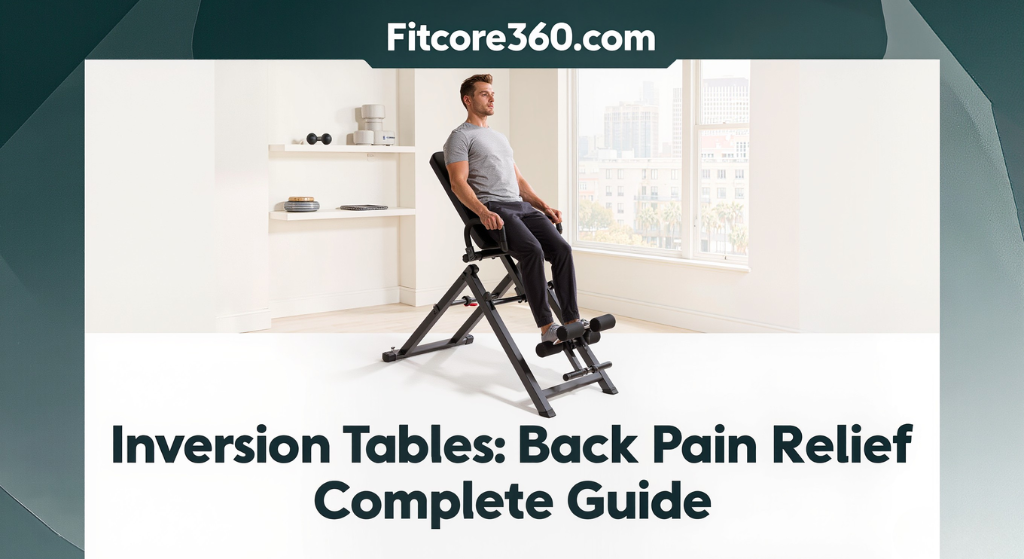
Inversion Tables: Back Pain Relief Complete Guide
Inversion therapy is one of the most misunderstood tools in back pain management. It’s not a cure, and it’s not for everyone — but for the right person, it’s genuinely effective. This guide covers the science, the safety, how long to hang, what angles to use, and which tables on Amazon are worth buying.
📋 In This Guide
- What Is Inversion Therapy & How It Works
- Does Inversion Therapy Actually Work? The Science
- Who Should Use an Inversion Table
- Who Should NOT Use an Inversion Table
- How Long Should You Hang on an Inversion Table
- Inversion Angles Explained — Beginner to Full
- Key Features to Look For When Buying
- Best Inversion Tables by Budget
- Amazon Product Picks — Full Breakdown
- Most Common Buying Mistakes
- Frequently Asked Questions
Inversion tables have been used for back pain management since the 1970s, yet they remain one of the most polarising pieces of rehab equipment on the market. Some physiotherapists swear by them; others dismiss them entirely. The reality, as with most things in physical therapy, is more nuanced.
This guide is built around the four most important questions buyers ask: Does it actually work? Who should avoid it? How long should you hang? And which table is worth buying? Each question has its own deep-dive section backed by the available clinical evidence.
What Is Inversion Therapy & How It Works
Inversion therapy involves lying on a pivoting table and tilting the body past horizontal — partially or fully inverted — so that gravity works on the spine from the opposite direction. The primary claimed mechanism is spinal traction: the separation of vertebrae under the body’s own weight, which temporarily reduces pressure on spinal discs and nerve roots.
There are three conditions where inversion therapy has the strongest theoretical and clinical basis:
- Lumbar disc herniation: A bulging or herniated disc pressing on a nerve root may temporarily reduce its pressure load during inversion, reducing pain signals.
- Degenerative disc disease: Discs that have lost height and fluid content are compressed throughout the day; inversion provides brief periods of reduced compression that may slow deterioration.
- Muscle spasm: Gravity-assisted traction can reduce muscle spasm in the lower back, providing temporary relief that allows movement to resume.
What inversion therapy does not do: it does not permanently rehydrate discs, it does not reverse structural damage, and it does not replace targeted physical therapy for core stability and movement pattern correction.
Does Inversion Therapy Actually Work? The Science
The evidence base for inversion therapy is modest in volume but consistent in direction. Most well-designed studies show short-term pain reduction for lower back pain, particularly for conditions involving nerve root compression. The effect size is meaningful but not dramatic — inversion rarely eliminates pain, but it commonly reduces it enough to enable other interventions like exercise and physiotherapy.
- Nosse (1978, Archives of Physical Medicine and Rehabilitation): One of the first controlled studies on inversion traction — found significant EMG activity reduction in lower back muscles during inversion, suggesting genuine muscle relaxation rather than placebo effect.
- Sheffield (1964) and subsequent replication: Inversion at 60° produced measurable disc space widening — later confirmed via MRI in multiple studies including Gianakopoulos et al.
- Ramos & Martin (1994): Randomised controlled trial showing patients using inversion therapy with physiotherapy had significantly higher rates of avoiding surgery vs. physio alone (77% vs. 22%) for lumbar disc herniation.
- The limitations: Most studies have small sample sizes, short follow-up periods, and are difficult to blind. Long-term evidence beyond 6 months is scarce. No rigorous trial demonstrates sustained structural benefit.
Who Should Use an Inversion Table
Inversion therapy is not appropriate for everyone with back pain — but there is a clear profile of user who is likely to benefit. If you fit this profile and don’t have any of the contraindications listed in the next section, an inversion table is a reasonable investment.
Who Should NOT Use an Inversion Table
This is the most important section in this guide. Inversion tables are safe for the right user — but there are absolute contraindications where inversion therapy is not just ineffective but potentially dangerous. The increased intracranial and intraocular pressure that occurs during inversion is the primary mechanism of harm.
How Long Should You Hang on an Inversion Table
Duration is the area where most new inversion table users get it wrong — almost always in the same direction. The instinct is to think that longer is better; in inversion therapy, it isn’t. The therapeutic benefit occurs quickly, and extended inversion introduces diminishing returns alongside increased risk of discomfort and adverse effects.
Intermediate (Week 3–6): 3–5 minutes per session, 1–2 sessions per day. Most therapeutic benefit occurs within this window.
Established users: 5–10 minutes per session is the accepted ceiling for most clinical protocols. Sessions beyond 10 minutes provide no additional benefit and increase risk of prolonged blood pooling and discomfort.
Inversion Angles Explained — Beginner to Full Inversion
One of the most persistent myths about inversion therapy is that full 90° inversion (completely upside down) is the goal. It isn’t. Research on spinal traction consistently shows that maximum decompression occurs between 60° and 70° — beyond that angle, the additional decompression is marginal while the cardiovascular and comfort risks increase meaningfully.
Key Features to Look For When Buying
The inversion table market is full of structurally unsafe products sold at low prices. The features below are not premium add-ons — several are minimum safety requirements. Any table missing the critical items below should be rejected regardless of price or review count.
Best Inversion Tables by Budget
There are good inversion tables at every price point above roughly $100. Below that threshold, the structural compromises — especially in ankle lock systems and frame gauge — create real safety concerns. The picks below represent the best value at each tier, not the cheapest option with the most reviews.
Entry
Best Value
Clinical
Top Tier
| Model | Price | Weight Cap. | Ankle System | Tether Strap | Best For |
|---|---|---|---|---|---|
| Teeter FitSpine X3 | ~$550 | 300 lbs | EZ-Ratchet Wrap | ✓ Included | Best overall — daily therapeutic use |
| Teeter EP-560 | ~$300 | 300 lbs | Cam Lock Ankle | ✓ Included | Best mid-range — UL safety certified |
| Ironman Gravity 4000 | ~$230 | 350 lbs | Foam Roller | ✓ Included | Best for heavy users / budget-conscious |
| Innova ITX9600 | ~$145 | 300 lbs | Foam Roller Bar | ✓ Included | Best true budget pick with safety features |
| Ironman Gravity 1000 | ~$110 | 250 lbs | Basic Foam Bar | ✗ Not included | Entry-level only — not recommended for regular use |
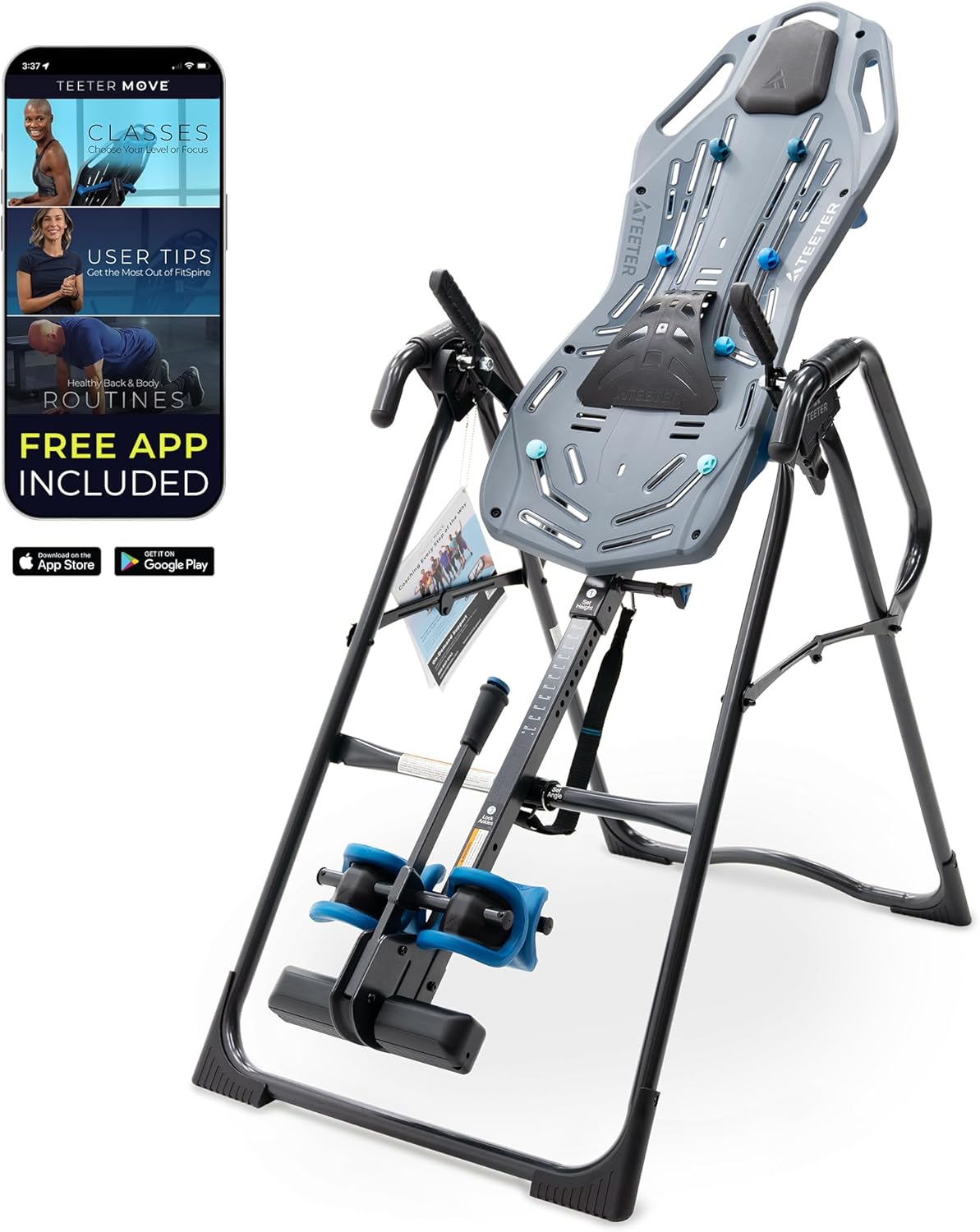
- EZ-Ratchet ankle locking system — most secure on the market
- Precision angle tether strap for exact degree control
- Acupressure nodes + lumbar bridge — active decompression
- 300 lb capacity, UL safety certified
- Stretch Max handles for assisted righting and stretching
- FDA registered Class I medical device

- UL safety certified — third-party structural validation
- Cam Lock ankle system — secure, easy to engage
- EZ-Angle tether strap for controlled inversion angles
- 300 lb capacity, height-adjustable frame
- Folds for storage — 20.5″ folded width
- Wirecutter and Good Housekeeping recommended

- 300 lb weight capacity — above average for this price
- 4-point adjustable headrest and lumbar support
- Angle tether strap included — critical safety feature
- Foam roller ankle lock — padded for comfort
- Easy storage fold — 17″ folded depth
- Best budget pick with essential safety features intact

ℹ️ FitCore360 is a participant in the Amazon Services LLC Associates Program. We earn a small commission at no extra cost to you. This never influences our editorial recommendations.
Most Common Inversion Table Buying Mistakes
These mistakes cost buyers money and in some cases create genuine safety risks — most are driven by misleading product listings and price anchoring.
| Mistake | Why It Happens | The Fix |
|---|---|---|
| Buying without checking contraindications | Listings never mention health exclusions — only benefits | Read the full safety section before purchasing |
| Buying a table without a tether strap | Budget tables omit this to cut costs; listings don’t highlight the absence | Confirm tether strap inclusion before buying — non-negotiable |
| Inverting too far, too soon | Believing full 90° is the goal | Start at 20–30°, build to 60° over 2–4 weeks |
| Sessions longer than 10 minutes | “More time = more benefit” is the wrong assumption | 1–5 min for beginners; max 10 min for experienced users |
| Buying on review count alone | Volume of reviews doesn’t reflect structural safety | Check: ankle lock type, tether strap, weight capacity, frame gauge |
| Not calibrating height before use | Assembly instructions are skipped or unclear | Set height correctly — wrong calibration makes balance control impossible |
| Buying for sciatica without a diagnosis | Inversion helps disc-related sciatica; it worsens piriformis-caused sciatica | Get a proper diagnosis before using inversion for sciatica |
Frequently Asked Questions
The most common questions from buyers researching inversion tables for the first time:
The Right Table, Used Correctly, For the Right Condition
Inversion therapy is not a universal back pain solution — but for disc-related lower back pain, sciatica from nerve root compression, and degenerative disc conditions, it has a reasonable evidence base and a clear practical benefit: daily decompression at home, between clinical appointments, for the cost of a single physiotherapy session.
The buying decision comes down to three things: confirm you don’t have contraindications, choose a table with a tether strap and a proper ankle lock, and start at a shallow angle for short sessions. The Teeter EP-560 is the correct choice for most buyers; the Innova ITX9600 is the correct budget choice if cost is a constraint. Anything below $100 is a structural risk not worth taking.
NOT SURE WHICH TABLE TO BUY?
The Teeter EP-560 is the safest, most validated mid-range option — UL certified, tether strap included, and used by physiotherapists worldwide.
Shop Teeter EP-560 on Amazon →