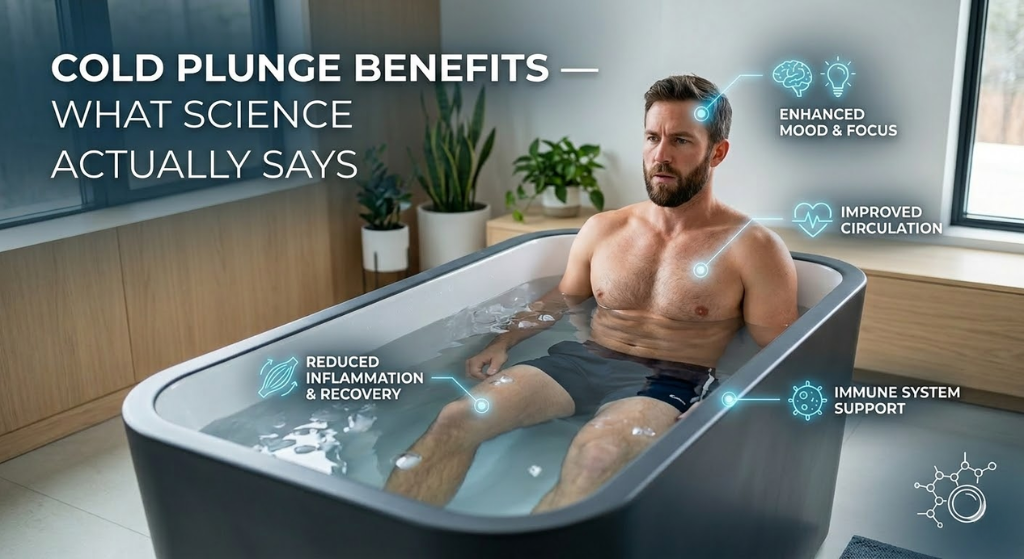
Cold Plunge Benefits — What the Science Actually Says
Cold water immersion has gone from niche biohacker ritual to mainstream recovery tool in the span of five years. The claims have multiplied just as fast — dopamine surges, fat incineration, immune supercharging, and lifespan extension. Some of it is real. Some of it is real but overstated. Some of it is not supported by current evidence at all. This article goes through every major claimed benefit, examines the actual research, and tells you what is proven, what is mixed, and what is marketing.
📋 In This Article
- Quick Answer — What’s Actually Proven
- What Happens to Your Body in Cold Water
- Muscle Recovery — The Strongest Evidence
- Inflammation — Real Effect, Nuanced Story
- Dopamine & Mood — The Most Impressive Data
- Fat Loss & Brown Fat Activation — What’s Real
- Immune Function — Emerging, Not Proven
- Sleep Quality — Indirect but Real
- The Muscle Growth Warning — Read This
- Full Evidence Summary Table
- The Optimal Cold Plunge Protocol (Science-Derived)
- Who Shouldn’t Cold Plunge
- Frequently Asked Questions
Quick Answer — What’s Actually Proven
What Happens to Your Body in Cold Water
Before evaluating any specific benefit claim, it helps to understand the physiological sequence that cold water immersion triggers. The body’s response to sudden cold immersion is not a single mechanism — it’s a cascade of overlapping responses across the nervous system, endocrine system, cardiovascular system, and immune system. Each claimed benefit maps to one or more of these mechanisms, and the strength of the evidence for each benefit depends largely on how well that specific mechanism has been studied.
Muscle Recovery — The Strongest Evidence
Of all the benefits attributed to cold water immersion, reduced muscle soreness and faster perceived recovery have the most robust evidence base. This is not a marginal finding — it has been replicated across dozens of studies and multiple meta-analyses, in different sports contexts, different immersion protocols, and different populations.
A 2021 systematic review and meta-analysis published in the British Journal of Sports Medicine analysed 52 randomised controlled trials involving cold water immersion for exercise recovery. The consistent finding across this literature: cold water immersion significantly reduced DOMS ratings at 24, 48, and 72 hours post-exercise compared to passive recovery. The effect size was moderate to large, particularly for resistance exercise and team sport activities. It also reduced perceived fatigue and improved perceived recovery readiness in the majority of included studies.
The Mechanism Behind DOMS Reduction
Delayed-onset muscle soreness is caused by microtrauma to muscle fibres and connective tissue, followed by a localised inflammatory response — swelling, prostaglandin release, and sensitisation of pain receptors. Cold water immersion reduces DOMS through two convergent mechanisms:
- Vasoconstriction reduces localised inflammatory response: By acutely reducing blood flow to peripheral muscles, cold immersion limits the delivery of pro-inflammatory cytokines (particularly IL-6 and TNF-α) to damaged tissue. This blunts the inflammatory cascade that produces soreness.
- Reduced nerve conduction velocity: Cold reduces the speed at which peripheral pain signals are conducted along sensory nerve fibres, producing a direct analgesic effect on the sore tissue. This effect is real and measurable — it’s the same mechanism that makes ice packs effective for acute injury pain management.
The practical implication: cold plunging within 1–2 hours post-training consistently reduces next-day soreness. For athletes in high-frequency training environments — multiple sessions per week, tournament-style blocks — this faster recovery has genuine performance implications. Being less sore at the next session allows more quality output.
Inflammation — Real Effect, Nuanced Story
The anti-inflammatory effect of cold water immersion is real and measurable in blood markers. Studies consistently show acute reductions in circulating pro-inflammatory cytokines — particularly IL-6, IL-1β, and CRP — following cold immersion protocols. This finding is well-replicated and the mechanism (vasoconstriction limiting cytokine delivery, reduced metabolic activity in cold-exposed tissue) is well-understood.
However, the relationship between cold immersion and inflammation contains an important nuance that most popular coverage misses entirely: not all inflammation is pathological, and suppressing it at the wrong time can impair the adaptations you’re training for.
Exercise-Induced Inflammation Is Necessary for Adaptation
When you train hard — particularly resistance training — the controlled microtrauma and subsequent inflammatory response is the signal that drives adaptation. Satellite cell activation, protein synthesis upregulation, and the remodelling of muscle fibres are all downstream consequences of the acute inflammatory response to exercise. Blunting this response acutely (via cold immersion immediately post-training) may reduce the adaptive signal alongside the soreness.
This concern is most relevant to the muscle hypertrophy discussion (covered in its own section below), but it extends to any training adaptation that depends on the post-exercise inflammatory cascade. The research picture here is mixed — some studies show no impairment of adaptation with post-training cold immersion, others show blunted strength and size gains over multi-week programmes. The prudent approach: use cold immersion strategically rather than automatically after every session.
- High-frequency competition blocks: Tournament athletes (team sports, combat sports, gymnastics) performing multiple sessions over 2–3 days benefit from the anti-inflammatory effect when the priority is performance maintenance rather than adaptation.
- Injury management: Acute soft tissue injury with significant localised swelling — cold immersion is a legitimate therapeutic tool for managing inflammatory response in the first 24–48 hours.
- Chronic systemic inflammation: Sedentary individuals or those with elevated baseline CRP levels — regular cold exposure shows promise for reducing chronically elevated inflammatory markers, though research here is less mature.
- Between-season recovery phases: When the training goal is recovery rather than new adaptation, anti-inflammatory cold immersion has no downside and meaningful upside.
Dopamine & Mood — The Most Impressive Data
If there is a single finding from cold water immersion research that justifies the enthusiasm of its practitioners, it is this: cold water immersion produces a sustained, 2–3 hour elevation in dopamine of approximately 250% above baseline.
This figure comes from a well-cited study measuring plasma catecholamine levels during and after cold water immersion at 14°C. The dopamine increase of ~250% and noradrenaline increase of ~300% are not transient spikes — they are sustained elevations that last well into the rewarming period. For context, cocaine produces a higher but far shorter-lived dopamine spike that drops below baseline on the comedown. Cold water produces a moderate but sustained elevation that does not fall below baseline — the neurochemical profile of a stable mood enhancement rather than a boom-bust cycle.
What Does Elevated Dopamine Actually Do?
Dopamine is commonly described as a “pleasure chemical,” but this is a significant oversimplification. Dopamine’s primary function in the context relevant to cold plunging is as a motivation, drive, and focus modulator. Elevated dopamine improves:
- Sustained attention and focus — the ability to engage with demanding tasks for longer without distraction. This is why many cold plunge practitioners report dramatically improved focus in the 2–3 hours post-immersion.
- Mood baseline and resilience — dopamine elevation correlates with improved mood, reduced anxiety, and increased tolerance for discomfort and stress. The deliberate discomfort of cold immersion may itself contribute to this via a stress inoculation mechanism.
- Motivation and drive to initiate tasks — dopamine is involved in the initiation of goal-directed behaviour. Practitioners who report being more productive post-plunge are not imagining it — there is a plausible neurochemical mechanism for this effect.
Is This Unique to Cold Plunging?
The honest answer is: partly. Vigorous exercise also elevates dopamine and noradrenaline, though with different kinetics. What makes cold immersion’s neurochemical profile distinctive is the combination of rapid onset, high magnitude, and prolonged duration of the catecholamine elevation — and the fact that it is achievable in 2–5 minutes rather than 30–60 minutes of exercise. For individuals who want a reliable mood and focus tool that is time-efficient and doesn’t require the physical output of intense exercise, cold immersion’s neurochemical profile is genuinely unusual.
Fat Loss & Brown Fat Activation — What’s Real
The fat loss claims around cold plunging are among the most overhyped in the space, and they deserve careful examination because the underlying science is real — it’s just being extrapolated far beyond what the data supports.
Brown Adipose Tissue — The Science Is Real
Brown adipose tissue (BAT) is metabolically active fat that burns calories to generate heat, unlike the white adipose tissue that stores energy. Adults retain small deposits of BAT, primarily around the neck, shoulders, and spine. Cold exposure activates BAT via the sympathetic nervous system — specifically via the beta-3 adrenergic receptor pathway triggered by noradrenaline release during cold exposure.
Studies using PET-CT scanning have confirmed that regular cold exposure increases BAT activity and, over time, BAT volume in adults. The BAT activation response is real, measurable, and replicable. This is not disputed.
The Magnitude Problem
The problem is the caloric contribution of BAT activation to total daily energy expenditure. Even maximally activated BAT in adults contributes approximately 100–400 kcal per day at peak cold exposure — and this is a ceiling figure from extreme cold protocols, not a typical cold plunge session. A standard 5-minute cold plunge activates BAT for a fraction of that time and at temperatures warmer than the research extremes.
The realistic additional caloric burn from a typical cold plunge session attributable to BAT activation and shivering thermogenesis combined is estimated at 50–150 kcal per session. This is not meaningless — over a consistent weekly practice, it represents a modest caloric contribution. But it is nowhere near the transformative fat loss claims circulating on social media, and it is dwarfed by the caloric expenditure of 30 minutes of moderate exercise.
The honest summary: cold plunging will not produce meaningful fat loss on its own. As one component of a comprehensive approach to body composition — adequate protein, resistance training, caloric awareness — the metabolic contribution of cold exposure is a genuine but minor additive effect.
Immune Function — Emerging, Not Proven
The immune benefits of cold water immersion are widely cited — particularly the claim that regular cold plunging reduces the frequency of common illnesses. This claim has a frequently referenced origin point: a 2016 Dutch study (Buijze et al.) in which participants who took cold showers for 30, 60, or 90 seconds daily reported 29% fewer sick days compared to a control group. This study is real, peer-reviewed, and published in PLOS ONE.
It is also a study with significant limitations that most popular coverage omits: the outcome was self-reported sick days (not clinically measured immune function), the cold shower group may have had confounding lifestyle differences, and the effect did not clearly dose-depend on exposure duration (the 30-second group did as well as the 90-second group, which complicates the mechanism interpretation).
What the Mechanism Research Shows
Mechanistic studies on cold water immersion and immune markers show genuinely interesting results. Regular cold exposure has been associated with:
- Increased circulating lymphocytes and NK (natural killer) cell counts in the hours following immersion — a transient upregulation of certain immune cell populations
- Modulation of pro-inflammatory cytokine balance — shifts in the ratio of pro-inflammatory to anti-inflammatory markers that may indicate improved immune regulation
- Wim Hof Method studies — controlled trials involving the combined cold exposure and breathing technique protocol showed subjects could voluntarily modulate immune response to endotoxin injection, reducing inflammatory symptoms. This was a genuinely significant finding.
The honest assessment: there is a plausible mechanism and preliminary evidence suggesting cold exposure has immune-modulatory effects. The jump from “immune modulation” to “you’ll get sick less often” is not yet supported by the quality or quantity of evidence required to make that claim confidently. The research is promising and warrants further study. The viral claims of immune “strengthening” currently outrun the evidence.
Sleep Quality — Indirect but Real
Cold plunging’s claimed sleep benefits are frequently presented as a direct effect — as if cold water immersion directly improves sleep architecture. The evidence is more nuanced than this, but the conclusion that cold plunging can improve sleep quality is still well-supported — through indirect mechanisms.
The Core Body Temperature Mechanism
Sleep onset and sleep quality are closely linked to core body temperature — specifically, the rate of core temperature decline in the evening. The body initiates sleep by releasing heat from the core to the periphery, lowering core temperature. Anything that accelerates this process facilitates faster sleep onset and improved slow-wave sleep depth.
Cold water immersion triggers initial vasoconstriction, but the rewarming response that follows involves significant peripheral vasodilation — the body actively pushing blood to the skin to restore temperature. This vasodilation in the rewarming phase effectively dumps heat from the core to the periphery, mimicking and amplifying the natural pre-sleep temperature drop. If timed correctly (early evening cold plunge, 2–4 hours before sleep), this rewarming-phase vasodilation creates a favourable temperature profile for sleep onset.
The Cortisol Timing Issue
There is an important caveat: cold plunging elevates cortisol and adrenaline acutely. A cold plunge immediately before bed (within 1 hour) is likely to delay sleep onset for most people, not improve it — the stimulatory catecholamine surge is incompatible with the physiological state required for sleep initiation. The sleep benefit of cold plunging is timing-dependent: early-to-mid evening immersion supports sleep; late-night immersion impairs it.
The dopamine elevation also contributes indirectly — improved mood and reduced stress (via the cortisol regulation effects of regular cold exposure) produce a quieter pre-sleep mental state in habitual practitioners. This is harder to study mechanistically but is consistent with the subjective reports of improved sleep quality among regular cold plungers.
The Muscle Growth Warning — Read This
This is the section that cold plunge enthusiasts least want to hear, but it is among the most important findings in the research for anyone who uses cold immersion in a strength training context.
A series of studies — most significantly work by Roberts et al. published in the Journal of Physiology — has demonstrated that cold water immersion performed immediately after resistance training significantly blunts both muscle hypertrophy and strength gains when compared to active recovery over the same training programme.
What the Roberts Study Found
The study had participants perform a 12-week lower body resistance training programme. One group used cold water immersion (10°C for 10 minutes) after every session; the control group performed active recovery (low-intensity cycling). At 12 weeks, the cold immersion group showed significantly less muscle hypertrophy (measured by MRI) and significantly lower strength gains compared to the active recovery group. A follow-up biopsy analysis found blunted satellite cell activity and reduced anabolic signalling (specifically mTOR pathway suppression) in the cold immersion group.
This finding has been replicated in subsequent studies and is now well enough established that it should change practice for anyone using cold immersion post-strength training.
The Mechanism
The mechanism is the same anti-inflammatory effect discussed earlier, but now working against the training goal:
- Resistance training produces controlled microtrauma and a localised inflammatory response in muscle fibres
- This inflammatory response is the primary signal for satellite cell activation, protein synthesis upregulation, and ultimately muscle fibre remodelling and growth
- Cold immersion suppresses this inflammatory signal — along with the soreness you wanted to reduce
- With a blunted inflammatory signal, the downstream anabolic response is reduced
- Over a training programme, this produces measurably less hypertrophy
Does This Apply to Endurance Training?
The evidence for cold immersion impairing endurance adaptation is less clear. Some studies suggest cold immersion may blunt mitochondrial biogenesis (the endurance equivalent of hypertrophy) following aerobic sessions, while others show no significant impairment. The consensus is less settled than for resistance training. The prudent approach for endurance athletes: use cold immersion after easy/recovery sessions rather than immediately after high-quality interval sessions where adaptation is the goal.
Full Evidence Summary — What’s Proven vs Overhyped
Every major claimed benefit, its evidence quality, and the honest practical takeaway:
| Benefit Claim | Evidence Quality | Effect Size | Timing Matters? | Verdict |
|---|---|---|---|---|
| DOMS reduction | High — multiple RCTs + meta-analyses | Moderate–Large | Yes — within 1 hr post-exercise | Use it |
| Dopamine elevation | High — replicated neurochemical studies | Large (~250%) | Yes — effect peaks 1–3 hrs post | Use it |
| Anti-inflammatory | High — mechanism well understood | Moderate | Acute effect only | Use strategically |
| Sleep improvement | Moderate — indirect mechanism | Moderate | Critical — 4–6 hrs before sleep only | Time correctly |
| Mood / mental health | Moderate — mechanistic + subjective data | Moderate | Morning preferred | Use it |
| Brown fat / metabolism | Moderate — mechanism real, magnitude modest | Small in practice | No | Minor benefit only |
| Immune function | Low–Moderate — promising but immature | Unclear | Unclear | Plausible, not proven |
| Post-strength training recovery | High — evidence of harm to hypertrophy | Moderate blunting | Critical — avoid post-resistance training | Avoid if building muscle |
The Optimal Cold Plunge Protocol (Science-Derived)
The protocol parameters below are derived from the research literature, not from anecdotal preference. The most cited evidence-based protocol framework is the one developed and popularised by Andrew Huberman (Stanford), which synthesises the available research into practical parameters — though the underlying research existed before the popularisation of his protocol.
Who Shouldn’t Cold Plunge
Cold water immersion is generally safe for healthy adults when practised sensibly. However, several conditions represent genuine contraindications — situations where the physiological stress of cold immersion creates real risk of serious adverse events:
- Cardiovascular disease, arrhythmia, or uncontrolled hypertension: The acute cardiovascular stress of cold immersion — sudden heart rate spike, blood pressure surge, and peripheral vasoconstriction forcing increased cardiac output — creates genuine cardiac event risk in individuals with compromised cardiovascular function. Cold water immersion deaths in the literature are disproportionately in individuals with undiagnosed cardiac conditions.
- Raynaud’s disease or cold urticaria: Cold-induced vasospasm in Raynaud’s disease can be severely exacerbated by full-body cold immersion. Cold urticaria (cold-induced hives) can trigger anaphylaxis — a life-threatening allergic response — triggered by cold exposure.
- Active infections or fever: Cold immersion while febrile can cause rapid core temperature fluctuations that complicate the body’s immune response. Do not cold plunge when sick.
- Pregnancy: Core temperature changes from cold immersion and the cardiovascular stress of the cold shock response are contraindicated in pregnancy. Consult an obstetrician before any cold water therapy during pregnancy.
- Peripheral artery disease: The vasoconstriction response of cold immersion can reduce peripheral blood flow to levels that cause ischaemic events in individuals with already compromised peripheral arterial supply.
- Controlled hypertension on medication: Blood pressure medications interact with the acute cardiovascular response to cold. Discuss with a cardiologist or GP before beginning a regular cold plunge practice.
- History of cold-water drowning near-miss or cold incapacitation: Some individuals have unusually strong cold shock responses or cold-induced muscle incapacitation. Prior cold water emergency events warrant medical evaluation before deliberate cold immersion.
- Type 1 or poorly controlled Type 2 diabetes: Cold exposure affects glucose metabolism and insulin sensitivity in ways that can be unpredictable in diabetic individuals. Monitor blood glucose carefully.
- Asthma: The cold shock gasping response can trigger bronchospasm. Use cold showers as a step-up test before full immersion; have a rescue inhaler accessible.
Frequently Asked Questions
The Bottom Line on Cold Plunge Science
Cold water immersion is not a miracle cure and it’s not pseudoscience. It is a well-studied physiological intervention with a specific set of real, documented benefits — and a specific set of limitations and cautions that should inform how you use it. The evidence for mood enhancement via dopamine, muscle recovery via soreness reduction, and acute anti-inflammatory effects is robust. The evidence for immune benefits is promising but premature. The evidence against using cold immersion immediately post-resistance training is strong enough to warrant changing practice.
Used intelligently — at the right temperature, for the right duration, at the right time relative to your training and sleep — cold plunging is a genuinely useful tool. Approached as a magic bullet or used indiscriminately after every training session, it can work against the goals you’re training for. The science is clear enough to give specific guidance. This article has tried to give it accurately.
READY TO START?
Find the right cold plunge tub for your outdoor setup — budget to premium.
See Best Outdoor Tubs →