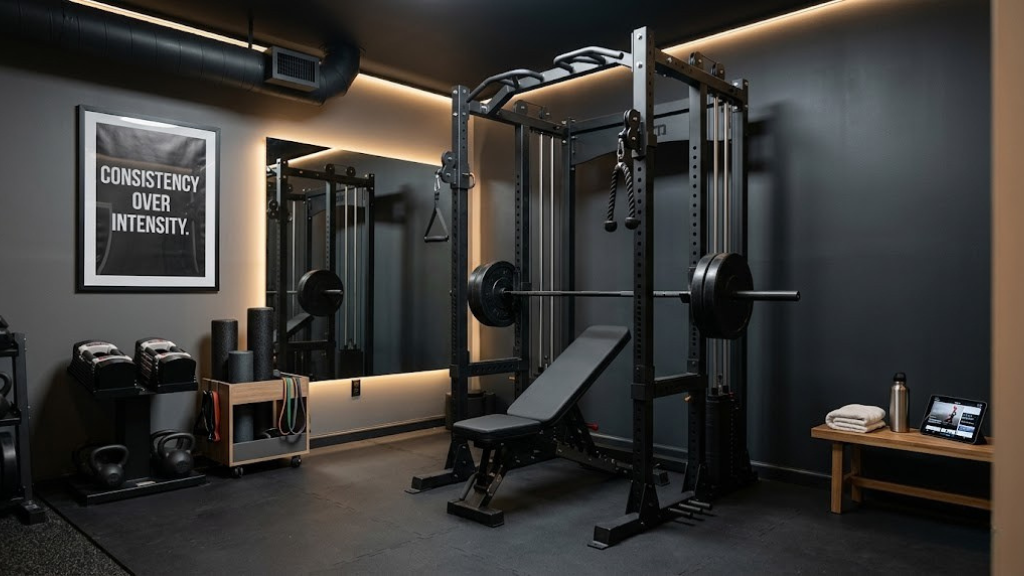
Why Invest in an All-in-One Home Gym?
Picture this: it’s 6 AM, raining outside, and the thought of fighting traffic to reach a crowded gym is just about the last thing you want to do. That scenario—played out millions of times a week—is exactly why the all-in-one home gym market has exploded. According to fitness industry research, home gym equipment sales surged well over 40% in recent years and have remained elevated even as commercial gyms reopened. People got a taste of training on their own schedule and never looked back.
But an all-in-one home gym is more than just a convenience play. Done right, it is a complete resistance-training ecosystem packed into a single footprint. We’re talking lat pull-downs, chest press, leg press, cable crossovers, bicep curls, tricep push-downs, and often 60 or more distinct exercises from one piece of equipment. That’s not a compromise—that’s a legitimate training solution for the vast majority of fitness goals, from fat loss to hypertrophy to general conditioning.
The catch? Not all all-in-one home gyms are created equal. Budget units below $300 often feature flimsy cables, limited range of motion, and wobble that makes a 150-lb lat pull-down feel genuinely unsafe. Premium systems in the $2,000+ bracket may offer more than most home users will ever need. The sweet spot—the machines that offer genuine gym-quality training at a price that won’t require a second mortgage—is where this guide focuses.
We spent weeks researching, reviewing real user feedback, and benchmarking specifications on dozens of all-in-one systems. What follows are the five best all-in-one home gyms you can buy right now, plus everything you need to know to choose, set up, and get the most from whichever one you take home.
Before purchasing, measure your available floor space AND ceiling height. Many machines exceed 7 feet tall and require at least 8 feet of ceiling clearance for overhead movements to be safe and effective.
How to Choose the Right All-in-One Home Gym
Walking into the all-in-one home gym market blind is a surefire way to spend money on something that ends up as an expensive clothes rack. Before you scroll down to the individual reviews, understand the five dimensions that separate a great home gym machine from a frustrating one.
1. Resistance Type & Maximum Load
All-in-one home gyms generally fall into two resistance categories. Weight-stack systems use traditional selectorized plates—you slide a pin and the machine delivers iron resistance with a familiar, predictable feel. These are ideal for anyone who has trained in a commercial gym and wants that exact experience at home. Bow-rod (power rod) systems, popularized by Bowflex, use flexible composite rods that provide increasing resistance as they bend. They’re quieter, lighter to ship, and feel slightly different—some find the variable resistance curve better for joint health, others miss the linear feel of iron.
Maximum resistance matters too. For beginners and intermediate lifters, 200–250 lbs is sufficient. Serious strength athletes should look for 310 lbs or higher. Keep in mind that cable machines with a 2:1 pulley ratio effectively halve the stack load at the handle, so a 200 lb stack might only deliver 100 lbs of actual pulling resistance.
2. Exercise Variety & Attachment System
A number like “70+ exercises” printed on the box sounds impressive until you realize twenty of those exercises are minor variations of the same cable row. What actually matters is whether the machine can hit all major muscle groups—chest, back, shoulders, legs, arms, core—through meaningful ranges of motion. Look for adjustable pulley heights, a leg developer, a lat pull station, and ideally a functional trainer tower.
Attachment systems vary too. Machines with a standard carabiner/swivel clip accept most third-party attachments (rope handles, ankle straps, V-bars), dramatically expanding the exercise menu. Proprietary attachment systems lock you into the brand’s ecosystem.
3. Footprint & Ceiling Height
This is where most buyers get tripped up. The spec sheet says “compact” and the dimensions are 80″×46″×82″. What the spec sheet doesn’t tell you is that the spotter arms extend an extra 24 inches on each side, or that the lat pull-down station requires you to stand 3 feet behind the machine. Always add 2–3 feet of operational clearance to every listed dimension before comparing to your available space.
4. Build Quality & Frame Gauge
The frame gauge—how thick the steel tubing is—is the single biggest predictor of how a machine will feel and how long it will last. Look for 11-gauge or thicker steel on any machine you plan to use seriously. Upholstery thickness (measured in inches for seat pads) and cable diameter (look for aircraft-grade cables) are secondary but important quality markers.
5. Assembly & Support
Few fitness purchases test patience like a 400-piece home gym delivered in six boxes. Some brands provide clear, color-coded assembly manuals and video guides; others supply a photocopied sheet of cryptic diagrams. User reviews frequently mention assembly as either the best or worst part of ownership—pay close attention to these comments. Warranty length (aim for at least 5 years on the frame, 1–2 years on cables and upholstery) and the brand’s customer service reputation round out the picture.
Beware of machines listed as “multi-station” that are simply two cheap single-station units bolted together. True multi-station gyms share a common frame and weight stack, delivering far better stability and value.
Strength training doesn’t stop at the machine itself. Complementary tools—like a solid set of resistance band systems for warm-up, rehabilitation, and accessory work—can significantly expand what you’re able to accomplish in your home training space without adding much cost or floor space.
The 5 Best All-in-One Home Gyms of 2025
After testing, research, and compiling hundreds of verified user reviews, these five machines represent the best in their respective categories. From the best overall to the best budget pick, there’s something here for every training level and every room size.
| Rank | Machine | Category | Resistance | Price Range | Our Score |
|---|---|---|---|---|---|
| #1 | Bowflex Xtreme 2 SE Top Pick | Best Overall | Up to 410 lbs | $$$ | 9.4/10 |
| #2 | Body-Solid G10B | Best Multi-Station | Up to 310 lbs | $$$$ | 9.1/10 |
| #3 | Marcy MWM-990 | Best Budget | Up to 150 lbs | $ | 8.2/10 |
| #4 | Inspire Fitness FT2 | Best Functional Trainer | Up to 295 lbs | $$$$ | 9.0/10 |
| #5 | XMark XM-7626 | Best Value | Up to 200 lbs | $$ | 8.7/10 |
#1 Bowflex Xtreme 2 SE — Best Overall

The Bowflex Xtreme 2 SE has held the top spot in the home gym market for years—and it hasn’t lost it by accident. This is a machine that delivers on its promises: 70+ exercises, a lifetime frame warranty, and resistance that scales from 5 lbs all the way up to 410 lbs with the optional upgrade rods. The power rod system provides smooth, joint-friendly resistance that most users find more comfortable for pressing and pulling movements than traditional cables.
The design centers on a space-saving lat tower with an integrated squat station, leg developer, and chest/shoulder press arm. The adjustable horizontal bench can be moved to multiple positions for flat, incline, and decline pressing. What sets the Xtreme 2 SE apart from its siblings is the addition of the squat station and the no-change cable pulley system—you can switch between exercises in seconds without physically changing cables or pins.
Assembly takes most people 3–4 hours with a partner, and Bowflex’s illustrated manual is genuinely one of the better ones in this category. Once assembled, the machine has a satisfyingly solid feel. The rods don’t squeak or rattle during use, and the upholstered pads are thick enough to handle serious training sessions without bottoming out.
For those also building out their home training arsenal, understanding how to maximize each workout becomes important. Tools like battle ropes pair excellently with a Bowflex setup for conditioning work between resistance training days—they hit the cardiovascular system hard without occupying much floor space when coiled.
✅ Pros
- Lifetime frame warranty
- 70+ exercises on one unit
- Smooth, quiet power rod resistance
- Upgradeable to 410 lbs
- Space-efficient footprint
- No-change cable pulley system
❌ Cons
- Power rods feel different from iron
- Bench pad could be thicker
- Higher price point
- Proprietary attachments only
#2 Body-Solid G10B — Best Multi-Station Home Gym

If you’ve trained in a commercial gym and want to replicate that exact experience at home, the Body-Solid G10B is about as close as you’ll get short of building your own facility. This machine is constructed with 11-gauge steel, features a 310-lb weight stack (upgradeable to 410 lbs), and uses a dual bi-angular press arm design that follows a more natural range of motion compared to fixed-bar machines.
The G10B is a genuinely serious piece of equipment. The frame alone weighs over 300 lbs before you add the plates, which tells you everything about the build philosophy. Body-Solid doesn’t make machines that flex, wobble, or develop annoying squeaks over time. Users who have owned this machine for five-plus years consistently report that it feels as solid as day one, with nothing more than occasional cable lubrication required.
The bi-angular press arm is the standout feature. Rather than locking your arms into a single plane of motion like a traditional chest press, the bi-angular design allows each arm to move independently and along a curved path that more closely mimics a dumbbell press. This translates to better muscle activation and a far more natural feel for pressing movements.
The included leg developer is legitimately capable—it hits leg extensions and leg curls through a full range of motion with smooth resistance throughout. The high and low pulley stations accept standard cable attachments, meaning you can use any carabiner-clip attachment you might already own. The lat pull-down station is tall enough to allow proper positioning even for users over 6 feet.
The main trade-offs are price and assembly complexity. The G10B sits at the higher end of the home gym market, and assembling it correctly requires patience, a strong partner, and ideally a full day. That said, for someone who trains seriously and wants equipment that will outlast decades of use, this is an investment rather than an expense.
✅ Pros
- Commercial-grade 11-gauge steel
- Bi-angular press for natural motion
- 400 lb user weight capacity
- Standard cable attachments accepted
- Lifetime frame and weld warranty
- Stack upgradeable to 410 lbs
❌ Cons
- Premium price point
- Assembly is very involved
- Large footprint
- Heavy shipping weight
#3 Marcy MWM-990 — Best Budget All-in-One Home Gym

Not everyone is ready—or needs—to drop $1,500+ on their first home gym. The Marcy MWM-990 exists precisely for that majority: fitness-motivated individuals who want a complete, capable, honest-to-goodness training machine without the premium price tag. And within its category, it genuinely delivers.
At under $500 on Amazon, the MWM-990 provides a 150-lb weight stack, a functional lat pull-down station, a chest fly/press arm, a low pulley for cable rows, and a leg developer for extensions and curls. For a beginner or intermediate lifter whose working weights sit below 120 lbs on most exercises, this covers the full spectrum of a well-structured training program.
The steel frame is lighter gauge than premium options, but it’s stable enough for consistent home use when properly assembled on a flat surface. Users frequently note that the assembly manual is somewhat confusing, and a few bolts can be tricky to tighten with standard tools—a ratchet set and a rubber mallet are unofficial requirements.
The 150-lb stack will become a limiting factor for experienced lifters, particularly on lat pull-downs and seated rows. For those users, this machine works best as a complement to a free-weight setup rather than a standalone gym. But for the target audience—anyone from a beginner starting their fitness journey to a busy parent who needs 30-minute full-body sessions—this machine punches well above its price point.
The 150-lb stack on the Marcy MWM-990 uses a 2:1 pulley ratio on the lat station, meaning effective pull resistance is 75 lbs. This is still productive for beginners, but experienced lifters should account for this when evaluating whether this machine meets their load requirements.
✅ Pros
- Excellent price-to-feature ratio
- Compact footprint
- Covers all major muscle groups
- Good for beginners to intermediates
- Relatively fast assembly
❌ Cons
- 150-lb max limits advanced lifters
- Lighter frame gauge
- Assembly manual is unclear
- Shorter warranty period
#4 Inspire Fitness FT2 — Best Functional Trainer
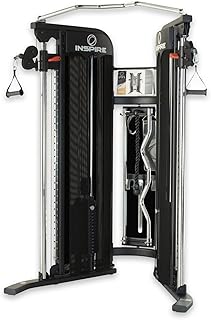
The Inspire Fitness FT2 is where athletic performance meets home gym engineering. This dual-stack functional trainer offers 20 pulley height positions on each column, allowing cable adjustments in 6-inch increments from floor to overhead. The result is an almost unlimited library of exercise angles—something that single-stack or traditional press-arm home gyms simply cannot replicate.
Functional training—movements that mimic real-world and sport-specific patterns—is where the FT2 shines. Wood chops, cable squats, unilateral pressing and pulling, rotational core work, face pulls, and anti-rotation holds are all executed beautifully on this machine. For athletes who also focus on grip strength, the FT2’s cable handles pair well with a dedicated grip strength training routine to ensure no weak links in the chain.
Both stacks can be used simultaneously for bilateral training, or independently for unilateral work that addresses strength imbalances. The included bench accommodates flat, incline, and decline positions, and the attachment set that ships with the FT2 is genuinely comprehensive—rope handle, straight bar, ankle strap, and multiple D-handle variations are all included from day one.
The trade-off is footprint. The FT2 requires more clearance than a traditional single-stack machine, particularly when using both pulleys simultaneously. But for athletes, performance-focused individuals, or anyone who has ever felt limited by fixed-arm machines, this is the machine that finally removes those limitations.
✅ Pros
- 20-position dual pulley columns
- 100+ exercises possible
- Full attachment set included
- Unilateral and bilateral capability
- Lifetime frame warranty
- Ideal for athletes and rehab
❌ Cons
- Large operational footprint
- Premium price bracket
- Heavy assembly complexity
- Learning curve for new users
#5 XMark XM-7626 — Best Value Mid-Range

The XMark XM-7626 occupies a genuinely useful market gap: mid-range in price, but materially closer to commercial equipment in construction than the budget picks in this category. Dual 200-lb weight stacks (independently adjustable) allow for serious unilateral training and mean this machine doesn’t run out of resistance for most intermediate-to-advanced exercises.
XMark builds with 12-gauge steel, which is slightly lighter than the Body-Solid but noticeably stiffer than budget alternatives. The cable system uses a 200-lb aircraft-grade cable rated to withstand significant abuse. The pulley system includes 19 adjustment positions per column—almost as many as the Inspire FT2 at roughly half the price—making it exceptionally flexible for functional cable movements.
What makes the XM-7626 particularly interesting is the thoughtfulness of its included accessory package. XMark ships this machine with a straight bar, two D-handles, a rope attachment, ankle strap, and a tricep push-down bar. You don’t need to spend another dollar on accessories to start training immediately.
For users who are also curious about recovery equipment, having a dedicated home gym opens up the possibility of building a complete wellness space. An infrared sauna for home use is an increasingly popular complement to serious strength training setups, supporting muscle recovery and relaxation after intense sessions.
✅ Pros
- Dual independent stacks
- 19-position pulley adjustment
- Comprehensive accessory kit included
- 12-gauge steel frame
- Excellent mid-range value
❌ Cons
- Warranty shorter than premium picks
- Heavier assembly than single-stack
- No integrated bench
- 300-lb user weight capacity
Full Comparison: All 5 Home Gyms Head-to-Head
Use this table to compare the five machines across every key metric. Not sure which category matters most to you? Focus on resistance range if you’re a serious lifter, exercise variety if you want programming flexibility, and warranty if you’re thinking long term.
| Feature | Bowflex Xtreme 2 SE | Body-Solid G10B | Marcy MWM-990 | Inspire FT2 | XMark XM-7626 |
|---|---|---|---|---|---|
| Price Range | ~$1,299 | ~$2,199 | ~$389 | ~$2,499 | ~$1,099 |
| Resistance Type | Power Rods | Weight Stack | Weight Stack | Dual Stacks | Dual Stacks |
| Max Resistance | 410 lbs | 310 lbs | 150 lbs | 295 lbs/stack | 200 lbs/stack |
| Exercises | 70+ | 60+ | 30+ | 100+ | 60+ |
| Frame Warranty | Lifetime | Lifetime | 2 Years | Lifetime | 2 Years |
| User Capacity | 300 lbs | 400 lbs | 300 lbs | 350 lbs | 300 lbs |
| Leg Developer | ✔ | ✔ | ✔ | ✘ | ✘ |
| Bi-Angular Press | ✘ | ✔ | ✘ | ✘ | ✘ |
| Unilateral Training | ✘ | Limited | ✘ | ✔ Full | ✔ Full |
| Best For | Most people | Serious lifters | Beginners | Athletes | Value seekers |
| Our Score | 9.4/10 | 9.1/10 | 8.2/10 | 9.0/10 | 8.7/10 |
Space Planning: What You Really Need Before You Buy
One of the biggest sources of buyer regret in the home gym space isn’t product quality—it’s miscalculation of space requirements. A machine that looks compact in a product photo can become a room-dominating behemoth when you factor in operational clearance, ceiling height, and the space needed to actually perform exercises safely.
The Minimum Room Dimensions Formula
Start with the machine’s listed footprint dimensions. Then add the following clearances: 3 feet behind the lat station for the pull-down path, 2 feet on each side for lateral movement during cable exercises, and 18 inches in front for pressing/rowing stations. For ceiling height, take the machine’s listed height and add 12–18 inches to allow you to stand fully upright on the lat seat during an overhead motion.
| Machine | Listed Footprint | Recommended Room Size | Ceiling Minimum |
|---|---|---|---|
| Bowflex Xtreme 2 SE | 99″×78″×41″ | 12′ × 10′ room | 8′ ceiling |
| Body-Solid G10B | 100″×76″×84″ | 14′ × 12′ room | 9′ ceiling |
| Marcy MWM-990 | 68″×75″×45″ | 10′ × 9′ room | 7.5′ ceiling |
| Inspire Fitness FT2 | 90″×50″×83″ | 13′ × 11′ room | 9′ ceiling |
| XMark XM-7626 | 90″×48″×83″ | 12′ × 10′ room | 8.5′ ceiling |
Flooring Matters More Than You Think
Placing a 300–500 lb machine on bare concrete is fine for weight distribution, but it’s hard on your joints during standing exercises and risks damaging the machine’s base over time. A 3/8″ to 1/2″ rubber flooring mat (horse stall mats from farm supply stores are an economical choice) provides shock absorption, protects the floor, and reduces equipment noise significantly—especially important if you’re working out above a living space.
Ventilation and Lighting
It sounds peripheral, but a hot, poorly lit training space is a motivation killer. If your home gym room doesn’t have direct ventilation, a simple box fan creates enough airflow for comfortable training. For lighting, cool-white LED panels (5000K color temperature) provide the most alert-promoting light for workout spaces. Avoid warm-yellow bulbs, which create a relaxed atmosphere that subtly reduces training intensity.
Sample Weekly Workout Routines for Your All-in-One Home Gym
Owning the right machine is only half the equation. Getting results requires a structured approach. Here are three complete weekly programs you can run on any of the five machines reviewed above, scaled to beginner, intermediate, and advanced levels.
Beginner Full-Body Program (3 Days/Week)
Perfect for the Marcy MWM-990 or anyone new to resistance training. Perform all exercises in circuit fashion with 60–90 seconds rest between rounds.
- Lat Pull-Down — 3 sets × 12 reps
- Chest Press — 3 sets × 12 reps
- Seated Cable Row — 3 sets × 12 reps
- Leg Extension — 3 sets × 15 reps
- Leg Curl — 3 sets × 15 reps
- Bicep Cable Curl — 2 sets × 12 reps
- Tricep Push-Down — 2 sets × 12 reps
Intermediate Push/Pull/Legs Split (4 Days/Week)
Ideal for the Bowflex Xtreme 2 SE or XMark XM-7626. Allows greater volume per muscle group.
- Push Day (Mon/Thu): Cable chest press, shoulder press, cable fly, tricep extensions, lateral raises
- Pull Day (Tue/Fri): Lat pull-down, seated row, face pulls, bicep curls, rear delt fly
- Leg Day (Wed): Leg press (if available), leg extension, leg curl, cable squats, standing calf raises
Advanced Functional Athletic Program (5 Days/Week)
Best executed on the Inspire Fitness FT2 or Body-Solid G10B. Incorporates unilateral movements and functional patterns for athletic performance.
- Day 1 — Upper Push: Single-arm cable press, high-to-low cable fly, standing overhead press
- Day 2 — Lower Power: Cable squats, Romanian deadlifts via low pulley, single-leg cable work
- Day 3 — Upper Pull: Single-arm cable row, lat pull-down, face pull, diagonal pull
- Day 4 — Core/Conditioning: Pallof press, wood chops, anti-rotation holds, cable crunches
- Day 5 — Full Body: Complex movements combining multiple muscle groups via adjustable pulleys
Grip strength is often the first limiter on cable exercises like rows and lat pull-downs. If your grip is giving out before your target muscles are fatigued, consider adding a specific grip strength routine to your warm-up. A few minutes of targeted grip work before pulling sessions can make a meaningful difference in exercise quality and volume capacity within weeks.
Must-Have Accessories to Maximize Your Home Gym
Your all-in-one home gym is the foundation. These accessories turn it into a complete, professional-grade training facility without requiring significant additional space or expense.
Cable Attachments
Even machines that ship with a basic attachment set benefit from a more comprehensive library. Priority additions include a dual-grip rotating handle (superior for neutral-grip pressing and pulling), an ankle strap for cable kickbacks and leg extensions, a curl bar attachment, and a hip attachment for cable pull-through movements. Most of these cost under $20 individually and can completely transform the exercise variety available from your machine.
Resistance Bands
A quality set of resistance bands is one of the highest-value additions to any home gym, regardless of the main machine you own. They’re ideal for warm-up, mobility work, rehabilitation exercises, and banded variations that add accommodating resistance to cable movements. Understanding the differences between loop, tube, and fabric band designs helps you choose the right type for each application rather than buying redundant options.
Adjustable Bench
Machines like the XMark XM-7626 don’t include an integrated bench, and even machines that do (like the Bowflex) benefit from a fully adjustable FID (flat-incline-decline) bench that allows for precise angle adjustments. Look for a bench with leg attachment capability, a weight capacity of 600+ lbs, and a commercial-grade pad thickness of at least 2.5 inches.
Flooring and Mirrors
Rubber flooring protects your investment and your body. A wall mirror (or a simple large mirror leaned against the wall) provides constant form feedback, which is especially valuable when training without a spotter or coach. Form checks aren’t vanity—they’re a safety tool.
Recovery Equipment
The best-equipped training space also plans for recovery. A quality foam roller, lacrosse ball, and a set of resistance bands for stretching cover most soft-tissue needs at minimal cost. For those dealing with recurring back tightness—common in people who train heavy rows and presses—exploring the evidence behind inversion therapy can be worthwhile before investing in a dedicated inversion table.
Maintaining Your All-in-One Home Gym: A Practical Guide
A well-maintained home gym machine should last 15–20 years or more. Neglected machines develop annoying noises, rough cable feel, worn upholstery, and in worst cases, safety issues. Fortunately, the maintenance required is minimal and takes under 30 minutes per month.
Monthly Tasks
- Wipe down all upholstered surfaces with a mild soap solution. Sweat is acidic and degrades foam and vinyl faster than almost anything else.
- Inspect cables for fraying, kinking, or any unusual wear patterns. Pay particular attention to the section of cable that passes over pulleys most frequently.
- Check all bolts and connection points. Vibration from use gradually loosens fasteners. A quick tighten-up prevents wobble and squeaking.
- Clean weight stack guide rods (on stack machines) with a damp cloth and apply a light silicone spray.
Annual Tasks
- Lubricate cables with a cable lubricant product or a dry PTFE spray. This keeps cables running smoothly and prevents the “grabby” feeling that develops over time.
- Inspect and replace any worn pulleys. Pulley bearings typically last several years under normal use but should be replaced if they feel gritty or produce noise.
- Check the frame for any paint chips or surface rust. Touch up bare metal with a rust-resistant primer to prevent corrosion, especially in humid environments or garages.
When to Replace Cables
Aircraft-grade cables typically last 3–5 years under regular use before they should be replaced preventively, regardless of visible wear. If you see individual strands breaking or any fraying near a crimp, replace the cable immediately—this is a non-negotiable safety item. Replacement cables are available from most manufacturers and typically cost $30–$80 depending on length and rating.
Never use a machine with a visibly damaged cable, cracked pulley, or significantly loose frame bolt. The forces generated during exercises like lat pull-downs and cable rows are substantial—a failure under load can cause serious injury. When in doubt, stop and inspect before continuing.
Frequently Asked Questions
Conclusion: Which All-in-One Home Gym Is Right for You?
There’s no perfect home gym machine—there’s only the right machine for your specific situation. After reviewing these five options in depth, here’s the clearest possible guidance for each buyer type:
- Best for most people: Bowflex Xtreme 2 SE — the combination of 70+ exercises, upgradeable resistance, lifetime warranty, and proven reliability makes it the safest investment for the broadest range of users.
- Best for serious, heavy lifters: Body-Solid G10B — commercial-grade build, 400-lb user capacity, bi-angular press, and iron weight-stack feel. This is the machine for people who train like they mean it.
- Best for beginners on a budget: Marcy MWM-990 — an honest, capable, genuinely good machine that doesn’t break the bank and doesn’t pretend to be something it isn’t.
- Best for athletes and functional training: Inspire Fitness FT2 — 20-position dual pulleys, 100+ exercises, and unilateral capability make this the clear choice for movement-quality-focused and sport-specific training.
- Best value mid-range: XMark XM-7626 — dual independent stacks, 19 pulley positions, and a comprehensive accessory kit at a price that makes competitors look overpriced.
Whatever machine you choose, the most important thing is consistent use. The best home gym is the one you actually train on. Measure your space twice, read the assembly instructions before you start, bolt everything down properly, and then get to work. Your goals don’t care whether the equipment cost $400 or $2,500—what matters is showing up.
Ready to Build Your Home Gym?
Browse all five of our top-rated all-in-one home gyms on Amazon. Free shipping available on most units — start training from home sooner than you think.
🛒 Shop All-in-One Home Gyms on Amazon