The Short Answer
⚡ Direct Answer
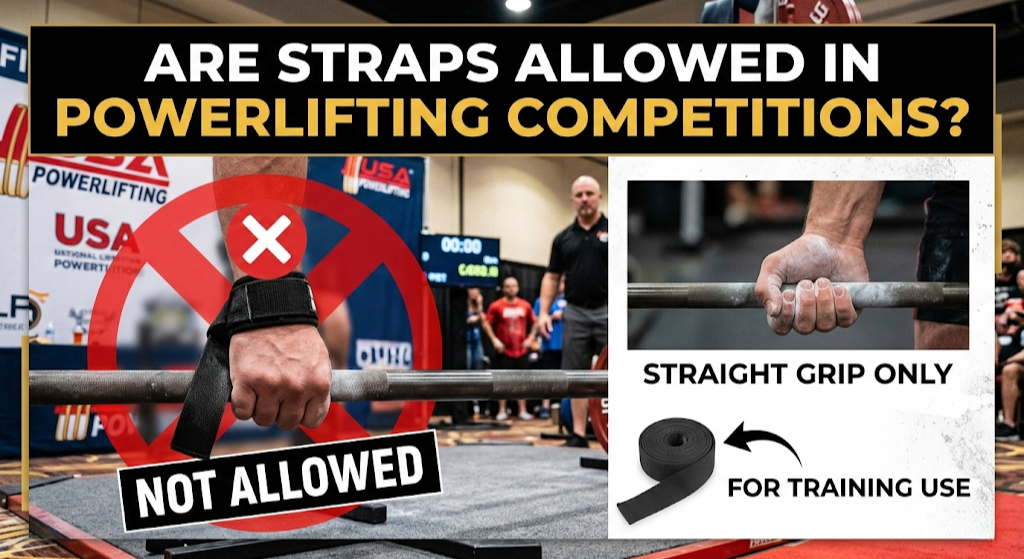
No — lifting straps are banned in every major powerlifting federation worldwide. This applies to the IPF, USAPL, USPA, WRPF, GPC, APF, RPS, and all nationally affiliated bodies. Using straps on any competition lift results in a red light on that attempt. Attempting to use them after being warned is grounds for disqualification. There are no exceptions and no weight classes or divisions where straps are permitted in sanctioned powerlifting.
This is one of the few areas in powerlifting rulebooks where every major federation is in complete agreement. The ban applies to all three competition lifts — squat, bench press, and deadlift — though in practice the only lift where a lifter would even consider using straps is the deadlift.
0Major powerlifting federations that permit lifting straps in competition
30+National and international bodies that explicitly prohibit straps in their rulebooks
RedLight outcome for any deadlift attempt performed with straps at a sanctioned meet
Why Straps Are Banned in Powerlifting
The ban isn’t arbitrary. Powerlifting competition tests the complete expression of strength in the squat, bench press, and deadlift — which inherently includes the grip required to execute those lifts. Straps transfer the hanging load from the fingers to the wrist structure, effectively bypassing the grip as a limiting factor. Allowing straps would mean the deadlift is no longer a test of how much weight a lifter can pull from the floor — it becomes a test of how much the posterior chain can produce with the grip constraint artificially removed.
🔑 The Principle Behind the Ban
- Grip is part of the lift. The deadlift requires holding the bar with your hands from floor to lockout. Straps change the mechanics of that hold in a way that cannot be standardised or measured consistently across lifters.
- Equipment standardisation. Powerlifting rules define exactly what equipment is permitted to ensure a level playing field. Straps introduce a variable advantage that differs between strap types, application techniques, and quality — impossible to standardise fairly.
- Historical precedent. The IPF and its predecessors established grip strength as an inherent component of the deadlift from the sport’s earliest organised rulebooks. This has never been contested at the federation governance level.
- Strongman is a different sport. Strongman competitions routinely permit straps on implement pulls, deadlifts, and carries. Powerlifting and strongman have different philosophies about what they’re testing — this is the central one.
Federation-by-Federation Rules
While the strap ban is universal in powerlifting, the rules around chalk, wrist wraps, knee sleeves, and tape vary meaningfully between federations. Here’s the complete picture for every major organisation:
🌍
IPF — International Powerlifting Federation
The global governing body — sets rules followed by all affiliated national federations
Straps: Banned
World Body
Liquid Chalk
Meet-specific
IPF rules: Chalk is provided at the competition platform. Lifters may use magnesium carbonate (block chalk) on hands, legs, and body. Personal liquid chalk is permitted at most IPF meets but confirm with the meet director. Thumb tape for hook grip is permitted. Wrist wraps are permitted (IPF-approved brands only for Classic division).
🇺🇸
USAPL — USA Powerlifting
US national affiliate of the IPF — follows IPF technical rules
Straps: Banned
Chalk: Yes
Liquid Chalk
Check meet rules
USAPL rules: As an IPF affiliate, USAPL follows IPF technical rules closely. Chalk is provided at the platform; lifters should confirm personal chalk policy with their specific meet director. Approved equipment list (singlets, belts, knee sleeves, wrist wraps) must be IPF-approved for national and international qualifier meets.
🇺🇸
USPA — US Powerlifting Association
Drug-tested and untested divisions — generally less restrictive equipment rules than USAPL
Straps: Banned
Chalk: Yes
USPA rules: Liquid chalk is widely accepted at USPA meets. Block chalk is permitted. The USPA has a less restrictive approved equipment list than USAPL — more belt and knee sleeve brands are approved. Straps remain banned regardless of division or drug-testing status.
🌐
WRPF — World Raw Powerlifting Federation
International federation — known for accessible equipment rules and online meets
Straps: Banned
Chalk: Yes
WRPF rules: One of the most accessible federations for new competitors. Chalk (block and liquid) is permitted. Equipment requirements are less strict than IPF, with a broader approved list. Straps are banned in all divisions including their online competition format.
🌍
GPC / APF — Global / American Powerlifting Committee
Multi-ply and raw divisions — historically popular for equipped powerlifting
Straps: Banned
Chalk: Yes
Suits / Gear
✓ Multi-ply OK
GPC/APF rules: Despite permitting squat suits, deadlift suits, and bench shirts in equipped divisions, straps remain banned. The equipment permitted in powerlifting (supportive suits, wraps) is fundamentally different in purpose from grip aids like straps — this distinction is maintained across all divisions.
🇺🇸
RPS — Revolution Powerlifting Syndicate
Beginner-friendly US federation with accessible meet formats
Straps: Banned
Chalk: Yes
RPS rules: Known for welcoming new competitors with a broad approved equipment list. Chalk permitted. Straps banned across all divisions. Often a good first federation for newer competitive lifters — but straps remain off the table regardless.
⚠️
Always verify with your specific meet director. While the strap ban is universal, chalk policies (especially liquid chalk vs block chalk) can vary between individual meet directors within the same federation. Email the meet director 2–4 weeks before the competition to confirm what’s permitted at their specific event.
What IS Allowed at Meets — The Full Grip Aid Picture
While straps are out, there are several grip-related aids and techniques that are permitted across major federations:
✓ Permitted in Most Federations
- Magnesium carbonate (chalk) — block chalk is the standard. IPF provides chalk at the platform; personal chalk is also permitted at most meets.
- Liquid chalk — permitted in USPA, WRPF, RPS, and most non-IPF federations. Check with IPF/USAPL meet directors individually.
- Thumb tape for hook grip — permitted in IPF and most affiliated federations. Must not extend past the first knuckle joint.
- Wrist wraps — permitted (approved brands/lengths depending on federation). Note: wrist wraps stabilise the wrist joint and don’t aid grip directly.
- Belt — permitted (approved brands, max widths, and styles vary by federation and division).
✗ Not Permitted in Powerlifting
- Lifting straps of any type — lasso, figure-8, Olympic loop. All banned universally.
- Grip gloves or grip pads — anything that adds friction to the palm beyond chalk is prohibited.
- Rosin or tackifier applied to the bar — the bar must not be treated to artificially increase grip.
- Wrist wraps wrapped around the fingers or bar — wrist wraps must stay on the wrist, not function as a strap substitute.
- Tacky substances on hands or equipment — powerlifting is explicitly chalk-only for grip enhancement.
💡
Hook grip is the most powerful legal grip strategy in powerlifting. By trapping the thumb under the fingers, hook grip dramatically increases grip security without any equipment. Olympic lifters use it exclusively. It requires 4–8 weeks of thumb discomfort while the tissues adapt — but once adapted, it’s significantly more secure than a double overhand grip and eliminates the bar rotation risk of mixed grip over time. Thumb tape makes the adaptation period more manageable and is permitted in competition.
🔗 Chalk Strategy for Competition
Consequences of Using Straps at a Meet
The enforcement is straightforward and the consequences are immediate. Understanding exactly what happens helps competitive lifters avoid any ambiguity at the platform:
1
Red light on the attempt — lift does not count
Any deadlift performed with straps visible on the bar receives a red light from all judges. The attempt is ruled a no-lift regardless of whether the bar was locked out successfully. The lift simply does not count toward the total.
2
Verbal warning from the chief referee
On a first infraction (or in cases where it appears accidental — e.g., a lifter who misunderstood the rules), the chief referee will issue a verbal warning. In practice this almost never happens — straps are not subtle equipment, and any lifter who competes knows the rules.
3
Disqualification for unsportsmanlike conduct on repeat
Attempting to use prohibited equipment after being warned constitutes unsportsmanlike conduct under IPF and most federation rules. The lifter is disqualified from the competition, receives no total, and may face a suspension from future competition depending on the federation’s disciplinary process.
4
Equipment check stage — straps are caught before the attempt in most cases
Most federations conduct equipment checks before lifting begins. Straps in a lifter’s bag or on their person aren’t inherently a problem — they’re commonly used in training warm-ups. The violation occurs when they reach the bar during a competition lift. Equipment inspectors check the bar area before lifts in many federations.
Training Without Straps for Competition
The most common mistake competitive powerlifters make is using straps heavily in training and then discovering their bare-hand max is substantially lower than their strap-assisted training weight. Building a competition-ready grip requires deliberate programming — not just removing straps in the final weeks before a meet.
The Competition Grip Gap Problem
If your training deadlift is 220 kg with straps and you’ve rarely pulled heavy without them, your bare-hand max might be 195 kg. That 25 kg gap is the competition grip gap — the difference between what your posterior chain can produce and what your unassisted grip will hold on meet day. Closing it requires months of deliberate work, not last-minute strap removal.
✗ What Creates a Large Grip Gap
- Using straps on every working set above 60% 1RM for extended training blocks
- Never training grip specifically — no dedicated grip work outside of pulling
- Removing straps only in the final 2–4 weeks before competition — not enough time to adapt
- Always using mixed grip without also developing double overhand and hook grip strength
✓ How to Eliminate the Grip Gap
- First working set always bare-handed — strap in only for subsequent heavy sets if needed
- Dedicated grip training 2× per week — grippers, farmer’s carries, thick bar work
- Phase out straps 8–12 weeks before a meet — not 2 weeks before
- Build hook grip progressively — start light, tape thumbs, add load over 6–8 weeks
📐 Competition Prep Rule
Your competition max must be trained bare-handed at some point every training block. A useful standard: if you cannot complete your planned competition opener with chalk and no straps in training, your opener is too heavy or your grip development is behind. The opener should feel like a technical demonstration, not a maximum effort — your grip must not be in question on attempt 1.
Competition Grip Strategies That Are Fully Legal
With straps off the table, these are the four legitimate grip strategies used by competitive powerlifters to maximise deadlift performance at meets:
← Scroll to see full table →
| Strategy | Security | Learning Curve | Legal? | Best For |
|---|
| Hook Grip + Chalk |
Maximum |
6–8 weeks thumb pain |
✓ All feds |
Competition-focused lifters, any pull weight |
| Double Overhand + Chalk |
Good |
Minimal |
✓ All feds |
Lighter classes, lifters with naturally strong grip |
| Mixed Grip + Chalk |
High |
Low |
✓ All feds |
Most competitive lifters — widely used at all levels |
| Thumb Tape + Hook Grip |
Maximum |
Moderate — technique needed |
✓ IPF + most feds |
Heavy classes, lifters transitioning to hook grip |
A Note on Mixed Grip and Long-Term Risk
Mixed grip (one hand supinated, one pronated) is the most widely used competition deadlift grip and is completely legal in all federations. The only consideration is long-term: the supinated arm is in a mechanically disadvantageous position that, under maximum loads repeated over years of competition, has an elevated bicep tear risk compared to hook grip or double overhand. Most lifters use mixed grip throughout their careers without injury — but it’s worth developing hook grip as a long-term investment, even if mixed grip is your competition grip today.
💡
Chalk application at a meet: Apply chalk in the warm-up room before walking to the platform, not on the platform itself. Most meets have chalk available at the warm-up area and at the competition bar. Apply a thin, even coat 30 seconds before your attempt — not so early that it wipes off on your singlet walking to the bar.
For lifters with sweaty hands, liquid chalk applied in the warm-up area and allowed to fully dry gives the most durable application through a heavy comp attempt.
Frequently Asked Questions
Are straps allowed in any powerlifting federation anywhere in the world?▾
Not in any sanctioned powerlifting federation that this guide is aware of as of 2026. The ban is universal across IPF and all major non-IPF federations globally. If a specific competition permits straps, it is either an unsanctioned event, a gym-internal competition with custom rules, or a different strength sport (strongman, Highland Games, etc.) that is being marketed informally as “powerlifting.” Any competition affiliated with a national or international powerlifting body prohibits straps.
What happens if I accidentally bring straps to the platform?▾
Having straps in your gym bag or warm-up area is not a violation. Many powerlifters use straps in their warm-up area for accessory work and pre-competition training sets — this is completely normal and not penalised. The violation occurs only when straps reach the competition bar during an attempt. If you realise you have straps wrapped on your wrists as you approach the bar, remove them before the lift begins. No violation occurs until the attempt is performed.
Can I use wrist wraps instead of straps to support my grip?▾
Wrist wraps are permitted but they don’t help your grip. Wrist wraps stabilise the wrist joint against hyperextension — they’re a pressing movement aid used primarily on bench press and overhead press. They provide no mechanical grip advantage on a deadlift because they don’t attach to the bar. You can wear wrist wraps during a deadlift and it’s completely legal, but they won’t solve a grip limitation. If your wrist is unstable during a deadlift, that’s a technique issue, not a wrap issue.
Is liquid chalk allowed at IPF and USAPL meets?▾
The IPF rulebook specifies magnesium carbonate as a permitted substance and does not distinguish between block and liquid formats. In practice, most IPF and USAPL meet directors permit liquid chalk, but this is
not uniformly codified — it varies by event. Block chalk is universally accepted and provided at the competition platform at virtually all sanctioned meets. If you use liquid chalk and your hands are heavy-sweating lifters,
see the liquid vs block chalk breakdown — liquid is often the better choice for competition precisely because it can be applied in the warm-up area and dries to a durable layer before you reach the platform.
My grip fails before my back on heavy deadlifts in training. How do I fix this before my first meet?▾
This is the most common problem for new competitors. The solution has two parts:
targeted grip training and
technique selection. For grip training, add grippers (3 sets of max-hold at medium resistance), plate pinches (45 lb plate, 3×30 seconds), and farmer’s carries 2× per week. This produces measurable grip improvement within 6–8 weeks. For technique, seriously consider transitioning to hook grip — it’s the only grip style that eliminates bar rotation as a failure mode entirely. The thumb discomfort is real but temporary; most lifters are fully adapted in 6 weeks.
The complete straps and chalk guide covers the full training protocol for building competition-legal grip strength.
Can I use straps during warm-ups at a powerlifting meet?▾
Yes — warm-up area usage is not restricted. The competition rules govern the competition platform only. In the warm-up area, you can use straps, deadlift shoes, a different belt, or any other training equipment you prefer. Most experienced powerlifters use straps for their heaviest warm-up sets to conserve grip for competition attempts — this is standard practice and completely acceptable. Just remove them before walking to the competition platform.
Are straps allowed in Olympic weightlifting competitions?▾
Yes — Olympic weightlifting is a completely different sport with different equipment rules. The IWF (International Weightlifting Federation) permits loop/Olympic straps on the snatch and clean & jerk. These are the quick-release style straps specifically designed to release when the bar is dropped — not lasso or figure-8 straps. Olympic weightlifting tests strength expression in the snatch and clean & jerk; the grip mechanics differ fundamentally from powerlifting.
See the deadlift vs Olympic lifting straps guide for the full breakdown of which strap type is appropriate for which sport and movement.
Straps Out, Grip Up
The strap ban in powerlifting isn’t going to change — it’s foundational to what the sport tests. The productive response isn’t to lament it but to build a grip that doesn’t need them at competition weights. Hook grip, chalk, and dedicated grip training have produced every world record deadlift in powerlifting history. The tools work. The training just has to be consistent enough to use them.
Use straps in training when they serve a purpose — protecting your posterior chain training quality when grip is the bottleneck, for high-volume accessory work, for rack pulls above your deadlift max. But always keep your competition grip alive: first sets bare-handed, a grip training block somewhere in every training cycle, and straps fully removed 8–12 weeks before the meet.
BUILD YOUR COMPETITION GRIP
The complete training protocol — chalk, straps, and how to peak without them for meet day.
Full Straps & Chalk Guide →