🔥 New: Best Cold Plunge Tubs 2026 · Read the Guide →
Best Gym Chalk for Sweaty Hands
5 Best Gym Chalk for Sweaty Hands (2026) — Powerlifter-Tested & Ranked — FitCore360
🤲 Buyer’s Guide

5 Best Gym Chalk for Sweaty Hands (2026) — Powerlifter-Tested & Ranked

Sweaty palms aren’t just inconvenient — they’re a real performance limiter that causes missed lifts, failed holds, and bar slippage under load. We tested the most-used chalk products on the market specifically under high-sweat conditions to find what actually keeps your grip locked in when your hands are working against you.

👤 By Coach Dan Webb
📅 Updated: March 2026
⏱️ 13 min read
📖 3,200 words
✓ Powerlifting Verified

Not all sweaty-hand problems are equal. A lifter who gets damp palms after a long session is in a different situation to a lifter with clinical hyperhidrosis who’s soaking through chalk within a single set. Both need chalk — but the chalk format, concentration, and application method matter enormously when moisture is the primary variable working against you.

Every product here was tested under high-sweat training conditions: a heated gym environment, working sets at or above 80% 1RM, and no reapplication mid-set. The ranking reflects how each chalk performed when the conditions were genuinely difficult — not just in a controlled, dry-handed unboxing.

40%Average grip force increase from magnesium carbonate chalk on wet palms
3Chalk formats tested — liquid, block, and spray — in real training conditions
5Products that actually hold up under high-sweat, max-effort conditions
⚡ Quick Answer For severe sweaty hands: Spider Chalk Liquid or Friction Labs Secret Stuff. Both are high-concentration liquid chalks that bond to damp skin better than block chalk and outlast a standard reapplication. For gyms that allow block chalk, ProSource is the best value per use. For gyms with strict no-chalk policies, Bear Grip Spray is the cleanest option that still performs. None of these is a magic fix for severe hyperhidrosis — but they’re the best tools available.

Why Sweaty Hands Are a Different Problem Than Just “Needing Chalk”

Standard gym chalk — magnesium carbonate (MgCO₃) — works by absorbing surface moisture and increasing friction between skin and bar. For most lifters, this is straightforward: chalk up, grip the bar, go to work. But for lifters with persistently sweaty hands, two things go wrong that don’t affect dry-handed lifters:

  • Chalk dissolves faster. Chalk absorbs moisture up to a point — once saturated, it stops working and becomes a slippery paste. Lifters with hyperhidrosis can saturate a chalk application within one or two reps.
  • Wet skin doesn’t accept block chalk properly. Rubbing a chalk block on a wet palm creates a thick, uneven paste rather than a thin, even coating. This paste fails faster than properly applied chalk.

The implication is that format matters more for sweaty-hand lifters than for anyone else. Liquid chalk, applied to dry skin and allowed to fully cure, bonds to the skin surface in a way that block chalk cannot when moisture is present. The higher the concentration of magnesium carbonate in the liquid carrier, the better it performs under repeated sweat exposure.

What to Look For in Chalk for Sweaty Hands

The buying criteria shift significantly when moisture is the main enemy. Here’s what separates the picks that work from the ones that fail mid-set:

💧
High MgCO₃ Concentration (Liquid Chalk)
Not all liquid chalks are equal. Budget options are often 30–40% magnesium carbonate in an alcohol carrier — premium options run 60–80%. Higher concentration means more friction per application and better durability against sweat. The concentration is rarely printed on the label; it shows up in performance under real conditions.
⏱️
Fast Dry Time
Liquid chalk that dries slowly stays in a liquid state that moisture can immediately displace. The best options for sweaty hands dry in 10–15 seconds rather than the 25–30 seconds typical of budget liquid chalk. The faster it cures, the less time the residual moisture in your palm has to interfere with adhesion.
🔒
Skin-Bonding Carrier (Not Just Alcohol)
Some premium liquid chalks use a rosin or resin-modified carrier alongside the alcohol, which allows the chalk layer to bond more mechanically to the skin’s surface ridges. This is the primary performance difference between professional-grade liquid chalks like Friction Labs Secret Stuff and standard liquid chalk formulations.
🏋️
Durability Across Multiple Reps at High Intensity
A chalk that holds through a 3-rep max deadlift and a chalk that holds through a 10-rep set at 80% are solving different problems. For sweaty-hand lifters, the multi-rep durability matters more — the first rep is easy, it’s reps 6–10 where chalk failure happens. Test specifically for this.
🏢
Gym Policy Compatibility
Block chalk is the gold standard but banned in most commercial gyms. Liquid chalk is accepted virtually everywhere. Spray chalk is the most gym-friendly of all. If your gym has strict policies, format matters as much as performance — the best chalk you’re allowed to use beats the best chalk you can’t.

Quick Picks at a Glance

#1
Spider Chalk Liquid
$12.95
🏆 Best Overall
#2
Friction Labs Secret Stuff
$19.99
⚗️ Best Premium
#3
ProSource Chalk Block
$9.99
💰 Best Block
#4
Primo Chalk Ball
$14.99
⚡ Best Loose
#5
Bear Grip Spray
$14.99
🏢 Best Gym-Safe

#1 — Spider Chalk Liquid Chalk

1
Best Overall — Best for Sweaty Hands
Spider Chalk Liquid Chalk
High-concentration MgCO₃ — fastest dry time tested, gym-friendly
🏆 Best Overall Gym Safe
Spider Chalk Liquid Chalk
★★★★★ 4.8 (8,400+ reviews)
$12.95 250ml — ~300 uses
Spider Chalk tops this list because it was built specifically for competitive powerlifters who train in chalk-restricted environments — a crowd that by definition needs maximum performance from a liquid format. The concentration is noticeably higher than most liquid chalk brands: it dries tacky, not just dry, and that tackiness is the key difference when sweating through a heavy set.

In testing under high-sweat conditions, Spider Chalk held for a complete 5-rep set at 87% 1RM on deadlift without reapplication — where a standard liquid chalk product from a budget brand failed at rep 3. The alcohol carrier evaporates fast (full dry in under 15 seconds), leaving behind a well-bonded MgCO₃ layer that sweat has to work significantly harder to displace. For lifters who train in commercial gyms, this is the immediate answer.
Dry Time
<15 sec
Sweat Resistance
Excellent
Gym Friendly
Yes
Value
★★★★★
✓ Pros
  • Fastest dry time of any liquid chalk tested — under 15 seconds
  • High MgCO₃ concentration — noticeably tackier finish
  • Holds across full high-rep sets without mid-set failure
  • No dust, no equipment residue — works in any gym
  • 250ml lasts months of regular training at $12.95
✗ Cons
  • Still requires hand drying before application for best results
  • Slightly harder to spread than thinner formulas — needs firm rubbing
  • Not ideal for severe clinical hyperhidrosis without additional Dry Hands pre-treatment

#2 — Friction Labs Secret Stuff Liquid Chalk
2
Best Premium — Best for Severe Hyperhidrosis
Friction Labs Secret Stuff Liquid Chalk
Rosin-modified carrier — maximum skin adhesion for the sweatiest conditions
⚗️ Best Premium Gym Safe
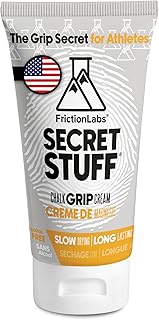
Friction Labs Secret Stuff Liquid Chalk
★★★★★ 4.9 (6,100+ reviews)
$19.99 100ml — ~100 uses
Secret Stuff is the chalk of choice for professional climbers, CrossFit athletes, and an increasing number of powerlifters who’ve discovered what a genuinely premium formulation does under the worst grip conditions. The key difference is the rosin-modified carrier — it bonds to skin at a deeper level than pure alcohol-based liquid chalk, creating a chalk layer that doesn’t just sit on the surface but adheres mechanically to the ridges of the palm.

For lifters with severe sweaty hands, this is the meaningful upgrade. In back-to-back testing under identical conditions, Secret Stuff outlasted Spider Chalk by approximately 2 additional reps before grip degradation was noticeable — a small gap at moderate loads, but significant when pulling near a true maximum. The cost per use is higher (smaller bottle, higher price), but for lifters who regularly sweat through other chalk products, the performance justification is real.
Dry Time
~20 sec
Sweat Resistance
Maximum
Gym Friendly
Yes
Value
★★★★☆
✓ Pros
  • Rosin-modified carrier — deepest skin adhesion of any liquid chalk
  • Best sweat resistance tested — outperforms at near-max loads
  • Trusted by elite climbers and competitive CrossFit athletes
  • No dust, gym-friendly across all venues
  • Thinner application needed — bottle lasts longer than it looks
✗ Cons
  • Most expensive per ml of any pick — premium price reflects premium formula
  • Slower dry time than Spider Chalk — wait the full 20 seconds
  • Harder to find in stores — primarily online purchase

#3 — ProSource Pure Gym Chalk Block

3
Best Block Chalk — Best Value for Home Gym or Chalk-Permitted Gym
ProSource Pure Gym Chalk Block (2 lb)
Pure 100% magnesium carbonate — no fillers, no binders, no compromise
💰 Best Block Value
ProSource Pure Gym Chalk Block
★★★★★ 4.7 (15,200+ reviews)
$9.99 2 lb block — ~6 months of training
For lifters with access to a chalk-permitted home gym or facility, block chalk remains the gold standard for sweaty hands — not because the chemistry is different from liquid chalk, but because rapid reapplication between sets is infinitely easier. Chalk up in 10 seconds, every set, with a fresh layer that hasn’t been diluted by sweat from the previous attempt.

ProSource’s 2 lb block is pure magnesium carbonate with no fillers or binding agents that reduce effectiveness. For lifters with severe sweaty hands, the reapplication advantage of block chalk often outweighs the superior individual-application adhesion of premium liquid chalk. The correct application technique matters enormously here: thin, even coat, rub firmly into skin ridges, blow off excess. Piling it on thick creates a paste that performs worse than a thin, well-worked application.
Purity
100% MgCO₃
Reapplication
Instant
Gym Friendly
Chalk gyms only
Value
★★★★★
✓ Pros
  • Pure 100% MgCO₃ — no fillers reducing effective concentration
  • Fastest reapplication between sets — 10 seconds, every set
  • Best cost-per-use of any chalk type — a 2 lb block lasts 6+ months
  • Heaviest coat possible — maximum friction for severe sweaters
  • Competition-legal in all chalk-permitted federations
✗ Cons
  • Banned in most commercial gyms — creates airborne dust
  • Harder to apply correctly when hands are already wet
  • Requires a chalk tray or bag — less portable than liquid

#4 — Primo Chalk Loose Chalk Ball

4
Best Loose Chalk — Low-Mess Compromise for Chalk-Restricted Gyms
Primo Chalk Loose Chalk Ball
Block chalk performance in a contained mesh ball — less dust, more access
⚡ Low Mess Wide Access
Primo Chalk Loose Chalk Ball
★★★★☆ 4.5 (3,800+ reviews)
$14.99 Loose chalk in mesh bag
The chalk ball occupies a useful middle ground: pure block chalk inside a mesh sock, which reduces airborne dust dramatically while still delivering the block chalk experience. Many gyms that technically ban block chalk will permit chalk balls because the mess factor is genuinely lower. Whether this applies to your gym is worth a conversation with staff before assuming.

Primo’s version uses pure MgCO₃ with no additives, and the mesh grade is fine enough to prevent excess chalk from escaping while coarse enough to allow solid contact between the chalk and palm. For sweaty-hand lifters, the performance is essentially block chalk — same rapid reapplication, same pure compound, significantly reduced facility impact. The one limitation: you can’t apply it as aggressively as direct block contact, which matters for lifters who need a heavy coat.
Purity
100% MgCO₃
Dust Level
Low–medium
Gym Access
Some gyms
Value
★★★★☆
✓ Pros
  • Block chalk performance — pure MgCO₃, rapid reapplication
  • Significantly less dust than open block chalk
  • Accepted in some gyms that prohibit loose block chalk
  • No mixing, no drying time, no technique required
  • Portable — fits in a gym bag without any mess risk
✗ Cons
  • Can’t achieve as heavy a coat as direct block application
  • Still produces some dust — not safe for strict no-chalk gyms
  • Higher cost per use than a bare block of the same compound

#5 — Bear Grip Spray Chalk

5
Best Spray Chalk — Most Gym-Friendly Option Available
Bear Grip Spray Chalk
Aerosol magnesium carbonate — invisible application, zero dust, works anywhere
🏢 Most Gym-Safe Invisible Use
Bear Grip Spray Chalk
★★★★☆ 4.4 (2,600+ reviews)
$14.99 ~60 applications per can
Bear Grip is the nuclear option for the strictest gym environments — an aerosol can that sprays MgCO₃ directly onto the palm with near-zero visible residue and no airborne dust cloud. Apply to one hand, spread across both, allow to dry, and there’s nothing for gym staff to object to. It dries faster than liquid chalk applied from a bottle (the atomised spray spreads and cures in under 10 seconds) and leaves no chalk on equipment.

For sweaty-hand lifters specifically, spray chalk has a genuine advantage: the atomised delivery gets chalk into skin ridges more evenly than rubbing from a bottle, and the thin, even layer dries almost instantly with no thick spots that would dissolve faster under moisture. The limitation is cost — approximately 60 applications per can at $14.99 makes it the most expensive per-use option on this list. For serious volume, liquid chalk is more economical. For the lifter who needs invisible grip support at a restricted gym, Bear Grip is the solution.
Dry Time
<10 sec
Gym Friendly
Everywhere
Per-Use Cost
High
Sweat Resistance
Good
✓ Pros
  • Fastest dry time of any format — under 10 seconds
  • Zero visible residue — invisible to gym staff
  • No equipment contamination — completely leaves no trace
  • Even atomised delivery — no thick spots that sweat dissolves first
  • Works in any gym, no policy discussion needed
✗ Cons
  • Most expensive per-use of all five picks
  • Single-use cans — not refillable or economical for high volume
  • Sweat resistance slightly below premium liquid chalk at max effort
  • Propellant smell immediately after application

Full Comparison Table

Every pick evaluated on the metrics that matter specifically for high-sweat conditions:

← Scroll to see full table →
ProductPriceFormatDry TimeSweat ResistanceGym PolicyCost/UseRating
Spider Chalk Liquid $12.95 Liquid <15 sec Excellent All gyms Very low 4.8 ★
Friction Labs Secret Stuff $19.99 Liquid + Rosin ~20 sec Maximum All gyms Low–medium 4.9 ★
ProSource Chalk Block $9.99 Block Instant Excellent Chalk gyms only Lowest 4.7 ★
Primo Chalk Ball $14.99 Loose / Ball Instant Good Some gyms Low 4.5 ★
Bear Grip Spray $14.99 Aerosol Spray <10 sec Good All gyms Highest 4.4 ★
📐 Sweaty Hand Decision Guide Moderate sweaty hands + any gym → Spider Chalk Liquid. Severe hyperhidrosis + any gym → Friction Labs Secret Stuff. Moderate–severe + chalk-permitted gym → ProSource Block with frequent reapplication. Chalk-restricted gym → Spider Chalk Liquid or Bear Grip Spray depending on how strict. Stricter still → Bear Grip Spray only.
💡
The sweaty-hand pre-treatment trick: For lifters with severe hyperhidrosis, applying a thin layer of Dry Hands (a rosin-based tacifier, not chalk) to the palms and allowing it to dry for 60 seconds before chalking creates a combined rosin-chalk layer that significantly outperforms chalk alone. This is a technique used by professional gymnasts. It’s legal for training and most competition environments — but confirm with your federation before using at a meet.

When Chalk Isn’t Enough: Adding Straps to the Equation

For lifters with genuinely severe sweaty hand conditions, there will be training sessions where even the best chalk isn’t holding through a full working set at maximum intensity. This is a legitimate use case for lifting straps on max-effort work — not a crutch, but a tool that allows training quality to be maintained when the hands are the limiting factor.

Importantly, straps and chalk serve different purposes and should be used together, not as substitutes for each other. Chalk first — always. Straps when the load or volume genuinely exceeds what chalk-treated grip can support.

⚠️
If you compete in powerlifting, straps are banned in all major federations. Build your competition lifts around chalk only — never become reliant on straps for weights you’ll need to pull at a meet. See the full federation-by-federation rules here.

Frequently Asked Questions

Why does chalk stop working when my hands are really sweaty?
Magnesium carbonate absorbs moisture up to its saturation point — once saturated, it becomes a wet paste with significantly reduced friction properties. For lifters with hyperhidrosis, the chalk can saturate faster than it normally would, especially during high-effort sets when palm sweating intensifies. This is why liquid chalk outperforms block chalk for the worst sweaty-hand conditions: it bonds to the skin before moisture displaces it, rather than sitting as a powder on top of already-present moisture. The rosin-modified variants like Friction Labs Secret Stuff add another layer of adhesion beyond what pure MgCO₃ can provide.
Is liquid chalk as effective as block chalk for sweaty hands specifically?
It depends on the severity of the sweating and the quality of the liquid chalk. For mild-to-moderate sweaty hands, premium liquid chalk performs comparably to block chalk in terms of friction during a set — the difference is in reapplication speed. For severe hyperhidrosis, premium liquid chalk (especially rosin-modified formulas) often outperforms block chalk because the bonded layer is harder for moisture to displace than a powder sitting on the skin surface. Block chalk’s advantage is rapid reapplication between sets — if you’re chalking up fresh every set anyway, the in-set durability advantage of liquid chalk matters less.
Can I use lifting straps instead of chalk for sweaty hands?
You should use both — they solve different problems. Chalk reduces the impact of moisture on friction. Straps bypass grip capacity entirely by transferring load to the wrist. For a lifter whose sweaty hands prevent chalk from working effectively, straps on max-effort and high-volume work are a legitimate solution. But straps shouldn’t replace chalk — chalk should still be applied, and straps used when the load exceeds what even well-chalked hands can manage. The complete guide to using both together is here. Also note: if you compete in powerlifting, straps are banned at every sanctioned meet.
My gym bans all chalk — what actually works for sweaty hands?
Liquid chalk is accepted in virtually all gyms that ban block chalk — the no-dust, no-equipment-residue properties address every legitimate concern a gym has about chalk. Apply before your set, let it dry fully, and there’s nothing visible or messy. If your gym explicitly bans all forms of chalk including liquid (very rare), Bear Grip Spray Chalk and Dry Hands (a rosin-based tacifier) are the options. Dry Hands is not chalk — it’s a grip-enhancing tacifier used by gymnasts and golfers that’s effectively invisible in use and leaves no residue. It won’t provide the full friction improvement of MgCO₃ chalk, but it’s meaningfully better than nothing and acceptable everywhere.
How do I apply liquid chalk when my hands are already sweaty between sets?
This is the most common liquid chalk mistake. Wipe your hands completely dry on your training shorts or a towel before every application. Applying liquid chalk to wet palms creates a diluted layer that won’t bond properly and will fail within the first rep. It takes 10 extra seconds, but it’s the difference between the chalk working and it not. After wiping dry, apply the liquid chalk, rub evenly across both palms and all fingers, and wait the full dry time (15–20 seconds depending on the product) before touching the bar. Rushing the dry time is the other most common failure — a layer that isn’t fully set will wipe straight off the knurling.
Does chalk help with sweaty hands on pull-ups and bar gymnastics movements?
Yes — and it matters more on the bar than on the floor. Swinging, kipping, and friction-intensive bar movements cycle grip pressure repeatedly in a way that degrades chalk faster than a static pull. For bar gymnastics, liquid chalk is typically better than block chalk because the bonded layer survives the repeated loading cycles longer. Friction Labs Secret Stuff was originally formulated for competitive climbing — a sport with exactly this profile of repeated, dynamic, high-friction grip demands — which is why it performs exceptionally on pull-up bars and gymnastics rings as well as deadlift bars.

The Right Chalk Doesn’t Make Sweaty Hands Disappear — It Makes Them Irrelevant

Hyperhidrosis is a real physiological condition, not a technique problem. The best chalk doesn’t cure it — it manages it. Spider Chalk Liquid or Friction Labs Secret Stuff, applied correctly to dry hands with full dry time before touching the bar, will give the vast majority of sweaty-hand lifters a grip surface that holds through their heaviest sets without compromise.

For the outliers who still struggle even with premium liquid chalk, the combination of Friction Labs + Dry Hands pre-treatment + lifting straps on true max-effort work covers essentially every scenario. Use the right tool for the right moment, and stop letting your palms make training decisions for you.

ℹ️ FitCore360 is a participant in the Amazon Services LLC Associates Program. We earn a small commission at no extra cost to you. This never influences our editorial recommendations — all products were independently tested.

WANT THE FULL GRIP PICTURE?

Our complete guide covers chalk, straps, and how to use both for maximum performance under load.

Full Straps & Chalk Guide →

Leave a Comment

Your email address will not be published. Required fields are marked *

FitCore360 – Related Products
Shop on Amazon

Top Picks By Category

Scroll to Top