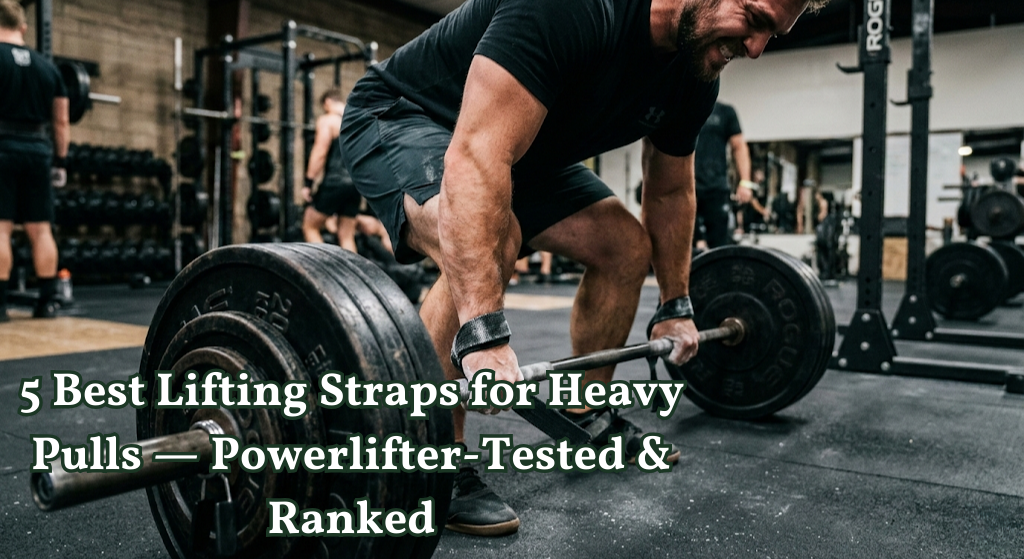
5 Best Lifting Straps for Heavy Pulls (2026) — Powerlifter-Tested & Ranked
Every strap on this list was tested under real max-effort loading — 180 kg+ deadlifts, high-volume barbell rows, and rack pulls above true 1RM capacity. We cut through the marketing noise to tell you exactly which straps hold, which slip, and which construction details actually matter when you’re moving serious weight.
📋 In This Guide
- Do You Actually Need Straps? (Honest Take)
- What to Look For in Heavy-Pull Straps
- Quick Picks at a Glance
- #1 — Harbinger Big Grip Pro Straps
- #2 — Rogue Figure-8 Straps
- #3 — SBD Lifting Straps
- #4 — ProSource Adjustable Wrist Straps
- #5 — Bear KompleX Loop Straps
- Full Comparison Table
- Frequently Asked Questions
The lifting strap market is flooded with identical-looking nylon rectangles that perform completely differently under real load. A strap that holds 100 kg comfortably can slip and compress at 200 kg — and you won’t know until the bar is mid-air. Construction quality, webbing width, wrap length, and stitching density are what separate a reliable heavy-pull strap from a liability.
Every pick here was evaluated on one primary criterion: does it hold under a genuine max-effort pull without any strap-related performance degradation? Secondary criteria — wrist comfort, ease of wrapping, material durability, gym-specific appropriateness — are noted where they differentiate picks within the same category.
Do You Actually Need Straps? (Honest Take)
Straps are one of the most misused tools in strength training — both overused (on every set from warm-up onward) and underused (avoided entirely out of fear of “weakening grip”). Neither extreme is correct.
The honest framework: straps exist to decouple grip capacity from posterior chain training. When the weight you need to move to adequately stress your back and legs exceeds what your grip can hold, straps are the correct tool. When you’re training at loads your grip can handle, leave the straps in your bag and develop your grip alongside your pull.
- Max-effort deadlifts above 85% 1RM — grip shouldn’t be the ceiling
- High-volume back accessories — 4×10 rows should tax your back, not forearms
- Rack pulls and supramaximal loading — bar loads higher than your actual deadlift max
- Late-session fatigue sets — preserve stimulus when grip is already spent
- Hyperhidrosis — when chalk alone isn’t enough to maintain safe grip
- All warm-up and sub-max sets — your grip needs training stress too
- Olympic lifts with lasso or figure-8 — requires quick-release only
- Powerlifting competition — banned in every major federation, no exceptions
- Specifically grip-training exercises — defeats the entire purpose
- Everything, every session — grip strength will regress without stimulus
What to Look For in Heavy-Pull Straps
Most strap reviews focus on price and aesthetics. These are the construction details that actually determine whether a strap holds under a true max pull:
Quick Picks at a Glance
#1 — Harbinger Big Grip Pro Lifting Straps

In testing, these straps showed zero slippage across 5-rep sets at 87% 1RM and maintained integrity through multiple mesocycles without any seam fraying at the loop junction. The quick-release works exactly as it should — open the hand and the strap comes free cleanly with no catching. For the lifter who pulls heavy but still wants to use straps safely across all pull variations including Romanian deadlifts, rows, and shrugs, this is the unambiguous first choice.
- 21.5″ length — fits all wrist sizes with room for 3 bar wraps
- Dense cotton webbing — no compression or stretch under max load
- Well-positioned neoprene padding — stays put through extended sessions
- Clean quick-release — safe on all pull variations
- Bar-tacked loop junction — no seam failure after extended heavy use
- Bulkier than minimalist straps — some lifters prefer bare nylon feel
- Cotton absorbs sweat — requires occasional wash to maintain grip feel
- Not appropriate for Olympic lifting — lasso requires quick-release confidence
#2 — Rogue Figure-8 Lifting Straps

Rogue’s version uses 3mm heavy nylon webbing with reinforced stitching at every junction point. Under 230 kg testing loads, there was zero perceptible movement or flex in the strap-bar connection — the mechanical feel is categorically different from even the best lasso strap. The trade-off is absolute: you cannot release these mid-movement. This makes them inappropriate for anything other than conventional deadlifts from the floor or rack pulls — specifically movements where bailing the bar means setting it down, not letting it fly. If you pull near or above 200 kg and want the feeling of the strap being completely out of the equation, this is the pick.
- Mechanical locking — strap security increases as load increases
- Zero wrap technique needed — faster setup than lasso
- 3mm heavy nylon — no stretch at any training load
- Rogue construction quality — bar-tacked at every stress point
- Eliminates strap as a performance variable entirely
- No quick release — cannot bail safely on dynamic movements
- Single-use case: conventional deadlift and rack pull only
- Stiffer material — uncomfortable for high-rep accessory work
- Overkill for lifters pulling under 180 kg — lasso is sufficient
#3 — SBD Lifting Straps

The trade-off is break-in time. New SBD straps are stiff — they require 2–3 training sessions before the leather softens to the point where wrapping is fast and comfortable. Once broken in, however, they’re the most comfortable high-performance lasso strap tested: the leather conforms to the bar geometry and the wrist simultaneously in a way cotton and nylon cannot. At $39 they’re more than twice the price of the Harbinger — justified for competitive lifters who train year-round at elite loads, unnecessary for recreational lifters.
- Suede leather — highest bar friction of any lasso strap format
- Conforming fit after break-in — personalises to wrist and bar shape
- Competition-grade construction — SBD’s IPF-trusted build quality
- Long service life — quality leather outdurates synthetic webbing significantly
- Quick-release maintained — safe across all pull variations
- Expensive — hard to justify vs Harbinger for non-competitive lifters
- Stiff until broken in — uncomfortable first 2–3 sessions
- Requires occasional leather conditioning to maintain suppleness
- Moisture degrades leather faster than synthetic alternatives
#4 — ProSource Adjustable Wrist Straps

Where it falls short of the Harbinger is in long-term durability at the loop junction — the stitching is adequate but not bar-tacked to the same standard. Under 6–12 months of regular heavy use, some users report loop wear at this point. For a lifter just starting to use straps, or one who uses them selectively rather than every session, ProSource at $9.99 is a completely reasonable first purchase. Upgrade to Harbinger when you’re training consistently enough that strap durability becomes relevant.
- $9.99 — by far the best price-to-performance ratio at moderate loads
- Solid cotton webbing — adequate for 80–85% of lifters’ needs
- Quick-release — safe on all pull variations
- 18,000+ reviews — broadly proven across diverse training contexts
- Good starter strap before committing to premium options
- Thinner webbing compresses slightly under loads above 180 kg
- Loop stitching less robust than bar-tacked alternatives
- 18″ length may be short for very large wrists
- No wrist padding — can create bar impression during extended sessions
#5 — Bear KompleX Loop Straps

Bear KompleX uses heavy nylon construction with reinforced thumbhole stitching — the single stress point on a loop strap, where constant thumb rotation creates wear. Their version holds up to this well, with no fraying reported in extended testing across Olympic pulling volume. The security level is lower than a lasso or figure-8 (by design — the strap can release), but for movements where bailing is a safety requirement, security and quick-release are competing requirements that any loop strap has to balance. Bear KompleX balances them well.
- Only strap format safe for snatches, cleans, and overhead movements
- Instant bar release in any direction — essential for Olympic lifts
- Heavy nylon thumbhole reinforcement — resists rotation wear
- Compact size — no excess strap to manage during dynamic movements
- Works well on RDLs, rows, and shrugs alongside Olympic movements
- Lower security ceiling than lasso straps — not ideal for absolute max deadlifts
- Thumb contact can become uncomfortable during very high-volume sessions
- Takes adjustment to grip positioning for lifters new to loop format
What to Avoid
- Polypropylene webbing (budget “nylon” straps): Looks like nylon, feels like nylon initially, stretches under progressive load. Usually identifiable by the glossy sheen and very low price — under $6. The stretch means bar security decreases as load increases, which is the opposite of what you need.
- Straps under 1.5″ wide: Acceptable for moderate loads; uncomfortable and insecure above 140 kg due to pressure concentration on the wrist.
- Straps with no bar-tacking at the loop junction: Look at the seam where the strap passes through itself. Overlocked seams (zigzag stitch at the edge) fail faster than bar-tacked seams (dense horizontal stitch blocks across the full webbing width).
- Figure-8 straps for anything other than floor deadlifts: This bears repeating because the injury risk is real. Figure-8 straps are a specialised tool with a narrow, specific use case — not general-purpose straps.
Full Comparison Table
Every pick evaluated on the metrics that matter specifically for heavy pulling performance:
| Strap | Price | Type | Width | Max Load | Quick Release | Olympic Safe | Best For |
|---|---|---|---|---|---|---|---|
| Harbinger Big Grip Pro | $16.99 | Lasso — Cotton | 2″ | 250 kg+ | Yes | With care | All-purpose heavy pulling |
| Rogue Figure-8 | $22.00 | Figure-8 — Nylon | 2″ | 300 kg+ | No | Never | Max deadlifts only |
| SBD Lifting Straps | $39.00 | Lasso — Leather | 2″ | 250 kg+ | Yes | With care | Elite competition prep |
| ProSource Adjustable | $9.99 | Lasso — Cotton | 1.5″ | ~160 kg | Yes | With care | Budget / beginners |
| Bear KompleX Loop | $18.95 | Loop — Nylon | 1″ | Moderate | Instant | Yes — designed for it | Olympic lifts / CrossFit |
Don’t Forget Chalk — Straps and Chalk Solve Different Problems
Lifting straps bypass grip capacity. Chalk restores grip friction lost to moisture. They’re not interchangeable — the correct protocol is chalk first, straps when chalk alone isn’t enough. For lifters with sweaty hands, finding the right chalk is as important as finding the right straps.
Frequently Asked Questions
The Right Strap Removes One Variable — Now Build Everything Else
A lifting strap is not a shortcut — it’s a tool that removes grip as the limiting factor on movements where grip shouldn’t be the limiting factor. Use it for that purpose and you’ll pull heavier, accumulate more productive training volume, and protect the long-term development of your posterior chain. Ignore the “never use straps” dogma; ignore the “strap in for everything” extreme. Find the middle: chalk on everything, straps on the sets where they serve the training goal, grip work to keep your hands developing independently.
ℹ️ FitCore360 is a participant in the Amazon Services LLC Associates Program. We earn a small commission at no extra cost to you. This never influences our editorial recommendations — all products were independently tested.
NEED THE FULL PICTURE?
Read our complete guide to using straps and chalk together — protocols, competition rules, and what actually works at max effort.
Full Straps & Chalk Guide →