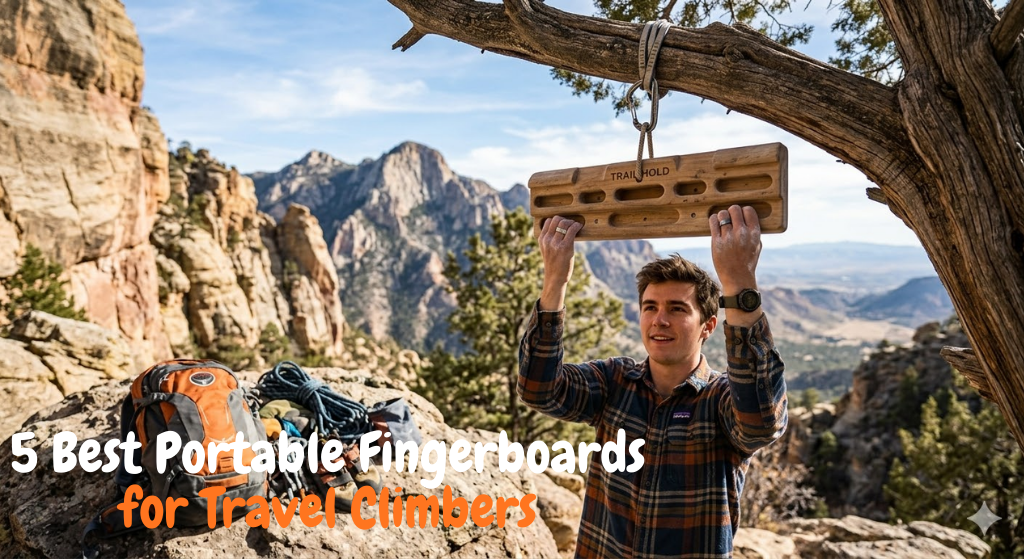
A portable hangboard is the most space-efficient training tool a travel climber can own. Under 2 lbs, installs in seconds on any pull-up bar, tree branch, or bolt hanger — and keeps your fingers conditioned through road trips, hotel stays, and van life climbing seasons. These are the five best options available on Amazon right now, ranked by training value, portability, and skin-friendliness.
⚡ Bottom LineThe Two Stones CJ-HB2055BX is the best all-round portable hangboard for most travel climbers. It offers the broadest hold variety in the portable category — 1, 2, 3, and 4-finger pockets at four depths, plus a long edge — all on a single CNC-milled wood block weighing 1.65 lbs. Hangs from any anchor on the included 6mm rope in under 30 seconds. For climbers who want premium sloper and pinch training while travelling, the So iLL Iron Palm is the upgrade pick. For pure edge training at the lightest possible weight, the YY Vertical La Baguette (only 380g) is unbeatable.
Portable hangboards are not miniature versions of wall-mounted boards — they’re a different product category with different design priorities. Before buying, understand exactly what variables matter for a board you’ll be throwing in a pack and hanging from crags, gym pull-up bars, and hotel door frames.
📋 Key Buying Criteria
Weight & pack size: Under 1 lb is excellent. Over 2 lbs starts to eat into climbing pack space. The lightest boards (La Baguette at 380g) fit in a chalk bag pocket.
Mounting method: Rope-hang boards are the most versatile — they work anywhere there’s a bar, branch, or bolt hanger. Strap-hang systems add friction but reduce anchor compatibility. Avoid boards that require a doorframe bracket for travel use.
Hold variety: The minimum useful portable board has two edge depths and allows both half-crimp and open-hand grips. Boards with pockets add pocket training; slopers add contact strength work.
Edge finish: Look for R3–R5 filleted (rounded) pocket edges — sharp edges cause skin damage and force shorter sessions. CNC-milled boards from a single wood block are more consistent than spliced or glued constructions.
Weight rating: Check the stated weight limit. Most portable boards are rated 220–400 lbs — sufficient for weighted hang protocols, but always verify before adding load.
Material: Wood is almost universally better than plastic for portable boards — lighter, skin-friendlier, and comfortable for volume sessions. Urethane (So iLL) is an exception with excellent grip properties.
⚠️
One thing portable boards cannot replace: A full wall-mounted board’s hold variety, sloper rails, and pinch blocks. If you have a permanent training space, use a wall board as your primary and a portable board as your travel supplement. See the full home wall hangboard guide for permanent setup recommendations.
#1 — Best Overall Portable Hangboard
1
🏆 #1 Best Overall
Two Stones Portable Hangboard — CJ-HB2055BX
The most complete portable training board available. Four pocket depths, full edge, and a 19.6″ deck that accommodates every grip position from open hand to two-finger pocket — all from a single-piece CNC wood block.
The CJ-HB2055BX is a 19.6-inch wide single-piece wood board — substantially wider than most portable boards, which means you can train with proper shoulder-width hand placement rather than cramped together on a narrow block. The hold profile covers 1, 2, 3, and 4-finger pockets at four depths, plus a long shallow edge running the full width for rail hangs and half-crimp work. All pocket edges are R5 filleted — the most generous radius in this guide — making it noticeably comfortable for extended sessions compared to cheaper boards with sharper corners.
🎯 Best For
This is the right board for climbers who want to run full structured sessions while travelling, not just warm-up hangs. The board width and hold variety support a complete 7/3 repeater session across multiple grip positions — half-crimp on the rail, open hand on the deep pockets, two-finger pockets mid-session. Includes 6mm × 3m climbing rope for anchoring. CNC’d from a complete wood block with no splicing — more durable than glued-block budget boards.
19.6″Width
1.65 lbsWeight
4 depthsPockets
400 lbsRated Load
✓ Pros
Widest deck in portable category — proper shoulder-width training
Most hold variety — 1/2/3/4-finger pockets + long edge
R5 filleted edges — extremely skin-friendly for long sessions
CNC single-block construction — no delamination risk
Includes rope — ready to hang out of the box
Best value per hold of any board in this guide
✗ Cons
Heavier than ultralight options (1.65 lbs vs 380g of La Baguette)
No sloper holds — contact strength training not possible
Width (19.6″) is slightly large for small chalk bags
No labelled edge depths — requires measuring if tracking min-edge progression precisely
Bottom line: The best all-rounder in portable boards. Widest deck, most holds, best skin comfort. Buy this if you want to run real training sessions on the road, not just warm-up hangs.
#2 — Best for Slopers & Pinches
2
🔵 #2 Best Slopers & Pinches
So iLL Iron Palm Hangboard
Designed by pro climber and hold shaper Jason Kehl. The Iron Palm’s signature ball-shaped slopers and double-pinch design offer grip training that no wooden pocket board can match — the best portable option for boulderers training compression and contact strength.
The Iron Palm is made from hollow urethane — surprisingly light for its footprint — with four primary edge rails (each a different depth and angle), two large ball-shaped slopers that are among the best-designed sloper holds in any hangboard category, and two pinch blocks with thumb catches. There are no pockets — all training is done on edges and open-face holds. The urethane texture is grippy but harder on skin than wood for very long sessions. Primarily wall-mountable but light enough to hang as a portable unit on a strong pull-up bar or beam.
🎯 Best For
This board is the upgrade choice for intermediate-to-advanced boulderers whose sport demands sloper, compression, and pinch strength. If your projects are at Maple Canyon, Horse Pens 40, or any compression-heavy destination, the Iron Palm trains the specific grips those routes demand. It’s also the best choice for climbers who already own a pocket-based portable board (like the Two Stones) and want a second board that fills the sloper and pinch gap. At ~$100, it’s the most expensive board in this guide — but the unique hold design justifies the premium for the right climber.
4 railsEdges
2 ballSlopers
2 pairPinches
HollowBuild
✓ Pros
Best slopers of any portable board — ball design is unmatched
Unique double-pinch system trains 3 pinch widths
Hollow urethane — lighter than appearance suggests
Designed by Jason Kehl — elite climbing-specific engineering
Grippy texture — excellent chalk uptake
High durability — urethane outlasts wooden boards in humid/outdoor conditions
✗ Cons
No pockets — cannot train two-finger pocket protocols
Most expensive board in this guide (~$100)
Urethane is harder on skin than wood for high-volume sessions
Better as supplement to a pocket board than a standalone portable
Primarily wall-mount design — hanging portable use is secondary
Bottom line: Best sloper and pinch training in the portable category. Buy this if you boulder on compression terrain and need to train the specific grip types most portables ignore.
#3 — Best for Edge Training & Ultralight Travel
3
⚡ #3 Best Ultralight
YY Vertical La Baguette
At 380g (0.84 lbs) and 18.5 inches long, the Baguette fits in the side pocket of a backpack and offers 6 labelled edge depths (10–30mm) plus two tilt modes. The most edge-variety-per-gram of any board in this guide.
La Baguette from French climbing brand YY Vertical is a bar-shaped wooden board with six edge depths — 10, 15, 20, 25, 30mm plus a top bar — all engraved with their depths so you can track minimum-edge progression precisely. The key differentiator is the two tilt modes: the board can be hung level for standard edge training, or tilted to create a more positive or negative edge angle, effectively expanding the training variety beyond what a fixed-position board offers. Made from recycled rubberwood with a smooth surface finish.
🎯 Best For
The Baguette is purpose-built for climbers doing minimum-edge protocols who want precise progression tracking on the road. The labelled depths (10–30mm) make it the most useful portable board for structured strength programmes — you know exactly which edge you’re on and can record progress. At 380g, it genuinely disappears into a pack. The top bar also works as a warm-up jug for the start of a session. Best for intermediate-to-advanced sport climbers who prioritise edge training over pocket or sloper work.
380gWeight
6Edge Depths
10–30mmEdge Range
2 modesTilt Options
✓ Pros
Lightest board with real training variety (380g)
Labelled edge depths — ideal for min-edge progression tracking
Two tilt modes add training variety beyond a fixed board
Thin profile — fits in chalk bag side pocket
Recycled rubberwood — good sustainability credentials
Top bar for warm-up jug hangs
✗ Cons
No pockets — edge-only training
No slopers or pinch holds
Narrower training variety than Two Stones #1 pick
More expensive than Two Stones for fewer hold types
10mm edge requires conditioned tendons — not beginner-friendly
Bottom line: Best portable board for edge-specific protocols and ultralight travel. Buy this if you’re tracking minimum-edge progression and want the lightest possible pack footprint.
#4 — Best Budget Portable Hangboard
4
💰 #4 Best Budget
POWER GUIDANCE Wooden Portable Hangboard
Clean, well-made wooden portable board with suspension training capability. Solid two-edge design for crag warm-ups and travel sessions on a budget — the best value entry point in the category.
The POWER GUIDANCE portable board is a CNC-milled wood board designed for both standard rope-hang use and suspension training mode — where the board functions similarly to a TRX anchor point as well as a hangboard. The board includes two edge depths for standard half-crimp and open-hand training, with a smooth polished surface and clean R-filleted edges throughout. Compact dimensions and light weight make it easily packable. Includes straps for multiple attachment configurations.
🎯 Best For
Ideal for climbers new to portable hangboarding who want a capable, well-built board without spending $100+. The two-edge design covers the two most important training positions (half-crimp and open-hand) for most warm-up and basic strength sessions. The suspension function adds body-row and core exercises to the board’s repertoire, making it more versatile than a pure fingerboard. Best for intermediate climbers at the crag or on climbing trips where a full session isn’t the goal — just maintenance and warm-up.
LightWeight
2Edge Depths
YesSuspension
WoodMaterial
✓ Pros
Best price in this guide — excellent entry value
Suspension training capability adds versatility
Clean CNC wood construction, well-finished edges
Compact and packable for travel
Suitable for both beginners and intermediates
✗ Cons
Only 2 edge depths — limited training progression
No pockets, slopers, or pinches
Less hold variety than Two Stones #1 at a similar price point
Bottom line: Best-value entry into portable hangboarding. Buy this if you’re new to travel training or need a budget crag warm-up board that also supports bodyweight suspension exercises.
#5 — Best for Beginners & Pull-Up Training
5
🌱 #5 Best for Beginners
Two Stones Pull-Up Ring Hangboard
A cleverly designed circular wooden fingerboard that functions as both a pocket training board and a gymnastics-style pull-up ring. Five pocket depths from jug to shallow single-finger enable gradual progression from beginner to advanced.
~$25–32 (pair)
580g per pairRing shape · R190mm5 pocket depthsSold as pair
📐 What You Get
The Two Stones Pull-Up Ring boards are circular wooden rings (R190mm) that combine the function of gymnastic rings with pocket fingerboard training. Each ring carries 5 pocket depths — from a full-hand jug down to a single-finger mono pocket — carved into the inner surface of the ring. They hang from straps, ropes, or carabiners like gym rings. Sold as a pair (580g total). When used as rings, they allow pull-ups, rows, and support holds in addition to finger-specific training.
🎯 Best For
This is the best pick for beginners building finger strength from scratch and for climbers who want to combine pull strength and finger training in a single ultra-portable unit. The jug-to-mono pocket progression means beginners can start on the largest pocket and progress depth by depth as strength builds — the most gradual and safe progression structure in this guide. The ring form factor also allows wrist rotation during exercises, which some climbers find more comfortable than fixed-position boards during pull movements.
580gWeight (pair)
5Pocket Depths
RingShape
2 pcsIn Pack
✓ Pros
Most beginner-friendly progression — jug to mono in one board
Pull-up ring function adds exercise versatility
Wrist rotation during pulls — more natural movement
Lowest price in this guide (~$25–32 for pair)
Sold as pair — both hands trained simultaneously
CNC beechwood — durable and skin-friendly
✗ Cons
Ring shape limits some standard hangboard exercises
No edge rail for half-crimp training
Less suitable for structured repeater protocols
Advanced climbers will outgrow the design fairly quickly
Mono pocket training risks injury without years of conditioning
Bottom line: Best entry-level portable board. Buy this if you’re in the first year of climbing, want to combine pull-up and finger training, or need the lowest-cost portable option.
Side-by-Side Comparison Table
← scroll to see full table →
Board
Weight
Hold Types
Best Grip Training
Skill Level
Price
Best For
🏆 Two Stones CJ-HB2055BX
1.65 lbs
Pockets (4 depths) + Long Edge
Half-crimp, Open-hand, Pockets
Beg → Adv
~$28–35
Full sessions on the road
🔵 So iLL Iron Palm
Light (hollow)
4 Edges + 2 Slopers + 2 Pinches
Slopers, Pinches, Edges
Int → Elite
~$95–110
Compression bouldering training
⚡ YY Vertical La Baguette
380g (0.84 lbs)
6 Edges (10–30mm) + Top Bar
Half-crimp, Open-hand, Rail
Int → Adv
~$40–55
Edge protocols, ultralight travel
💰 POWER GUIDANCE Wooden
Light
2 Edges
Half-crimp, Open-hand
Beg → Int
~$35–45
Budget warm-up, crag training
🌱 Two Stones Ring Board
580g (pair)
5 Pocket Depths (Jug → Mono)
Pockets, Pull-ups, Wrist rotation
Beginner
~$25–32
Beginners, combined pull training
Category Rankings at a Glance
Category
🏆 Two Stones CJ-HB2055
🔵 So iLL Iron Palm
⚡ YY Vert Baguette
💰 Power Guidance
🌱 Ring Two Stones
Hold Variety
★★★★★
★★★★☆
★★★☆☆
★★☆☆☆
★★★☆☆
Portability
★★★☆☆
★★★☆☆
★★★★★
★★★★☆
★★★★☆
Sloper Training
✗ None
★★★★★
✗ None
✗ None
✗ None
Beginner Safety
★★★★★
★★★☆☆
★★★☆☆
★★★★☆
★★★★★
Value ($/hold)
★★★★★
★★☆☆☆
★★★☆☆
★★★★☆
★★★★★
Edge Precision
★★★☆☆
★★★☆☆
★★★★★
★★☆☆☆
★★☆☆☆
Which One Should You Buy?
🎯 Decision Guide by Climber Type
Most climbers — buy the Two Stones CJ-HB2055BX. Best hold variety, best value, best skin comfort, works for beginners through advanced. The correct default choice.
Boulderers on compression routes — add the So iLL Iron Palm. The sloper and pinch training it provides is unavailable on any other portable board. Buy alongside #1, not instead of it.
Sport climbers running structured edge protocols — buy the YY Vertical La Baguette. Labelled depths and tilt modes make it the best portable board for climbers tracking min-edge progression precisely. Choose this over #1 if edge training is your primary goal.
Budget-limited or casual — buy the POWER GUIDANCE Wooden. Covers the basics well for crag warm-ups and light travel sessions at the lowest price.
Beginners (under 18 months climbing) — buy the Two Stones Ring Board. The jug-to-pocket progression is the safest and most gradual entry point, and the pull-up ring function adds exercise variety while your tendons are still developing tolerance.
Van life / big wall climbers — pair #1 + #3. The Two Stones for pocket and open-hand variety, the La Baguette as a backup ultralight edge board that genuinely fits in a chalk bag. Combined weight under 1kg.
💡
Portable boards for crag warm-up only? Any board in this guide works for a standard pre-session warm-up. Spend 5 minutes on large holds at 40–50% intensity before your session — the specific board matters much less for warm-ups than for structured training. For full training protocols, choose based on the decision guide above. Full protocol guide in the Rock Climber’s Bible.
Frequently Asked Questions
Yes — with the right board and realistic expectations. The Two Stones CJ-HB2055BX (our #1 pick) has sufficient hold variety to run a complete 7/3 repeater session across multiple grip positions, including half-crimp on the edge rail and open-hand on the deeper pockets. What portable boards cannot do: provide a sloper rail for sustained contact strength work, offer the wide-body ergonomics of a 24–30 inch wall board for some shoulder positions, or give you the full hold inventory of a 31-hold mounted board like the Metolius Simulator 3D. For full-spectrum training programmes, a wall-mounted board remains the primary tool. Portable boards are best used as travel supplements or crag warm-up tools — with the best options in this guide capable of supporting real training sessions when a mounted board isn’t available.
Portable boards are remarkably versatile — they can be anchored almost anywhere a rope or carabiner can attach. Common travel hang points: a healthy tree branch (test by jumping on it first), the top of a door frame using a rope over the door (works with lighter boards for warm-ups — not for weighted hangs), a gym pull-up bar, the first bolt on a sport route before you lead it, a squat rack cross bar in a hotel gym, a playground pull-up bar, or a van rack/roof bar. The key is always that the anchor is solid enough to hold at least 2× your bodyweight for the hang duration. Avoid anything that can flex, break, or slip. Always test your anchor before committing to it by applying progressive load before hanging fully.
A portable board is perfectly adequate as a beginner’s first hangboard — and often preferable. The most important reason: beginners should not be doing high-volume, high-intensity hangboard training. A beginner programme involves conservative loads on large holds, short sessions, and long rest periods. A portable board with a deep pocket and a large edge handles all of this. There’s no benefit to a 31-hold wall board for someone doing 3 × 10-second hangs on a 30mm edge. The practical advantage of starting with a portable board is that it removes the mounting commitment — you can test whether you’ll actually use a board before drilling into a wall. If you find yourself wanting more hold variety and training precision after 3–6 months of structured work, that’s the right time to add a wall-mounted board.
The safest door-frame option is over-the-door hanging, using a pull-up bar or a padded rope thrown over the top edge of the door. For bodyweight-only hangs on small boards (under 1.2 lbs), a folded towel or rubber pad over the door edge protects both the door and the rope. This works for light warm-up hangs but is not reliable for weighted protocols — the rope can slip under load. A better solution for apartment climbers is a free-standing pull-up bar that sits inside the door frame using pressure — these are available on Amazon for $30–50, support 300+ lbs, and allow any portable board to be used without wall damage. For structured training, a free-standing bar + portable board combination is as reliable as a wall mount and requires zero tools or permanent installation.
Two Stones makes a large number of portable board variants with different hold configurations — the model number (CJ-HB) distinguishes them. The key variants: CJ-HB2055BX (our #1 pick) — wide 19.6-inch bar with 1/2/3/4-finger pockets at four depths and a long edge; CJ-HB2024 — similar but slimmer profile with a jug, two pocket depths, and one long edge; CJ-HB2025 — compact version with pockets and edges; B0D2DKRDYK — the ring-shaped boards we ranked #5; B08WX5JMB4 — ring boards with 4 pocket depths. When choosing between them, prioritise the CJ-HB2055BX (our pick) for the most complete training hold variety. The ring boards are better for beginners and combined pull-up training. Avoid the most minimal two-pocket variants unless weight is the primary constraint.
On a climbing trip, use a portable board for warm-up only — not for additional training volume. If you’re climbing 4–6 hours a day, your fingers are already getting significant stimulation. Adding hangboard sessions on top of full climbing days is a reliable path to overuse injury, particularly when you’re also tired from travel and may be less attuned to warning signs. The correct use of a portable board on a trip: 5–10 minutes of progressive warm-up hangs before each session on the wall, starting with the largest holds and working down to your working edge depth. This prepares the tendons for the loading they’re about to receive without adding load on top of climbing volume. Only use a portable board for genuine training sessions on rest days — when you’re not climbing that day — and even then, keep volume conservative.
✓ Final VerdictFor most travel climbers, the Two Stones CJ-HB2055BX is the clear choice. The widest deck, most hold variety, best skin comfort, and best value in the portable category — under $35. If you need sloper and pinch training while travelling, pair it with the So iLL Iron Palm. If you’re doing precision edge protocols and want the lightest possible pack footprint, the YY Vertical La Baguette at 380g is the specialist pick. All five boards in this guide are available on Amazon, well-reviewed by real climbers, and capable of keeping your fingers conditioned through extended trips away from your home wall.