Crusher vs Spring vs Coil Grippers:
Which Type Should You Buy?
Not all grip trainers are built the same — and buying the wrong type is the #1 reason people quit. This is the definitive breakdown of every gripper mechanism: what each type trains, who it’s for, and which one will actually get you results based on your goal.
📋 In This Guide
Walk into any gym, open any fitness site, and you’ll see “hand gripper” used as if it describes a single product. It doesn’t. The term covers at least five distinct mechanism types — and choosing the wrong one can mean months of wasted effort, stalled progress, or a cheap piece of kit that breaks in three weeks.
This guide cuts through the confusion. We compare spring grippers vs coil grippers vs crusher/aluminium grippers, explain adjustable mechanisms, finger trainers, and pinch tools — and give you a direct verdict on which type is right for your specific goal.
The Three Main Gripper Types — At a Glance
Before diving deep, here’s what you need to understand about each category. Most people conflate spring and coil grippers because they look similar — but they behave very differently under load. Crusher/aluminium grippers are a completely different category built for serious strength athletes.
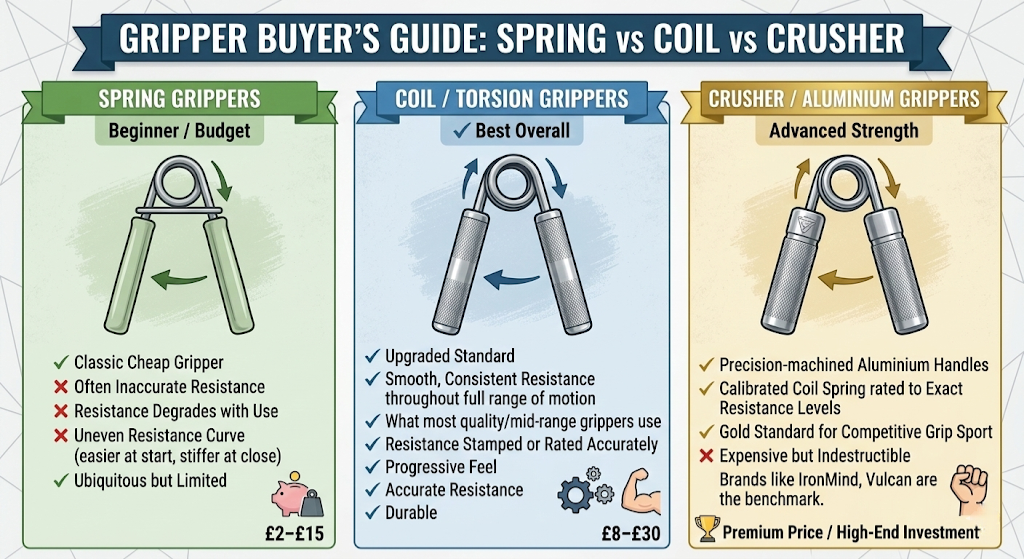
The upgraded standard. A torsion spring coils around a central pivot, providing smooth, consistent resistance throughout the full range of motion. This is what most mid-range and quality grippers use. Resistance is usually stamped or rated accurately.
The classic cheap gripper. A flat or curved leaf/coil spring connects two handles. Resistance is often inaccurate, degrades with use, and the resistance curve is uneven — easier at the start, stiffer near close. Ubiquitous but limited.
Precision-machined aluminium handles with a calibrated coil spring rated to exact resistance levels. The gold standard for competitive grip sport. Brands like Captains of Crush (IronMind) and Vulcan are the benchmark. Expensive but indestructible.
Spring Grippers — Full Breakdown
Spring grippers are what most people picture when they think of a hand gripper — two plastic or rubber-coated handles connected by a spring. They’re the grippers that come in multipack sets, often labelled “100 lb,” “150 lb,” or “200 lb” in bright marketing text.
How Spring Grippers Work
A single compression spring (flat or coiled) sits between the two handle arms. When you squeeze, you compress the spring. The resistance curve is front-loaded — the spring offers more resistance early in the close, then the mechanical advantage of your hand changes the feel as you approach full closure. This is the opposite of what your grip needs: your fingers are weakest at the start of a close, not the end.
The Resistance Labelling Problem
This is the biggest issue with cheap spring grippers. Most budget spring grippers wildly overstate their resistance. A gripper labelled “200 lbs” commonly measures at 60–80 lbs on a calibrated dynamometer. Manufacturers measure peak resistance (handles fully apart, spring maximally stretched) rather than the working resistance across the squeezing range.
Who Spring Grippers Are Actually Good For
- Complete beginners with very low baseline grip strength (e.g. post-injury rehabilitation)
- Children or older adults doing light endurance work
- Stress relief / fidget use — low-stakes, light resistance squeezing at a desk
- Musicians or surgeons doing gentle finger warm-up before performance

Coil / Torsion Grippers — Full Breakdown
Coil grippers (sometimes called torsion grippers) are the most common type in the mid-price bracket and represent a significant upgrade over cheap spring grippers. The resistance comes from a torsion spring — a coiled spring that twists rather than compresses — which gives a fundamentally different resistance curve.
How Torsion/Coil Grippers Work
Instead of a spring that compresses between two handle arms, a torsion spring sits at the pivot of the gripper. As you close the handles, the spring twists. This produces a more linear and progressive resistance curve — the resistance increases consistently as you close, which better matches how your grip muscles function and allows for more controlled eccentric (opening) reps.
Why the Resistance Curve Matters
Your finger flexors produce maximum force at the beginning of a close, not the end. A progressive resistance curve means the gripper gets harder as your fingers approach the weaker end of their range — exactly where you need training stimulus. Spring grippers do the opposite.
Adjustable Coil Grippers
The best version of the coil gripper is the adjustable model — typically with a threaded mechanism or sliding collar that changes the effective spring stiffness or starting position of the handles. These allow you to dial in resistance from as low as 10 lbs to 150+ lbs on a single device. For progressive overload, this is the most practical option for most people.


Crusher / Aluminium Grippers — Full Breakdown
Crusher grippers — most famously represented by the Captains of Crush line from IronMind — are precision-manufactured aluminium-handle grippers with calibrated, certified resistance levels. They represent a completely different category from anything sold in a blister pack at a supermarket.
What Makes Crusher Grippers Different
- Machined aluminium handles — knurled for grip, perfectly matched in width and weight
- Calibrated resistance — each model is tested to within ±5% of its stated rating. A #2 Captains of Crush is 195 lbs. Every unit, every time.
- Fixed, graduated levels — you buy progressively harder grippers as you advance (e.g. CoC Trainer → #1 → #1.5 → #2 → #2.5 → #3)
- Competition use — closing a #3 (280 lbs) or #4 (365 lbs) is a recognised feat of grip strength in the strength sport community
The Downside: No In-Built Progression
The key limitation of crusher grippers is that each unit has a single, fixed resistance level. To progress, you need to buy a new, harder gripper. This means the cost adds up — serious grip athletes may own 5–8 different CoC levels. They’re also not suitable for beginners; the lightest standard crusher gripper (CoC Sport, ~60 lbs) is still challenging for untrained individuals.
Who Crusher Grippers Are For
- Intermediate-to-advanced grip athletes who have outgrown adjustable grippers
- Competitive grip sport athletes training for certified closes
- Serious powerlifters and strongmen supplementing deadlift grip work
- Collectors — CoC grippers are precision objects with genuine craftsmanship appeal

Full Head-to-Head Comparison
| Category | Spring Gripper | Coil / Adjustable | Crusher / Aluminium |
|---|---|---|---|
| Resistance accuracy | ❌ Often wildly inaccurate | ✓ Generally accurate | ✓✓ Certified ±5% |
| Resistance curve | Uneven / front-loaded | Progressive / linear | Progressive / linear |
| Progressive overload | ❌ Fixed only | ✓ Adjustable models | Requires buying more units |
| Beginner friendly | ✓ Very accessible | ✓ Wide range | ❌ Too heavy to start |
| Advanced ceiling | ❌ Very limited | Moderate (150+ lbs) | ✓✓ 365 lbs+ |
| Durability | Low–medium | Medium–high | ✓✓ Essentially permanent |
| Cost | £2–£15 | £10–£35 | £25–£60+ per unit |
| Best for | Rehab / complete beginners | Most people (all levels) | Intermediate–advanced athletes |
| Muscle size gains | ❌ Too light typically | ✓ With heavy settings | ✓✓ High mechanical tension |
| Overall rating |
|
|
|
The bottom line: coil/adjustable grippers win on accessibility and value for most people. Crusher grippers win on absolute performance ceiling. Spring grippers win on price but lose almost everything else.
Adjustable Grippers Explained — Why They’re the Best Starting Point
Adjustable grippers work by changing either the effective spring stiffness or the starting gap between the handles. The most common adjustable mechanism uses a threaded knob or collar that compresses the spring pre-load — tighten it to increase resistance, loosen to decrease.
What to Look for in an Adjustable Gripper
- Wide resistance range: Look for at least 10–150 lbs, ideally 10–165 lbs. Cheap adjustables often only go to 80 lbs.
- Clear calibration markings: The resistance setting should be labelled in lbs or kg — not just numbered positions.
- Metal handle construction: Avoid plastic handles on adjustable grippers; they flex under heavy resistance and give inaccurate feedback.
- Smooth adjustment mechanism: The setting should stay secure during use. Grippers that slip or change resistance mid-set are dangerous and useless for progressive overload.
- Ergonomic handle spacing: Handles should accommodate both smaller and larger hands without modification.
Finger Trainers & Pinch Tools — The Overlooked Category
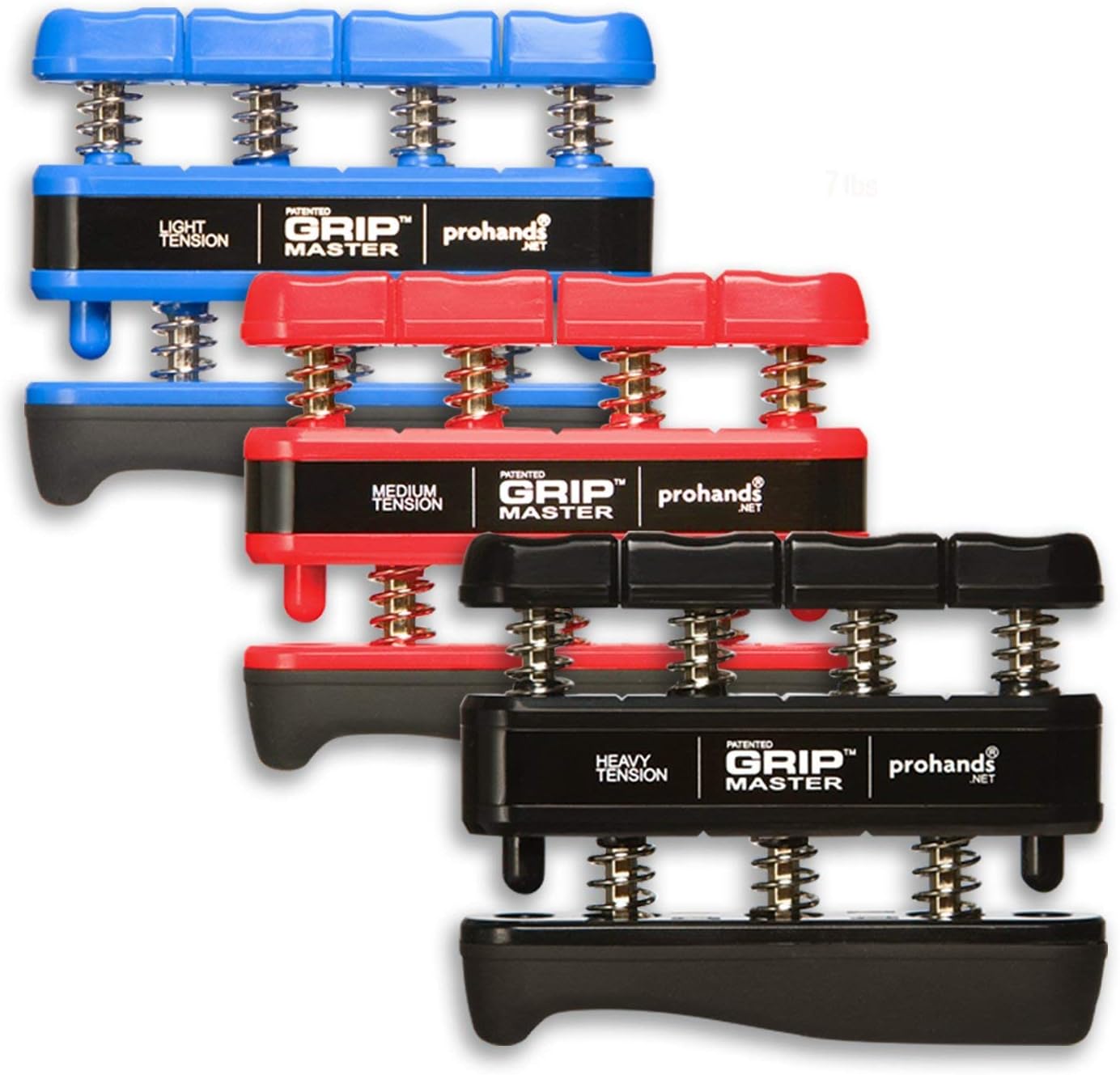
Standard grippers (spring, coil, or crusher) train all four fingers simultaneously in a power close pattern. But there are two additional tool categories that address grip weaknesses standard grippers miss entirely.
Individual Finger Trainers
These devices allow you to train each finger in isolation — either through individual spring-loaded buttons or through a ring-style device that loads a single finger at a time. They’re critically important for:
- Rock climbers — individual finger strength (especially ring and middle) is the primary limiter in climbing performance
- Musicians (guitarists, pianists) — individual finger independence and strength
- Rehabilitation — recovering from individual finger/pulley injuries
- Correcting imbalances — if one finger is noticeably weaker than others
Pinch Trainers
Pinch trainers develop thumb-and-finger pinch strength, which is a distinct grip pattern from power close gripping. Pinch strength is trained by squeezing two parallel surfaces (usually a spring-loaded paddle or a weighted plate held by thumb and fingers). This targets the flexor pollicis longus (thumb flexor) and thumb adductors — muscles that standard grippers barely touch.

Which Gripper Type Should You Buy? — Direct Decision Guide
Stop overthinking it. Here’s a direct decision tree based on who you are and what you want:
Buy: An adjustable coil gripper with a range of at least 10–150 lbs. Set it heavy enough that you reach near-failure in 8–12 reps. Increase resistance every 2–3 weeks as you adapt. Pair with wrist curls and reverse curls for full forearm development.
Buy: An adjustable coil gripper plus farmer’s carry practice. Train grippers at 60–120 lbs for sets of 5–10. Stop using straps — every pulling movement should be done with bare hands until grip becomes the limiting factor. Then train the grip.
Buy: A light spring gripper or an adjustable coil gripper set to its lowest resistance. Focus on form, slow eccentrics, and consistency before chasing resistance. 3 sessions per week at low resistance beats 1 heavy session per week for tendon adaptation.
Buy: An individual finger trainer plus a fingerboard/hangboard. Standard power-close grippers are secondary for climbing — finger-specific loading and open-hand positions (not full crimp/power close) are what transfer to the wall. See our full climber guide below.
Buy: Captains of Crush or equivalent calibrated aluminium crushers, starting from the level you can’t yet close. Work your way up across multiple units over months/years. Supplement with pinch trainers and thick bar work for complete development.
Best Gripper Type by Goal — Quick Reference
| Goal | Best Gripper Type | Resistance Range | Priority Features |
|---|---|---|---|
| Build forearm size | Adjustable coil | 60–150 lbs working | Wide range, progressive overload |
| Grip for deadlifts / rows | Adjustable coil | 50–130 lbs | Durability, endurance capacity |
| Rock climbing | Finger trainer + board | Bodyweight loads | Individual finger, open-hand grip |
| Rehab / recovery | Light spring or coil | 5–40 lbs | Smooth resistance, gentle |
| Maximum raw strength | Crusher / aluminium | 100–280 lbs+ | Certified resistance, durability |
| Thumb / pinch strength | Pinch trainer | 10–80 lbs | Thumb-specific loading |
| Musicians / artists | Individual finger trainer | 1–10 lbs per finger | Individual isolation, very light |
| Best value overall | Adjustable coil | 10–165 lbs | Range + durability + price |
Frequently Asked Questions
Direct answers to the most-searched gripper type questions:
Final Verdict: Crusher vs Spring vs Coil
The confusion between gripper types is understandable — they look similar in photos and share the same basic motion. But they are fundamentally different tools producing different training outcomes.
Spring grippers are fine as a stepping stone for absolute beginners but are quickly outgrown. Coil/adjustable grippers are the practical best choice for the vast majority of people — versatile, affordable, and genuinely effective with appropriate resistance. Crusher/aluminium grippers represent the peak of the category for serious athletes who have earned their use.
Buy an adjustable coil gripper with a wide resistance range, use it progressively and consistently, and revisit crusher grippers in 6–12 months if you’ve genuinely maxed out. That’s the decision the science and experience supports.
- Spring grippers: Beginner / rehab only. Don’t trust the resistance label.
- Coil / adjustable grippers: Best choice for most people. Buy adjustable for progressive overload.
- Crusher / aluminium grippers: Best for advanced athletes. Not a beginner purchase.
- Finger trainers: Essential for climbers, musicians, and finger rehabilitation.
- Pinch trainers: Completes the grip picture — don’t neglect thumb strength.
SEE OUR TOP PICKS
We’ve tested 20+ grippers across all types and budgets. Here are the ones that actually deliver.
View Best Grip Trainers →Affiliate Disclosure: FitCore360 participates in the Amazon Associates Programme. When you click our Amazon links and make a purchase, we may earn a small commission at no extra cost to you. This never influences our editorial recommendations — we only feature products we’d genuinely recommend.