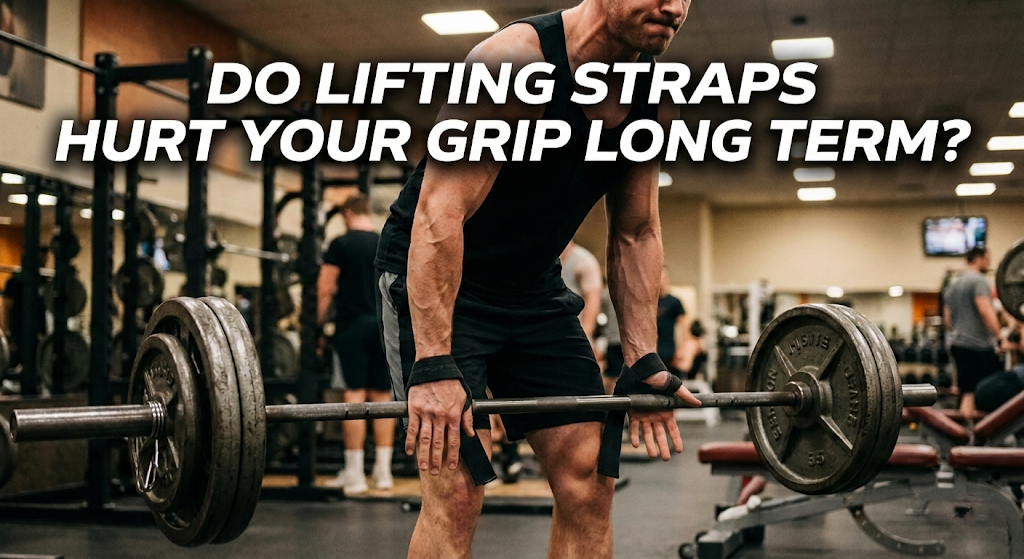
Do Lifting Straps Hurt Your Grip Long-Term?
The fear that straps weaken your grip is common — and partially justified. But the full picture is more nuanced than the blanket “straps make you weak” claim that circulates in training culture. Here’s what the physiology actually says, the specific scenarios where grip loss is real, and the protocol that lets you use straps without paying a long-term grip penalty.
📋 In This Article
Two lifters train for the same year. One uses straps on every set above 60% 1RM. The other never touches straps and pulls bare-handed throughout. At the end of the year, who has the stronger grip?
The answer is: it depends entirely on what else they’re doing. The strap-user who also programmes dedicated grip work twice a week will almost certainly have a stronger grip than the no-strap lifter who does nothing but deadlifts and assumes the pulling alone is enough. The variable that determines the outcome isn’t whether straps are used — it’s whether grip receives a sufficient training stimulus regardless of strap usage.
The Short Answer
How Grip Strength Actually Works
Grip strength is a product of forearm flexor musculature, connective tissue adaptation in tendons and ligaments, and neural drive to the finger flexors. Like every other motor quality, it improves with progressive overload and regresses when stimulus is removed or reduced below a maintenance threshold.
The critical principle is SAID: Specific Adaptation to Imposed Demand. The body adapts specifically to the stresses placed upon it. Grip adapts to grip demand — not to total training volume, not to deadlift weight, not to how hard you’re working in general. The load on the bar only matters for grip if it’s transmitted through the grip.
- Crush grip — finger flexion force against a round object (bar, gripper). Dominant in deadlifts, rows, and carries. Directly trained by bare-hand pulling and gripper work.
- Support grip — sustained hold endurance without active squeezing. Developed by farmer’s carries, long deadlift sets, and any sustained hanging or holding under load.
- Pinch grip — thumb-opposing-fingers force. Trained by plate pinches, thick implements, and towel pull-ups. Less directly relevant to barbell work but contributes to overall hand strength.
- Wrist stabilisation — force capacity at the wrist under load. Developed by wrist curls, lever work, and heavy pulling movements. Often the limiting factor on very heavy pulls even with straps, since the wrist still bears load.
Straps affect crush grip and support grip directly — by transferring bar load away from the finger flexors, they reduce the stimulus those mechanisms receive. A lifter who uses straps but also does farmer’s carries and gripper work is maintaining crush and support grip stimulus through other means, making strap use on heavy sets largely irrelevant to long-term grip development.
What the Research Actually Shows
Direct studies on lifting straps and long-term grip are limited. What the broader exercise science literature establishes clearly is the detraining timeline and the dose required to maintain strength adaptations.
- Grip strength begins declining within 2–4 weeks of removing grip stimulus entirely — consistent with other muscular strength detraining curves
- Meaningful losses (10–15%) appear at 4–8 weeks of complete grip stimulus removal
- Full regression to pre-training baseline takes 3–6 months — longer in experienced lifters due to structural tendon adaptations
- Maintenance requires less volume than development — as few as 1–2 grip-specific sessions per week maintains built strength
- Dedicated grip training produces faster progress than incidental grip loading from general barbell work alone
- Gripper training transfers to crush grip on the bar — trained lifters show measurably higher deadlift grip security
- Farmer’s carries have the highest transfer to support grip capacity of any single exercise
- Frequency matters more than volume — 2 shorter sessions outperform 1 long session at equivalent weekly volume
The practical implication: straps accelerate grip detraining only when they replace all grip stimulus. When grip training is maintained — even at a reduced maintenance dose — strap use on heavy working sets has no meaningful negative effect on long-term grip capacity.
When Straps Do Hurt Your Grip — The Four Problem Patterns
Grip loss from strap use is real. It occurs consistently under these specific conditions:
- Strapping in on every set including warm-ups. Even light-to-moderate loads handled exclusively with straps contribute zero grip stimulus. Over months, this removes the accumulated grip training effect that routine barbell handling normally provides. The bar is in your hands for 30–60 sets per week — if every one is strapped, that’s a significant daily maintenance stimulus being eliminated.
- Strapping in below the grip-limiting threshold. If your grip can comfortably hold the load, strapping in provides no posterior chain benefit while removing grip stimulus. Straps should supplement grip only where grip is actually the limiting factor — using them at 50% of your deadlift max removes stimulus without any compensatory benefit.
- No dedicated grip training in the programme. Lifters who rely entirely on incidental grip loading and then add straps are removing their only grip stimulus. Without direct grip training to compensate, grip will regress proportionally to the volume of strapped work added.
- Peaking for competition without a strap removal phase. A competitive lifter who trains strapped all year and then attempts competition-standard lifts bare-handed discovers their working maxes no longer transfer. Straps are banned in all powerlifting competitions — a training protocol that doesn’t account for this creates a predictable performance gap on meet day.
When Straps Don’t Hurt Your Grip
- First sets always bare-handed. Warm-up sets and the first working set bare-hand, every session. Straps only added for heavy sets where grip is genuinely the limiting factor.
- Dedicated grip training 2× per week. Grippers, farmer’s carries, or plate pinches provide specific grip stimulus independently of what happens on the bar.
- Straps only above the grip-limiting threshold. If your working deadlift is 180 kg and your bare-hand max is 160 kg, straps on 170–180 kg sets are appropriate. Straps on 130 kg sets remove stimulus with zero benefit.
- Bare-hand work maintained throughout competition prep. Competition openers and second attempts trained bare-handed across the final 12 weeks minimum.
- Higher posterior chain loading → heavier carries possible. If straps allow heavier RDL and row loading, and that transfers to heavier farmer’s carries, the overall non-strapped grip stimulus can actually increase.
- Recovery allocation. Grip tissue recovers more slowly than muscle. Straps on high-volume accessory work reduce cumulative grip tissue load, enabling higher-quality grip-specific sessions because the tissue is fresher.
- Training past injury. Minor grip injuries (finger pulley strains, wrist impingements) can be managed with strategic strap use while preserving posterior chain training quality during rehab.
The Smart Strap Protocol
This protocol is designed for strength-focused lifters who want to use straps for their intended purpose — enabling heavier training loads — without creating a long-term grip deficit. Use it as a phase-by-phase reference across the full training year.
| Phase | Strap Policy | Grip Work | Competition Distance |
|---|---|---|---|
| AccumulationHypertrophy / Volume | Straps on sets 3+ when grip limits reps. First 2 sets always bare-hand. | 2× /week — grippers + farmer’s carries | Off-season — 16+ weeks out |
| IntensificationStrength / Heavy Loading | Straps on max-effort sets only. All sub-max sets bare-hand. | 2× /week — grippers + plate pinches. Reduce carry load. | 8–16 weeks out |
| Competition PrepPeaking / Meet Prep | Straps only for rack pulls and accessories above competition weight. All deadlift attempts bare-hand. | 1× /week maintenance — grippers only. No carries (fatigue management). | 4–8 weeks out |
| Peak WeekCompetition Taper | No straps on any competition-simulated lift. Straps only on warm-up area non-competition sets. | None — grip stimulus from training is sufficient; adding more loads fatigue without benefit. | 0–4 weeks out |
| Off-Season / GPPGeneral Prep / Base | Free use on accessory work. First deadlift set each session always bare-hand regardless of load. | 2–3× /week — mixed methods. Priority on farmer’s carries. | Not competing |
Grip Training to Counteract Strap Use
Two sessions per week, 15–20 minutes each, covers the full spectrum of grip mechanisms that straps reduce stimulus for.
| Exercise | Grip Mechanism | Sets × Reps | Frequency | Progression |
|---|---|---|---|---|
| Gripper work | Crush grip | 3×5–8 per hand | 2× /week | Reps → heavier gripper |
| Farmer’s carries | Support grip / endurance | 2–3 × 40 m | 2× /week | +2.5–5 kg per hand |
| Plate pinches | Pinch grip / thumb | 2–3 × 25 sec | 2× /week | Time → 45 sec → add plate |
| Dead hangs | Passive grip / connective tissue | 2–3 × max hold | 3–4× /week | Time → +2.5 kg belt |
| Bare-hand DL sets | Crush + support (compound) | 1st set every session | Every session | Load follows DL progression |
Frequently Asked Questions
The Tool Isn’t the Problem — The Programme Is
Straps are a load management tool. They allow you to train the movements you want at the intensities your posterior chain is capable of, without grip being the ceiling on every session. Used intelligently — first sets bare, grip trained directly, competition prep bare-hand — they don’t create a grip penalty.
The practical rule is simple: know your bare-hand max. Test it every 4–6 weeks. If it’s tracking within 10% of your strap-assisted training weight, your programme is working. If the gap is widening, add grip training before reducing strap use — not instead of it.
READY TO ADD STRAPS?
Find out exactly when to start using straps — and which type to use for each movement.
When to Start Using Straps →