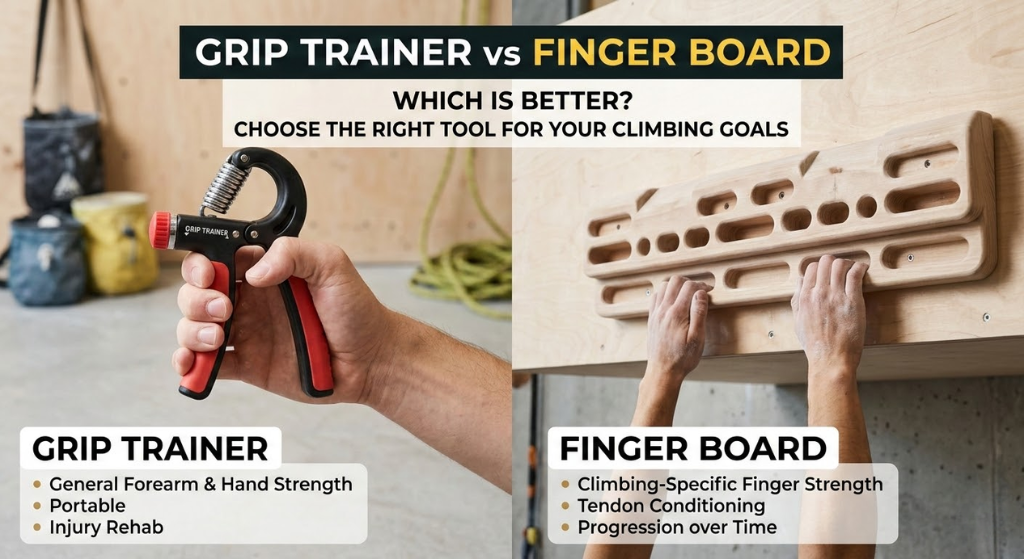
Search “grip strength training” and you’ll find passionate advocates for both hand grippers and fingerboards. The debate gets heated — especially in climbing communities — because people conflate the two tools as interchangeable when they’re not. They train different muscles, different movement patterns, and produce different outcomes.
The short version: hand grippers train power close strength and general forearm development; fingerboards train climbing-specific finger positions that grippers simply cannot replicate. Choosing between them depends entirely on what you’re actually trying to achieve.
2Fundamentally different training tools
8Criteria compared head-to-head
1Clear winner per goal
Quick Answer
⚡ Short Answer
For rock climbing: fingerboard wins decisively. It trains the exact finger positions climbing demands — open hand, half crimp, full crimp — at the specific angles and contact points that matter on a wall. Hand grippers cannot replicate this. For general fitness, lifting, and forearm development: grippers win. They’re more practical, more progressive, and directly train the power-close strength that transfers to deadlifts, pull-ups, and everyday grip. For serious climbers who also lift: use both.
What Each Tool Actually Trains
This is the core of the debate — and where most comparisons go wrong by skipping the physiology.
✊
Hand Gripper
Power Close & Forearm Flexors
Grippers train the crush grip — all four fingers moving simultaneously toward the palm in a power-close pattern. This primarily develops the flexor digitorum superficialis and profundus (forearm flexors), the palmaris longus, and the intrinsic hand muscles.
Crush grip pattern
Forearm flexors
Progressive resistance
Power close strength
General forearm size
🏔️
Fingerboard / Hangboard
Climbing-Specific Finger Positions
Fingerboards train isometric hanging strength across multiple grip positions — open hand, half crimp, full crimp, and pocket holds. This targets the flexor tendons, A2 pulleys, and the specific motor patterns used on real rock and indoor climbing walls.
Open hand / half crimp
Full crimp / pockets
Sport-specific transfer
Tendon adaptation
Isometric strength
The key insight: grippers are dynamic, concentric tools — you’re moving through a range of motion against resistance. Fingerboards are isometric tools — you’re holding a static position under load. These aren’t just different methods for the same adaptation; they produce genuinely different physiological outcomes.
Hand Grippers — Deep Dive
What They’re Good At
Hand grippers excel at training the crush grip — the functional pattern used when gripping a barbell, pulling a deadlift, carrying heavy objects, or shaking someone’s hand. This has enormous real-world and athletic relevance outside of climbing. Strong crush grip is a limiting factor in deadlifts, rows, pull-ups, and any loaded carry.
Quality adjustable grippers also offer genuine progressive overload: you can increment resistance in small steps over months and years, following the same hypertrophy and strength principles as any other resistance exercise. This makes them excellent for building forearm size, which a fingerboard cannot match.
What They Can’t Do
Grippers cannot train open-hand or half-crimp positions. The movement is always a power close — fingers moving in toward the palm. They also cannot train individual finger strength in isolation (without a specialised product like the Prohands Gripmaster). And because the resistance is always dynamic, they don’t build the isometric tendon strength and pulley adaptation that climbing demands.
💡
Gripper Sweet Spot: For lifters, athletes, and general fitness, grippers are the primary tool. For climbers, they’re a supplement to fingerboard training — not a replacement for it. The two address different limiting factors.
Best Hand Grippers to Buy
Best Overall
✊ Top Gripper Pick
NIYIKOW Adjustable Hand Grip Strengthener (22–440 lbs)
★★★★★
4.6 · 5,200+ reviews
Widest resistance range of any adjustable gripper tested. Full metal build, accurate resistance markings, secure locking collar. Works for beginners through advanced athletes on one device.
Climbers
🖐 Individual Finger Gripper
Prohands Gripmaster Hand Exerciser (Light / Medium / Heavy)
★★★★☆
4.4 · 14,000+ reviews
The closest a gripper gets to climbing specificity — each finger trains independently. Best gripper supplement for climbers who want individual finger isolation between wall sessions.
Fingerboards — Deep Dive
What They’re Good At
Fingerboards (also called hangboards) are purpose-built for climbing-specific finger strength. The key advantage is grip position specificity: the sloper, half-crimp, full-crimp, and pocket hold configurations on a fingerboard directly match the positions your fingers adopt on a real climb. The isometric loading builds both muscular strength and — critically — tendon and pulley adaptation that no other tool provides.
This is the decisive argument for climbers: A2 pulley strength, flexor tendon stiffness, and the specific neuromuscular patterns of open-hand hanging can only be developed by actually hanging in those positions under load. No gripper trains this. A fingerboard program of 2–3 sessions per week is the most evidence-backed method for improving climbing performance outside of climbing itself.
What They Can’t Do
Fingerboards are isometric — you hang and hold. They do not train the dynamic power-close strength that grippers develop. They also have a significant learning curve, a higher injury risk for beginners (particularly pulley strains), require installation or a door frame, and cannot be used portably. They’re also poor tools for building forearm size, since they don’t create the dynamic tension that drives hypertrophy in the forearm flexors.
⚠️
Fingerboard Injury Warning: Fingerboard training causes significantly more climbing injuries than any other training tool. Beginners should not use a fingerboard until they have 12–18 months of regular climbing experience. The pulleys and tendons need time to adapt to climbing loads before being stressed further by hangboard protocols.
Best Fingerboards to Buy
🏔️ Best for Beginners
Metolius Simulator 3D Hangboard
★★★★★
4.7 · 3,200+ reviews
Jugs, slopers, and open-hand edges — ideal range for beginners. Three-dimensional sculpted holds reduce tendon stress. Wide jug rail for two-handed hangs.
🏔️ Best for Intermediate+
Beastmaker 1000 Series Fingerboard
★★★★★
4.8 · 1,800+ reviews
The professional standard. 18mm and 12mm edges, pockets, slopers. Widely used by competition climbers. Comes with a free structured training app.
Head-to-Head: 8-Criteria Comparison
A direct comparison across every dimension that matters for training decisions:
← Scroll for full table →
| Criteria |
✊ Hand Gripper |
🏔️ Fingerboard |
Winner |
| Climbing transfer |
Low — power close pattern doesn’t match climbing positions |
High — exact grip positions used on rock |
Fingerboard |
| Forearm size / hypertrophy |
High — dynamic resistance drives flexor hypertrophy |
Low — isometric loading limits size gains |
Gripper |
| Lifting performance (deadlift, pull-ups) |
High — crush grip directly matches barbell and pull-up grip |
Low — no transferable pattern to barbell movements |
Gripper |
| Tendon / pulley adaptation |
Low — dynamic loading, no specific pulley stress |
High — isometric loading drives tendon stiffness and pulley strength |
Fingerboard |
| Progressive overload |
Easy — adjust resistance incrementally on adjustable grippers |
Harder — requires added weight vest or band-assist to increment precisely |
Gripper |
| Injury risk |
Low — low pulley / tendon stress, manageable overuse risk |
High — leading cause of climbing-related finger injuries |
Gripper |
| Portability & convenience |
Excellent — pocket-sized, use anywhere, anytime |
Poor — requires installation, fixed location, minimum door frame |
Gripper |
| Cost |
Low — quality adjustable grippers from $15–$25 |
High — entry-level fingerboards from $50–$120+ |
Gripper |
✓ Summary Verdict
Grippers win 6 of 8 criteria — but that doesn’t make them the better tool for climbers. The two categories where fingerboards dominate (climbing transfer and tendon adaptation) are precisely the categories that matter most for climbing performance. The criteria where grippers win (portability, cost, injury risk, hypertrophy) matter more for non-climbers.
Which Tool for Your Specific Goal?
Stop thinking about which tool is “better” in the abstract — think about which tool is better for you:
🏋️
Lifters & Strength Athletes
Your limiting factor is crush grip strength — holding a barbell, rack pulling, heavy rows, and loaded carries. Fingerboards train nothing relevant to these patterns. A quality adjustable gripper at 60–150 lbs working weight, used 3x/week, is the most direct intervention.
✊ Use: Hand Gripper
🧗
Rock Climbers (Intermediate+)
Your limiting factor is climbing-specific finger positions — open hand on slopers, half crimp on edges, full crimp on small holds. Only a fingerboard trains these patterns at the angles that matter. 2x/week hangboard sessions following a structured protocol (minimum 7-second hangs with 3-minute rest) is the most evidence-supported climbing strength intervention available.
🏔️ Use: Fingerboard
🧗
Rock Climbers (Beginner, <12 Months)
Your tendons and pulleys are not ready for fingerboard loading. The most effective training is simply climbing more frequently. If you want to supplement between sessions, a Prohands Gripmaster at low resistance for finger isolation is the safest option — no fingerboard until you have the base.
✊ Use: Light Finger Gripper
💪
General Fitness / Forearm Development
You want visible forearm development and functional hand strength. Grippers win clearly — the dynamic resistance produces the muscle hypertrophy that isometric fingerboard loading cannot. Use an adjustable gripper at 8–12 rep failure range, 3–4 sets, 3x/week.
✊ Use: Hand Gripper
🎸
Musicians (Guitar, Piano, Bass)
You need individual finger independence and endurance — not maximum strength. Neither a standard power-close gripper nor a fingerboard is ideal here. A Prohands Gripmaster trains each finger independently and is widely used by professional musicians and their physiotherapists.
🖐 Use: Prohands Gripmaster
🔄
Climbers Who Also Lift Seriously
You need both: climbing-specific finger positions from the fingerboard, and crush-grip strength and forearm size from the gripper. Program them in different sessions — fingerboard on climbing days or off-days at low volume; grippers after lifting sessions. They don’t interfere with each other significantly.
✅ Use: Both
Injury Risk: The Factor Most Guides Ignore
Hand Grippers — Injury Profile
Grippers carry a relatively low injury risk when used correctly. The most common issues are:
- Flexor tendon overuse: Training too frequently without adequate recovery. Finger flexor tendons have poor blood supply and recover slowly. Limit heavy gripper sessions to 3x/week maximum with 48+ hours between.
- Lateral epicondylitis (tennis elbow): Imbalanced training — all grip flexion, no extension work. Always pair grippers with wrist extension exercises or extension bands to balance the forearm.
- Crush injuries / nerve compression: Extremely rare and only relevant with very heavy resistance (200+ lbs). Never max out single-rep attempts without a warmup.
Fingerboards — Injury Profile
Fingerboards are the most injury-prone training tool in climbing. The risks are serious and specific:
- A2 pulley rupture: The most feared climbing injury. The A2 pulley (base of ring and middle finger) is under extreme load during full-crimp hanging. A partial or complete tear means 3–6+ months off climbing.
- Flexor pulley strains (Grade I–III): The precursor to rupture. A pop, pain, and a bowstringing sensation during a hang are warning signs that require immediate rest.
- Flexor tendon strains: Less catastrophic than pulley injuries but still cause significant downtime. Poor warm-up, training fatigued, or progressing too fast are the main causes.
- Growth plate damage in youth climbers: Fingerboard training is not appropriate for climbers under 16–18 due to open growth plates at the finger joints.
⚠️
Fingerboard Protocol Safety: Always warm up with 10–15 minutes of easy climbing or movement before hanging. Never train on a fingerboard when fatigued, sore, or during a climbing session. Use the open-hand position preferentially over full crimp — it distributes load across the tendon system more safely.
Our Recommended Picks
Based on our testing and the use-case analysis above — the specific products we’d buy for each scenario:
Best Hand Grippers
✊ Best Overall Gripper
NIYIKOW Adjustable Gripper (22–440 lbs)
★★★★★4.6 · 5,200+ reviews
Widest range, most accurate, metal build. The one device that takes a beginner to an advanced athlete.
🖐 Best for Climbers & Musicians
Prohands Gripmaster (Light / Med / Heavy)
★★★★☆4.4 · 14,000+ reviews
Individual finger isolation. Best gripper supplement for climbers — trains each digit independently.
Best Fingerboards
Beginner
🏔️ Best Beginner Fingerboard
Metolius Simulator 3D Hangboard
★★★★★
4.7 · 3,200+ reviews
Sculpted 3D holds reduce tendon stress compared to flat-edged boards. Wide jug rail, two sizes of edges, slopers, and two pocket depths. The most recommended beginner hangboard by physios and climbing coaches. Wall-mount or door-frame compatible.
Pro Standard
🏔️ Best Intermediate–Advanced Fingerboard
Beastmaker 1000 Series Fingerboard
★★★★★
4.8 · 1,800+ reviews
The industry professional standard. Handcrafted wood (more skin-friendly than plastic), 18mm and 12mm edges, two-finger pockets, mono pocket, slopers. Comes with free Beastmaker app with structured training protocols used by competition climbers. Not for beginners.
Frequently Asked Questions
Is a fingerboard better than a hand gripper for climbing?
▾
Yes — for climbing specifically, a fingerboard is significantly better. It trains the exact grip positions (open hand, half crimp, full crimp, pocket) that you use on a real climb, and builds the tendon and pulley adaptation that climbing performance depends on. Hand grippers train power-close strength, which has limited transfer to climbing movement patterns.
Can I use a hand gripper instead of a fingerboard if I don’t want to install one?
▾
You can, but you should understand the trade-off clearly. A gripper will develop crush-grip strength and forearm size — both useful for climbing — but it will not develop the open-hand or crimped finger strength that is the actual limiting factor for most climbers above beginner level. If installation isn’t an option, a Prohands Gripmaster is the closest gripper alternative — it isolates individual fingers — but it still cannot replicate the isometric tendon loading of a hangboard.
Can a beginner climber use a fingerboard?
▾
No — this is one of the most important rules in climbing training. Beginner climbers (under 12–18 months of regular climbing) should not use a fingerboard. The A2 pulleys and flexor tendons need time to adapt to climbing loads before being further stressed with additional training load. Fingerboarding before the connective tissue is ready is one of the primary causes of pulley injuries in recreational climbers. Climb frequently — fingerboard later.
Do hand grippers improve deadlift grip?
▾
Yes — significantly better than a fingerboard for this purpose. The crush grip pattern in a gripper (fingers closing toward the palm) directly mirrors the grip used when holding a barbell. Research consistently shows that crush-grip strength development transfers to barbell pulling movements. A quality adjustable gripper at 60–130 lbs working weight, trained 3x/week, will measurably improve deadlift grip within 6–8 weeks.
Can I use both a gripper and a fingerboard?
▾
Yes — and for climbers who also lift seriously, using both is the optimal approach. Program them in separate sessions: fingerboard on climbing or rest days (low volume, high quality), grippers after lifting sessions or as an evening accessory. The two tools do not significantly interfere with each other because they train different muscle actions and loading patterns. Monitor cumulative finger flexor fatigue and reduce volume if any finger soreness persists between sessions.
Which fingerboard is best for home use?
▾
For beginners and intermediate climbers, the Metolius Simulator 3D is the most recommended home fingerboard — the three-dimensional holds are more forgiving on tendons than flat-edged plastic boards, and it mounts to a standard door frame without drilling. For intermediate to advanced climbers, the Beastmaker 1000 is the professional standard — wood construction is better for skin, and the free app provides structured protocols that remove the guesswork from programming.
How often should I use each tool?
▾
For grippers: 3 sessions per week maximum, 48+ hours between sessions. Heavy resistance work (near-failure in 8–12 reps) drives strength and size; lighter resistance for higher reps builds endurance. For fingerboards: 2 sessions per week is the standard for intermediate climbers. Max-recruitment hanging (7–10 second hangs, 3-minute rest) is the most evidence-backed protocol. Never fingerboard fatigued, after a hard climbing session, or more than 3x/week even at advanced level.
📌 Final Decision Guide
- I lift weights / want forearm size: Hand gripper — get the NIYIKOW Adjustable (~$20)
- I climb (intermediate+): Fingerboard — Metolius Simulator 3D (~$60) to start
- I’m a beginner climber (<12 months): Just climb more. Optionally add a Prohands Gripmaster for light finger work.
- I climb and lift seriously: Both — fingerboard for climbing specificity, gripper for crush strength
- I play guitar / piano: Prohands Gripmaster — individual finger isolation, used by professional musicians
Affiliate Disclosure: FitCore360 participates in the Amazon Associates Programme. When you click our Amazon links and make a purchase, we may earn a small commission at no extra cost to you. Rankings and editorial recommendations are never influenced by commercial arrangements.
NOT SURE WHICH TO BUY?
Most people: start with the NIYIKOW adjustable gripper. Climbers: the Metolius Simulator 3D fingerboard.
See Our Full Reviews →