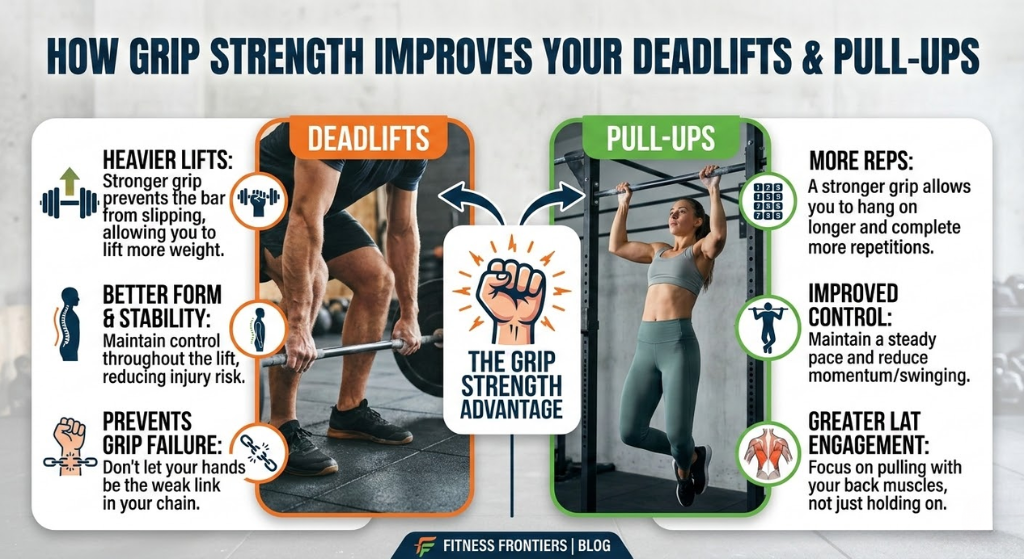
How Grip Strength Improves Deadlifts & Pull-Ups: The Science Explained
Your back, legs, and arms might be strong enough — but if your hands give out first, none of that matters. Here’s exactly how grip strength becomes the hidden ceiling on your deadlift, pull-up, and every major pulling movement, and how to fix it permanently.
📋 In This Guide
- Why Grip Is Your Hidden Weak Link
- How Grip Strength Directly Affects Your Deadlift
- How Grip Strength Affects Pull-Ups & Chin-Ups
- Other Lifts Grip Quietly Limits
- The 3 Types of Grip Used in Lifting
- Lifting Straps vs Grip Training — The Truth
- The Grip Training Protocol for Lifters
- Best Grip Exercises for Deadlifts & Pull-Ups
- How Long Until Your Grip Stops Being the Limit?
- FAQs
There’s a moment every lifter knows. You’re pulling hard on a heavy deadlift — your legs are driving, your back is braced, everything is working — and then your hands just… open. The bar rolls out of your fingers before your actual muscles have given out. The lift fails at the point of contact, not at the point of effort.
Grip failure is one of the most common and most undertrained limiters in strength sports. This guide breaks down exactly how grip strength affects your deadlift, pull-ups, rows, and every major pulling movement — and gives you a concrete plan to make your hands the strongest link in the chain.
Why Grip Is Your Hidden Weak Link
Most lifters train their posterior chain, lats, and biceps with meticulous attention. They track progressive overload, periodise their training, and obsess over programming. Then they completely ignore the only part of their body that is in contact with the bar during every single rep of every single pulling movement: their hands.
The grip is a bottleneck. When your grip fails before your target muscles, you never get to fully stimulate the muscles you’re trying to train. Your back never reaches true failure on heavy rows. Your lats never get fully taxed on pull-ups. Your entire posterior chain never reaches its potential on deadlifts. Every set ends with a grip problem disguised as a strength problem.
Research published in the Journal of Strength and Conditioning Research found a strong correlation between grip strength and overall upper body pulling performance. Athletes with stronger grips not only lifted more — they also accumulated more total volume per session because they could complete more sets before grip fatigue intervened.
How Grip Strength Directly Affects Your Deadlift
The deadlift is the king of strength movements — and it is also where grip failure is most brutally exposed. A conventional deadlift involves picking up anywhere from 100 to 600+ lbs from the floor using nothing but your hands, a bar, and your muscles. There is nowhere to hide a weak grip.
The Chain of Force in a Deadlift
When you deadlift, force travels from the floor through your feet, up through your legs and hips, through your spine, across your shoulders, down your arms, and into your hands — which are the last point of force transfer before the bar. If any link in this chain fails, the lift fails. And because your forearm flexors and finger flexors are relatively small compared to your glutes, hamstrings, and spinal erectors, they are statistically the most likely link to fail first.
How Grip Strength Affects Pull-Ups & Chin-Ups
Pull-ups are often thought of as a pure lat exercise. In reality, they are one of the most grip-dependent bodyweight movements in existence. Every rep, your full bodyweight is hanging from your fingers — and as grip fatigue sets in, the mechanics of the movement deteriorate.
What Grip Fatigue Does to Your Pull-Up
- Hands rotate open mid-rep, reducing lat engagement
- Death grip compensates — forearms pre-exhaust before lats do
- Sets end 2–4 reps early due to hand fatigue, not lat failure
- Inability to hang for negatives or dead hangs for mobility
- Bar slipping causes form breakdown at the top of the rep
- Secure grip allows full focus on lat activation and scapular movement
- Forearms don’t pre-exhaust — lats reach true failure
- More reps per set, more volume per session, faster lat development
- Able to perform weighted pull-ups, L-sit pull-ups, and advanced variations
- Dead hangs and scapular pulls become accessible for shoulder health
A 2019 study in the International Journal of Sports Physiology and Performance found that grip strength training in recreational athletes increased pull-up max reps by an average of 18% over 8 weeks, with no change in their lat or bicep training. The gains came entirely from removing the grip bottleneck.
- On pull-ups, your grip should feel automatic and secure — not the hardest part of the movement
- If your forearms pump out before your lats do, grip training is your fastest route to more reps
- A strong grip also enables better scapular control — the foundation of healthy shoulder mechanics in overhead pulling
- Thick bar training (fat grips) is particularly effective for transferring grip strength to pull-up performance
Other Lifts Grip Quietly Limits
Deadlifts and pull-ups get all the attention, but grip is a silent limiter across the entire pulling spectrum. Here’s where else a weak grip is secretly capping your gains:
| Exercise | How Grip Limits It | Grip Type | Impact |
|---|---|---|---|
| Barbell Row | Bar rolls forward mid-rep, reduces back activation and forces early termination | Crush grip | 🔴 Very High |
| Rack Pull / Romanian DL | Higher bar contact = more grip demand; grip often fails before hamstrings | Crush grip | 🔴 Very High |
| Farmer’s Carry | Grip is literally the entire event — no grip = no carry | Supporting | 🔴 Very High |
| Cable Rows | Handle slipping reduces mind-muscle connection and shortens effective range | Crush + pinch | 🟠 High |
| Dumbbell Rows | Heavy dumbbells require strong crush grip; fatigue limits back volume | Crush grip | 🟠 High |
| Shrugs / Trap Bar | Grip failure limits traps stimulus; most people can’t shrug their actual max | Supporting | 🟠 High |
| Bicep Curls (heavy) | Wrist stability under load requires strong grip — weak grip = cheated reps | Crush + wrist | 🟡 Medium |
| Olympic Lifts | Hook grip security is entirely grip-strength dependent at heavy loads | Hook grip | 🔴 Very High |
The 3 Types of Grip Used in Lifting
Not all grip strength is the same. Different lifts demand different grip mechanics, and training only one type leaves gaps. Understanding which grip each lift uses helps you target the right adaptations.
Lifting Straps vs Grip Training — The Truth
- Grip remains the ceiling — exposed on every lift without straps
- Forearm and hand muscles atrophy relative to the rest of the body
- Can’t perform heavy deadlifts without them — grip becomes a dependency
- No carryover to pull-ups, carries, or any bar-contact sport
- Risk of injury when straps fail unexpectedly under load
- Grip trained to exceed lift requirements — straps only for max-volume sets
- Forearms grow alongside the rest of the body
- Full double-overhand capacity on working sets without straps
- Grip strength carries over to every pulling movement in and out of the gym
- Better injury resilience and wrist stability under heavy load
The smart approach: train without straps on your first 2–3 sets of any pulling movement to accumulate grip stimulus, then use straps on your final heavy sets to maximise posterior chain volume without grip being the limiting factor. Over time, your bare-hand capacity will grow to match your strap-assisted capacity.
The Grip Training Protocol for Lifters
This protocol is designed specifically for people whose primary goal is improving deadlift and pull-up performance — not general grip development. It’s built around the specific grip demands of those movements and fits into a standard strength training week.
Best Grip Exercises for Deadlifts & Pull-Ups
Each exercise below targets a specific grip quality that carries directly into deadlift and pull-up performance:
How Long Until Your Grip Stops Being the Limit?
This is the question every lifter wants answered. The good news: grip strength responds quickly to training — faster than most primary muscle groups — because the adaptations are both neural (your brain learns to recruit the muscles harder) and structural (the muscles and tendons thicken).
| Timeframe | What Happens to Grip | Deadlift Impact | Pull-Up Impact |
|---|---|---|---|
| Week 1–2 | Neural adaptations begin — grip feels more secure even before structural change | Less bar drift on heavy sets | Reduced forearm pre-exhaustion |
| Week 3–4 | Forearm pump reduces; grip endurance visibly improves across a session | Can complete full sets at working weight without straps | 1–3 extra reps per set |
| Week 5–8 | Measurable strength gains; finger flexors and brachioradialis begin to hypertrophy | Grip no longer limits working weight selection | +15–20% reps; can add belt weight |
| Month 3–6 | Grip fully exceeds lift requirements; becomes a non-factor in programming | Grip is no longer the conversation — back, hips, and legs are | Train pull-ups to true lat failure every session |
Frequently Asked Questions
The most-asked questions about grip and lifting performance:
Recommended Products for Lifters
Tested by our team — these are the tools that directly fix the grip issues covered in this article. Contains affiliate links.

- Industry-standard aluminium handle, precision spring
- 10 resistance levels — progress from Trainer to #4
- Used by Olympic lifters & powerlifters worldwide
- Made in USA, virtually indestructible build quality

- 21.5″ neoprene-padded cotton straps, thick & durable
- DuraGrip leather palm pad protects against bar abrasion
- Use on final heavy sets to maximise posterior chain volume
- Pairs perfectly with bare-hand training for hybrid approach

- Converts any bar, dumbbell, or cable to thick bar instantly
- Forces full hand engagement — fastest crush grip builder
- Used by NFL, NHL, UFC athletes & special forces
- Military-grade compound; fits any standard bar

ℹ️ FitCore360 is a participant in the Amazon Services LLC Associates Program. We earn a small commission at no extra cost to you. This never influences our editorial recommendations.
Stop Letting Your Hands Limit Your Training
Every rep of every deadlift, every pull-up, every row — the force travels through your hands. Grip strength isn’t a nice-to-have accessory quality. It’s the interface between your effort and the bar. When it’s weak, everything on the other side of it is capped.
The good news: grip responds fast. Four weeks of focused training — dead hangs, farmer’s carries, bar holds, and a heavy gripper — is often enough to completely eliminate grip as a limiting factor. At that point, your training conversations shift where they should be: to the muscles that are actually doing the work.
Your hands are ready to stop being the problem. Train them like it.
- Grip is the force bottleneck on every pulling movement — deadlifts, pull-ups, rows, carries.
- Neural + structural changes start within 1–2 weeks of targeted grip training.
- Use straps strategically — not as a substitute for training grip strength directly.
- 3 sessions per week of targeted grip work eliminates grip as a limiter within 6–8 weeks.
- Best exercises: dead hangs, farmer’s carries, bar holds, fat grip rows, heavy grippers.
STOP GRIP FAILING YOUR LIFTS
We’ve tested 20+ grip trainers. Here are the ones that actually work for lifters.
See Our Top Picks →