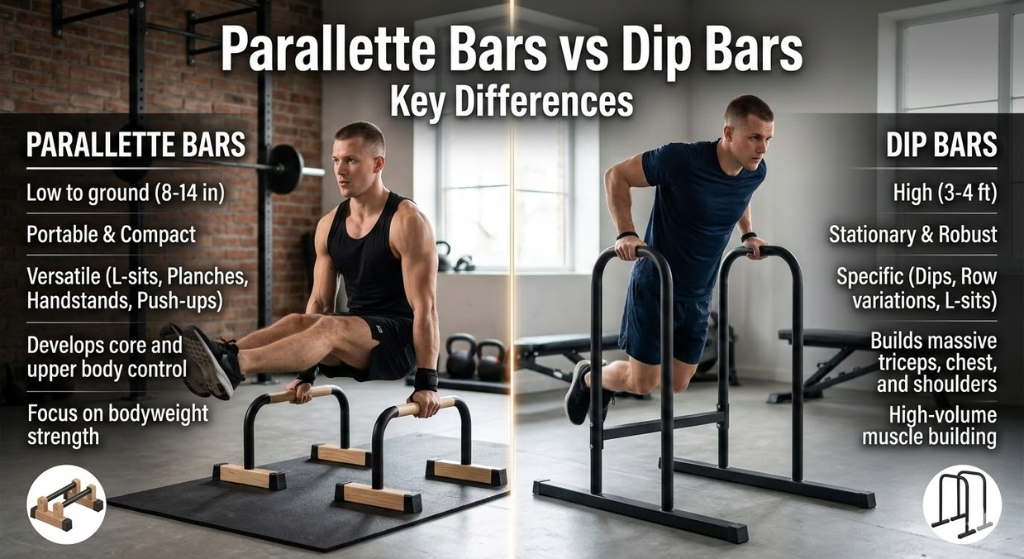
The confusion between these two pieces of equipment is understandable. Both involve pairs of handles. Both are used for push-based bodyweight work. Both show up in gym settings and home setups. But the training outcomes they produce are meaningfully different — and choosing the wrong one for your goals means either missing movements you need or buying equipment with more limitations than you realise.
The core issue is height. Height dictates which movements are accessible, how stability behaves under load, what skill families can be trained, and how the equipment interacts with your body position. Everything else — width, portability, load rating considerations — flows from that single variable.
6–45cmTypical parallette bar height range — floor-level work, skills and pressing
65–100cmTypical dip bar height range — body suspended above the floor throughout
4Movement families parallettes unlock that dip bars cannot replicate at floor level
Quick Answer — The Core Distinction
⚡ Direct Answer
Dip bars are elevated to suspension height (65–100cm) and are designed for one primary movement: the dip. Parallettes are floor-level handles (6–45cm) designed for the full range of calisthenics skill work — pressing with depth, L-sits, planche progressions, handstand push-ups, and compression training. High parallettes (30cm+) can perform dips. Dip bars cannot perform planche, L-sit, or handstand push-up work. If you train calisthenics skills, parallettes are the correct tool. If you train primarily for hypertrophy and dips are your main push movement, a dip station covers that goal more cleanly.
What Each One Actually Is
🤸 Parallette Bars
- Height: 6–45cm off the floor — the athlete always remains close to or touching the ground
- Purpose: Floor-level calisthenics skill training — pressing depth, compression holds, balance work, inversion training
- Design origin: Derived from gymnastics floor parallel bars — a scaled-down version for home and floor-based training
- Placement: Fully independent — placed at any width the athlete requires, which is a critical variable for different skills
- User profile: Calisthenics athletes, gymnasts, anyone targeting L-sit, planche, or HSPU progressions
- Load type: Static holds, compression, slow controlled pressing — not primarily ballistic or explosive
💪 Dip Bars
- Height: 65–100cm — the athlete is suspended with feet off the floor for the primary movement
- Purpose: Dips (tricep, chest, and shoulder emphasis variations) and elevated push-up accessories
- Design origin: Adapted from parallel bar dips in gymnastics and weightlifting — simplified for gym and home use
- Placement: Fixed width on most designs (some adjustable); connected frame means handles move together
- User profile: Hypertrophy-focused athletes, powerlifters adding upper body volume, general gym users
- Load type: Dynamic pushing — full range dips, weighted dips, body rows on some designs
The 6 Key Differences
These are the differences that actually affect training decisions — not superficial specs, but the variables that determine which movements are accessible, how each tool performs under load, and where each one reaches its limits.
01 — Height
6–45cm. The athlete stays at floor level. Low CoM means high stability under lean and planche loading. Height is the primary skill variable — low for planche/L-sit, mid for general use, high for dips and deficit HSPU.
65–100cm. The athlete’s feet must clear the floor for the primary movement. At this height, planche and L-sit work becomes structurally impractical — the CoM is too high and stability is insufficient for balance skills.
02 — Handle Width Control
Fully independent placement. The athlete sets exact handle width before each session. Planche athletes typically use shoulder-width or slightly narrower. L-sit athletes may go slightly wider. This adjustability is a genuine training variable.
Fixed or semi-fixed width. Most dip bar designs have a connected frame that sets handle width at approximately shoulder width. Some premium adjustable dip stations allow width changes, but they are the exception and considerably more expensive.
03 — Stability Under Planche Load
High stability for forward-lean work. Low CoM means the tipping moment created by planche lean is manageable. Quality low parallettes with rubber feet are genuinely stable under full planche loading — the CoM stays close to the base.
Poor stability for planche loading. At 65–100cm height, the same forward lean that creates planche position generates a large tipping moment at the base. Dip bars tip under planche loading unless they are exceptionally heavy — a safety issue, not just a comfort one.
04 — Wrist Position
Fully neutral wrist throughout all movements. The handle orientation means wrists sit at 0–20° extension regardless of movement. This is the structurally optimal position and is one of the primary reasons parallettes outperform the floor for wrist-sensitive athletes.
Neutral wrist on dips, but not relevant for floor skills. Dip bar handles also provide neutral wrist for dip movements — this is one genuine shared advantage. But at dip-bar height, the floor-level wrist benefits of parallettes (for push-ups, planche, HSPU) are irrelevant since the movements aren’t performed.
05 — Portability & Footprint
Compact and portable. Most low-to-mid parallettes fit in a backpack or gym bag. They store under a bed, in a cupboard, or in a gym bag. Floor space when in use is minimal — two shoe-box footprints.
Large and fixed. Full-height dip stations require significant floor space (typically 60×80cm or more) and are not practical to move between locations. Some fold for storage but are still substantially larger than parallettes.
06 — Price
£20–£150 / $25–$180. Entry-level steel parallettes are extremely affordable. Premium wooden or competition-grade sets cost more but are still under £150 for most athletes. No assembly required on most designs.
£30–£300+ / $40–$400+. Budget dip stations start similarly low but sturdy, purpose-built freestanding dip bars with weighted-dip capacity and stability for heavier athletes cost significantly more. Quality matters more here because frame flex under load is a real issue on budget designs.
Movement Overlap & Gaps
The most useful framing is which movements each tool can perform, which it can approximate, and which it simply cannot do. This is the complete picture.
← Scroll to see full table →
| Movement |
Parallettes |
Dip Bars |
Notes |
| Dip (full range) |
✓ With 30cm+ height only |
✓ Primary movement |
Low parallettes cannot do dips — legs contact floor before bottom position |
| Push-up (depth) |
✓ Full depth, neutral wrist |
✓ Elevated push-up variation possible |
Parallettes provide better wrist position and standardised depth |
| L-sit |
✓ Optimal — purpose-built |
✗ Structurally impractical |
At dip bar height, hip clearance is there but balance and stability are inadequate for skill work |
| Tuck Planche |
✓ Optimal |
✗ Unsafe — high tipping risk |
Planche lean force creates tipping moment dip bars cannot safely absorb |
| Full Planche |
✓ Optimal |
✗ Not feasible safely |
Even heavily weighted dip stations are not designed for planche loading |
| Deficit HSPU |
✓ Depth = handle height |
✗ Cannot — height is reversed |
Dip bars are too tall; athlete would need to be inverted above them |
| Pike Push-Up |
✓ Excellent base |
✗ / Limited |
Dip bar height makes pike push-up mechanics awkward and unstable |
| Weighted Dip |
✓ High parallettes only |
✓ Primary use case |
Dip bar frame is designed for the additional load vector; high parallettes work but require care |
| Body Row / Australian Pull-Up |
✗ Not feasible at floor level |
✓ Excellent — underrated feature |
Dip bar height allows horizontal body row as a pull-focused bodyweight exercise |
| V-sit |
✓ Direct progression from L-sit |
✗ Not feasible |
Requires same floor-level stable base as L-sit |
| Handstand (wall-assisted) |
✓ Neutral wrist, wrist fatigue reduction |
✗ Height makes wall assist impractical |
Dip bar height would require inverting over the bars — not a sensible progression |
💡
The body row is the most underrated dip bar advantage. A dip station at the right height allows horizontal body rows — essentially an inverted row — that provide pulling stimulus without a pull-up bar. For athletes who have dip bars but no pull-up bar, this adds meaningful back and bicep training volume. Parallettes cannot replicate this at floor level.
Skill Training Comparison
This is where the gap between the two pieces of equipment becomes most consequential. Calisthenics skill training — the structured progression toward L-sit, planche, handstand push-up, and compression holds — is almost entirely a parallette domain.
🤸 Parallettes Unlock
- L-sit to V-sit progression — tuck → single leg → full L → V-sit → manna
- Planche progression — lean → tuck → adv. tuck → straddle → full planche
- HSPU depth progression — pike push-up → deficit → wall HSPU → strict deficit HSPU
- Handstand practice with wrist-neutral positioning for longer accumulation
- Press to handstand — the terminal floor skill combining compression and inversion
- Wrist-neutral push-up volume for athletes with floor wrist sensitivity
💪 Dip Bars Unlock
- Full-range dip with consistent suspension — the cleanest dip stimulus available outside a full gym
- Weighted dips — belt-loaded or weighted vest for progressive overload on chest, tricep, and shoulder
- L-sit at height — not optimal for skill progression but achievable for static hold practice
- Body row / Australian pull-up — horizontal pulling on the same equipment, no extra purchase needed
- Tricep dip variations for targeted arm hypertrophy
- Knee raises and leg raises — hanging core work from the support position
⚠️
Attempting planche training on dip bars is a safety issue, not just an inefficiency. The forward lean required for planche tuck and planche holds applies a horizontal force vector to the bar frame that most dip stations are not designed to absorb. Even heavy, well-built dip stations can tip under full planche loading because the contact point (athlete’s hands) is far above the centre of the base. If you’re serious about planche training, this is a decisive factor — dip bars are structurally unsuitable.
Who Should Buy Which
→
Buy Parallettes If: You Train Calisthenics Skills or Want to Start
If any of these are on your training agenda — L-sit, planche, handstand push-ups, improving floor push-up quality, reducing wrist pain on pressing — parallettes are the correct purchase. High parallettes (30cm+) will also cover your dipping needs, making them the more versatile single purchase for most athletes.
→
Buy Parallettes If: You Train at Home and Want Maximum Movement Per Square Metre
The floor space and storage footprint of parallettes vs a full dip station is not a marginal difference — it’s substantial. If space is a constraint, parallettes unlock a wider training vocabulary in a smaller footprint. Two parallettes store in under 30cm × 30cm of space and deliver more training options than a full dip station that requires 60–80cm of dedicated floor space.
→
Buy Dip Bars If: Weighted Dips Are Your Primary Upper Body Push Movement
For hypertrophy-focused athletes who dip with added weight as a primary chest and tricep movement, a purpose-built dip station is the cleaner tool. The frame stability under belt-loaded or vest-loaded dips at 30–50kg+ additional weight is more reliable on a proper dip station than on high parallettes, which weren’t primarily designed for that loading vector.
→
Buy Dip Bars If: You Want Pulling and Pushing From the Same Station
If your home gym lacks a pull-up bar and budget is limited, some dip stations include a pull-up bar as part of the frame — giving both vertical pull and dip push from one unit. This is a dip station advantage that parallettes don’t address. For maximally budget-constrained athletes who need both movements, a combined dip/pull-up station may outperform parallettes + a separate pull-up solution on cost.
→
Buy Neither Yet If: You’re Under 3 Months into Training
In the first 8–12 weeks of training, floor push-ups, body rows on a kitchen table, and pike push-ups build the foundation that both pieces of equipment extend. Neither parallettes nor dip bars deliver a meaningful advantage over household substitutes until you have consistent push-up form, basic shoulder stability, and some core strength already developed. Build the base first; buy the equipment when it becomes a genuine limiting factor.
📐 The Verdict
For the majority of calisthenics-focused athletes, high parallettes (25–35cm) are the better single purchase. They cover dip work, all skill training, pressing depth, and handstand/HSPU progressions in a portable, compact package. Dip bars are the right call only if weighted dips are a specific priority, you need pulling + pushing from a single station, or your training is entirely hypertrophy-focused with no skill work on the horizon. When in doubt, parallettes are the more versatile starting point.
Can You — Should You — Own Both?
Yes, and the combination works well when each piece is used for what it does best rather than trying to make either do the other’s job. The overlap in movement (dips, push-ups, support holds) means you won’t use both for every session — but the non-overlapping territory justifies owning both once training has reached the level where each tool is genuinely needed.
✅ The Case for Owning Both
- Low parallettes for all skill work (planche, L-sit, V-sit, deficit HSPU, handstand practice) — this is where they are irreplaceable.
- Dip station for weighted dips and body rows — once dip strength has progressed to belt-loaded work, the dip station provides better frame stability for heavy loading than parallettes.
- Total cost is reasonable. A quality low parallette set (£30–£60) plus a solid budget dip station (£40–£80) is under £150 combined — less than many single equipment purchases and more versatile than either alone.
- They serve different training phases. A session might use parallettes for skill work in the first 20 minutes and transition to the dip station for weighted dip hypertrophy work afterward — no movement redundancy, complementary stimulus.
💡
Sequencing suggestion if buying both: Buy parallettes first. They cover more ground earlier in your training and the skill work they unlock is unique. Add a dip station later when dip strength and hypertrophy training have developed to the point where weighted dips are a primary movement — typically 6–12 months into consistent calisthenics training.
Frequently Asked Questions
Can I do dips on parallettes, or do I need dedicated dip bars for that?▾
Yes, with a height caveat. Parallettes at 30cm or higher allow full-range dips — your feet clear the floor at the bottom position and you get the full dip ROM. Low parallettes (under 20cm) cannot do dips because your legs contact the floor before you reach the bottom of the movement. If you want to do dips on parallettes and currently own or are considering low bars (10–15cm), they won’t work for dips. Mid-to-high parallettes (25–40cm) will. See
our height guide for the full breakdown of which movements each height unlocks.
Is it safe to do planche work on dip bars if I brace them against a wall?▾
Not recommended. Bracing against a wall addresses the tipping risk in one axis but doesn’t resolve the fundamental structural issue — the bars are designed for vertical loading, not the horizontal/diagonal loading vectors that planche lean generates. The contact points between the handles and the frame may also not be rated for this kind of loading. More practically: planche training requires the ability to shift and adjust your lean progressively across many sets, which is incompatible with a wall-braced setup. The correct tool is low parallettes with rubber feet — they’re designed for exactly this loading pattern and cost £30–£60 for a basic set.
Do dip bars or parallettes build more muscle?▾
Neither inherently builds more muscle — the load and progressive overload applied to each determines hypertrophy, not the implement. Dip bars have a practical edge for hypertrophy-focused athletes because they allow weighted dips (belt-loaded or vest) more cleanly than parallettes, and higher loads with progressive overload are the primary driver of hypertrophy. Parallettes build the same pushing muscles through push-up, pseudo planche push-up, and dip variations, but progressive overload is harder to apply systematically (you add reps and difficulty rather than weight). For pure hypertrophy without skill work, dip bars are marginally the better tool. For overall upper body development that includes skill-specific strength and positions, parallettes produce a broader stimulus.
I have wrist pain from floor push-ups. Will dip bars or parallettes help?▾
Parallettes. The wrist-neutral handle position that parallettes provide directly addresses the wrist extension stress that causes pain on floor push-ups. Dip bars provide the same neutral wrist positioning for dip movements, but they don’t solve the floor push-up wrist problem because the dip movement doesn’t involve the same wrist position as a push-up. If floor push-up wrist pain is your issue, parallettes are the fix — you continue training push-ups (now with neutral wrists on the handles) and the wrist extension load that was causing pain is removed. Most athletes with this issue notice the improvement within the first session on parallettes.
Which is better for beginners — parallettes or dip bars?▾
Parallettes, for most beginners with a calisthenics or general fitness goal. The accessible entry point (push-up variations, support holds, wrist-neutral pressing) plus the long-term skill progression ladder (L-sit, planche, HSPU) makes parallettes more suitable for beginner-to-advanced continuity. A beginner buying dip bars has a tool that works well for one movement (dips) and has limited growth beyond that in a home setting. A beginner buying parallettes has a tool that works well immediately and grows with them for years. The exception: beginners who specifically want dips as their primary push movement and have no interest in calisthenics skill work — in that case, a budget dip station is the more direct tool.
Can parallettes replace rings for calisthenics training?▾
Partially, but not fully. Parallettes and rings serve different roles in calisthenics. Parallettes are stable — they excel at progressive overload of static skills (planche, L-sit) where consistent position demands accumulation without stability interference. Rings are unstable — they require constant rotational stabilisation, developing shoulder stability and scapular control in ways parallettes don’t replicate. Ring dips, ring push-ups, muscle-ups, and ring L-sits create different muscular demand profiles than the parallette equivalents. Most serious calisthenics athletes eventually train both. If buying only one, parallettes give faster visible skill results early (because progressive overload is cleaner); rings give broader shoulder development long-term. For a full comparison of training tools in this space, see
The Calisthenics Bible.
The Equipment Doesn’t Overlap — Your Goals Do
The confusion between parallettes and dip bars comes from the fact that both involve handles and both are used for pushing. But the training purposes diverge sharply once you look beyond that surface similarity — one is a floor-level skill training tool, the other is a suspension-height pushing station. They happen to share a small overlap (dips, support holds) but are otherwise doing different jobs.
The practical decision is straightforward: if calisthenics skill development is any part of your training goal, parallettes are the right purchase and high parallettes will cover your dip needs as well. If weighted dips are specifically your priority and skill work isn’t on the agenda, a dip station does that job more cleanly. And if budget and space allow both, they complement each other without redundancy — each excels in territory the other can’t reach.