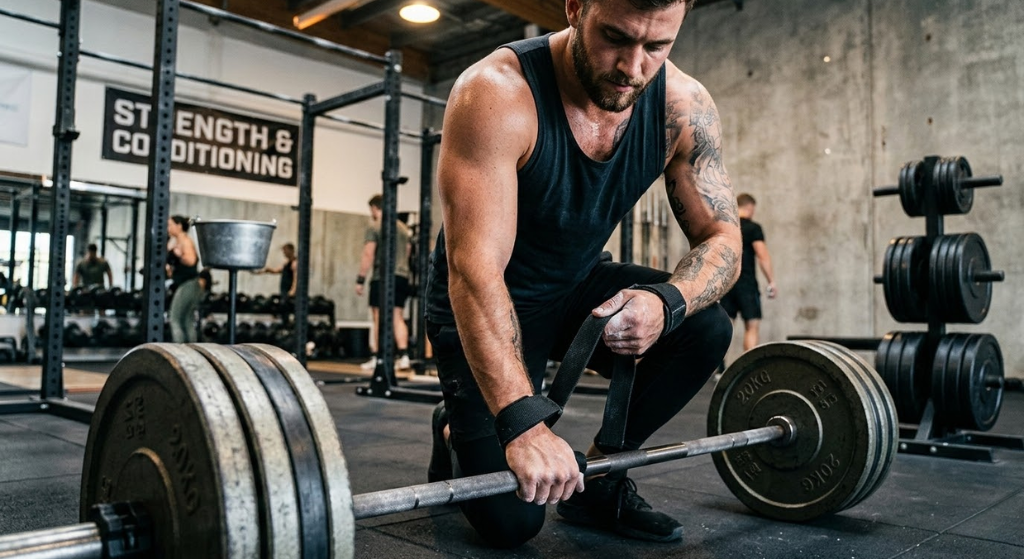
Lifting straps show up in almost every serious gym — on the deadlift platform, the dumbbell rack, the cable machine. The lifters using them look like they know what they’re doing. And so a newer lifter pulls their grip from the bar at 120 kg, watches a more experienced lifter pull 200 kg with straps, and reasonably concludes: straps are the solution to grip limitations.
Sometimes that conclusion is right. Often it’s premature. The difference between using straps at the right time and using them too early is the difference between a useful training tool and a crutch that delays grip development by months or years — development you’ll eventually have to come back and rebuild.
1.2×Bodyweight deadlift — the general threshold where grip commonly starts to genuinely limit pulling progress
6–12Months of training before most lifters reach the load where straps become a legitimate tool, not a shortcut
3Tests to determine readiness: the load test, the chalk test, and the bare-hand max test
Quick Answer — The Core Rule
⚡ Direct Answer
Start using straps when grip is genuinely the limiting factor on your posterior chain development — not just when it’s uncomfortable. The practical benchmark: when your deadlift is above 1.2–1.5× bodyweight and you can consistently demonstrate that your bare-hand grip fails before your back and legs do on working sets, straps are a legitimate tool. Below that threshold, grip discomfort is typically a grip strength and technique issue — both of which resolve through training, not through bypassing them with straps. The right sequence is: fix technique, add chalk, build grip strength. Introduce straps last.
What Straps Actually Do (and Don’t Do)
Before deciding when to add straps, it helps to be precise about what they do and what problems they actually solve — because the framing of “my grip is limiting me” can mean very different things.
✅ What Straps Actually Do
- Transfer bar load from finger flexors to the wrist and forearm. The strap wraps the bar to your wrist, meaning the bar is supported by the strap rather than by your finger flexors closing around the bar. Your grip becomes a positioning tool rather than a load-bearing one.
- Remove grip as the ceiling on pulling load. If your grip fails at 160 kg but your back and legs can handle 180 kg, straps on the 170–180 kg sets allow your posterior chain to train at its actual capacity.
- Reduce grip fatigue accumulation across high-volume accessory work. Straps on RDLs, rows, and shrugs preserve grip tissue for max-effort deadlifts later in a session or for dedicated grip training.
- Enable heavier training loads that produce stronger backs, legs, and pulling mechanics. This is the actual training benefit — not magic grip improvement, but posterior chain overload that builds the base that grip strength will eventually need to match.
❌ What Straps Don’t Do
- They don’t build grip strength. Strapped sets provide near-zero grip stimulus. A lifter who straps in too early and never develops bare-hand grip will face a harder grip deficit to close later than a lifter who built grip naturally while working up to strap-appropriate loads.
- They don’t fix grip technique. Many lifters who think grip is limiting them are actually holding the bar in the wrong position — across the palm rather than in the fingers. This error reduces grip force production by 20–40% regardless of grip strength. Straps mask this problem rather than fixing it.
- They don’t prepare you for competition. Straps are banned in all powerlifting competitions. A training programme that relies on straps without maintaining bare-hand capacity creates a performance gap that shows up directly on meet day.
- They don’t replace chalk. Chalk eliminates the moisture variable that is often the actual cause of grip failure at moderate loads. Many lifters who reach for straps at 120–140 kg would find chalk alone sufficient if tried first.
The Strength Threshold Test
The most reliable way to determine strap readiness is a three-part test. All three should be true before introducing straps as a regular training tool.
1
The Load Test — Are You Above 1.2× Bodyweight on the Deadlift?
At loads below 1.2× bodyweight, grip failure during deadlifts almost always reflects a fixable technique or strength limitation rather than a genuine ceiling. A 80 kg lifter pulling 90 kg whose grip fails is not at the strap threshold — they need grip strength development. The same lifter at 100 kg pulling 130 kg with chalk who fails on rep 4 of a working set is approaching strap territory. The 1.2× figure is a guide, not an absolute rule — very tall lifters with long fingers will reach a higher natural threshold; shorter lifters with compact hands may hit it a little earlier.
2
The Chalk Test — Have You Used Chalk and Still Grip-Failed?
Good quality chalk eliminates the moisture variable and extends bare-hand grip endurance by a meaningful margin — often enough to bridge the gap at moderate training loads. Before concluding straps are needed, use chalk for at least 4 weeks of consistent pulling. If chalk alone brings grip security to a level where you can complete your working sets without failure, you don’t need straps yet. If you’re using chalk correctly and still failing grip before completing working sets at loads your back and legs handle easily, the chalk test is passed.
3
The Bare-Hand Max Test — Does Grip Fail Before Your Posterior Chain?
The defining condition for strap use: your posterior chain (back, hips, hamstrings) has more capacity than your grip. Test this by attempting your working weight bare-hand with chalk. If you hit technical failure — your back rounds, your hips shoot up, your legs give — before your grip fails, straps won’t help your training; the limit isn’t grip. If your back stays solid and your legs drive cleanly but the bar rolls out of your hand, grip is genuinely the ceiling. That’s strap territory.
💡
Quick self-test: Load the bar to your current working weight and attempt a set bare-hand with chalk. Count the reps before grip failure vs. technical failure. If grip goes first by 3+ reps, you’re at the strap threshold. If technical failure comes first or at the same time as grip failure, build posterior chain strength and grip in parallel before adding straps.
Signs You’re Ready for Straps
✓ Green Lights — You’re Ready
- Your deadlift is consistently above 1.2–1.5× bodyweight and grip fails before your back or legs on working sets, even with chalk
- You’ve been training seriously for 6–12+ months and grip has been trained directly, not just incidentally through pulling
- You want to increase pulling volume for hypertrophy (RDLs, rows, rack pulls) and grip fatigue is preventing adequate loading on accessory work
- You’re managing a minor grip injury (finger pulley strain, wrist issue) and need to preserve posterior chain training quality during rehab
- You’re doing Olympic lifting accessories (high pulls, snatch-grip work) where bar speed matters and grip security becomes genuinely limiting above moderate loads
- You compete in a sport where straps are permitted and heavier accessory loading via straps improves sport-specific performance
✗ Red Lights — Wait Longer
- Your deadlift is under 1× bodyweight — grip “failure” at this load is almost certainly a technique or early-stage strength issue, not a genuine ceiling
- You haven’t tried chalk yet. This is the most common premature strap adoption scenario — chalk alone resolves the issue for many lifters at moderate loads
- You’ve been training less than 6 months. Early-stage training produces rapid grip development in proportion to pulling strength — straps at this stage shortcut a window that’s particularly productive for grip adaptation
- Grip feels uncomfortable but doesn’t actually fail. Discomfort and actual failure are different. Grip discomfort during heavy sets is normal; grip failure — bar rolling out before completing the set — is the signal, not discomfort
- You’re using straps because someone experienced does. Context matters — a 200 kg puller strapping in has earned that tool through years of grip development. Copying the tool without having built the base it’s designed to extend doesn’t replicate the benefit
The Real Cost of Adding Straps Too Early
The argument for waiting isn’t ideological — it’s practical. Early-stage training represents the most productive window for grip adaptation. In the first 6–12 months, grip strength develops proportionally with pulling strength when straps aren’t used, building durable structural adaptations (tendon thickening, neural drive, forearm flexor mass) that take longer to develop through targeted grip training later.
⚠️ What Premature Strap Use Costs You
- Lost grip development window. The first year of pulling is when grip adapts fastest relative to effort invested. Strapping in at 80 kg means never training the crush and support grip adaptations that would naturally develop between 80 kg and 130 kg bare-hand — a range that is relatively easy grip training but builds the structural base for everything heavier.
- A larger grip deficit to close later. Eventually, competition, injury, or programme changes will require bare-hand pulling. A lifter who strapped early faces a larger and harder-to-close gap between their bare-hand max and their strap-assisted training weights — a gap that can take 8–12 weeks of structured work to close, versus never having opened it.
- Masked technique errors. Grip technique — particularly bar placement in the fingers versus the palm — has a large effect on grip force production. Straps cover these errors rather than fixing them. A lifter who adds straps at 100 kg without fixing their grip position may find that their bar position problem has been ignored for years by the time it surfaces again.
- False ceiling identification. If straps go on before the bare-hand test is properly conducted, a lifter may incorrectly diagnose grip as their limiting factor when the actual limit is insufficient posterior chain strength. This means training with straps at loads that don’t actually challenge the posterior chain — getting the downsides of strap use with none of the overload benefit.
Movement-by-Movement Guide
The threshold for introducing straps varies by movement. Some exercises justify straps at lower absolute loads because they involve positions where grip is structurally disadvantaged; others have no legitimate strap use case at most training levels.
← Scroll to see full table →
| Movement |
When Straps Are Justified |
When to Hold Off |
Priority Fix First |
| Deadlift |
Above 1.2–1.5× BW; chalk fails; grip goes before posterior chain |
Under 1.2× BW or chalk not yet tried |
Chalk, bar position in fingers |
| Romanian Deadlift |
High-rep sets (8+) where grip limits total volume; above 1× BW |
Low-rep strength sets where load is sub-maximal |
Chalk, reduce rep count temporarily |
| Barbell Row |
Above ~80% of deadlift max; high-rep back volume sets |
Moderate loads where grip fatigue isn’t the session limiter |
Chalk, reduce supination/pronation error |
| Rack Pull / Block Pull |
Any load above deadlift max — rack pulls are specifically for overload |
Almost always appropriate on rack pulls above training max |
Chalk for sub-max work |
| Dumbbell Row |
Heavy sets (80 kg+ dumbbell) where grip limits back loading |
Under 60 kg — grip shouldn’t be the limit at these loads |
Chalk, wrist neutral positioning |
| Farmer’s Carry |
Not recommended — carry is a grip training exercise |
Almost never — the loading IS the grip training |
Reduce load, build grip capacity |
| Shrug |
Very heavy trap overload work where load exceeds grip max |
At loads under deadlift max where grip can manage |
Chalk, mixed grip for moderate loads |
| Snatch / Clean |
Never — releasing the bar is a safety requirement |
Never on the competition lift |
Olympic loop straps only on specific accessories |
How to Introduce Straps Correctly
Once all three threshold tests are passed, this is the protocol for introducing straps without creating the grip deficit problem or building a dependency.
1
First Set of Every Session — Always Bare-Hand
Regardless of how heavy you’re training, the first working set is always bare-hand with chalk. This preserves the daily grip stimulus that prevents long-term regression and maintains your grip-to-load connection across the training year. This is the single most important rule of smart strap use — it’s non-negotiable in every training block.
2
Straps Only on Sets at or Above Your Bare-Hand Max
Identify your current bare-hand 1RM with chalk. Straps go on at or above that load. Never strap in at loads your grip can comfortably handle — using straps at 70% of your deadlift max when your grip is fine at that weight removes stimulus with zero benefit. As your bare-hand max increases over time, raise the strap threshold to match it.
3
Add Dedicated Grip Training Alongside Strap Introduction
The week you introduce straps, also introduce 2 dedicated grip sessions per week — gripper work and farmer’s carries cover the mechanisms straps reduce stimulus for.
Don’t separate these two decisions. Straps and grip training are a package deal; one without the other either limits your training (grip as a ceiling, no straps) or builds a deficit (straps, no grip work). See
the full grip training protocol for the exact exercise selection.
4
Test Your Bare-Hand Max Every 4–6 Weeks
Schedule a bare-hand test set at your current working weight every 4–6 weeks. The gap between your bare-hand max and your strap-assisted training weight should stay within 10–15%. If the gap widens beyond that — your strap-assisted work has moved significantly heavier than your bare-hand can follow — add a grip training block before continuing to increase strap-assisted loads.
5
If You Compete — Remove Straps 12 Weeks Out
For competitive powerlifters, all competition-weight deadlift attempts must be trained bare-hand for at least the final 12 weeks before a meet. Straps can continue on accessories and above-competition-weight rack pulls, but your opener, second, and third attempt weights should be rehearsed in competition conditions throughout the peak.
All major federations ban straps — failing to account for this creates a predictable meet-day performance gap.
📐 The Bottom Line
Straps at the right time = heavier training, stronger posterior chain, no grip penalty. Straps too early = delayed grip development, masked technique errors, and a harder deficit to close later. The three tests — load, chalk, bare-hand max — give you an objective basis for the decision rather than relying on when it starts feeling uncomfortable or when the lifter next to you happens to strap in.
🔗 Which Straps to Use Once You’re Ready
Frequently Asked Questions
I’ve been training for 3 months and my grip fails on deadlifts at 100 kg. Should I use straps?▾
Not yet — try chalk and fix your bar position first. At 3 months of training with a 100 kg deadlift, grip is almost certainly a fixable issue rather than a genuine ceiling. First: have you tried chalk? Chalk alone often resolves grip failure at moderate loads. Second: check your bar position — the bar should be sitting in the base of your fingers, not across your palm. A palm grip reduces force transmission significantly. Work these two fixes for 4–6 weeks. If you’re over 1.2× bodyweight and chalk still isn’t enough, revisit the strap question then. Straps at 3 months will shortcut grip development during the window it adapts fastest.
Is it okay to use straps for accessory work (rows, RDLs) even if I’m not ready for them on deadlifts?▾
Yes, with caveats. There’s a reasonable case for using straps on high-rep accessory work — 4×10 RDLs or cable rows — before you need them on your main deadlift. The logic: high-rep accessory work accumulates grip fatigue that can compromise max-effort deadlift performance later in the session. Using straps on accessories while keeping main deadlifts bare-hand is a legitimate fatigue management strategy. The caveat: this should only apply when the accessory load is genuinely challenging relative to your posterior chain, not just when grip feels uncomfortable at light-to-moderate loads. And grip training still needs to happen alongside this — strapped accessories don’t exempt you from direct grip work.
My gym doesn’t allow chalk. Does that change when I should add straps?▾
Yes — liquid chalk first, straps second. If you’re in a chalk-banned facility,
liquid chalk is permitted in almost all commercial gyms and eliminates the same moisture problem block chalk does. Try liquid chalk for 4 weeks at your current training loads. If liquid chalk (applied correctly — full palm coverage, wait for alcohol to dry) still doesn’t provide enough grip security for your working sets, and you pass the load and bare-hand tests, straps are justified. No-chalk gyms shift the strap decision threshold slightly lower because one of the standard pre-strap interventions is unavailable, but liquid chalk covers most of that gap.
I train for hypertrophy, not powerlifting. Do the same rules apply?▾
The rules are similar but the threshold is slightly lower for hypertrophy-focused training. High-rep pulling sets (8–15 reps) accumulate grip fatigue faster than low-rep strength sets, so grip becomes a genuine limiter on back volume at lower absolute loads. For hypertrophy training, straps are justified when you can demonstrate that grip failure on accessory pulling work (RDLs, rows, cable pulls) is preventing you from achieving adequate back stimulus — typically meaning your back gives out 3+ reps before your grip on sets you want to complete. The first-set-bare-hand rule and dedicated grip training still apply — you still need grip stimulus even if the training goal is hypertrophy rather than strength.
What’s the difference between lasso straps and figure-8 straps for a beginner starting out?▾
Start with lasso straps. Lasso straps loop around the bar and your wrist — they provide good load transfer and, critically, release when you open your hand. Figure-8 straps lock you to the bar permanently and are only appropriate for max-effort deadlifts in powerlifting-specific training where you have no intention of dropping the bar. For someone just adding straps to their training, lasso straps on everything is the correct choice.
The full strap guide covers the full type comparison — lasso, figure-8, and Olympic loop straps — with specific recommendations at each training level.
How do I know if my grip failure is technique or strength?▾
Two-part test: First, check your bar position. With empty bar in hand, check whether the bar sits in your palm (bad — diagonal across the meat of the palm, closing your wrist angle) or in your fingers (correct — perpendicular to your fingers at the base of the proximal phalanges, keeping wrist alignment strong). If the bar is in the wrong position, you’re leaving significant grip force on the table — this is a technique issue, not a strength issue. Second, test with chalk. If chalk gives you 3+ additional reps before grip failure compared to bare hands, grip strength is the limiting factor and you need training, not straps. If chalk makes minimal difference, bar position is likely the issue. Both are fixable without straps.
Can I use straps on every set once I’ve reached the threshold?▾
No — always keep the first set bare-hand. Regardless of training block, training phase, or how heavy you’re going, the first heavy pulling set of every session remains bare-hand with chalk. This preserves daily grip stimulus and prevents the progressive grip deficit that develops when straps replace all grip loading. Beyond that first set, strap use on subsequent sets is determined by where your bare-hand max sits relative to your working weight — straps on sets at or above your bare-hand max, bare-hand on everything below. See the
full strap protocol for the phased approach across accumulation, intensification, and competition prep.
The Sequence Matters More Than the Tool
Straps are a good tool. They’ve enabled heavier training loads for thousands of serious lifters and they’ll continue to do so. The only mistake is using them before you’ve exhausted the earlier interventions — bar position, chalk, and bare-hand grip training — that would have produced the same result without a grip development cost attached.
Follow the sequence: fix technique, add chalk, build grip strength, then introduce straps at the load threshold where grip is genuinely — not just uncomfortably — the ceiling. At that point, straps stop being a shortcut and start being what they’re designed to be: a load management tool that lets your posterior chain train at its actual capacity.