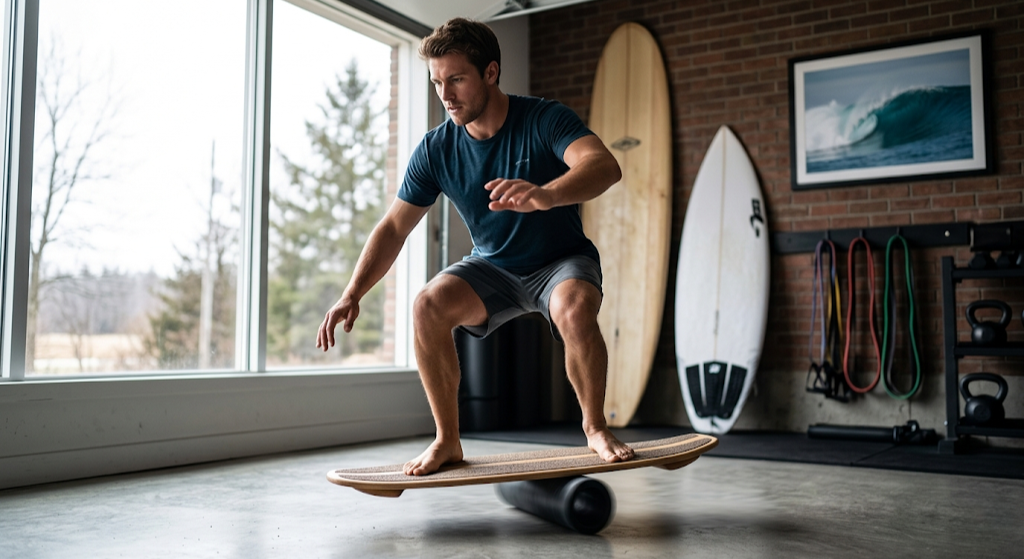
When the waves go flat or the swell drops out, the best surfers don’t stop training — they shift to land. Balance boards replicate surf-specific movement patterns, develop the neuromuscular foundations that separate good surfers from great ones, and maintain the proprioceptive sharpness that takes months to build and weeks to lose. This guide covers everything: which board type matches your surfing style, what actually transfers to water, and an 8-week program to hit the season in your best shape yet.
The quality of surfing is built in the nervous system first, muscles second. Proprioception — the body’s ability to sense its own position and make real-time micro-corrections — is the underlying skill that determines how naturally you read and respond to a wave. The problem is that proprioceptive training can’t be faked with gym machines; it requires unstable surfaces, unpredictable forces, and the same movement patterns used in your sport.
Balance boards deliver this on land. They replicate the instability of a surfboard on water in a controlled environment where you can focus on specific movement patterns, practice drills repeatedly, and build neuromuscular habits that transfer directly to your surfing when you’re back in the water.
34%Improvement in dynamic balance scores after 8 weeks of board training in surfer study populations
6×More proprioceptive activation on an unstable surface vs flat ground training
3 wksTime to detectable proprioceptive decline without balance-specific training during off-season
🎯 The Off-Season PrincipleYou don’t lose surf fitness when you stop surfing — you lose the specific neuromuscular patterns that make surfing feel automatic. Balance board training maintains these patterns. Surfers who train on balance boards consistently through the off-season report feeling “back on the wave” within 1–2 sessions when the season resumes, vs 2–4 weeks of re-adaptation for those who stopped entirely.
🏄
Know Your Equipment
The Three Board Types
Roller, wobble, and rocker boards train fundamentally different aspects of surf movement. Choosing the right type is the single most important equipment decision.
The Three Board Types
🛹
Type 01
Roller Board
CarvingFlowRail-to-Rail
A flat board sits on a cylindrical roller, allowing full 360° of rotational instability. The board can shift in any direction over the roller — the closest replication of surfboard feel available on land. Trains lateral weight transfer, carving mechanics, and the continuous micro-adjustments of surfing.
Surf Specificity
Beginner Friendly
⚖️
Type 02
Wobble Board
AnkleCoreFoundation
A circular platform balanced on a central hemisphere, tilting in all directions simultaneously. More accessible for beginners and excellent for ankle proprioception and core stability. Less surf-specific than a roller board but invaluable for building the base that makes roller board training effective.
Surf Specificity
Beginner Friendly
🪵
Type 03
Rocker Board
Nose/TailPipelineTrim
A board with a curved underside that rocks front-to-back on a flat surface. Specifically trains the nose-to-tail pressure shifts used in trim surfing, barrel riding stance, and the front-to-back weight transfers of cutbacks and nose rides. Excellent complement to a roller board.
Not every training benefit shows up in the water. These are the skills that have direct, measurable transfer to surf performance.
What Actually Transfers to Water
This is the most important question for any surf training. Plenty of gym work looks athletic but doesn’t make you a better surfer. Balance board training scores high on transfer because the movement patterns it trains are nearly identical to the ones used on a wave — the nervous system can’t tell the difference between making balance corrections on a roller board and making them on a surfboard.
🏄 Rail-to-Rail Carving Weight Transfer92%
The lateral toe-to-heel pressure shifts on a roller board directly mirror the mechanics of initiating turns on a wave. Highest transfer of any trainable land skill.
⚡ Ankle Proprioception & Reactive Balance88%
The micro-correction speed of ankle joints trained on wobble/roller boards is the same mechanism used to stay on the board when a wave section unpredictably shifts.
🔄 Hip Rotation Timing80%
Balance board drills that involve torso rotation build the hip-lead timing that generates power in off-the-tops and cutbacks. Moderately high transfer when trained intentionally.
📐 Stance Width Optimisation74%
Extended time on a balance board helps surfers find their optimal stance width through trial and error in a low-risk environment — corrections are faster and clearer than in the water.
🎯 Front-to-Back Pressure (Nose/Tail Trim)70%
Rocker board training specifically develops the front-to-back pressure control used in trimming on small waves, cross-stepping, and setting up for barrels.
💪 Core Activation Timing65%
The anticipatory core bracing that balance boards demand — pre-loading before a weight shift — has meaningful transfer to the core timing required on powerful waves.
🤸 Pop-Up Speed & Landing Mechanics55%
Moderate transfer. Pop-up practice on a balance board builds the landing mechanics and stance acquisition but doesn’t fully replicate the timing dynamics of a real wave.
Choosing a Balance Board by Surf Level
The right board type depends as much on your surf ability as anything else. A beginner surfer doesn’t need the most challenging balance board — they need the one that builds the right foundations for where they are in their surf development.
🟢 Beginner Surfer
Learning to stand · Whitewash · Green waves only
Start with a wobble board — build ankle proprioception first
Rocker board for pop-up practice is excellent at this stage
Avoid roller boards until you can stand on a wobble board for 2+ minutes
The pop-up is the most practised and most misunderstood movement in surfing. Done correctly on a balance board, it develops the landing mechanics and stance consistency that eliminate hesitation in the water.
Pop-Up Training on a Balance Board
The pop-up is not a single movement — it’s a four-phase sequence that needs to be trained as a complete pattern, not broken into separate exercises. Most surfers practise the pop-up movement on flat ground, which builds the upper body push but doesn’t train the most critical element: landing in a stable, functional surf stance on an unstable surface.
A rocker board or a large roller board with end stops is the ideal surface for pop-up practice. The instability forces you to nail the landing mechanics — you’ll know immediately if you landed too far forward, too far back, or with your weight off-centre, because the board will tell you.
01
Prone Position
Hands under chest. Board horizontal. Feel the board’s movement — don’t fight it.
02
Push & Tuck
Push chest up. Tuck front knee forward in one fluid motion. Never pause mid-movement.
03
Foot Placement
Front foot lands sideways across the centreline. Back foot at 45°. Both feet land simultaneously.
04
Stick the Stance
Weight centred. Knees bent. Arms out. Hold the balance for 3 full seconds before resetting.
🌊
The 3-second hold rule: After every pop-up, hold your surf stance for 3 seconds on the board before stepping off. This trains the nervous system to “commit” to the stance rather than immediately shifting weight — the same commitment needed on a real wave when your instinct says “get off” but your brain knows you need to hold the trim line.
⚠️
Don’t practise bad pop-ups. Thirty sloppy pop-ups a day will encode incorrect movement patterns. Ten clean, committed pop-ups with the 3-second hold and conscious foot placement are more valuable. Use a mirror or camera to check your stance — foot position errors that feel correct become hard to fix after months of reinforcement.
🎯
Training Library
The Core Drill Library
Eight drills covering the full range of surf-specific movement patterns. Each targets a distinct aspect of wave riding that transfers directly to performance.
The Core Drill Library
01Static Surf Stance HoldBeginner
Duration
60–120 sec
Board
Any
Sets
3–5×
Stand in your natural surf stance with eyes closed. The closed-eye version forces the vestibular system and proprioception to work without visual cues — exactly what happens when you’re focused on reading the wave rather than watching your feet. Builds the subconscious stability that makes surfing feel automatic. Start with eyes open for 30 seconds, progress to eyes closed once you can hold 90 seconds eyes-open without correction steps.
02Rail-to-Rail Carve SimulationIntermediate
Duration
30–45 sec
Board
Roller Board
Sets
5–8×
From a centred surf stance on a roller board, shift weight progressively onto the toe edge, hold for 2 seconds, then transfer to the heel edge. The movement should feel like initiating a bottom turn followed by a top turn — not simply rocking side to side. Lead with the hips, not the shoulders. The upper body should stay relatively quiet while the lower body drives the weight shift.
03Squat Pulse to Pop-UpBeginner
Duration
8–12 reps
Board
Rocker Board
Sets
4×
Start in a deep squat on the board (riding a wave crouch position), pulse gently three times, then explosively rise to standing surf stance. Trains the extension movement that generates speed through sections and sets up aerial manoeuvres. Focus on landing back in the crouch position after the explosive rise — absorbing the return is as important as the explosive phase.
04Hip Rotation Cutback DrillIntermediate
Duration
20 reps each side
Board
Roller Board
Sets
3×
Standing in surf stance, initiate a controlled rotation at the hips toward your front arm — mimicking the body rotation of a cutback — while simultaneously shifting weight onto the heel rail. The rotation initiates at the pelvis, not the shoulders. Hold the rotation for 2 seconds at end range, then unwind back to centre. This drill builds the hip-lead timing that separates powerful cutbacks from upper-body-only turns.
05Barrel Riding Crouch HoldAdvanced
Duration
30–60 sec
Board
Rocker Board
Sets
5×
Deep crouched barrel stance — front hand trailing, back arm forward, weight slightly on the back foot, knees well inside the board edge. Hold on the rocker board for timed duration while resisting the front-to-back instability. The rocker board specifically mirrors the nose/tail pressure shifts that happen inside a barrel as the wave face steepens. Add micro front-to-back pressure changes within the hold for advanced progression.
06Single-Leg Reactive BalanceIntermediate
Duration
30 sec each leg
Board
Wobble Board
Sets
4× each
Stand on one leg on the wobble board. Have a partner lightly push the board from different directions at random intervals — or use a wall tap (lightly push the board edge with your free foot). This reactive challenge replicates the unpredictable force changes that happen when a wave section shifts unexpectedly. The key metric is recovery speed — how quickly you re-establish balance after the disruption, not how long you hold static balance.
07Paddle-to-Pop SequenceBeginner
Duration
10 full sequences
Board
Rocker Board
Sets
3×
Lie prone on the rocker board with hands paddling (alternating arm circles mimicking paddle stroke for 5 counts), then execute the complete pop-up sequence. Builds the mental pattern of the full catch-to-standing sequence, including the transition point where many surfers hesitate. The rocker board movement during paddling simulation also activates the same spinal extension muscles used in real paddling.
08Off-the-Top Rebound SimulationAdvanced
Duration
8–10 reps
Board
Roller Board
Sets
3×
From a centred stance, rapidly shift onto the toe rail (bottom turn initiation), compress into a squat (hitting the lip), then explosively rebound back through centre to the heel rail (landing and re-engaging). The full sequence should take 2–3 seconds. This compound drill trains the complete mechanical sequence of an off-the-top — rail engagement, compression, explosive extension, and re-entry absorption — in one continuous pattern.
📅
Complete Program
8-Week Off-Season Program
Structured progression from balance fundamentals to surf-specific performance training. Click each week to expand the schedule.
8-Week Off-Season Program
The structure follows four phases — Foundation, Build, Peak, and Surf Prep — each with a specific focus that builds on the previous. The first two weeks develop the balance base that makes all subsequent drills effective. Do not skip Phase 1 regardless of your surf ability.
WK 1Balance FoundationPhase 1 — Foundation▾
Equipment: Wobble board only. Goal: Establish stable surf stance and basic proprioception. Sessions: 3–4×/week, 15–20 min.
Day 1 · 3
Static Stance Hold
Drill 01: 5 × 60 sec eyes open. Rest 30 sec between. End with 2 × 30 sec eyes closed.
Day 2 · 4
Pop-Up Practice
Drill 07: 3 × 10 paddle-to-pop sequences on rocker board. Focus on foot placement only.
Day 5–7
Rest / Active Recovery
Light swimming, yoga, or stretching only. Let proprioceptive adaptations consolidate.
WK 2Stance StabilityPhase 1 — Foundation▾
Equipment: Wobble board + rocker board. Goal: Extend hold durations, clean up pop-up mechanics. Sessions: 4×/week, 20 min.
Day 1 · 3
Extended Holds + Eyes Closed
Drill 01: 5 × 90 sec, alternating eyes open/closed. Add single leg holds: 3 × 30 sec each.
Day 2 · 4
Pop-Up Refinement
Drill 07: 4 × 10 sequences. Record video — check foot placement is consistent every rep.
Day 5–7
Rest / Ocean Swim
If ocean access available, 20–30 min body surfing or swimming maintains aquatic proprioception.
Drill 03: 4 × 10 squat pulse to pop-up. Drill 07: 3 × 10 paddle sequences. Time entire session: 20 min.
Day 6 · 7
Rest
Full rest from balance board training. Leg stretches, hip flexor work, ankle mobility.
WK 5–6Manoeuvre SimulationPhase 3 — Peak▾
All three board types in use. Goal: String drills together as movement sequences mimicking real surf manoeuvres. Sessions: 5×/week, 30–40 min.
Day 1 · 3 · 5
Full Manoeuvre Chains
Roller: Drill 02 + 04 + 08 in continuous 3-min flow. Rest 2 min. Repeat 4×. Simulate an imaginary wave line.
Day 2 · 4
Barrel + Reactive Work
Rocker: Drill 05 (barrel hold) 5 × 45 sec. Wobble: Drill 06 (single leg reactive) 4 × 30 sec each leg.
Day 6 · 7
Active Rest + Visualisation
Watch surf footage and mentally rehearse the manoeuvre sequences you’ve been drilling. Visualisation reinforces motor patterns.
WK 7–8Surf Prep & SharpeningPhase 4 — Surf Prep▾
Reduce volume, increase intensity and specificity. Goal: Peak neuromuscular sharpness for season return. Sessions: 4×/week, 25 min focused sessions.
Day 1 · 3
High-Intensity Flow
Roller board: 20 min continuous movement — full carving sequences, no stopping, simulating a full session of waves. Maximum intensity.
Day 2 · 4
Drill Refinement
Focus on any weaknesses identified in weeks 5–6. Pop-up consistency check. Barrel crouch timing. 20 min targeted work.
Day 5–7
Taper + Ocean Entry
If season starts this week: no board training day before first surf. Your neuromuscular patterns are set — rest lets them consolidate.
Program Principle
The program deliberately slows down in the final two weeks — not because training stops mattering, but because neuromuscular patterns consolidate during rest, not during training. The work is done in weeks 1–6. Weeks 7–8 sharpen and taper. Coming into the season’s first session slightly undertrained but fully rested produces better first-session performance than grinding through high volume right up to the last day.
🏄 Recommended Balance Boards
Best-in-class for each board type — selected for surf training suitability
🔗 Contains affiliate links
🏆 Best Roller
🛹
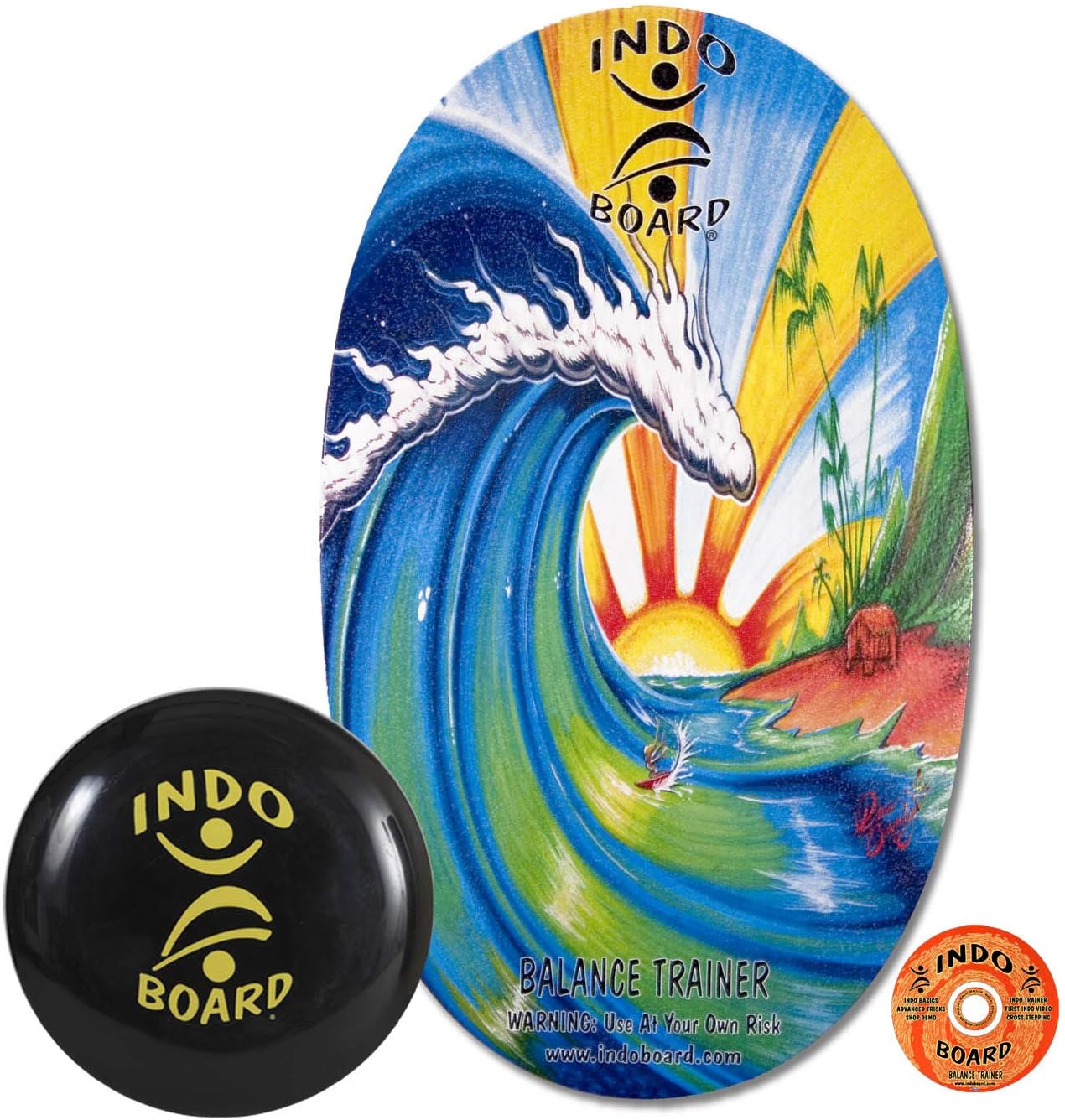
Indo Board
Original Training Package — Deck + Roller
★★★★★4.7(3,200+ reviews)
$134.99
30″ × 18″ deck — widest in class, closest to surfboard feel
6.5″ diameter roller creates the longest arc of motion available
Non-slip grip tape identical in texture to surf deck traction pads
Designed by a surfer specifically for surf training — not repurposed fitness gear
Supports 250 lbs · compatible with cushion upgrade for softer instability
ℹ️ FitCore360 participates in the Amazon Associates programme. We earn a small commission at no extra cost to you. Product recommendations are based on surf training suitability, not commission rates.
Frequently Asked Questions
Most surfers report a noticeable difference in their first post-off-season surf session after 4–6 weeks of consistent balance board training. The specific improvements vary: surfers who trained rail-to-rail drills most consistently report cleaner turn initiation; those who focused on pop-up practice find their stance is immediately comfortable rather than requiring 10–15 minutes to “find.” The most significant indicator is how quickly you feel “on” in your first session back — surfers who trained consistently report feeling their normal level within 1–2 sessions instead of the usual 1–2 weeks of re-adaptation.
Always train in your natural surf stance, not alternating. Balance board training is about encoding specific neurological patterns — the same ones your body uses when surfing. Practicing in your correct stance means the habits being built match what your body does on a wave. That said, spending 10–15% of your training time in your non-dominant stance has value: it improves your switch-foot surfing, helps you understand what the opposite rail feels like, and can expose imbalances in your ankle stability that carry over to your main stance.
Yes — and arguably it’s more valuable for beginners than advanced surfers. The neuromuscular patterns a beginner is trying to establish are exactly what balance board training builds. A wobble board for ankle proprioception and a rocker board for pop-up practice are the most appropriate starting tools. The key difference for beginners: the goal isn’t surf specificity (you don’t have established surf patterns to refine), it’s building the physical vocabulary of balance that will make your first real waves much more comfortable. Start with wobble board fundamentals before moving to a roller board. See our surf training board guide for beginner-specific recommendations.
For surf-specific training, a roller board beats a BOSU ball at intermediate and advanced levels, but the comparison is more nuanced for beginners. A BOSU ball offers multidirectional instability with a larger platform — useful for building general stability and functional movement. A roller board offers surf-specific lateral instability and carving mechanics that have direct transfer to wave riding. The honest answer: both have value and they’re not mutually exclusive. BOSU for full-body unstable training; roller board for surf-specific mechanical work. See our full comparison for the detailed breakdown.
The 8-week program above recommends 4–5 sessions per week in the foundation and build phases, tapering to 4 sessions in the final two weeks. The minimum effective dose is 3 sessions per week — below this, adaptation occurs too slowly to meaningfully outpace detraining. The maximum useful volume is approximately 45 minutes per day — beyond this, fatigue accumulates without proportional proprioceptive benefit. Daily training is fine if sessions are kept under 30 minutes, particularly during the first four weeks. Rest days are essential once training volume and intensity increase in weeks 5–8.
The balance board training emphasis differs significantly between disciplines. Shortboard surfers should focus on roller board rail-to-rail drills, explosive squat-to-pop sequences, and hip rotation mechanics — the violent, rapid movements of performance surfing. Longboard surfers should emphasise rocker board front-to-back pressure work (replicating nose-riding and cross-stepping weight shifts), slow control holds, and single-leg balance for the high-line stance work. The wobble board serves both equally well. Longboarders should also practise the one-footed nose ride stance — standing far forward on a wobble board trains the exact balance demand of a hanging five or hang ten.
The Off-Season Is Where Seasons Are Won
The surfers who show up at the start of a new season feeling sharp, fluent, and “in their body” aren’t just naturally talented — they maintained the neuromuscular specificity of their surfing during the months when there were no waves to ride. A balance board is the most direct and portable tool for doing this.
Eight weeks, four to five sessions a week, a roller board and a rocker board. That’s the investment. The return is a season that starts where the last one ended rather than spending the first weeks clawing back what you had in October.