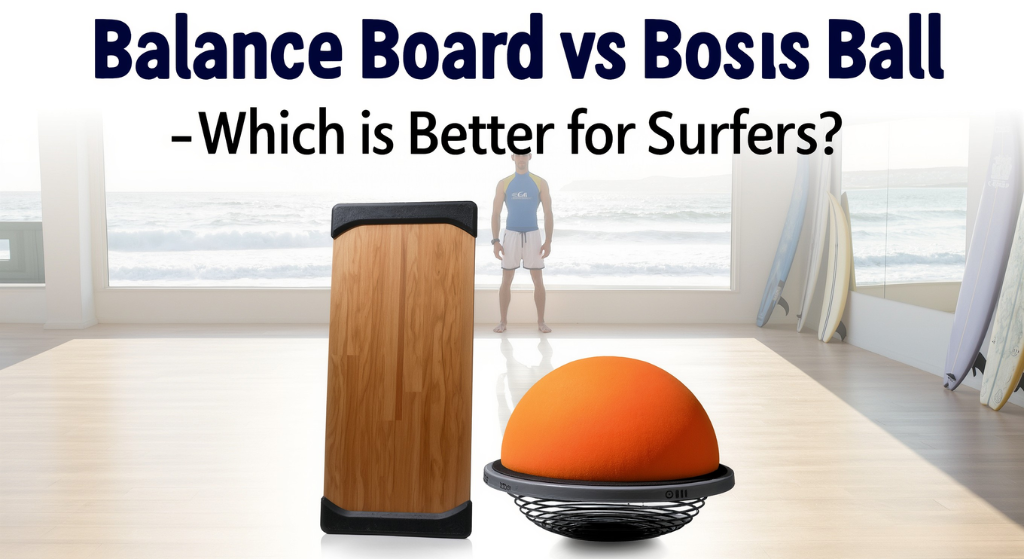
Balance Board vs BOSU Ball: Which Is Better for Surfers?
The balance board and the BOSU ball are both sold as surf conditioning tools — but they train fundamentally different things. One replicates surf movement. The other builds the fitness that supports it. Understanding that difference changes how you train, how you budget, and whether you end up with the right tool for your actual surf goals or an expensive mistake. Here’s the complete breakdown.
📋 In This Comparison
- Quick Answer
- How Each Tool Works — The Mechanisms
- Surf Training Transfer — What Each Actually Develops
- Muscles Worked — Full Anatomical Breakdown
- The 5 Surf Movements and Which Tool Trains Each
- What the Research Says About Instability Training
- Head-to-Head: 6 Key Variables
- Sample Surf Training Sessions for Each
- The 12-Week Surf Balance Progression
- 9 Mistakes Surfers Make With Both Tools
- 7 Alternatives to Balance Boards and BOSU Balls
- Buying Guide — The Specs That Actually Matter
- Beyond Surfing — SUP, Skate, Snow & Kite
- Safety, Injury Prevention & Rehab Use
- Setup, Care, Storage & Maintenance
- How Long Until You See Results?
- Full Comparison Table
- Which Should You Buy?
- Best Options on Amazon
- Frequently Asked Questions
- Conclusion
Quick Answer
How Each Tool Works — The Mechanisms
The balance board and the BOSU produce instability through completely different physical mechanisms — and understanding those mechanisms explains exactly why they train different things and why neither can replace the other.
The Balance Board Mechanism
A balance board — whether a roller board, wobble board, or rocker board — creates instability by removing the stable base the body normally relies on. A roller board deck sits freely on a cylindrical roller with no attachment and no range limit: the deck can travel the full length of the roller, and the roller itself can move across the floor. The body has no safety net — every fraction of a second requires active neuromuscular correction to maintain position. The direction of that instability is predominantly lateral (side-to-side), which directly replicates the plane of movement in surfing. For a full technical breakdown of roller, wobble, and rocker board mechanisms, see Roller Board vs Wobble Board vs Rocker Board.
The BOSU Ball Mechanism
The BOSU (Both Sides Up/Utilised) is an inflatable rubber hemisphere attached to a rigid flat base. Used dome-side up, the soft compliant dome deforms under foot pressure — the degree of instability depends on inflation level, but is always forgiving and multi-directional. Unlike a roller board, the BOSU cannot translate across the floor: both the dome and the base are fixed relative to each other. The instability is limited by the dome’s compliance and the base’s ground contact, making dramatic falls essentially impossible. This makes the BOSU safe for loaded exercises — squats, overhead presses, and plyometrics — that would be dangerous on a roller board.
- Primary axis: lateral (heel-to-toe and rail-to-rail)
- No floor contact safety net — full dynamic range
- Demands constant active correction at high frequency
- Replicates the lateral translation of a moving wave face
- Primary axis: omnidirectional, compliant
- Rigid base prevents board travel — safe safety net
- Instability is proportional to dome inflation and load position
- Does not replicate lateral wave-face translation
Why the Mechanism Difference Matters More Than the Marketing
Both products are marketed with the same vocabulary — “balance,” “stability,” “core,” “proprioception” — and that shared vocabulary hides a real biomechanical divide. The useful way to think about it is degrees of freedom. A roller board has two meaningful degrees of freedom: the deck rotates about the roller’s long axis, and the deck translates along it. Both are essentially frictionless and neither is self-correcting, which means a small error grows quickly unless you actively reverse it. That escalating-error property is the entire training stimulus. It forces the nervous system to predict where the board is going rather than react after it has already moved.
The BOSU has a different profile. The dome compresses under load and returns you toward centre when you shift weight — the deformation itself acts as a restoring force. In control-systems terms, the BOSU is a damped, self-centring system while the roller board is an undamped, divergent one. That single distinction explains almost every downstream difference between the two: why the BOSU is beginner-safe and the roller board isn’t, why loaded lifting works on one and not the other, and why one feels like surfing and the other feels like standing on a firm pillow.
It also explains a common frustration. Surfers who train exclusively on a BOSU often report that their balance “feels great in the gym” but doesn’t change much in the water. The reason is that a self-centring surface rewards a strategy — sink into the surface, let it push you back — that has no equivalent on a moving wave face. A wave does not push you back to centre. It keeps moving, and so must you.
- Roller board: divergent, unlimited travel, lateral bias, predictive control required
- Wobble board: divergent but range-limited by rim contact, omnidirectional tilt
- Rocker board: single-axis tilt, range-limited, the mildest true balance board
- BOSU dome-up: damped and self-centring, omnidirectional, load-tolerant
- BOSU dome-down: semi-divergent — behaves more like a large, soft wobble board
Surf Training Transfer — What Each Actually Develops
The physiological mechanisms each tool stimulates are distinct — and map to different aspects of surf performance. Neither tool is universally better: they develop different components of the physical capability that surfing demands.
What a Balance Board Develops for Surfers
Balance board training produces adaptations in the proprioceptive nervous system — specifically, it improves the speed and precision of the reflexive muscle responses that prevent falling on an unstable surface. For surfers, these adaptations manifest as improved ability to hold a rail line through turbulence, faster recovery when caught off-balance mid-manoeuvre, and more automatic foot placement during pop-ups and turns. The lateral bias of roller boards also directly strengthens the ankle evertors and invertors — the muscle groups that control heel-to-toe weight distribution, which is the same mechanism that drives turn initiation and completion on a surfboard.
What a BOSU Develops for Surfers
BOSU training develops functional stability under load — the ability to generate force (in squats, lunges, explosive jumps) while simultaneously managing an unstable base. For surfers, this translates to improvements in paddle power (the shoulder, core, and hip stability that makes paddling efficient under fatigue), pop-up explosiveness (the ability to generate ground force quickly while landing in an unstable surf stance), and late-paddle endurance (the core stability that maintains body position on the board during long paddle-outs). The BOSU also develops rotational core stability through anti-rotation drills that are difficult to replicate on a narrower balance board.
- Surf stance balance simulation — the closest dry-land replication of riding a wave
- Proprioceptive reflex speed — faster involuntary corrections mid-manoeuvre
- Ankle-knee-hip chain coordination — the specific neural chain driving turns
- Foot placement habituation — ingraining pop-up stance automatically
- Rail-to-rail weight shift drills — simulating cutback and carve mechanics
- Cross-step and noseriding practice (roller boards with wide decks)
- Loaded balance training — squats, deadlifts, overhead press under instability
- Plyometric conditioning — jump landings, explosive pop-up drills
- Core anti-rotation strength — Pallof press, chop patterns
- Paddle-position endurance — plank and prone holds on the dome
- Beginner-safe stability foundation — first step for surfers new to balance training
- Full conditioning circuit — multiple exercises without equipment changes
Specificity: The Principle That Settles the Argument
Sports science has a durable principle called specificity of transfer: training adaptations carry over to a target activity in proportion to how closely the training resembles that activity in movement pattern, velocity, joint angles, and — critically for balance work — the type of sensory information the nervous system has to process. Balance is not a single general attribute you top up like a fuel tank. It is a collection of highly task-specific control strategies. Someone with world-class slackline balance is not automatically good on a surfboard, and a gymnast with elite beam balance may fall off a roller board in seconds.
This is why the question “which is better for surfers” has a defensible answer rather than being purely a matter of taste. On the specificity axis, the roller board is closer to surfing in three measurable ways: the dominant plane of perturbation is lateral, the perturbation is continuous rather than triggered, and the surface has momentum that must be anticipated. The BOSU matches surfing on none of those three. It does, however, match the strength and power demands of surfing well — which is a different training target, and a legitimate one.
Where the BOSU Genuinely Beats the Balance Board
It would be dishonest to frame this as a one-sided comparison. Surfing is not only a balance sport. Analyses of recreational surf sessions consistently show that the majority of time in the water is spent paddling, not riding — often 45 to 55 percent paddling, 20 to 30 percent sitting and waiting, 5 to 10 percent duck-diving or turtle-rolling, and under 10 percent actually standing on a wave. Judged by time spent, surfing is predominantly an upper-body endurance sport with brief, explosive, balance-intensive bursts.
That time distribution matters for equipment choice. A roller board does nothing for the 50 percent of your session spent paddling, nothing for shoulder endurance, and nothing for the pressing strength that drives a fast pop-up. A BOSU addresses all three. For a surfer whose limiting factor is fatigue rather than balance — someone who surfs well for twenty minutes and then falls apart — the BOSU may honestly be the higher-value purchase, even though the balance board wins the skill-transfer argument.
Muscles Worked — Full Anatomical Breakdown
“Works your core” is the laziest claim in the fitness equipment industry, and both of these products lean on it heavily. Here is the actual muscular picture, broken down by region, with the practical surf consequence of each.
Lower Leg and Ankle Complex
This is where the balance board does its most distinctive work. Standing on a roller board recruits the peroneus longus and brevis (which evert the foot and resist rolling inward), the tibialis posterior and anterior (which invert and dorsiflex), and the soleus in a near-continuous low-level contraction. Electromyography studies on unstable-surface standing consistently show that ankle stabiliser activity rises sharply relative to firm ground, and that the rise is greatest on surfaces that tilt in the frontal plane — exactly what a roller board produces.
For a surfer, this matters because the ankle is the primary steering input on a surfboard. Turn initiation begins with a subtle shift of pressure toward the toes or heels; the fin engages; the board changes line. A surfer with slow or weak ankle stabilisers loses the top of that chain and compensates by over-rotating with the hips and shoulders, which is why so many intermediate surfers look stiff through turns. The BOSU also trains the ankle complex, particularly in single-leg holds, but the compliance of the dome means the demand is lower-amplitude and less frontal-plane biased.
Knee and Thigh
On the balance board, the quadriceps and hamstrings co-contract to stiffen the knee, and the vastus medialis in particular works hard to control small valgus collapses. This is isometric, low-load work — useful for joint control, negligible for hypertrophy or maximal strength. On the BOSU, the same muscles can be loaded through a full range with body weight or external weight, which produces genuine strength adaptation. If you want stronger legs, the BOSU is the tool. If you want better-controlled legs, the board is.
Hips and Glutes
The gluteus medius and minimus are the unsung heroes of surf balance. They control pelvic drop and hold the pelvis level when weight shifts to one leg — which happens every time you set a rail. Both tools recruit them, but differently: the board recruits them reactively at high frequency, while the BOSU recruits them under load in exercises like single-leg deadlifts and lateral step-ups. There is a strong argument for doing both, since reactive capacity and force capacity are separate qualities.
Trunk and Core
On a balance board, the transverse abdominis, internal and external obliques, quadratus lumborum, and erector spinae fire as a stiffening unit. The stimulus is anti-movement: the trunk’s job is to be a rigid link that transmits corrections between the feet and the upper body. On a BOSU, those same muscles can additionally be trained through dynamic patterns — chops, lifts, Pallof presses, rotational throws — and in loaded anti-rotation, which the board cannot safely provide. For paddling, which is an extended anti-extension challenge with alternating rotation, the BOSU’s dynamic core work is more relevant than the board’s isometric work.
Shoulders, Chest and Back
Here the comparison ends quickly. The balance board trains the upper body essentially not at all; the arms function as counterweights and nothing more. The BOSU, used for push-ups, planks, mountain climbers, dome-down presses and prone paddle simulations, provides real stimulus to the serratus anterior, rotator cuff, deltoids, pectorals and lats — the exact musculature paddling depends on. A surfer training only on a balance board is leaving the paddling half of the sport completely untrained.
| Muscle Group | 🛹 Balance Board | 🔵 BOSU Ball | Surf Relevance |
|---|---|---|---|
| Peroneals / ankle evertors | Very high (reactive) | Moderate | Rail pressure, turn initiation |
| Tibialis anterior/posterior | High | Moderate | Toe-side control, drop stability |
| Calves / soleus | Moderate isometric | High under load | Pop-up drive, compression |
| Quadriceps | Isometric only | Full-range loaded | Pop-up power, crouch hold |
| Hamstrings | Co-contraction | Loaded (SLDL) | Backside turns, deceleration |
| Gluteus medius | High reactive | High loaded | Pelvic control on one rail |
| Gluteus maximus | Low | High | Explosive pop-up extension |
| Obliques / rotational core | Isometric | Dynamic + loaded | Paddle rotation, cutback torque |
| Deep spinal stabilisers | High | High | Force transfer, posture |
| Serratus / scapular stabilisers | None | High | Paddle efficiency, shoulder health |
| Pecs / anterior delts | None | High | Pop-up push, paddle pull-through |
| Lats | None | Moderate | Primary paddling muscle |
- The board owns the ankle-hip reactive chain — the steering system of surfing
- The BOSU owns force production and the entire upper body — the engine of surfing
- Neither covers both. Any claim that one tool is “complete surf training” is marketing, not anatomy
- Overlap is smaller than it looks — which is exactly why owning both isn’t redundant
The 5 Surf Movements and Which Tool Trains Each
Rather than comparing the tools in the abstract, it’s more useful to break surfing into its component movements and ask which tool trains each one. Five movements account for nearly everything you do in the water.
1. Paddling
Prone on the board, alternating deep arm strokes, head and chest lifted, lumbar spine extended, legs together and quiet. The physical demands are shoulder endurance, scapular control, anti-extension core endurance, and the ability to hold a slightly uncomfortable extended posture for long periods. Winner: BOSU, decisively. Lying prone across the dome with paddle-arm motion is one of the closest dry-land analogues of the paddling position available, and it loads the lower back and scapular stabilisers in the same shortened-extended pattern paddling uses. A balance board contributes nothing here.
2. The Pop-Up
From prone to a full riding stance in one explosive movement, ideally in under a second, landing with both feet placed correctly on a surface that is already moving and tilting. The demands are pressing power, hip mobility, thoracic extension, and the ability to land into instability without a stabilising step. Winner: split. The BOSU trains the explosive push and the landing absorption; the roller board trains the landing accuracy and the instant stabilisation that follows. Serious surfers do the strength half on the BOSU and the stance half on the board — and there’s a strong case for combining them: pop up on the floor, land on the board.
3. Trimming and Holding a Line
Standing in the pocket, making continuous micro-adjustments to keep the board at optimum speed and position on a wave face that is constantly changing shape. This is the purest balance task in surfing and it is almost entirely a reactive, frontal-plane control problem. Winner: balance board, decisively. Nothing in dry-land training replicates trimming as well as standing on a roller board and holding position while making small pressure changes. The BOSU’s self-centring dome actively teaches the wrong strategy here.
4. Turning — Bottom Turns, Cutbacks, Top Turns
Rapid, deliberate weight transfer from one rail to the other, driven by ankle pressure, hip rotation and upper-body lead. The demands are rate of force development in the lateral plane, rotational core control, and the ability to load and unload a leg quickly without losing the stance. Winner: balance board for the pattern, BOSU for the power. Rail-to-rail drills on a roller board reproduce the timing and the weight-shift feel; BOSU lateral hops and loaded rotational work build the force capacity behind it. Surfers who train only pattern without power get smooth, weak turns; those who train only power get strong, clumsy ones.
5. Duck-Diving and Turtle-Rolling
Pushing the board underwater against oncoming whitewater, or flipping it and hanging on. The demands are upper-body pressing strength, grip, breath control, and trunk rigidity under load. Winner: BOSU. Weighted push-ups, dome-down pressing and plank variations all contribute; the balance board contributes nothing. Grip is worth mentioning here too — surfers who struggle to hold rails in heavy water often have a grip endurance problem rather than a strength problem, and a dedicated grip trainer addresses it more efficiently than either of these tools.
Scored this way, the result is a genuine 2–2 split with one tie — which is a more honest summary than any single verdict. The balance board wins the two movements that determine how well you surf; the BOSU wins the two that determine how much you surf before fatigue ends the session. Which matters more depends entirely on which one is currently limiting you.
What the Research Says About Instability Training
Instability training has a mixed reputation in strength and conditioning circles, and it’s worth separating what the evidence supports from what equipment marketing claims.
Where the Evidence Is Strong
Balance training on unstable surfaces has a robust evidence base in injury prevention and rehabilitation. Programmes using wobble boards and similar devices have been shown repeatedly to reduce recurrence rates of lateral ankle sprain, and to improve measures of joint position sense, single-leg stance time and reactive stability in athletes with previous ankle injury. This is the single best-supported claim either product can make, and it applies to both.
The evidence is also reasonably strong that balance training improves the specific balance task trained, with partial transfer to similar tasks and limited transfer to dissimilar ones. This is the specificity finding discussed earlier, and it is consistent across balance training literature: you get good at what you practise, and the closer the practice resembles the target, the better the carryover.
Where the Evidence Is Weak or Negative
Instability training is not an effective way to build maximal strength or power. Studies comparing squats on unstable surfaces to squats on firm ground consistently find that force output and external load drop substantially on the unstable surface — often by 20 to 40 percent — while muscle activation in the prime movers either stays flat or falls, even though stabiliser activation rises. The practical conclusion drawn by most strength coaches is: build strength on stable ground, train balance on unstable ground, and don’t try to do both at once.
This has a direct implication for how surfers should use a BOSU. Doing your squats on the dome because it “adds a core challenge” means you squat lighter, produce less force, and get a weaker strength stimulus in exchange for a modest stability benefit you could have gotten from a dedicated balance drill. A better structure is heavy squats on the floor, then BOSU work as separate stability and conditioning blocks. If you want the load, a proper barbell setup with appropriate support gear beats unstable-surface lifting on every measure that matters.
The Honest Summary for Surfers
Read carefully, the literature supports a fairly narrow set of claims: unstable-surface training improves proprioception and joint control, reduces re-injury risk in previously injured ankles, transfers best to tasks that resemble the training, and is a poor substitute for stable-surface strength work. It does not support claims that balance boards “double core activation,” “burn more calories,” or “replace gym training.” Any product page making those claims is overreaching.
Head-to-Head: 6 Key Variables
Category Winners at a Glance
Sample Surf Training Sessions for Each
These sessions show how each tool fits into a practical off-season surf training week. Neither session is better than the other — they target different training objectives and are designed to complement each other.
A Combined 40-Minute Session When You Own Both
If you have both tools and only want to train three times a week, the most efficient structure is a single combined session rather than alternating tool-specific days. Balance work is best done fresh, when the nervous system is unfatigued, so it goes first. Conditioning goes second, when fatigue is an asset rather than a liability.
The 12-Week Surf Balance Progression
Most people who buy a balance board use it enthusiastically for ten days and then leave it under the sofa. The reason is almost always the same: no structure. Balance training responds extremely well to progressive overload, but the overload variables are unfamiliar — you’re not adding weight, you’re removing sensory information, narrowing the base, adding a secondary task, or increasing the instability of the equipment itself. Here’s a twelve-week structure that works for a surfer starting from scratch.
Weeks 1–3: Foundation (BOSU or Rocker Board)
The goal in this phase is tolerance, not challenge. Three sessions a week, ten to fifteen minutes each. Two-footed holds on the dome for sixty seconds, single-leg holds for twenty to thirty seconds each side, and simple weight shifts forward, back and side to side. If you own a rocker board, this phase can be done on that instead — it’s range-limited and forgiving enough to be a legitimate starting point. Expect visible improvement quickly: single-leg time on an unstable surface usually doubles within three weeks for an untrained beginner.
Progression cue for this phase: when you can hold sixty seconds on one leg on the dome without your foot chattering or your arms flailing, you’re ready to move on.
Weeks 4–6: Transition (Wobble Board + Loaded BOSU)
Now you introduce a genuinely divergent surface. A wobble board tilts in every direction and, unlike the dome, doesn’t push you back to centre — but the rim contacts the floor, which limits how far things can go wrong. Two balance sessions and one to two conditioning sessions per week. Balance work: two-footed holds, controlled rim-touch circles (tilt the board so the rim traces a full circle without slamming), and single-leg holds. Conditioning: the BOSU circuit from the previous section, adding light external load to squats and step-ups.
Progression cue: a controlled rim circle in both directions, plus thirty seconds single-leg on the wobble board, means you have the base for a roller board.
Weeks 7–9: Surf-Specific (Roller Board Introduction)
This is where the real surf transfer begins. Set up next to a wall or in a doorway for the first three sessions — hand contact is a training wheel, not a failure. Start with assisted mounts and short holds, progress to unassisted holds, then to intentional rail-to-rail pressure changes. Keep sessions short: twelve to fifteen minutes is plenty, because the quality of the nervous system’s output degrades fast once fatigue sets in and sloppy reps build sloppy patterns.
Progression cue: ninety seconds of unassisted hold with quiet feet and relaxed arms. “Quiet” is the key word — the goal is not survival, it’s stillness.
Weeks 10–12: Integration and Complexity
Now you add the variables that make balance genuinely surf-like: eyes closed, head turns, a ball toss with a partner, arm patterns that mimic a cutback, and pop-up landings onto the board. This phase is also when you should start alternating your stance — regular and goofy — because switch-stance work builds a more symmetrical ankle-hip chain and pays off on your weaker turn direction.
| Phase | Primary Tool | Sessions/Week | Duration | Exit Criterion |
|---|---|---|---|---|
| Weeks 1–3 Foundation | BOSU / rocker board | 3 | 10–15 min | 60 sec single-leg hold |
| Weeks 4–6 Transition | Wobble board + BOSU | 3–4 | 15–20 min | Controlled rim circles both ways |
| Weeks 7–9 Surf-Specific | Roller board | 3 | 12–15 min | 90 sec unassisted, quiet feet |
| Weeks 10–12 Integration | Roller board + BOSU | 4–5 | 20–30 min | Eyes-closed holds, both stances |
How to Progress Once the 12 Weeks Are Done
The skill ceiling on a roller board is high enough that you will not run out of progressions. In rough order of difficulty: longer roller (more travel), smaller-diameter roller (faster, twitchier), narrower deck, rocker-shaped deck with no stops, single-leg holds, squats on the board, 180-degree turns, and finally cushion-and-roller combinations where a soft pad sits between board and roller. Most surfers never need to go past single-leg holds — but it’s useful to know the runway exists, because it means the purchase keeps paying off years later.
9 Mistakes Surfers Make With Both Tools
Most of the disappointment surfers report with balance equipment comes down to a handful of avoidable errors. These are the ones that show up most consistently.
1. Buying a Roller Board First With No Balance Base
A roller board is a genuinely advanced piece of equipment. Someone with no board-sport background who buys one as their first balance tool usually spends three frustrating sessions falling off and then abandons it. The fix is the progression above — or, if impatience wins, at least buy a board with a stopper strip on the deck and start in a doorway.
2. Loading a Balance Board With Weights
This deserves repeating because people keep doing it. Holding dumbbells on a roller board means that if the roller escapes, you fall with weights in your hands and no free arms to protect yourself. There is no training benefit here that justifies the risk. If you want loaded instability, that is precisely what the BOSU exists for.
3. Squatting Heavy on the BOSU Dome
The mirror-image error. Standing on an inflated dome with a loaded barbell reduces the weight you can handle, reduces force output, and adds a fall risk with a bar across your back. Build strength on stable ground. The research on this is unambiguous.
4. Training Balance to Failure
Balance work is nervous-system training, not muscular endurance training. Grinding out a fourth set when your feet are chattering and your form has collapsed teaches your body a sloppy control strategy. Stop each set while the quality is still high — the last good rep, not the first bad one.
5. Never Switching Stance
Almost every surfer has a strong and a weak turn direction, and almost every surfer trains only in their natural stance, which reinforces the asymmetry. Spending a third of your board time in switch stance is uncomfortable and unglamorous and pays off more than almost anything else you can do in twelve weeks.
6. Staring at the Floor
Looking down narrows your balance strategy to visual correction, which is the slowest of the three systems your body uses. In the water you look where you’re going, not at your feet. Train the way you’ll perform: eyes up, focused on a point at eye level, then progress to head turns and eyes closed.
7. Treating Instability Work as a Warm-Up
Balance training placed at the end of a session, after heavy legs, produces degraded reps. Placed at the very start as a two-minute “warm-up,” it’s too brief to drive adaptation. It deserves its own dedicated block, early in the session, after a general warm-up but before fatigue.
8. Under- or Over-Inflating the BOSU
Inflation level is the BOSU’s difficulty dial and most owners never touch it. Firmer means more instability and more travel for the same weight shift; softer means a more forgiving, damped surface. A BOSU that’s been sitting at half pressure for two years is a substantially different — and easier — tool than the one you bought.
9. Expecting the Board to Replace Water Time
No dry-land tool teaches wave selection, positioning, reading a section, or timing a take-off. Balance equipment accelerates the physical side of your development during periods when you can’t surf. It is a supplement, and the surfers who get the most out of it are the ones who understand that clearly.
- Roller board on hard tile or polished concrete — the roller skates, and falls are unforgiving. Use carpet, a rubber mat, or a rug.
- Roller board near furniture corners or glass — you need a clear 6 ft radius minimum.
- Barefoot on a worn, grip-tape-free deck — sweat plus smooth wood is how ankles get rolled.
- BOSU jumps onto an under-inflated dome — the rim can contact the floor and jar the joints.
- Any balance work on an acutely injured or unstable ankle without clearance from a clinician.
7 Alternatives to Balance Boards and BOSU Balls
Neither product is the only option, and for some surfers a third tool is a better fit than either. Here’s how the realistic alternatives compare.
1. Balance Cushion / Wobble Disc ($15–30)
An inflatable disc, roughly 33cm across. It’s essentially a miniature, portable, much cheaper BOSU dome with a smaller surface. Excellent for single-leg work, ankle rehab and travel; useless for pop-up drills or anything requiring a platform. For a surfer on a tight budget who mainly wants ankle proprioception, this is the best value item on this list. It also doubles as a desk-chair or standing-desk balance tool.
2. Slackline ($40–80)
A webbing line tensioned between two anchors. It trains balance ferociously and is genuinely fun, but the balance strategy it develops is dominated by hip and arm counterweighting rather than the ankle-driven, feet-planted control surfing uses. Good general athleticism; mediocre specificity. Needs two trees or a rack and a fair amount of outdoor space.
3. Surf Skate ($120–250)
A skateboard with a spring-loaded, high-pivot front truck that lets you pump and carve like a surfboard. For turn mechanics, upper-body lead and rail-to-rail timing, a surf skate is arguably closer to surfing than any balance board. Its weaknesses are that it needs smooth pavement, it carries genuine road-rash risk, and it doesn’t train static balance at all. Many surfers end up with a surf skate for turn mechanics and a roller board for static control.
4. Slant Board ($40–90)
Not a balance tool at all, but worth mentioning because ankle dorsiflexion range is a hidden limiter for a lot of surfers. Restricted dorsiflexion means you can’t get into a deep, compressed stance, which costs you speed generation and control. A wedge board is the most direct way to build that range and to load the tendons around the knee. See slant board squat vs heel-elevated squat and the best slant boards for home use for the detail.
5. Stability Ball ($20–40)
A full Swiss ball provides omnidirectional instability with a much larger range than a BOSU dome. It’s better than a BOSU for some core work (stir-the-pot, ball rollouts, hamstring curls) and worse for anything standing, since you can’t safely stand on it. A reasonable BOSU substitute for surfers who only want the core and prone-paddle work and don’t need a standing platform.
6. Foam Balance Pad ($25–45)
A dense foam block used widely in physiotherapy. It provides mild, damped instability with essentially zero fall risk — the safest entry point on this list, and the standard tool for early-stage ankle rehab. For a surfer coming back from injury, a foam pad is where you start before you’re ready for a dome.
7. Resistance Band Circuits ($20–50)
Bands don’t train balance, but they address two of the things the balance board can’t touch: paddling endurance and shoulder health. Band pull-aparts, external rotations, face pulls and prone paddle simulations build the rotator cuff and scapular stabilisers that keep surfers’ shoulders healthy across a long season. For a comparison of styles see loop vs tube vs fabric bands, and for rehab-focused use, bands for physical therapy and rehab.
| Tool | Price | Surf Specificity | Safety | Best Use |
|---|---|---|---|---|
| Roller balance board | $100–160 | Very high | Moderate | Trim & stance control |
| BOSU ball | $130–200 | Moderate | High | Conditioning & paddling |
| Wobble / rocker board | $40–90 | Moderate–high | High | Progression step, rehab |
| Balance cushion | $15–30 | Moderate | Very high | Ankle work, travel |
| Surf skate | $120–250 | Very high (turns) | Lower — road risk | Turn mechanics |
| Slackline | $40–80 | Low | Moderate | General balance, fun |
| Foam balance pad | $25–45 | Low | Highest | Early rehab |
Buying Guide — The Specs That Actually Matter
Both categories are full of near-identical-looking products at wildly different prices. These are the specifications that make a real difference in use, and the ones that are marketing noise.
Balance Board Specs Worth Checking
Deck Length and Width
This is the single most important spec for a surfer. A deck under 28 inches forces a narrow stance and makes pop-up drills impractical. Look for 30 inches or longer and at least 16–18 inches wide if you want to practise a real surf stance. Longboarders wanting to train cross-stepping need to go longer still — 40-inch-plus decks exist specifically for that.
Roller Diameter
Larger diameter equals faster travel and a higher, twitchier ride. Most surf-oriented boards ship with a 6-inch roller, which is a sensible default. A 4.5-inch roller is noticeably easier and a good first step; anything above 6.5 inches is for people who already have the skill and want more challenge. Some brands sell rollers separately, which is the cheapest way to add years of progression to a board you already own.
Deck Stops vs Open Deck
Stops are small raised strips near the deck ends that prevent the board from rolling completely off the roller. They make learning far less intimidating and dramatically reduce board-shooting-across-the-room incidents. Experienced users usually prefer an open deck for maximum range. If you’re buying your first board, get one with stops.
Deck Surface
Grip tape is grippier and rougher on bare feet; a textured non-slip coating is kinder to skin and slightly less secure when sweaty. For barefoot surf training, a quality non-slip coating is usually the better experience, but check reviews for how it behaves when wet with sweat.
Weight Capacity and Construction
Look for a stated capacity of at least 250 lbs and multi-ply hardwood construction — birch or maple. Cheap boards use thin plywood that flexes or delaminates, and flex in a balance board deck is a safety issue rather than a comfort one.
BOSU Specs Worth Checking
Dome Diameter
The standard is 65cm; the “Sport” version is 50cm. The smaller dome is lighter, easier to store and travel with, and slightly more unstable per unit of weight shift — which some surfers prefer. The larger dome is more comfortable for prone paddle work and push-ups because there’s more surface to lie across. For a surfer whose main BOSU use is paddling simulation, the 65cm is worth the extra bulk.
Base Rigidity and Handles
The flat base needs to be genuinely rigid — flexy bases make dome-down work unstable in a bad way. Integrated handholds or grip ports matter if you plan to use it dome-down for push-ups or carry it regularly.
Bladder Quality and Inflation Valve
This is where the price difference between a genuine BOSU and a $45 lookalike actually lives. Cheap domes lose pressure over weeks rather than months, and seam separation between dome and base is the most common failure mode reported on budget units. A hand pump should be included; if it isn’t, factor that in.
Weight Rating
Look for at least 250–300 lbs, and remember that plyometric landing forces are several times body weight. A unit rated at exactly your bodyweight is not rated for jumping on.
- Under $80 total: a wobble board or rocker board plus a balance cushion. Real training value, no compromise on safety.
- $80–160: one quality roller board with stops. The highest-value single purchase for a surfer whose limiter is balance.
- $160–250: a BOSU plus a wobble board — best for a surfer whose limiter is conditioning, or who wants one tool that also serves general fitness.
- $250–350: roller board + BOSU. The complete kit described in the verdict below.
- Don’t spend on: “smart” boards with apps, LED feedback, or step-count features. None of it improves the training stimulus.
Beyond Surfing — SUP, Skate, Snowboard & Kite
Plenty of people buying these tools aren’t only surfers. The verdict shifts depending on which board sport you’re training for, because each one loads balance differently.
Stand-Up Paddleboarding
SUP balance is a slow, continuous, small-amplitude problem — long periods of standing on a mildly moving platform while generating paddle force. That makes it closer to the BOSU’s profile than to a roller board’s. The BOSU’s damped instability plus standing paddle-pattern work with a band is a strong match. A wobble board is useful too. A roller board is more instability than SUP actually demands, though it certainly won’t hurt.
Skateboarding and Surf Skating
Skate balance is dominated by foot placement and rapid lateral weight transfer — squarely the roller board’s territory. Roller boards were originally popularised by skaters and snowboarders, not surfers. For skate training, the balance board wins outright and the BOSU adds relatively little beyond general conditioning.
Snowboarding and Skiing
Snow sports demand sustained isometric leg strength, edge-pressure control and excellent eccentric capacity for absorbing terrain. This is one of the few cases where a serious argument exists for owning both, weighted toward strength: the board for edge-pressure feel, and the BOSU (plus real barbell work) for the leg strength and landing absorption that long runs and moguls require.
Kitesurfing and Wing Foiling
Foiling in particular is a balance task unlike anything else — the platform pitches in a plane most people have never had to control, and small pitch errors compound rapidly. That divergent, unforgiving character makes a roller board a better analogue than a dome. Many foilers add a rocker-shaped balance board oriented for fore-aft tilt specifically to train the pitch axis.
General Fitness and Older Athletes
If balance training is for fall prevention, healthy ageing or general fitness rather than a board sport, the calculus reverses completely: the BOSU or a foam pad is the correct choice, and a roller board is an unnecessary fall risk. Balance decline with age is a real and trainable problem, but the training that addresses it best is frequent, safe and unglamorous, not high-difficulty.
| Sport / Goal | Better Choice | Why |
|---|---|---|
| Shortboard surfing | 🛹 Balance board | Lateral, divergent, trim-focused |
| Longboard surfing | 🛹 Long-deck roller board | Cross-stepping needs deck length |
| Stand-up paddleboarding | 🔵 BOSU | Slow, damped, paddle-force focused |
| Skateboarding | 🛹 Balance board | Foot placement, lateral transfer |
| Snowboarding | Both | Edge feel + leg strength |
| Wing foiling | 🛹 Rocker/roller board | Pitch-axis divergence |
| General fitness / ageing | 🔵 BOSU or foam pad | Safety and frequency matter most |
| Ankle rehab | 🔵 BOSU / wobble board | Graded, controllable instability |
Safety, Injury Prevention & Rehab Use
Both tools are frequently prescribed in rehabilitation settings, and both can cause injuries if used carelessly. Understanding the risk profile of each is worth five minutes before your first session.
Setting Up a Safe Balance Board Space
The single biggest risk with a roller board is the board or roller escaping and the user landing awkwardly. Mitigate it with surface, space and structure:
- Surface: low-pile carpet or a rubber gym mat. Avoid tile, polished wood and concrete — the roller slides and there is no forgiveness in the landing.
- Space: a clear radius of at least six feet. No coffee tables, no glass, no pets, nothing you’d mind stepping on when you dismount fast.
- Structure: a wall, doorframe or rack within arm’s reach for the first several sessions. Hand contact is a legitimate regression, not cheating.
- Footwear: barefoot or thin flat shoes. Cushioned running shoes dull the sensory feedback that is the entire point of the exercise.
- Dismount plan: learn to step off forward deliberately before you need to do it involuntarily.
BOSU-Specific Safety Points
The BOSU’s risks are different and mostly relate to loading and orientation. Standing on the dome with weights overhead puts you in a position where a stumble has nowhere good to go. Dome-down work concentrates force through the wrists, which is a common complaint — if wrists are an issue, use push-up handles or keep the dome up. Check the seam between dome and base periodically; delamination is the failure mode that causes sudden collapses. And confirm inflation before any jumping: an under-inflated dome lets the rigid rim reach the floor, which transmits a hard jolt through the ankles and knees.
Using These Tools in Ankle Rehab
Lateral ankle sprain is the most common serious injury in surfing after board trauma, and both tools appear in standard rehab progressions — but at different stages. A typical sequence runs: firm-ground double-leg → firm-ground single-leg → foam pad → wobble board or BOSU dome → perturbation and reactive drills → sport-specific work such as a roller board. Jumping stages is the most common rehab error, and the roller board in particular should only enter the picture once single-leg stance on a compliant surface is solid and pain-free.
Who Should Be Cautious
- Anyone with an unresolved ankle, knee or hip injury — get clearance and start at the foam-pad end of the spectrum.
- People with vestibular or inner-ear conditions — balance training can be valuable but needs supervision, and eyes-closed work may be inappropriate.
- Anyone with significant osteoporosis or fracture risk — the fall consequence, not the exercise itself, is the concern.
- People on medications affecting balance or blood pressure — dizziness on an unstable surface is a bad combination.
- Children under about 10 on roller boards — wobble and rocker boards are fine and fun; roller boards need supervision and a helmet-height awareness of the space.
Injury Prevention Benefits for Healthy Surfers
The flip side is that this is genuinely protective training. Surfing exposes the ankle and knee to unpredictable loading — shallow-water landings, wipeouts with the foot still on the deck, rapid deceleration on a closeout. Improving reactive ankle control and gluteus medius responsiveness reduces the probability that an awkward load becomes an injury. Of everything in a surfer’s dry-land programme, balance work and mobility work have the best injury-prevention evidence behind them.
Setup, Care, Storage & Maintenance
These are long-lived products if you look after them, and both have one or two failure modes worth heading off.
Balance Board Care
Wooden decks want to stay dry. Storing a board in a damp garage or leaving it in a wet wetsuit bag causes the plies to swell and eventually separate, and a delaminating deck is not safe to stand on. Wipe the deck down after sweaty sessions, especially if it has grip tape, which holds moisture and salt. Grip tape itself is a consumable — expect to replace it every couple of years with heavy barefoot use, which costs a few dollars and takes ten minutes.
The roller is the part that actually wears. Plastic rollers develop flat spots if stored under load or left in direct sun; a flat-spotted roller feels lumpy and ruins the smooth travel that makes the training worthwhile. Store the roller loose, out of sunlight, and check it occasionally by rolling it across a flat floor to see if it tracks straight.
BOSU Care
The dome is rubber and rubber ages. Three things shorten its life: UV exposure, extreme temperature, and abrasive surfaces. Keep it indoors and out of a sunny window; don’t leave it in a hot car; don’t drag it across rough concrete. Clean it with mild soap and water only — solvent-based cleaners and alcohol wipes degrade the rubber surface over time and cause the fine surface cracking people mistake for manufacturing defects.
Check inflation every few weeks with a hand pump rather than by feel; domes lose pressure gradually and you won’t notice the drift. The manufacturer’s guidance is generally to inflate until the dome reaches a specified height rather than to a pressure figure, since these are low-pressure bladders. Storing it fully inflated is fine and preferable to repeated deflation cycles, which stress the valve.
Storage in a Small Space
A balance board stores flat under a bed, behind a door, or on two wall hooks — it’s one of the most apartment-friendly pieces of fitness equipment in existence. A BOSU doesn’t stack, doesn’t fold, and doesn’t hang easily; the realistic options are a corner of a room, under a desk, or deflated in a cupboard. If floor space is genuinely scarce, that alone may decide the purchase for you. Surfers building out a fuller home setup should read the home gym setup guide for layout and flooring decisions that affect both tools.
Travelling With Them
A rocker board or balance cushion is the only genuinely luggage-friendly option here. A roller board fits in a car easily and in checked luggage awkwardly. A BOSU can be deflated and packed flat, but reinflating without the right pump on the other end is an unpleasant surprise, and the rigid base is bulky regardless. For surf trips, most people take a cushion or a band set and leave the big items at home.
How Long Until You See Results?
Balance adaptations arrive faster than strength adaptations, which makes this training unusually rewarding early on — and unusually easy to plateau on later if you don’t progress the difficulty.
Week 1–2: Neural Familiarisation
Almost all of the improvement in the first two weeks is coordination learning rather than any physical adaptation. You get better at the specific task extremely quickly — single-leg hold times often double — because your nervous system is learning the task, not because anything has changed physiologically. This phase feels great and means very little for your surfing yet.
Week 3–6: Genuine Proprioceptive Adaptation
Now measurable changes appear in reflex latency and joint position sense. This is the window where most people first notice something in the water: quicker recovery when the board gets pushed off line, less flailing on a bumpy drop. The change is subtle and easy to miss unless you’re paying attention.
Week 6–12: Transfer and Consolidation
With consistent training, the adaptations become robust enough to hold up under fatigue and distraction — which is when they actually matter, because your balance doesn’t fail on the first wave of a session, it fails on the twentieth. Surfers who train consistently through this period commonly report better stance stability late in sessions and improved confidence on steeper take-offs.
Beyond 12 Weeks: Maintenance vs Progression
Once you have the adaptation, holding it takes surprisingly little: two short sessions a week maintains most of the gain. Progressing further requires deliberately increasing difficulty — the progressions listed earlier. Surfers who surf frequently in season can drop dry-land balance work to maintenance levels and put the recovered training time into strength and conditioning instead.
| Timeframe | What Changes | Noticeable in the Water? |
|---|---|---|
| Week 1–2 | Task-specific coordination | No |
| Week 3–6 | Reflex speed, joint position sense | Subtly |
| Week 6–12 | Fatigue-resistant control, confidence | Yes |
| 12+ weeks | Maintenance or further progression | Sustained |
How to Actually Measure Progress
Vague impressions are unreliable. Test yourself every four weeks with the same three measures and write them down: longest unassisted hold on your board, longest single-leg hold per side on the dome, and an eyes-closed single-leg hold on the floor. That last one is a clean, equipment-free proxy for proprioceptive quality and it’s the one that tends to improve most visibly.
Full Comparison Table
| Variable | 🛹 Balance Board | 🔵 BOSU Ball |
|---|---|---|
| Instability Type | Hard, dynamic, laterally biased | Soft, compliant, omnidirectional |
| Surf Feel Replication | ★★★★★ Excellent | ★★☆☆☆ Limited |
| Proprioception Depth | High — lateral-chain focused | Moderate — omnidirectional |
| Exercise Versatility | Low — balance drills only | High — full conditioning platform |
| Core Activation | Isometric / passive | Dynamic / loaded |
| Loaded Training | ✗ Not safe | ✓ Fully supported |
| Beginner Safety | Moderate (roller boards steep curve) | High — safe from day 1 |
| Portability | Excellent — flat, light, travel-friendly | Poor — bulky dome, hard to store |
| Price Range | $60–160 | $130–200 |
| Physical Lifespan | 10+ years (wood/grip tape) | 4–7 years (dome wear) |
| Best Surf Level | Beginner → Advanced | Beginner → Intermediate |
| Pop-Up Training | ✓ Excellent | ✓ Good |
| Paddling Carryover | ✗ None | ✓ Strong |
| Upper-Body Training | ✗ None | ✓ Extensive |
| Noise Level | Moderate — roller rumble | Low — near silent |
| Apartment Friendly | Yes (storage) / moderate (noise) | Quiet but space-hungry |
| Skill Ceiling | Very high — years of progression | Moderate — plateaus sooner |
| Rehab Suitability | Late-stage only | Early to mid-stage |
Which Should You Buy?
The right choice depends on your surf level, training goals, budget, and available space. Use this guide — and see the full product ranking at 5 Best Balance Boards for Surf Training for specific product recommendations.
- Buy one — get a roller board (Indo Board). If you can only have one tool and your primary goal is surfing, a roller board has more direct surf-training value than a BOSU at every surf level above complete beginner.
- Buy both — balance board + BOSU. The combination covers the complete physical demands of surfing: the balance board trains surf-specific proprioception and stance mechanics; the BOSU trains the strength, power, and conditioning that supports surfing performance.
- Sequence them correctly. If you’re new to both: BOSU first for 6–8 weeks to build the stability foundation, then add a balance board once your proprioceptive base is established.
Best Options on Amazon — One of Each
These are the top Amazon-available picks representing each tool. For the full ranked balance board guide covering all five options, see 5 Best Balance Boards for Surf Training.


How to Choose Between These Three
The Indo Board is the default answer for a surfer who has some balance background and wants the highest-transfer tool. The deck is long enough for real surf stance and pop-up work, the 6-inch roller is the right default difficulty, and the skill ceiling means you won’t outgrow it. It’s the most expensive of the three and the least beginner-friendly.
The BOSU Sport makes sense if conditioning is your limiter, if you want one item that also serves general fitness, or if you’re starting from a low balance base and want something you can use confidently on day one. The 50cm size is the more storage-friendly option; if prone paddle work is your main use, consider the larger 65cm version instead.
The rocker board is the smart budget entry. It’s the mildest true balance board, it’s the standard tool in physiotherapy clinics for good reason, and at roughly a third of the Indo Board’s price it gives a genuine training stimulus with very little fall risk. Plenty of surfers start here and upgrade to a roller board after a couple of months — and the rocker board stays useful afterwards as a warm-up and rehab tool.
Frequently Asked Questions
Conclusion
The balance board versus BOSU ball debate only looks like a close call until you separate the two questions hiding inside it. Which tool trains surf balance? The balance board, and it isn’t close — a roller board produces divergent, lateral, momentum-carrying instability that a self-centring dome simply cannot reproduce. Which tool trains surf fitness? The BOSU, and that isn’t close either — paddling, duck-diving, pop-up power and shoulder durability all live on the BOSU’s side of the line, and the balance board contributes nothing to any of them.
Since surfing demands both, the honest recommendation for a committed surfer is to own both and use them for different jobs: the board early in the session while the nervous system is fresh, the BOSU afterwards for conditioning. At around $280 combined, that’s less than a single mid-range wetsuit and it will outlast several of them.
If the budget only allows one, the deciding question is the one posed earlier in this guide: what actually ends your sessions? Balance failures point to the board. Fatigue failures point to the BOSU. Most surfers already know the answer and just haven’t asked themselves the question directly. And if you’re completely new to both, the sequencing advice stands — six to eight weeks on a forgiving surface first, then the roller board, which will feel far less impossible than it would have on day one.
Whichever you choose, the thing that determines your results isn’t the purchase. It’s whether the tool ends up in a visible corner of the room where you’ll use it for ten minutes a day, or in a cupboard behind the vacuum cleaner. Frequency, not equipment, is what turns balance training into better surfing.
SEE THE TOP 5 BOARDS
Every balance board type ranked for surf training — with Amazon links.
View Rankings →