⚡ Who This Guide Is For
This guide is written for three types of reader: athletes rehabbing a specific lower limb injury who have been told to use a slant board but haven’t been given a detailed programme; home gym athletes who want to use their slant board beyond calf stretching; and coaches and trainers building programming for athletes with ankle, knee, or Achilles limitations. Every exercise here has clinical support — these are not general fitness movements adapted for a slant board.
Before You Start — Safety, Equipment & Angle Selection
Slant board exercises are low-risk when performed correctly, but a few principles prevent the most common mistakes — primarily training at the wrong angle for your current capacity, or loading too aggressively in early rehabilitation stages.
15°–20°Starting angle for all rehab protocols — progress from here
25°–35°Working angle for established mobility and strengthening work
3–4×Weekly frequency recommended for most PT slant board protocols
🟢 Beginner / Acute Phase
Weeks 1–3
15° board angle. Bodyweight only. Focus on controlled movement and pain-free range. Stop if sharp pain occurs. Soreness 24–48hrs post-session is acceptable; pain during is not.
🟡 Intermediate / Load Phase
Weeks 4–8
20°–25° angle. Begin adding slow tempo and increased time-under-tension. Progress to single-leg variations where indicated. Minor discomfort during loading is acceptable; pain above 4/10 is not.
🟠 Advanced / Strength Phase
Weeks 8–16
25°–35° angle. Add load via dumbbell, vest, or resistance band. Focus on progressive overload. Full-speed eccentric variations. Pain should be absent or minimal (0–2/10).
🔴 Performance Phase
Week 16+
30°–40° angle where available. Plyometric and sport-specific loading. Bilateral to unilateral. Target reducing required board angle as raw ankle mobility improves. Goal: squat well at flat.
⚠️
Important: This guide provides general exercise information consistent with published physiotherapy protocols. It is not a substitute for an individual assessment from a registered physiotherapist. If you have an acute injury, recent surgery, or significant pain above 4/10 during exercise, consult a physiotherapist before beginning these protocols.
Minimum Equipment Required
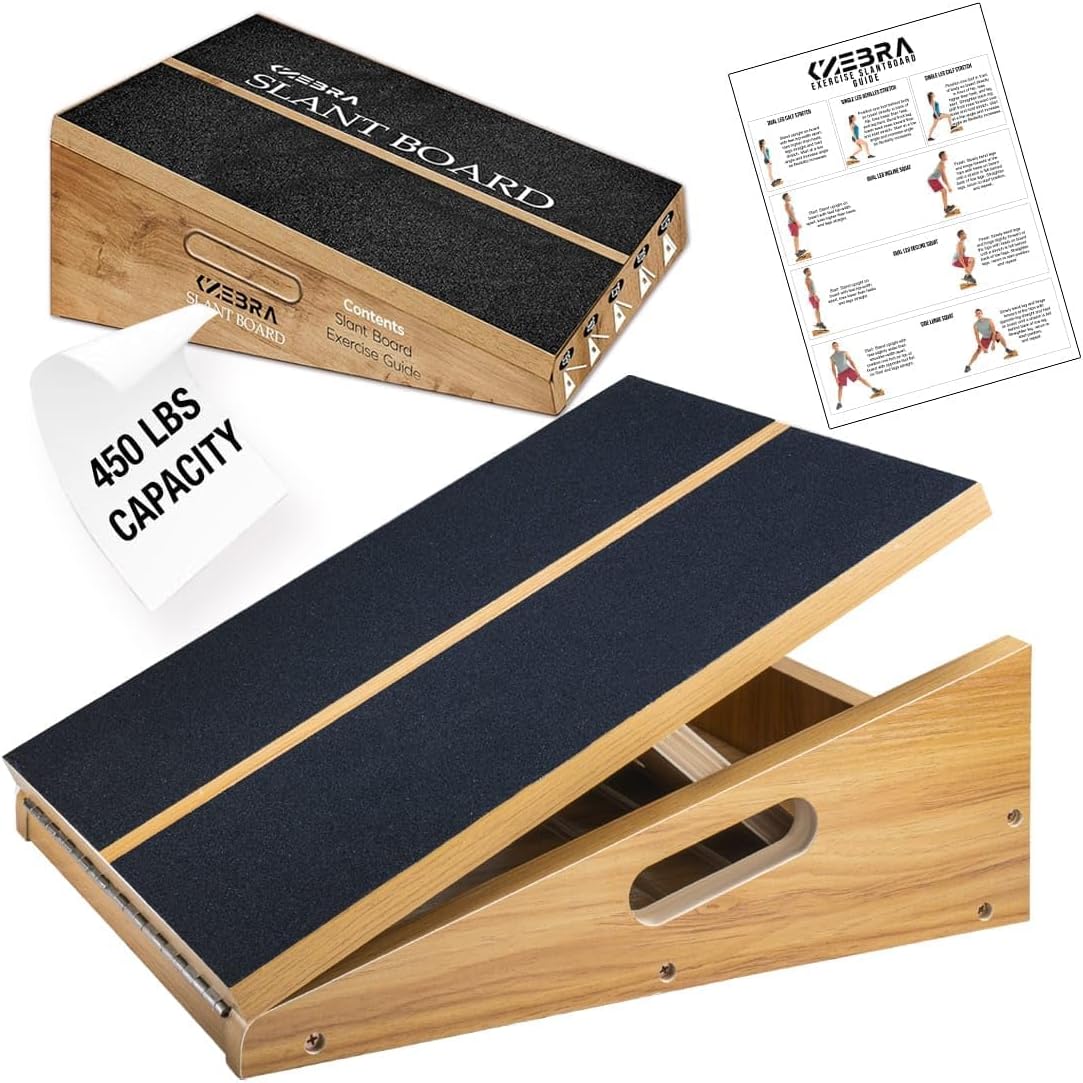
Most exercises in this guide require only an adjustable slant board (5-position, at minimum 15°–35° range) and a stable surface. A few strength exercises optionally use a light dumbbell or resistance band. No other equipment is needed. For board recommendations, see our full Amazon slant board review. For angle-type decisions, see Adjustable vs Fixed Slant Boards.
Achilles Tendinopathy Exercises
The slant board eccentric heel drop is the most clinically studied exercise in the management of Achilles tendinopathy. The landmark Alfredson protocol (1998) demonstrated that heavy, slow eccentric loading of the Achilles on a declined surface produces superior outcomes to conventional physiotherapy for chronic midportion Achilles tendinopathy — results that have been replicated consistently in subsequent research. These are the core exercises derived from that and follow-on protocols.
Achilles Exercises (4 Total)
EX 01
Eccentric Heel Drop — Bilateral
Achilles Tendinopathy
Beginner
Gastrocnemius · Soleus
3Sets
15Reps
15°Angle
3sEccentric
2×/dayFrequency
0Load
The foundational Achilles rehab exercise. Stand on the slant board with both feet, rise onto your toes using both legs, then slowly lower on one leg only over a 3-second count, feeling a controlled stretch through the calf and Achilles at the bottom. Use the non-working leg to return to the start position. This eccentric loading is the core stimulus for tendon remodelling.
How to Perform
- Stand on the slant board at 15°, feet hip-width apart, weight centred through both feet
- Rise up onto both toes — this is the concentric (lifting) phase, done with two legs
- Shift weight to one foot, then slowly lower the heel over 3 seconds until you feel a loaded stretch at the bottom
- Return to start by pushing through both feet — never use the single working leg to lift back up
- Complete all reps on the same leg before switching
✓ Key Cues
- The eccentric (lowering) phase is the therapeutic stimulus — never rush the descent
- Some discomfort in the Achilles during loading is expected and acceptable — sharp pain at the insertion point is not
- Keep the knee straight to target gastrocnemius; slightly bent knee targets the deeper soleus
↑ Progression
Weeks 1–3: 3×15 bodyweight. Weeks 4–8: progress to 3×15 with a loaded backpack or holding a dumbbell (Alfredson protocol uses heavy load — pain up to 5/10 during exercise is acceptable in chronic presentations). Progress angle from 15° → 25° as pain decreases.
EX 02
Eccentric Heel Drop — Bent Knee (Soleus Focus)
Achilles Tendinopathy
Beginner
Soleus · Achilles
3Sets
15Reps
15°Angle
3sEccentric
2×/dayFrequency
Identical to EX 01 but performed with a slight bend (15–20°) at the working knee. The bent knee position reduces gastrocnemius involvement and isolates the deeper soleus muscle, which contributes significantly to Achilles tendon load. The Alfredson protocol prescribes this as the second exercise alongside the straight-knee version — both should be completed in every session.
✓ Key Cues
- Maintain the same slight bend throughout — don’t let the knee straighten or deepen during the set
- The stretch sensation will feel deeper and lower compared to the straight-leg version
- If insertional Achilles tendinopathy is diagnosed (pain at the heel bone attachment), avoid end-range lowering — stop at neutral, not below
↑ Progression
Follow the same load progression as EX 01. Add weight once 3×15 at bodyweight is pain-free and easily controlled. The bent-knee version often lags behind the straight-knee version in load tolerance — progress each independently.
EX 03
Isometric Calf Hold on Slant Board
Achilles Tendinopathy
Acute Phase
Gastrocnemius · Soleus
5Sets
45sHold
15°Angle
2 minRest
Used in the acute or highly irritable phase when eccentric loading is too painful to begin. Stand on the slant board and hold a mid-range calf raise position (toes elevated, heel slightly raised) for 45 seconds. Isometric contractions produce immediate analgesic effects in tendinopathy — this is not simply stretching, it is a targeted pain-modulating loading strategy. Use this before progressing to EX 01 if acute pain prevents eccentric work.
✓ Key Cues
- Maintain 70–80% of maximal effort during the hold — it should feel challenging, not comfortable
- Bilateral hold to start; progress to single-leg once 5×45s bilateral is manageable
- Immediate pain reduction post-set is a good sign — this is the analgesic isometric effect working
EX 04
Single-Leg Calf Raise — Slow Tempo
Achilles Tendinopathy
Intermediate
Gastrocnemius · Soleus
3Sets
12Reps
20°Angle
3-1-3Tempo
A full concentric-eccentric single-leg calf raise on the slant board, used once the acute phase has resolved. The 3-1-3 tempo (3 seconds up, 1 second hold at top, 3 seconds down) maximises time-under-tension and builds capacity for daily-load activities like walking, running, and jumping. This bridges the gap between rehabilitation exercises and return-to-sport loading.
✓ Key Cues
- Achieve full toe-up height at the top of every rep — partial range means partial stimulus
- The incline on the slant board increases the loaded range compared to a flat surface — this is the therapeutic advantage
- Add weight (backpack or dumbbell) when 3×12 at bodyweight can be completed with 0–2/10 pain
↑ Progression
Progress to 3×15 before adding load. Then add 5kg and return to 3×12. Increase angle from 20° → 30° over weeks 8–12. Goal: 3×12 with significant added load at 25°+ before return-to-run.
Plantar Fasciitis Exercises
Plantar fasciitis (more accurately plantar fasciopathy) is driven by repetitive overload of the plantar fascia at its calcaneal attachment. The slant board addresses this from two directions: restoring calf and Achilles flexibility (tight posterior chain significantly increases plantar fascia tensile load) and progressively loading the plantar fascia through controlled dorsiflexion positions to stimulate tendon remodelling. Both components are required for full resolution.
Plantar Fasciitis Exercises (4 Total)
EX 05
Standing Calf Stretch — Static Hold
Plantar Fasciitis
Beginner
Gastrocnemius · Plantar Fascia
3Sets
60sHold
15°–20°Angle
2×/dayFrequency
The most commonly prescribed plantar fasciitis exercise in outpatient physiotherapy. Stand on the slant board with feet parallel, knees straight, and hold the stretch position for 60 seconds. The slant board positions the ankle in controlled dorsiflexion, placing a consistent tensile load on both the gastrocnemius-Achilles complex and the plantar fascia — addressing the most common mechanical driver of plantar heel pain. Morning sessions before first steps are particularly effective for the classic “first step” pain of plantar fasciitis.
✓ Key Cues
- Keep the knee fully extended — bending the knee reduces gastrocnemius stretch and reduces therapeutic effect
- Stand tall; don’t lean forward into a wall — the stretch comes from the board angle, not body lean
- A stretch sensation in the calf, Achilles, and sometimes the arch is expected and correct
↑ Progression
Begin at 15°. Progress to 20° after 1–2 weeks if 60s holds are comfortable. Add a bent-knee version (EX 06) alongside this exercise to address the soleus component. Maintain this exercise for the full 12-week standard plantar fasciitis protocol minimum.
EX 06
Bent-Knee Calf Stretch — Soleus & Achilles
Plantar Fasciitis
Beginner
Soleus · Achilles · Plantar Fascia
3Sets
60sHold
15°Angle
2×/dayFrequency
Identical to EX 05 but performed with a gentle bend (15–20°) at the knee. The bent knee position removes the gastrocnemius from the stretch and targets the deeper soleus muscle, which is a primary contributor to restricted ankle dorsiflexion in plantar fasciitis patients. Research consistently shows that both straight-knee and bent-knee calf stretching are required for optimal plantar fasciopathy outcomes — performing only one misses half the posterior chain restriction.
✓ Key Cues
- Feel the stretch lower and deeper in the calf than EX 05 — that’s the soleus
- Keep the heel fully in contact with the board — don’t let it lift
- Both feet on the board for bilateral stretching is fine; progress to single-leg once comfortable
EX 07
Plantar Fascia Load — Toe Extension Stretch
Plantar Fasciitis
Beginner
Plantar Fascia · Intrinsic Foot
3Sets
30sHold
20°Angle
2×/dayFrequency
Stand on the slant board and rise onto the balls of the feet and toes (toe-raise position), holding for 30 seconds. The dorsiflexed ankle on the board combined with active toe extension directly loads the plantar fascia through its full functional range, stimulating fascial remodelling more specifically than passive calf stretching alone. This is the exercise most directly targeting plantar fascia tissue adaptation.
✓ Key Cues
- Rise as high onto the toes as possible — a deep ache in the arch is the therapeutic sensation
- Hold the top position; don’t pulse — sustained load is the stimulus
- Start bilateral; progress to single-leg once bilateral 3×30s is manageable without >4/10 pain
EX 08
Weighted Calf Raise on Slant Board
Plantar Fasciitis
Intermediate
Gastrocnemius · Soleus · Plantar Fascia
3Sets
12–15Reps
20°–25°Angle
3sEccentric
Progressive loaded calf raises on the slant board, used in the load-tolerance phase (typically weeks 4–8 of a plantar fasciitis programme). Hold a dumbbell at your side or wear a loaded backpack. The combination of heel elevation (from the board angle) and full calf-raise range provides progressive tensile loading across the plantar fascia and Achilles-calf complex — the required stimulus for tissue remodelling and tolerance to walking and running loads.
✓ Key Cues
- Full range: heel as low as comfortable on the board at the bottom, full rise to tiptoe at the top
- The eccentric lowering phase (3 seconds down) is the primary loading stimulus — prioritise control
- Begin with 5–10kg. Progress by 2.5–5kg when 3×15 is completed with ≤2/10 discomfort
Knee Rehab — Patellofemoral Pain & VMO Strengthening
The slant board is a primary clinical tool for two distinct knee conditions: patellofemoral pain syndrome (PFPS), where VMO weakness and poor patellar tracking cause anterior knee pain; and general quad atrophy following knee surgery, injury, or disuse. Both conditions benefit from controlled knee loading in the dorsiflexed position — which the slant board enables with better safety and precision than flat-surface quad exercises in early rehabilitation stages.
For the comprehensive case behind slant boards and knee health, see: Slant Boards: Squat Better, Fix Your Knees.
Knee Rehab Exercises (4 Total)
EX 09
Slant Board Squat — Controlled Descent
Patellofemoral Pain · VMO
Beginner
VMO · Quad · Glute
3Sets
10–15Reps
20°Angle
3-1-2Tempo
3×/wkFrequency
A full bilateral squat on the slant board using a 3-second descent, 1-second pause at the bottom, and 2-second ascent. The slant board angle increases ankle dorsiflexion, allowing the knee to travel further over the toes in an upright torso position — the preferred VMO loading position. The slow tempo maximises time-under-tension at the angles where VMO is most active (60–90° knee flexion).
How to Perform
- Stand on the slant board, feet hip-width apart, toes forward or slightly turned out
- Descend slowly over 3 seconds — allow the knees to track directly over the toes throughout
- Pause for 1 second at the bottom (90° knee bend minimum)
- Drive through the full foot to stand in 2 seconds
- At the top, squeeze the quads hard for 1 second before beginning the next rep
✓ Key Cues
- Knee tracking is the priority — if knees collapse inward (valgus), reduce depth until glute strength improves
- Chest upright throughout — the slant board should allow this without forward lean
- Mild anterior knee ache (2–3/10) during the exercise is acceptable for patellofemoral rehab — sharp pain is not
↑ Progression
Bodyweight for 2–3 weeks. Progress to goblet squat (holding a light dumbbell at chest) once 3×15 is controlled. Increase angle from 20° → 30° as mobility allows. Single-leg variations (EX 11) introduced at week 4–6.
EX 10
Terminal Knee Extension (Band) on Slant Board
Patellofemoral Pain · Post-ACL
Beginner
VMO · Distal Quad
3Sets
15Reps
15°Angle
2s holdAt lockout
Attach a resistance band to a fixed point (door anchor or rack) behind you at knee height. Stand on the slant board facing away from the anchor, band looped around the back of the knee. From a slightly flexed knee position, extend the knee to full lockout against the band resistance and hold for 2 seconds. The slant board’s incline loads the exercise in the ankle-dorsiflexed position that maximises VMO activation at terminal extension — the most clinically relevant range for patellofemoral tracking improvement.
✓ Key Cues
- Full extension at the top — “lock out” the knee completely; the VMO fires hardest here
- Band tension should be moderate — enough to feel resistance, not enough to disrupt balance
- Maintain upright posture on the slant board; hold a wall if balance is the limiting factor
EX 11
Single-Leg Squat on Slant Board
Patellofemoral Pain · VMO
Intermediate
VMO · Quad · Glute Med
3Sets
8–10Reps
20°–25°Angle
3-1-2Tempo
A single-leg squat performed on the slant board — the most demanding and functional VMO exercise in this guide. The unilateral loading exposes and addresses side-to-side strength asymmetries (common post-injury) while the slant board angle maintains optimal ankle-knee joint geometry for VMO activation throughout the range. This is the bridge between rehabilitation and return to sport.
✓ Key Cues
- Hold a light dumbbell (2.5–5kg) in the opposite hand to load the working leg asymmetrically and challenge lateral stability
- Watch for knee cave (valgus) — if the knee tracks inward, reduce depth and add glute-strengthening work
- Use a finger-touch on a wall for balance assistance initially — remove this as stability improves
EX 12
Slant Board Split Squat
Knee Strength · ATG
Advanced
VMO · Quad · Hip Flexor
3Sets
8Reps
25°–30°Angle
3-0-2Tempo
Place the front foot on the slant board, rear foot on the floor. Descend into a split squat, allowing the front knee to travel well past the toes due to the inclined surface. The slant board on the front foot dramatically increases quad and VMO loading depth compared to a flat-surface split squat, while the incline keeps the ankle loaded through its full dorsiflexion range. This is the standard ATG-adjacent split squat movement used in performance knee programming.
✓ Key Cues
- Front knee should track over the toes and travel as far forward as comfortable — this is the point of the slant board
- Upright torso: avoid forward lean; the depth comes from the ankle, not the hips
- Add dumbbells at sides when 3×8 bodyweight is controlled with full depth
↑ Progression
Bodyweight split squat → goblet-hold split squat → dumbbell split squat → barbell split squat. Increase angle from 25° → 35° as ankle mobility and quad strength progress. This exercise is the final stage before full ATG split squat programming — see
the ATG guide for the full continuum.
Ankle Mobility Exercises
These exercises are not rehabilitation for injury — they’re the systematic method for improving ankle dorsiflexion range in athletes whose squat depth, landing mechanics, or lower limb loading patterns are limited by restricted ankle mobility. Consistent use over 6–12 weeks produces measurable improvements in active dorsiflexion range. For why this matters for squatting specifically, read Slant Board Squat vs Heel Elevated Squat.
Ankle Mobility Exercises (3 Total)
EX 13
Loaded Calf Stretch — Progressive Angle
Ankle Mobility
Beginner → Advanced
Gastrocnemius · Ankle Capsule
3Sets
90–120sHold
Start 15°→ Progress
DailyFrequency
The foundational ankle mobility exercise. Stand on the slant board at the angle that produces a moderate (not maximal) calf stretch. Hold for 90–120 seconds per set. The combination of sustained loading time and joint position stimulates both fascial tissue lengthening and joint capsule adaptation — the two primary restrictors of ankle dorsiflexion. Progress the angle by 5° every 2–3 weeks. Daily frequency produces faster results than 3×/week.
✓ Key Cues
- Hold a dumbbell at your sides to add load — weighted stretching produces faster fascial adaptation than bodyweight alone
- Track your angle monthly: note the angle at which you feel a moderate stretch. This should decrease over time as mobility improves.
- Best done first thing in the morning and pre-training
↑ Progression
Week 1–2: 15°, bodyweight, 90s. Week 3–4: 20°, add 5–10kg dumbbell. Week 5–8: 25°, 2×90s per leg single-leg. Week 8–12: 30°–35°, loaded. Goal: comfortable bilateral flat-floor squat depth.
EX 14
Deep Squat Hold on Slant Board
Ankle Mobility · Squat
Intermediate
Ankle · Hip · Thoracic
3Sets
60sHold
20°–30°Angle
DailyFrequency
Descend into a full squat on the slant board and hold the bottom position for 60 seconds. The loaded deep squat position applies traction through the entire lower limb kinetic chain — ankle, knee, hip, and lumbar spine — simultaneously. The slant board allows athletes to reach a full squat depth they cannot yet achieve on flat ground, enabling the joint capsule and posterior chain to accumulate time-under-tension in the mobility-limiting range.
✓ Key Cues
- Hold a dumbbell at arm’s length in front of your chest as a counterweight if balance is the limiting factor
- Heels must stay on the board throughout — heel rise negates the ankle mobility stimulus
- Relax into the position progressively over the first 20 seconds; don’t resist the stretch
EX 15
Dorsiflexion Oscillations — Dynamic Mobility
Ankle Mobility · Warm-Up
Beginner
Ankle · Calf · Achilles
2Sets
20Reps
20°Angle
Pre-trainingWhen
Stand on the slant board and perform slow, controlled knee-drive oscillations — push both knees forward over the toes in unison, hold for 2 seconds at maximum dorsiflexion depth, then return. This is a dynamic mobility drill that loads the ankle through active range of motion, stimulating synovial fluid distribution and preparing the ankle capsule for loaded squat training. Use as a pre-training warm-up exercise rather than a primary mobility exercise.
✓ Key Cues
- Drive the knees as far forward as possible without heel lift — maximum range every rep
- This is a warm-up drill, not a strength exercise — light, controlled, rhythmic
- Progress to single-leg once bilateral 2×20 feels easy
Squat & Quad Strengthening Exercises
These exercises use the slant board as a performance tool rather than a rehabilitation instrument — appropriate for athletes with no acute injury who want to use the board to increase squat depth, develop quad mass, and reduce reliance on heel elevation over time.
Squat & Strength Exercises (3 Total)
EX 16
Goblet Squat on Slant Board
Squat Strength · Quad
Intermediate
Quad · VMO · Core
4Sets
10–12Reps
25°–30°Angle
3-1-2Tempo
Hold a dumbbell at chest height in both hands and perform a full-depth squat on the slant board. The goblet hold creates anterior loading that reinforces the upright torso position the slant board already promotes, and the combined effect produces the highest quad and VMO activation of any bilateral squat variation accessible without a barbell. The standard home gym quad-building exercise.
✓ Key Cues
- Dumbbell should touch the sternum at the top and sit just above the thighs at the bottom
- Full depth: aim for thighs parallel or below — the slant board should make this comfortable
- Progress load: add 2.5–5kg when 4×12 is completed with 2 reps in reserve
↑ Progression
10kg → 20kg → 30kg+ over 8–12 weeks. Add a 1-second pause at the bottom to increase VMO stimulus when load progression stalls. Progress board angle from 25° → progressively lower as raw ankle mobility improves.
EX 17
ATG Split Squat on Slant Board
Squat Strength · ATG
Advanced
Quad · VMO · Hip Flexor
3–4Sets
8–10Reps
30°–35°Angle
Full ROMDepth
Place the front foot on the slant board at 30°–35° and perform a full-depth split squat, allowing the front knee to travel maximally over the toes. This is the full ATG split squat movement — the exercise that the slant board community was built around. The inclined front foot enables the depth that builds true knee health, quad mass, and the ankle mobility that transfers to all lower-body movements.
✓ Key Cues
- Knee tracks over the second toe at all times — never collapses inward
- Front heel stays flat on the board — it should not rise during the movement
- Upright torso throughout the full range — forward lean is a sign of insufficient hip flexor length or quad strength
EX 18
Sissy Squat Progression on Slant Board
Quad Isolation · Patellar Tendon
Advanced
Rectus Femoris · VMO · Patellar Tendon
3Sets
8–12Reps
25°Angle
3sEccentric
From a standing position on the slant board, hinge at the knees and slowly lower the body backward, keeping the hips extended and the torso straight (a reverse lean). The slant board provides the toe-elevated position that allows the full range of rectus femoris and patellar tendon loading that the flat-floor sissy squat approximates but cannot achieve. Used in patellar tendinopathy management and advanced quad development.
✓ Key Cues
- Hips stay extended — this is a pure knee-hinge, not a squat. Hips dropping forward reduces the quad isolation
- Grip a fixed object in front for balance — the movement is difficult without a counterbalance initially
- Not appropriate for acute patellofemoral pain or patellar tendinopathy without PT guidance — this is an advanced tendon-loading exercise
Sample Weekly Protocols by Condition
These protocols combine the exercises above into structured weekly programmes matched to specific conditions. Follow for a minimum of 8–12 weeks for measurable outcomes.
Protocol A — Achilles Tendinopathy (Alfredson-Based)
✓ 12-Week Minimum
1
Isometric Calf Hold (EX 03)
Acute phase only (weeks 1–2). Use before eccentric work if pain is high.
5 × 45s
2
Eccentric Heel Drop — Straight Knee (EX 01)
Twice daily, every day. Core Alfredson exercise.
3 × 15
3
Eccentric Heel Drop — Bent Knee (EX 02)
Twice daily, every day. Immediately following EX 01.
3 × 15
4
Single-Leg Calf Raise Slow Tempo (EX 04)
Add from week 4 once eccentric work is established.
3 × 12
5
Loaded Calf Stretch (EX 13)
Daily. Separate session from eccentric work.
3 × 90s
Protocol B — Plantar Fasciitis
✓ 3× Per Week + Daily Stretch
1
Static Calf Stretch — Straight Knee (EX 05)
Daily, morning and pre-activity. Non-negotiable throughout protocol.
3 × 60s
2
Bent-Knee Calf Stretch (EX 06)
Daily, immediately following EX 05.
3 × 60s
3
Plantar Fascia Load — Toe Extension (EX 07)
3× per week. Builds plantar fascia load tolerance.
3 × 30s
4
Weighted Calf Raise on Slant Board (EX 08)
Add from week 4. Progressive loading — start light.
3 × 15
Protocol C — Patellofemoral Pain & VMO Strengthening
✓ 3–4× Per Week
1
Slant Board Squat — Controlled (EX 09)
Foundation exercise. Every session.
3 × 12
2
TKE on Slant Board (EX 10)
Weeks 1–4. Direct VMO terminal-extension work.
3 × 15
3
Loaded Calf Stretch (EX 13)
Daily. Reduces posterior chain tension on patella.
2 × 90s
4
Single-Leg Squat (EX 11)
Add from week 4–6 once bilateral squat is pain-free.
3 × 8
5
Goblet Squat (EX 16)
Add from week 4. Progressive quad loading.
4 × 10
💡
Track your pain score (0–10) at the start of every session. A consistent score of 0–2 means you can progress load or angle. A score of 3–4 means maintain current load. A score above 5 means reduce load, not stop training — complete rest rarely accelerates recovery in tendinopathy and fasciopathy.
Recommended Slant Boards on Amazon
Every exercise in this guide requires an adjustable slant board with at minimum 15°–35° range. Here are the five Amazon-verified boards we recommend — ranked in our full slant board review.
Frequently Asked Questions
How long before I see results from slant board rehab exercises?▾
Most patients notice meaningful pain reduction within 4–6 weeks of consistent protocol adherence (3–4 sessions per week minimum). Full tendon remodelling — the structural change that produces lasting resolution — typically takes 12–16 weeks for Achilles and plantar conditions. Ankle mobility improvements are often noticed earlier (6–8 weeks). The most common reason for slow progress is inconsistent frequency — these exercises need to be performed as prescribed, not occasionally. A useful benchmark: if you’re not seeing at least partial improvement by week 6, seek an individual physiotherapy assessment as your presentation may require modification.
Should I stop training while doing these rehab exercises?▾
For most conditions, complete rest is not required or recommended. Current physiotherapy consensus is that tendinopathies and fasciopathies respond better to graded loading than to rest. You should modify training to reduce the specific provocative loads — for Achilles issues, reduce running volume and impact; for plantar fasciitis, reduce prolonged standing and high-impact activities in the early weeks — while maintaining general fitness. Complete rest often delays recovery by reducing the tendon-loading stimulus that drives remodelling. The rehabilitation exercises replace, not merely supplement, the provocative activity.
Can I do these exercises if I’m post-surgery?▾
Only with clearance and specific guidance from your surgeon or physiotherapist. Post-surgical rehabilitation timelines vary significantly depending on the procedure, and self-prescribing exercises outside your clearance stage can damage healing tissue. Many of the exercises in this guide — particularly the eccentric loading protocols — are used in post-surgical rehabilitation, but the timing, range, and load parameters are determined by healing stage, not general protocol. Use this guide to understand the exercises; use your physiotherapist to determine when and how to apply them post-operatively.
Is it normal to feel soreness after slant board exercises?▾
Delayed onset muscle soreness (DOMS) 24–48 hours after sessions is normal and expected — especially when beginning eccentric loading protocols for the first time. The calf and soleus muscles are often undertrained relative to their functional demands, and the eccentric protocols produce significant muscle damage as part of the remodelling process. What is not normal: sharp pain during the exercises (above 4–5/10), pain that persists beyond 48 hours, or swelling that increases after sessions. Use the traffic light system: green (0–2/10 pain or soreness) = progress normally; yellow (3–4/10) = maintain current load; red (5+/10) = reduce load and consult a physiotherapist.
What angle should I use for plantar fasciitis stretching?▾
Start at 15° and progress to 20° after 1–2 weeks. For plantar fasciitis, the therapeutic window is a moderate stretch — one that produces a noticeable pulling sensation through the calf and arch without being uncomfortable enough to cause guarding. Too shallow (under 15°) provides minimal stimulus; too steep too early can aggravate the condition. Most plantar fasciitis patients find their working angle settles between 15° and 25° for the stretching exercises, and they progress through this range over the 12-week protocol. Once the condition has resolved, continued use at 20°–30° maintains the calf flexibility that prevents recurrence.
Do I need an expensive slant board for these exercises?▾
No — a mid-range board at ~$45–$60 is fully adequate for every exercise in this guide. The KZEBRA at ~$45 and the StrongTek Professional at ~$60 both cover the 15°–35° angle range used across all protocols, with sufficient stability for single-leg loading and weight capacity for any loaded calf raise or squat variation. The expensive boards (Shogun VMO Pro at ~$100) are justified for ATG and step-up training, not for rehabilitation stretching. The cheap boards (unbranded pine under $25) are not recommended — they lack the angle precision and surface stability that rehab protocols require. See the full equipment review at
Best Slant Boards for Home Use.
18 Exercises, Four Conditions, One Tool
The slant board appears in physiotherapy clinics worldwide because it solves a specific mechanical problem with precision: it places the ankle, calf, Achilles, plantar fascia, and knee in exactly the loaded positions that drive tissue adaptation. The exercises in this guide represent the clinically-supported core of what that tool can do — from acute Achilles rehab through advanced ATG squat development.
The single most important variable is consistency. These protocols work when performed as prescribed, for the full programme length. Pick the protocol that matches your condition, commit to it for 12 weeks, and track your pain score every session. The board does the rest.
NEED A SLANT BOARD?
See the top 5 PT-recommended Amazon picks — tested and ranked for 2026.
View Top 5 →