Adjustable vs Fixed Slant Boards — Which Should You Buy?
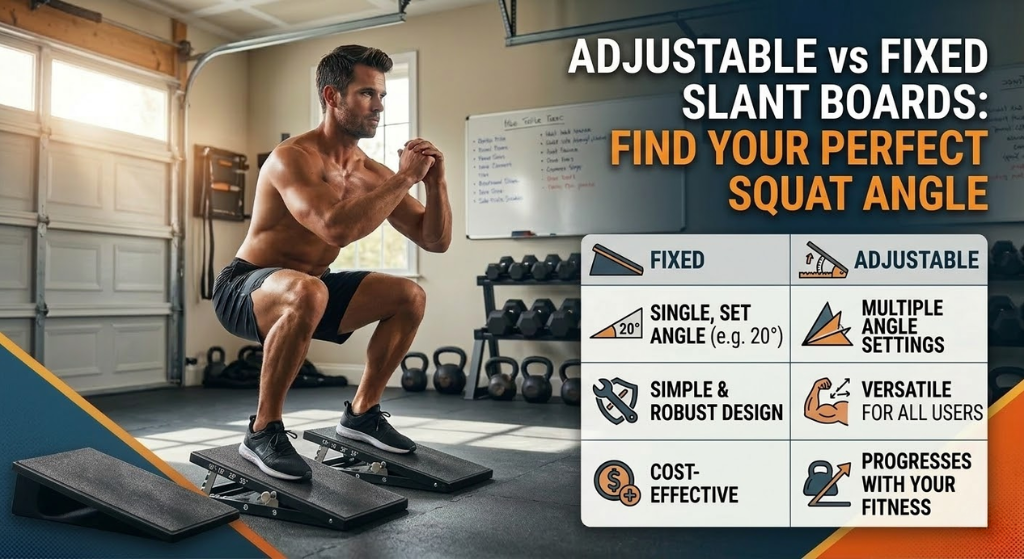
Adjustable slant boards let you dial in the exact incline you need and reduce it progressively as ankle mobility improves. Fixed boards are simpler, cheaper, and more rigid under heavy load. This comparison breaks down every meaningful difference — angle range, stability, durability, price, and which board fits which training goal — so you can make the right call before you buy.
⚡ The Short VersionBuy the adjustable board for almost all home gym use. The ability to start at a higher angle and progressively reduce it as mobility improves is the correct therapeutic and training progression — a fixed board cannot do this. The price difference is $15–30, which is negligible given the additional utility. The one clear exception: if you know you will always train at one specific angle and want the most rigid platform possible for heavy loaded work, a fixed board’s one-piece construction has a genuine structural advantage.
$20–30Typical price gap between fixed and adjustable — small for the added utility
5–7Angle positions on most adjustable boards — covers every training and rehab use case
1Angle on a fixed board — the angle you buy is the angle you use, permanently
Adjustable Slant Boards — Full Deep Dive
Adjustable slant boards use a locking hinge or pin-slot mechanism to set the incline across a range — typically 15° to 35° in 5° increments, giving 5–7 distinct positions. The platform surface is usually non-slip rubberised grip or texture-stamped plastic. Most fold flat for storage. Weight capacity is typically 300–350 lbs for home-grade boards.
🔶 Adjustable Board
The Progressive Training Tool
The defining advantage of the adjustable board is matching the incline precisely to where your ankle mobility is today, then reducing it systematically as that mobility improves. Start at the angle that allows your goal movement with good form, reduce by 2.5–5° every 3–4 weeks — the board progressively challenges mobility improvement rather than simply accommodating it indefinitely. Most rehab protocols for patellar tendinopathy, PFPS, and ankle dorsiflexion restriction specify an adjustable surface for this reason. A fixed board locks you into a single loading position that may be too much or too little for your exact presentation.
The secondary advantage is versatility across exercises. A 15° angle is ideal for daily passive standing and calf stretching; 20° is the sweet spot for goblet squats and single-leg work; 25–30° provides maximum anterior knee drive for early-stage tendon loading and isolation work. Having all positions in one tool means you’re never limited by what you bought.
✅ Advantages
Progressive angle reduction — matches and drives mobility improvement
Correct approach for ankle dorsiflexion restriction rehab
Single tool covers every angle needed across all exercises
Matches all rehab protocols specifying angle adjustment
Lower settings (15°) comfortable for extended passive standing
Usually folds flat — easy storage in home gym
Better resale value on the secondhand market
❌ Disadvantages
$15–30 more expensive than a comparable fixed board
Locking mechanism is a wear point — pins degrade over years
Slightly less rigid than one-piece construction under very heavy loads
Heavier and bulkier than a fixed board
Adjustment takes 10–20 seconds between positions
Budget versions develop hinge play within 12–18 months
Fixed Slant Boards — Full Deep Dive
Fixed slant boards are moulded or machined as a single rigid piece — typically injection-moulded high-density plastic, solid wood, or welded steel — at a single predetermined angle, most commonly 25° or 30°. No moving parts, no hinges, no adjustment mechanism. What you buy is what you get, permanently.
🟣 Fixed Board
Maximum Stability, Minimum Complexity
The case for a fixed board is straightforward: one-piece construction is inherently more rigid than a hinged mechanism, and rigidity matters under heavy loaded single-leg squats or barbell-assisted slant work. There is no mechanism to wear, no pin to misalign, and no wobble to develop over years of training. The board performs identically in year one and year ten — no maintenance, no replacement parts, no adjustment required.
Fixed boards make clear sense when you have done the mobility work and know exactly what angle you need long-term. An intermediate lifter who has resolved ankle restriction and wants a 25° board permanently for single-leg squat work and calf raises has no use for adjustability they’ll never need. Simplicity has value — and for some users the absence of a hinge under heavy load is a meaningful rather than trivial point.
✅ Advantages
Maximum structural rigidity — zero flex or wobble under heavy load
No moving parts — nothing to wear, misalign, or fail
$15–30 cheaper than comparable adjustable boards
Lighter and easier to move around the gym
Long-term durability essentially unlimited for quality materials
Simpler to use — no adjustment between sets
Solid hardwood options suit home gym aesthetics well
❌ Disadvantages
Cannot reduce angle as mobility improves — undermines the progression model
One angle may be too steep for extended passive standing
Cannot accommodate different exercises needing different angles
Wrong angle at purchase means buying a second board
Less appropriate for formal rehab protocols specifying progressive reduction
No flexibility for asymmetrical restrictions needing angle changes
25–30° may be uncomfortable for long daily standing
🔶 Adjustable
Exercise versatility
Covers all exercises at the optimal angle per movement
Limited to exercises suited to the fixed angle
🔶 Adjustable
Ease of use
10–20 sec adjustment between positions
Zero setup — use immediately
🟣 Fixed
Best for beginners
Yes — start high and reduce progressively
Only if fixed angle matches current mobility
🔶 Adjustable
Heavy loaded squats
Good — adequate for most home gym loads
Best — maximum stability at extreme loads
🟣 Fixed
Value for most users
Higher — more utility per dollar across training lifecycle
Good value if you know exactly what you need
🔶 Adjustable
Category-by-Category Winners
🔶 Adjustable Wins — Progressive Mobility Training
The Only Tool That Drives Its Own Obsolescence
Start at 25–30° when ankle restriction is severe, reduce to 20° once the movement is easy, then 15°, and eventually flat. This is the correct progression model — the board’s assistance decreases as your ankle range increases. A fixed board keeps the ankle compensation constant, accommodating the restriction indefinitely without systematically challenging it. For anyone using a slant board primarily to improve mobility, adjustable is the only appropriate choice.
🟣 Fixed Wins — Structural Integrity Under Load
One-Piece Construction Has No Flex, No Wobble, No Wear
For heavily loaded single-leg squats or any movement with significant external load, the one-piece rigidity of a fixed board is a genuine advantage. The hinge mechanism of an adjustable board introduces a flex point that is unnoticeable at bodyweight but detectable under heavy external load — particularly if the hinge has seen years of use. A solid-construction fixed board simply does not flex. If heavy loading at a known angle is your primary use case, fixed is the right tool.
🟣 Fixed Wins — Long-Term Durability
No Moving Parts Means Nothing Breaks
The locking mechanism of an adjustable board is where quality differences between products become most apparent over years of use. Budget adjustable boards develop hinge play within 12–18 months. Higher-quality boards hold their mechanism well, but even the best hinge accumulates wear. A fixed board made from quality hardwood or welded steel has a lifespan measured in decades. If long-term durability matters most and you know your working angle, fixed is the more durable purchase.
🔶 Adjustable Wins — Rehabilitation Protocols
Most PT Protocols Specify Progressive Angle Reduction
Patellar tendinopathy HSR protocols, PFPS rehab progressions, and post-surgical return-to-load programmes typically include angle adjustment as a progression variable. Starting at a higher angle and reducing it as the tendon and muscle adapt is standard practice. A fixed board can be used within these protocols only if its angle happens to match the required position — you cannot adjust it when the protocol says to. See our PT-approved exercise guide for full protocol details.
🤝 Tie — Storage and Footprint
Both Fit Neatly in a Home Gym
Adjustable boards fold flat — their stored footprint is similar to a fixed board’s active footprint. Fixed boards are a simple wedge: small, light, and easy to slide under a bench or rack. Neither type presents a meaningful storage disadvantage for a home gym. Base the decision on training criteria, not storage.
Score Comparison
🔶 Adjustable Board
Versatility
9.6
Rehab Suitability
9.5
Mobility Progression
9.8
Value for Most Users
9.0
Structural Rigidity
7.8
Long-term Durability
8.0
Price
7.2
🟣 Fixed Board
Versatility
4.8
Rehab Suitability
6.2
Mobility Progression
3.8
Value for Most Users
7.6
Structural Rigidity
9.7
Long-term Durability
9.6
Price
9.2
Which One Is Right for You?
Work through the scenarios below. Each row presents a situation and the board type that serves it better.
🔍 Find Your Board Type
You’re addressing limited ankle mobility and want to squat deeper over time
Heels rise on flat-floor squats — you want to train out of the restriction progressively
Adjustable
You’re following a physio rehab protocol for knee tendinopathy or PFPS
Your PT has prescribed specific angle progressions or told you to reduce incline over time
Adjustable
You want to stand on it daily for 10–15 minutes as a passive calf stretch
High fixed angles (25–30°) are often uncomfortable for extended passive standing
Adjustable
You’ve resolved your ankle mobility and always train at 25°
Mobility is solid — you want the board for loaded VMO work at a consistent angle
Fixed
You perform very heavy loaded single-leg squats and need maximum stability
External load is significant — you want zero hinge flex under peak effort
Fixed
You’re on a tight budget and know exactly what angle you need
$20–40 fixed vs $40–70 adjustable — the savings matter for your setup
Fixed
You’re buying your first slant board and aren’t sure what angle you’ll need
Unknown starting point — you want to adjust as you learn what works for you
Adjustable
You want one board for calf stretching, squats, lunges, and single-leg work
Different exercises benefit from different inclines — you want the full toolkit
Adjustable
You want a board that lasts 10+ years with zero maintenance
Durability matters more than flexibility — a hardwood fixed board never wears out
Fixed
You’re unsure — you want the safest, most useful default choice
If in doubt, adjustable serves the vast majority of home gym users better
Adjustable
✅ Our RecommendationFor the majority of home gym users, buy the adjustable board. The $20–30 premium buys you the ability to match your current mobility, drive progressive improvement, cover every exercise at its optimal angle, and use it comfortably for extended passive standing. The fixed board’s rigidity advantage only becomes meaningful at loads beyond what most home gym single-leg squat training involves. If you’re already experienced, have known good ankle mobility, and want a board specifically for heavy loaded work at one angle, fixed is a perfectly valid choice — but adjustable serves everyone else better.
💡
If you’re buying fixed, choose 25°. It’s steep enough for effective VMO isolation and tendon loading, but not so extreme it makes passive standing uncomfortable or forces excessive forward lean in beginner squats. 25° is the most versatile single angle for a fixed purchase.
At bodyweight and moderate loads, adjustable boards are stable enough for all standard slant board exercises. The hinge locks firmly with no perceptible flex during single-leg squats, goblet squats, and calf work on quality boards. The rigidity difference becomes detectable under heavy external loading — typically above 30–40 kg additional weight — where one-piece construction has a tangible advantage. For 95% of home gym use, adjustable boards are stable enough that the difference is not a practical concern.
25° is the most versatile single angle for a fixed board. It provides meaningful ankle compensation for most users with moderate restriction, produces effective VMO loading and anterior knee drive during squats, and is workable for calf raises and passive standing. At 30° the incline starts to feel extreme for most users during dynamic squatting. If your ankle restriction is severe — heel rises significantly on flat squats — consider 30°. Otherwise, 25° covers most needs.
Quality matters significantly. Budget adjustable boards (under $35) often develop hinge play within 12–18 months of regular use — the pin-slot mechanism loses its tight lock and the board rocks slightly under load. Mid-range boards ($40–70) from reputable brands maintain their mechanism well for 3–5+ years. Signs of quality: the hinge uses a metal pin rather than plastic clips, locking positions click firmly with no play, and the pivot is reinforced rather than moulded. Reading Amazon reviews specifically for long-term hinge durability is the best pre-purchase research you can do on adjustable boards.
Yes — a fixed slant board is usable for most rehabilitation exercises, including patellar tendinopathy HSR protocols, PFPS VMO work, and Achilles tendinopathy eccentric calf loading. The limitation is that you can’t adjust angle as rehab progresses — but in many cases a fixed 25° board covers the entire protocol at one appropriate angle. A fixed board becomes genuinely limiting if your physiotherapist prescribes a specific starting angle that doesn’t match your board, or if the protocol explicitly specifies reducing angle as a milestoned progression step. See the PT-approved exercises guide for full details.
For a fixed board, solid hardwood (typically birch or beech plywood) is generally superior to injection-moulded plastic in rigidity, load capacity, and long-term durability. Wood doesn’t flex, doesn’t crack under impact the way some plastics do, and develops no creaks over time. The downsides: wood can be damaged by sustained moisture exposure, it’s heavier than plastic, and quality wooden boards typically cost $35–60 vs $20–35 for plastic. For indoor home gym use, hardwood is the premium option worth the extra cost if you’re buying fixed.
Weight plates produce a similar mechanical effect but with important practical limitations. Plates shift on hard flooring, producing an inconsistent and potentially unsafe surface. They’re not wide enough for single-leg work. The angle depends on what plates you own and can’t be adjusted precisely. And they don’t provide the stable, wide non-slip surface needed for passive standing. Plates are an acceptable temporary substitute for bilateral squats when you have no board — not a long-term training tool. See the full comparison at Slant Board Squat vs Heel Elevated Squat.
Default to Adjustable — The Price Difference Is Small
At a $20–30 price gap, the decision should almost always resolve in favour of the adjustable board. The only scenarios where fixed is clearly the better choice are when you know your working angle and never plan to change it, when you’re performing very heavy loaded work and want maximum rigidity, or when long-term durability over decades outweighs flexibility. For everyone else — beginners, rehabilitation users, people still building ankle mobility, and anyone wanting one tool for multiple exercises — the adjustable board is simply more useful per dollar.
Whatever you decide, both types will do the job. The difference between a good adjustable board and a good fixed board is far smaller than the difference between having a slant board and not having one. If you’re still on the fence, the best slant boards ranked guide has specific product recommendations for both types across every budget.