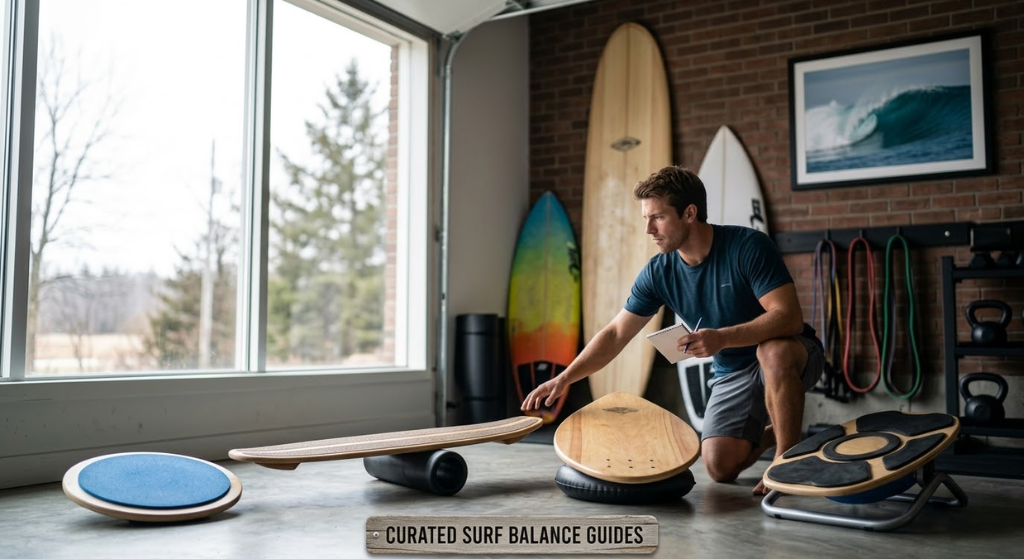
Quick Picks — Best Balance Boards for Surfers
⚡ Bottom Line Up Front
For experienced surfers who want maximum surf-feel off the water: Indo Board Original. For surfers focused on progressive lateral training and trick skill: Revolution 101. For strength + stability combined: StrongBoard. For injury prevention and ankle proprioception: Fitter First Pro. Complete beginners or those cross-training for surf fitness: BOSU Sport 50cm.
🔗 Related Surf Training Guides
How We Tested
Each board was evaluated over a minimum four-week period by surfers of varying skill levels — beginner through intermediate — with structured surf-specific training sessions logged daily. Boards were assessed across five criteria directly relevant to surf performance improvement.
Testing Criteria — Surf-Specific
🏄
Surf Stance Replication
How accurately the board replicates the lateral, dynamic balance demands of riding a wave — including heel-to-toe edge engagement.
🦵
Proprioceptive Load
The quality and intensity of ankle, knee, and hip proprioceptive challenge produced — the key mechanism linking balance training to on-water performance.
📈
Skill Progression Range
How wide a skill gap the board bridges — from a complete beginner getting on it for the first time to an advanced surfer using it for specific drills.
🔧
Build & Durability
Deck material, roller/fulcrum quality, weight capacity, and long-term structural integrity after sustained daily training use.
💰
Value for Money
Price versus performance — does the board deliver meaningful surf training benefit proportionate to its cost?
🎯
Surf Drill Versatility
Whether the board supports multiple surf training drills — pop-up simulation, cutback weight shifts, nose-riding stance, and off-season conditioning circuits.
#1 — Indo Board Original Trainer
01
Overall Rank
🥇 Best Overall
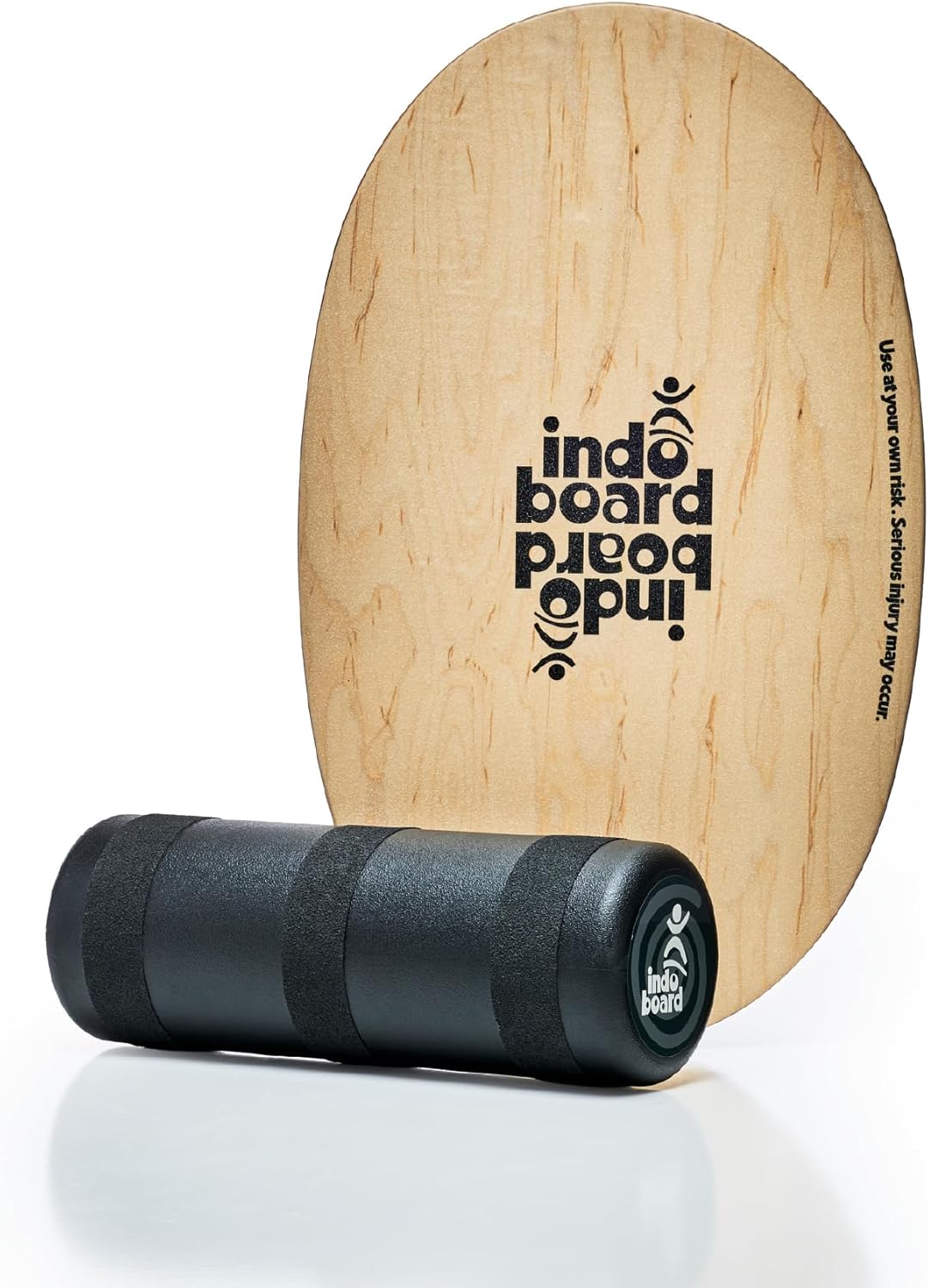
Indo Board Original Trainer
The surf industry standard — designed specifically for surfers, used by pros
30″×18″Deck Size
RollerType
250 lbsMax Weight
~$150Price
✓ Pros
- Designed by surfers, for surfers — Indo Board was created specifically for surf training, not adapted from general fitness equipment
- The 6″ diameter Indo Roller produces the most authentic wave-face lateral movement of any dry-land training tool
- 30″×18″ deck accommodates both regular and goofy stances with room for realistic weight shifts
- Extremely durable — grip tape deck, solid wood construction, withstands years of daily training
- Massive community, tutorial library, and progression programme available online
- Scales from beginner (cushion under roller) to advanced (tricks, nose-rides, no-look balancing)
✗ Cons
- Steep learning curve — most beginners fall off repeatedly in the first sessions; not appropriate for self-directed training without padding the surrounding area
- Roller can mark hardwood floors — use a mat
- At ~$150 it’s the most expensive entry in this list
- No ankle restraint — freedom is the point, but it can feel unsafe to cautious beginners
🏄 Surf Training Verdict
The Indo Board is the benchmark. No other dry-land training tool has been more directly validated by professional surfers — from Kelly Slater down. The roller-under-deck mechanism produces a lateral tipping instability that closely replicates the feel of trimming across a wave face, making every session directly transferable to on-water performance. The steep initial learning curve is by design — mastering the board at beginner level requires the same ankle-knee-hip coordination chain that surfing demands. For any intermediate-to-advanced surfer serious about off-season training, this is the non-negotiable choice.
🛒 Amazon Prime eligible — Ships with Indo Roller and deck. Cushion available separately for beginners.
#2 — Revolution 101 Balance Board
02
Overall Rank
💧 Best Roller Board

Revolution 101 Balance Board
High-quality Canadian maple roller board with structured skill progression
28″×10″Deck Size
RollerType
220 lbsMax Weight
~$100Price
✓ Pros
- 7-ply Canadian maple deck — excellent stiffness-to-weight ratio, comparable to skateboard deck quality
- 6.5″ PVC roller provides a slightly more forgiving ride than the Indo Board roller — better for surfers who struggle with the Indo Board’s initial difficulty
- Narrower deck (10″ vs 18″) demands more precision — translates well to narrow surfboard stances
- Trick-learning potential is high — spinning, manuals, and pivot tricks are all achievable, training the rotational body control surfers use on turns
- Better price point than Indo Board without significant performance compromise
✗ Cons
- Narrower deck limits realistic two-footed surf stance simulation compared to the Indo Board
- 220 lb weight limit is restrictive for larger surfers
- Less surf-brand heritage — Revolution is a skateboard/fitness brand rather than a dedicated surf training brand
🏄 Surf Training Verdict
The Revolution 101 hits the sweet spot between challenging and accessible. Its slightly smaller roller and narrower deck make it a more natural stepping stone from zero balance board experience to Indo Board-level proficiency — and at ~$100 it’s an excellent entry into dedicated roller board training. The trick-progression pathway is a bonus for surfers who want to develop rotational control alongside basic balance, mimicking the body rotations of bottom turns and cutbacks.
🛒 Amazon Prime eligible — Ships as complete board-and-roller set.
#3 — StrongBoard Balance Board
03
Overall Rank
💪 Best Spring Platform

StrongBoard Balance Board
Spring-loaded platform for loaded balance training and reactive surf conditioning
18″×18″Deck Size
Spring PlatformType
300 lbsMax Weight
~$180Price
✓ Pros
- Four-spring platform creates multi-directional instability — trains the ankle-knee-hip chain in all planes simultaneously
- Safe for loaded training — squats, overhead press, and dumbbell curls can be performed on the platform, building functional strength in an unstable environment
- 300 lb weight capacity — the highest of any board in this list
- Rubber feet prevent sliding on hardwood floors — no mat required
- Best board for surfers combining strength training with balance conditioning in a single session
✗ Cons
- Less surf-specific than roller boards — spring platforms don’t replicate lateral wave-face movement as directly
- Higher price point (~$180) for a board with a narrower surf-skill transfer application
- Not appropriate for pop-up simulation or surfing trick drills — it’s a conditioning tool, not a surf-replication tool
🏄 Surf Training Verdict
The StrongBoard occupies a distinct niche in the surf trainer lineup: it’s the best tool for surfers who want to build loaded balance — performing exercises like squats, deadlifts, and upper body work in an unstable environment that demands constant neuromuscular stabilisation. This translates directly to the active stabilisation surfers perform while paddling into bumpy conditions and during rail-to-rail transitions. If your off-season programme includes strength work, perform it on the StrongBoard and compress two training goals into one.
🛒 Amazon Prime eligible — Made in USA. Patent-pending spring design.
#4 — Fitter First Pro Rocker Board
04
Overall Rank
🌊 Best Wobble / Rocker Board

Fitter First Pro Rocker Board
Professional-grade wobble board — the physiotherapy standard for ankle and proprioception training
16″ RoundDeck Size
Rocker/WobbleType
300 lbsMax Weight
~$60Price
Beginner Accessibility9.0
✓ Pros
- Physiotherapy-clinic standard — the same rocker board used in ankle sprain rehabilitation worldwide
- Best board for ankle proprioception development — the curved base challenges the full 360° ankle stabilisation required for surfing in messy conditions
- Extremely safe for beginners — the rocker limits maximum tilt to a manageable range, preventing falls
- Compact and light — easily moved between home, gym, and surf trips
- Lowest price of any board in this list at ~$60
- Solid birch construction has lasted years in testing
✗ Cons
- Lowest surf-replication fidelity — the rocker motion doesn’t closely resemble wave-face movement
- Advanced surfers will outgrow the proprioceptive challenge quickly — it’s a foundation tool, not a performance tool
- Single-axis (rocker) or limited multi-axis (wobble) motion depending on variant selected
🏄 Surf Training Verdict
The Fitter First Pro earns its place through specialisation: no board develops ankle proprioception — the neurological foundation of all surf balance — more efficiently. For surfers returning from ankle sprains, those with chronic ankle instability, or beginners building the neuromuscular foundation before progressing to roller boards, this is the correct starting point. At ~$60 it’s the most accessible entry into dedicated balance training and represents exceptional value for the proprioceptive return it delivers. For the full comparison of wobble vs roller vs rocker mechanisms, see
Roller Board vs Wobble Board vs Rocker Board.
🛒 Amazon Prime eligible — Professional grade, ships with non-slip base pad.
#5 — BOSU Sport 50cm Balance Trainer
05
Overall Rank
🌱 Best for Beginners

BOSU Sport 50cm Balance Trainer
The classic half-dome — surf conditioning, functional fitness, and beginner-safe balance training
50cm domeSize
Half-DomeType
250 lbsMax Weight
~$130Price
✓ Pros
- Safest balance training tool for beginners — the dome limits maximum instability, making falls nearly impossible for most users
- Extremely versatile — squats, lunges, push-ups, mountain climbers, and pop-up simulations all work on the dome surface
- Flat side down (dome up) for balance training; dome side down (flat up) for an even greater instability challenge
- Surf conditioning circuits can be built entirely around the BOSU — burpees, surfer squats, single-leg balance holds
- Well-suited to surfers cross-training for overall fitness alongside surf-specific balance work
✗ Cons
- Lowest surf-stance replication score — the BOSU doesn’t move laterally in the way a wave does; it’s a conditioning tool more than a surf simulator
- At ~$130 it’s expensive for what experienced surfers will get from it — roller boards provide more direct surf-skill transfer at similar or lower cost
- Bulky — the 50cm dome takes up significant storage space compared to flat boards
🏄 Surf Training Verdict
The BOSU Sport is the safest entry point into surf conditioning — particularly for beginners who aren’t ready for the difficulty of roller boards, or for fit non-surfers who want to build the proprioceptive and core foundations before getting in the water. It won’t replicate the feel of a wave, but it will build the stability, core endurance, and single-leg balance that surf fitness demands. For a detailed comparison of the BOSU against dedicated surf balance boards, see
Balance Board vs BOSU Ball — Which Is Better for Surfers?
🛒 Amazon Prime eligible — Includes pump. 50cm Sport version is more compact than the full-size 65cm Pro.
Full Comparison Table
← scroll to see full table →
| Board |
Type |
Price |
Surf Feel |
Difficulty |
Weight Cap |
Best For |
| Indo Board Original |
Roller |
~$150 |
★★★★★ |
Advanced |
250 lbs |
Intermediate–Advanced surfers |
| Revolution 101 |
Roller |
~$100 |
★★★★☆ |
Intermediate |
220 lbs |
Lateral balance + trick progression |
| StrongBoard Balance |
Spring Platform |
~$180 |
★★★☆☆ |
Intermediate |
300 lbs |
Loaded strength + stability |
| Fitter First Pro |
Rocker/Wobble |
~$60 |
★★☆☆☆ |
Beginner |
300 lbs |
Ankle rehab + proprioception |
| BOSU Sport 50cm |
Half-Dome |
~$130 |
★★☆☆☆ |
Beginner |
250 lbs |
Surf conditioning + cross-training |
Surf Training Balance Board Buying Guide
The balance board market is flooded with general fitness products that aren’t designed with surfing in mind. Choosing one based on surf-specific training goals rather than general fitness ratings dramatically improves off-season training ROI. These are the questions that matter for surf training selection.
Match Board Type to Your Surf Skill Level
🏄 Which Board Type for Your Surf Level?
- Complete beginner surfer (0–1 years): Rocker/wobble board (Fitter First) or BOSU — build ankle proprioception and single-leg balance before adding lateral instability
- Progressing surfer (1–3 years): Revolution 101 roller board — adds the lateral instability that directly trains surfing’s primary balance demand
- Intermediate surfer (3–6 years): Indo Board Original — the standard tool for direct surf-feel training at this level; also add StrongBoard for loaded conditioning sessions
- Advanced surfer (6+ years, competing): Indo Board plus targeted rocker board for ankle maintenance — the combination of surf-specific lateral training and ankle stability is the complete off-season package
Roller Board vs Wobble Board vs Rocker Board
The three main balance board mechanisms produce fundamentally different balance challenges. For the complete technical breakdown of each type, see Roller Board vs Wobble Board vs Rocker Board. In brief:
- Roller boards (Indo Board, Revolution 101) — Best surf-feel replication. The deck rolls on a cylinder, producing the lateral tipping that most closely resembles trimming on a wave. Hardest to learn but highest surf-specific transfer
- Wobble/rocker boards (Fitter First) — Fixed fulcrum under the deck, tilts in one or all directions. Best for ankle proprioception and injury rehabilitation. Lower learning curve, slightly less surf-specific
- Spring/platform boards (StrongBoard) — Multi-directional instability via springs. Best for loaded balance training. Less surf-specific but adds loaded strength dimension unavailable from roller or wobble boards
- Half-dome (BOSU) — Inflatable dome provides compliant instability. Most beginner-friendly. Lowest surf-stance replication but highest exercise versatility for conditioning work
💡
The best surf training approach: Own two boards. A roller board (Indo Board or Revolution 101) for surf-specific lateral balance sessions, and a wobble board or BOSU for warm-up proprioception work, ankle maintenance, and cross-training circuits. The combination covers all surf balance demands across an off-season training block. See the complete off-season programme at
Balance Board Training — The Surfer’s Off-Season Guide.
⚠️
Safety first with roller boards. Always train near a wall or between two sturdy objects for the first 2–4 weeks. The roller can shoot out from under the deck if you step off-centre — always train in bare feet or grippy socks, never shoes, and lay thick yoga mats either side of the board for the first sessions.
Frequently Asked Questions
How much time on a balance board does it take to improve surfing?▾
Most surfers notice measurable on-water balance improvement within
4–6 weeks of consistent balance board training — typically 15–20 minutes daily, 5 days per week. The proprioceptive adaptations that transfer to surf balance are neurological (muscle activation timing and sensitivity) rather than strength-based, meaning they develop within weeks rather than months. The key is consistency — daily short sessions outperform twice-weekly long sessions for proprioceptive development. For a complete training schedule, see the
Surfer’s Off-Season Guide.
Is the Indo Board worth it for intermediate surfers, or is a cheaper board adequate?▾
For intermediate surfers, the Indo Board is worth every dollar. The difference between the Indo Board and a cheaper roller board isn’t cosmetic — it’s the size of the roller (6″), the size of the deck (30″×18″), and the quality of the grip surface. The larger roller produces a softer, more wave-like lateral movement; the wider deck accommodates realistic two-footed surf stance with weight shifting; the grip tape surface allows bare-foot training without slipping. A beginner can get away with a cheaper board — but once you’re riding waves regularly and want training that directly improves specific surf skills, the Indo Board is the right tool.
Can kids use balance boards for surf training?▾
Yes — wobble boards and the BOSU are appropriate for children aged 6+ under supervision. Roller boards are suitable for children aged 10+ who have good existing balance and are supervised throughout initial sessions. The Indo Board’s weight capacity (250 lbs) comfortably accommodates most children, and kids often learn roller boards faster than adults due to lower centre of gravity and fearlessness. Always pad the surrounding area for children learning roller boards, and start them with the optional cushion under the roller to reduce difficulty. The BOSU is the safest option for younger children.
Can balance boards help with surfing pop-ups?▾
Yes — with the right board and the right drill. The Indo Board and Revolution 101 are particularly suited to pop-up simulation: start prone on the board, perform the explosive push-to-feet movement, and immediately control the resulting instability in surf stance. The dynamic balance challenge of the pop-up drill on a roller board closely replicates what the body experiences when completing a pop-up on an unstable moving wave. The BOSU also works for this drill. Wobble boards are less effective for pop-up training due to their smaller size. For a complete drill library, see the
Surfer’s Off-Season Balance Board Guide.
What’s the difference between a BOSU ball and a balance board for surf training?▾
The primary difference is the type of instability they produce. A BOSU’s inflatable dome provides compliant, multi-directional instability — it moves in all directions but with a soft, forgiving quality that makes it difficult to fall. Balance boards (particularly rollers) produce a harder, more dynamic lateral instability that more closely resembles the feel of standing on a moving wave. For surf-skill transfer, roller boards consistently outperform the BOSU — but the BOSU is safer, more versatile for general conditioning exercises, and better suited to beginners. Many surfers use both: BOSU for warm-up and conditioning circuits, roller board for surf-specific balance sessions. For the full comparison, see
Balance Board vs BOSU Ball — Which Is Better for Surfers?
How long does a quality balance board last?▾
A quality balance board should last 5–10+ years with regular use. The Indo Board’s hardwood deck and PVC roller are essentially indestructible under normal training conditions — Indo Boards purchased a decade ago still perform identically to new ones. The primary consumable is the grip tape, which may need replacing after 2–3 years of daily bare-foot use. Revolution 101 maple decks similarly last for years. The BOSU’s dome can develop cracks or delamination over 5–7 years of heavy use, but replacement domes are available. Spring platform boards (StrongBoard) have spring fatigue as their primary long-term wear point — check spring tension annually after year 3. Budget boards with lower-quality construction may last only 1–2 years under serious daily training use.
✓ Final Verdict
For pure surf-training effectiveness, the Indo Board Original is the clear winner — it’s the only tool in this list specifically designed to replicate the dynamic lateral balance of wave riding. The Revolution 101 is the best value runner-up for surfers who want roller board feel at a lower price. Add a Fitter First rocker board for ankle proprioception maintenance and injury prevention work, and you have a complete off-season balance training kit for under $220. The StrongBoard and BOSU fill conditioning niches — worthwhile additions for surfers who integrate strength training and fitness work into their off-season programme.
READY TO TRAIN?
Build the surfer’s off-season balance board programme — exercises, scheduling, and progressions.
View Off-Season Guide →