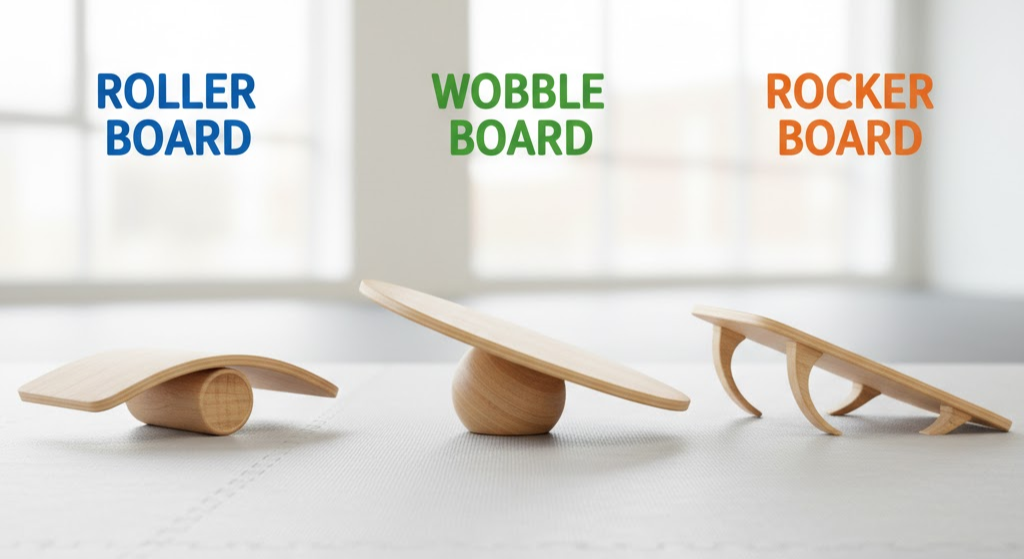
Quick Overview — The 3 Board Types
Before diving into mechanics, it helps to understand what physically separates these three board types, because the confusion between them is almost entirely caused by the terms being used interchangeably in marketing copy. They are distinct tools with different mechanisms that produce different physiological training effects.
🛹
Type 01
Roller Board
Flat deck rides freely on a cylindrical roller — full lateral freedom of movement
LateralPrimary Axis
HighDifficulty
🌀
Type 02
Wobble Board
Deck sits on a fixed dome fulcrum — tilts in all 360° directions simultaneously
360°Primary Axis
MediumDifficulty
〰️
Type 03
Rocker Board
Deck rocks on a curved base — single axis tilt like a seesaw, controlled range
SinglePrimary Axis
Low–MedDifficulty
⚡ The Short Answer
Roller boards best replicate surf movement and produce the highest surf-specific training transfer. Wobble boards train 360° proprioception and are ideal for ankle stability and intermediate balance development. Rocker boards are the safest entry point — controlled single-axis tilt with a predictable range, best for beginners and injury rehabilitation. Most serious surfers eventually own both a roller board and a rocker or wobble board.
🔗 Related Surf Training Guides
Type 01 — Roller Board
A roller board consists of two components: a flat or slightly curved deck and a cylindrical roller that sits beneath it on the floor. The deck is not attached to the roller in any way — it simply rests on top of it. This means the deck can slide freely in any direction across the roller’s surface, with the roller itself free to roll across the floor beneath it. The result is a fully dynamic, unconstrained bilateral instability — there is no fixed pivot point and no range-of-motion limit. The deck can travel the full length of the roller in either direction, and the roller itself can roll across the floor if the deck weight is positioned over the edge.
LateralPrimary movement
★★★★★Surf feel
HighDifficulty
~$100–160Price range
What it trains for surfers: The roller board trains the exact lateral ankle-knee-hip chain that surfing demands — the body’s ability to continuously adjust heel-to-toe and rail-to-rail pressure to maintain position on a moving surface. This is the closest dry-land replication of wave-face riding available. The absence of a fixed pivot point means every micro-adjustment the body makes is functional and transferable. More advanced users can use the roller board for cross-step practice, nose-ride stance holds, and cutback weight-shift drills by deliberately moving weight through the deck to simulate different surfing positions.
✓ Strengths
- Highest surf-movement replication of any balance board type
- Trains the lateral ankle-knee-hip chain directly
- No range limit — forces the nervous system to develop true dynamic balance rather than limiting-range proprioception
- Enormous skill ceiling — tricks, cross-steps, and stance transitions keep progression interesting for years
- Available in surf-specific sizes (Indo Board’s wide deck accommodates realistic two-footed stance)
✗ Limitations
- Steep learning curve — most beginners cannot balance independently for the first several sessions
- Roller can cause injury if it shoots out from under the deck — requires padded surrounding area initially
- Does not train 360° ankle stability as effectively as a wobble board — lateral axis focus can leave rotational stability undertrained
- Roller marks hardwood floors — mat required
🏄 Ideal For
Intermediate and advanced surfers (1+ years surfing experience) who want the most direct dry-land transfer to on-water performance. Also suited to experienced skateboarders and snowboarders who already have developed lateral balance — they typically progress faster than pure surf beginners. Not recommended as the first balance board for complete beginners with no board sport background.
Type 02 — Wobble Board
A wobble board is a flat or slightly concave deck mounted on a fixed hemispherical dome fulcrum — typically made from rubber or hard plastic — permanently attached to the underside of the deck’s centre. The dome contacts the floor at a single point, allowing the deck to tilt in any direction simultaneously — forward, backward, laterally, and diagonally — but cannot travel across the floor (the dome is fixed to the board). This 360° freedom of tilt is the wobble board’s defining characteristic and its key functional difference from the rocker board (which tilts in one axis only) and the roller board (which translates across the floor).
360°Tilt freedom
★★★☆☆Surf feel
MediumDifficulty
~$30–80Price range
What it trains for surfers: The wobble board is the superior tool for developing 360° ankle proprioception — the ability of the ankle complex to detect and respond to instability in every plane simultaneously. This is particularly valuable for surfers because ocean waves are chaotic and multidirectional; the instability a surfer must manage is never purely lateral. Wobble boards also make excellent warm-up tools before surfing, activating the proprioceptive nervous system across all ankle planes before paddling out, and are the best option for ankle sprain rehabilitation due to their manageable tilt range and full-plane challenge.
✓ Strengths
- Best 360° proprioceptive training — challenges ankle stability in every plane of movement
- More accessible than roller boards — most users can stay on a wobble board from their first session
- Excellent for ankle sprain rehabilitation and injury prevention
- Compact and light — easiest board to travel with
- Most affordable board type — quality wobble boards from $30–80
- Safe to use without surrounding padding — limited tilt range prevents dramatic falls
✗ Limitations
- Does not replicate lateral wave-face movement — the tilt is omnidirectional but does not translate across the floor
- Lower skill ceiling than roller boards — most users reach a plateau within a few months without additional progression tools
- Smaller deck size limits full surf-stance practice with realistic weight shifting
🏄 Ideal For
Beginner-to-intermediate surfers building their proprioceptive foundation. Surfers recovering from ankle sprains or other lower limb injuries — the wobble board is the standard tool in physiotherapy for ankle proprioception rehabilitation. All surfers as a warm-up tool — 5 minutes on a wobble board before surfing activates the ankle stabilisers more effectively than any static warm-up. Good supplementary tool for advanced surfers alongside their roller board.
Type 03 — Rocker Board
A rocker board (also called a balance board in the most basic sense, though the term is used loosely across all three types) is a flat deck resting on a curved base — either a central rocker arc or an angled fulcrum fixed at the midpoint. The curved base defines the maximum tilt angle (typically 15–25°) and restricts movement to a single axis — front-to-back or side-to-side, depending on orientation. Unlike the wobble board’s omnidirectional tilt, the rocker board rocks in one plane only, like a seesaw. This is the most mechanically constrained of the three types, which simultaneously makes it the safest and the most limited in terms of proprioceptive breadth.
SingleAxis freedom
★★☆☆☆Surf feel
Low–MedDifficulty
~$30–70Price range
What it trains for surfers: The rocker board is the foundational proprioception tool — it isolates one balance plane at a time, making it the most approachable starting point for complete beginners and the safest option for users returning from injury. Its single-axis restriction is also its primary training benefit for early-stage surfers: it allows the nervous system to develop stability and timing in one plane before adding the complexity of multi-plane wobble or the fully dynamic roller. Placed laterally (rocking side-to-side), the rocker board offers a constrained version of the lateral balance that roller boards train — useful for developing the basic heel-to-toe weight shift pattern before graduating to a roller.
✓ Strengths
- Safest balance board for complete beginners — limited tilt range and single axis make falls nearly impossible
- Ideal first step for surfers with no balance board experience
- Excellent for controlled proprioception work during ankle rehabilitation
- Most affordable entry point — quality rocker boards from $30
- Can be rotated 90° to train front-to-back balance separately from lateral balance — useful for targeting specific proprioceptive weaknesses
✗ Limitations
- Single-axis movement is the least representative of real surfing balance demands — waves are chaotic and multidirectional
- Most users outgrow the proprioceptive challenge within 4–8 weeks
- Limited skill progression — there’s a ceiling to what can be done on a rocker board before it must be replaced with a more challenging tool
- Does not train the lateral translation that roller boards develop
🏄 Ideal For
Complete beginners with no balance board or board sport background. Older surfers or those with joint conditions where the safety of a constrained range is important. Ankle rehabilitation — particularly in the early stages of recovery where multi-directional wobble board challenge would be excessive. Use the rocker board as a stepping stone: 4–8 weeks on a rocker board significantly accelerates the learning curve when progressing to a wobble or roller board.
Head-to-Head: 6 Key Variables
These six comparisons cover the variables that matter most for surfers choosing between board types. Each breakdown compares the three mechanisms directly across a specific training or usability dimension.
01 — Surf Movement Replication
🛹 Roller Board
🌀 Wobble Board
〰️ Rocker Board
Best. The free lateral translation of the deck across the roller directly replicates the feel of trimming across a wave face — the body must continuously adjust lateral pressure to stay centred, exactly as it does on a moving wave. Wide-deck roller boards (Indo Board) even accommodate the full spread of a surf stance.
Moderate. The 360° tilt trains the body to manage multidirectional instability — more representative of wave chaos than a rocker board — but without lateral translation it doesn’t fully replicate the movement of standing on a wave face. Better for proprioception than surf-feel replication.
Limited. Single-axis rocking is mechanically the least similar to surfing. Placed laterally it offers a very constrained version of heel-to-toe balance, but the fixed tilt range and single axis mean it cannot produce the continuous dynamic adjustment that surfing demands.
02 — Proprioceptive Breadth
🛹 Roller Board
🌀 Wobble Board
〰️ Rocker Board
High lateral proprioception. Exceptional training of the lateral ankle, knee, and hip chain. Less effective for rotational and sagittal plane ankle stability — if used as the only balance tool, anterior/posterior and rotational stability may be undertrained.
Best 360° proprioception. The omnidirectional tilt challenges ankle stabilisers in every plane simultaneously — the most comprehensive single-tool proprioceptive stimulus. The preferred tool in physiotherapy specifically because it does not restrict ankle challenge to one plane.
Focused single-plane proprioception. Best for isolating and developing one plane of ankle stability at a time. Useful for rehabilitation targeting a specific proprioceptive deficit, but insufficient as a comprehensive training tool for general surf proprioception development.
03 — Learning Curve & Beginner Safety
🛹 Roller Board
🌀 Wobble Board
〰️ Rocker Board
Steep curve, higher injury risk. Most beginners cannot stay on a roller board independently for the first 1–3 sessions. The roller can shoot out from under the deck if weight is positioned incorrectly — padding surrounding area and having a spotter is essential in early sessions.
Moderate curve, low injury risk. Most beginners can achieve basic balance on a wobble board within the first session. The dome’s contact point limits how far the board can tilt, preventing dramatic falls. Safe for solo training from session one for most users.
Gentle curve, very low injury risk. The single-axis constraint and limited tilt range make the rocker board the safest of all three types. Most beginners can balance comfortably within minutes. An appropriate starting point for older users, those recovering from injury, and children.
04 — Skill Progression Ceiling
🛹 Roller Board
🌀 Wobble Board
〰️ Rocker Board
Extremely high ceiling. Cross-step walking, spin tricks, nose ride holds, pop-up simulations, and stance transition drills keep the roller board challenging for years. Advanced surfers use roller boards indefinitely — there’s no point at which the board is “mastered” in any practical sense.
Moderate ceiling. Single-leg balance, eyes-closed balance, overhead exercises, and loaded squats extend the wobble board’s challenge progressively. Most users reach a plateau within 3–6 months of regular training unless exercises are deliberately progressed.
Low ceiling. Most users exhaust the rocker board’s progressive challenge within 4–8 weeks of regular training. It is a foundation tool, not a long-term training tool — it should be viewed as a stepping stone to a wobble or roller board rather than an end destination.
05 — Injury Rehabilitation Suitability
🛹 Roller Board
🌀 Wobble Board
〰️ Rocker Board
Not for acute rehab. The uncontrolled tilt range and roller instability are inappropriate in the acute and subacute phases of ankle or lower limb injury rehabilitation. Appropriate only in the final return-to-sport phase when the injury is fully resolved and normal balance is re-established.
Best for established rehab phases. The gold standard for ankle proprioception rehabilitation in physiotherapy. Appropriate from the subacute phase (week 3–4 post-sprain) when controlled multidirectional challenge can be introduced. Used in virtually every clinical ankle rehab protocol.
Best for early-phase rehab. The single-axis constraint and limited tilt are ideal for the early rehabilitation phase — sufficient proprioceptive stimulus without the fall risk of omnidirectional wobble. Appropriate from week 1–2 post-sprain in many clinical protocols.
06 — Value & Longevity
🛹 Roller Board
🌀 Wobble Board
〰️ Rocker Board
Best long-term value. Higher upfront cost ($100–160) but a skill ceiling so high that a quality roller board is genuinely a lifelong training tool. The Indo Board purchased a decade ago performs identically to one purchased today — no consumable components beyond grip tape. Best cost-per-year of use.
Good value, moderate longevity. Lower cost ($30–80) with a moderate skill ceiling — useful for 1–2 years of dedicated training before supplementation with a roller board becomes necessary. Long physical lifespan — wood rocker boards rarely fail structurally.
Lowest cost, limited useful life. Cheapest entry ($30–60) but the lowest practical useful life for a progressing surfer — typically 4–8 weeks before the challenge is insufficient. Better viewed as an investment in faster progression to a more capable board than as a long-term tool.
Full Comparison Table
← scroll to see full table →
| Variable |
🛹 Roller Board |
🌀 Wobble Board |
〰️ Rocker Board |
| Mechanism |
Deck on free-rolling cylinder |
Deck on fixed dome fulcrum |
Deck on curved rocker base |
| Movement Axes |
Full lateral + translation |
360° tilt |
Single axis only |
| Surf Feel Replication |
★★★★★ Excellent |
★★★☆☆ Moderate |
★★☆☆☆ Limited |
| Proprioceptive Breadth |
Lateral-focused |
360° comprehensive |
Single-plane only |
| Beginner Safety |
⚠️ Requires supervision |
✓ Solo-safe from day 1 |
✓✓ Safest option |
| Skill Ceiling |
Lifetime progression |
1–3 years |
4–8 weeks |
| Best Rehab Phase |
Return to sport only |
Subacute (wk 3–4+) |
Early phase (wk 1–2) |
| Typical Price |
$100–160 |
$30–80 |
$30–60 |
| Long-term Value |
Best (lifetime tool) |
Good (1–2+ years) |
Limited (stepping stone) |
Sizing, Surface & Setup Guide
Getting the right size and setting up a safe training space matters as much as picking the right board type. This is one of the most commonly overlooked parts of balance board buying guides, and it directly affects both how fast you progress and how likely you are to get injured in the process.
Deck Size — Why It Matters More Than Most Buyers Think
Deck dimensions determine how much of a real surf stance you can actually replicate. A narrow deck under 26 inches forces the feet closer together than a real surf stance, which changes the balance demand in ways that don’t transfer as cleanly to the water. For roller boards specifically, look for a deck in the 28–30 inch range with at least 9–10 inches of width — the Indo Board Original Trainer’s 30″×18″ deck is on the larger end and is intentionally sized to accommodate a full two-footed surf stance rather than a narrow single-file stance. Wobble boards and rocker boards are typically round or square and sized between 15 and 20 inches — width matters less here because the user’s stance is usually centred rather than staggered.
Roller Diameter and Difficulty Scaling
The diameter of the roller cylinder is the single biggest factor in how difficult a roller board is to use. A wider roller (around 6.5 inches) sits lower and rolls more slowly, which reduces difficulty and is more forgiving for someone transitioning from a rocker or wobble board. A narrower roller (4–5 inches) sits higher off the ground and rolls faster under the same input, increasing difficulty and instability. Some roller boards, including the Indo Board, include a rubber cushion that can be placed under the roller to further dampen and slow the roll — an excellent way to reduce difficulty during the first few weeks without buying a second board.
Dome Height on Wobble Boards
Wobble board domes vary from roughly 2 inches to 4+ inches in height. A taller dome allows a greater maximum tilt angle before the deck edge contacts the floor, which increases the proprioceptive challenge but also increases the chance of a hard tip-over for beginners. Most physiotherapy-grade wobble boards, including the type used in clinical ankle rehab, use a moderate dome height in the 2.5–3 inch range — enough challenge for meaningful proprioceptive stimulus without excessive fall risk.
Setting Up a Safe Training Space
🛠️ Setup Checklist
- Floor surface: use a dense exercise mat (¾ inch or thicker) under any roller board — it protects hardwood or laminate floors from roller marks and cushions falls
- Clearance radius: keep at least 3 feet of clear space in every direction around a roller board — the roller itself can travel further than expected if it shoots out
- Wall or rail nearby: for the first 1–2 weeks on a roller board, train within arm’s reach of a wall, doorframe, or sturdy rail for a light touch-point while your nervous system adapts
- Footwear: barefoot or grip socks for all board types — shoes reduce the sensory feedback that drives proprioceptive adaptation
- Overhead space: if you plan to progress to overhead exercises on a wobble or rocker board, make sure there’s at least 7 feet of clearance above
Training Drills by Board Type
Owning the right board is only half the equation — how you use it determines how much surf-specific benefit you actually get. Below is a practical drill progression for each board type, organised from foundational to advanced.
Rocker Board Drill Progression
- Static hold (Week 1): Stand centred on the board and hold a stable position for 30–60 seconds, focusing on minimising unnecessary micro-corrections rather than fighting every small movement.
- Controlled tip-to-tip (Week 1–2): Deliberately rock the board from one edge contact to the other in a slow, controlled rhythm — this teaches the ankle to control the full range rather than only resisting it.
- Squats on the rocker (Week 2–3): Add bodyweight squats while balancing, which layers a loaded movement pattern on top of the proprioceptive challenge — closer to the demand of popping up and absorbing a bottom turn.
- Rotated orientation (Week 3–4): Turn the board 90° to train the perpendicular axis (front-to-back instead of side-to-side, or vice versa) so both planes get equal development before moving to a wobble board.
Wobble Board Drill Progression
- Two-foot 360° hold: Stand centred and keep the edge of the deck from touching the floor in any direction for 45–60 seconds — this is the foundational proprioceptive drill.
- Single-leg balance: Once two-foot holds are comfortable, progress to single-leg standing for 20–30 seconds per side — this closely mirrors the single-leg loading that happens during a bottom turn or cutback.
- Eyes-closed balance: Removing visual input forces greater reliance on the ankle’s own proprioceptors, which is closer to how balance actually works when reading a wave rather than looking down at your feet.
- Loaded wobble squats: Holding a light dumbbell or kettlebell while performing controlled squats on the wobble board adds a strength component without sacrificing the proprioceptive stimulus.
- Pre-surf activation: A simple 3–5 minute two-foot and single-leg hold sequence immediately before paddling out primes the ankle stabilisers more effectively than static stretching alone.
Roller Board Drill Progression
- Wall-assisted stance (Session 1–3): Stand on the deck with light fingertip contact on a wall or rail, focusing purely on staying centred over the roller without falling.
- Independent centred stance (Session 3–8): Remove the wall contact once basic centring is achievable for 20+ seconds, progressively extending hold time.
- Lateral trimming drill: Deliberately shift weight from one rail to the other in a smooth, continuous motion — this is the single most surf-specific drill available on any balance board, directly training the same weight-shift pattern used to trim across a wave face.
- Cross-step walking: Once lateral trimming is comfortable, practise walking the length of the deck (simulating a cross-step toward the nose) while maintaining control of the roller.
- Pop-up simulation: Lie prone on the deck, execute an explosive pop-up movement into a surf stance, and immediately stabilise — this combines the strength/power element of popping up with the balance demand of landing on an unstable surface.
💡
Programming tip: rotate through all three boards across a training week rather than exclusively using one. A simple structure is rocker or wobble board work on lighter days (10–15 minutes, proprioception-focused) and roller board sessions on dedicated training days (20+ minutes, skill and surf-specific focus). See the full weekly structure in the
Surfer’s Off-Season Balance Board Guide.
Common Mistakes to Avoid
Most of the frustration surfers report with balance board training comes down to a handful of avoidable setup and technique mistakes rather than the equipment itself.
⚠️
Buying a roller board as your very first balance board. This is the single most common mistake. Without any prior board-sport balance background, most beginners spend weeks fighting the roller board’s steep learning curve and give up before seeing progress. Starting with a rocker or wobble board and progressing to a roller board produces faster long-term results for true beginners.
⚠️
Training on a hard, unpadded floor with no clearance. Roller boards in particular need a dense mat and clear surrounding space. Training on tile or concrete with furniture nearby is the most common cause of avoidable injury with this equipment.
⚠️
Wearing thick-soled shoes while training. This blunts the sensory feedback from the sole of the foot that drives proprioceptive adaptation. Barefoot or thin grip socks give the nervous system the information it actually needs to adapt.
⚠️
Staying on one board type indefinitely. Sticking exclusively with a rocker board well past the point of challenge, or never adding a wobble board’s 360° stimulus to a roller-board-only routine, leaves gaps in proprioceptive development. Progression between board types compounds the benefit of each.
⚠️
Training through sharp or worsening pain. Balance board work should feel challenging, not painful. Sharp pain in the ankle, knee, or lower back during a session is a signal to stop and reassess — particularly during injury rehabilitation phases where a physiotherapist’s guidance should take priority over generic drill progressions like the ones in this guide.
Care & Maintenance
Balance boards are mechanically simple, but a small amount of care meaningfully extends their usable life and keeps grip performance consistent.
Roller Boards
- Wipe the deck’s grip-tape surface periodically with a damp cloth — built-up dirt and foot oils reduce grip over time
- Inspect the roller for flat spots or warping if it’s foam or plastic-cored; a warped roller changes the roll characteristics unpredictably
- Store the roller separately from the deck if space is limited, but keep both away from direct sunlight or heat sources that can warp wood decks
- Re-apply or replace grip tape once it becomes smooth or starts peeling at the edges
Wobble and Rocker Boards
- Check the dome or rocker base periodically for cracking, especially on boards used outdoors or in garages with temperature swings
- Tighten any bolts connecting the deck to the base every few months — repeated tilting can gradually loosen fasteners on bolted designs
- Clean rubber domes with mild soap and water; avoid harsh solvents that can degrade rubber compounds over time
- Store on a flat surface rather than leaning against a wall on the dome, which can create a flat spot over long periods
Buying Guide — What Actually Matters
With the mechanism differences, sizing considerations, and training use cases covered, here’s a condensed checklist of what actually separates a good balance board purchase from a disappointing one, regardless of which type you choose.
✅ What to Prioritise
- Deck material: multi-ply wood (typically birch or maple) is more durable and provides better grip-tape adhesion than plastic decks, which tend to flex and can crack under repeated loading
- Weight capacity: check the rated capacity against your bodyweight with margin — a board rated exactly to your weight will wear faster and feel less stable under dynamic loading than one with 30–50 lbs of headroom
- Grip surface: textured grip tape (roller boards) or a textured deck surface (wobble/rocker) matters more for barefoot training than most buyers expect — smooth decks become genuinely dangerous when feet sweat
- Base stability: for wobble and rocker boards, check that the dome or rocker base is either moulded as one piece or securely bolted — glued-on bases are the most common failure point in budget boards
- Portability: if you plan to travel with your board, wobble boards and compact rocker boards pack far more easily than a roller board’s separate deck-and-cylinder setup
⚠️
What to be cautious of: extremely cheap balance boards (under $20) frequently use thin plastic decks and low-grade grip surfaces that degrade within months of regular use. For a training tool used multiple times a week, the mid-range price points covered in this guide represent meaningfully better durability and training value per dollar spent.
Which Should You Buy?
The right board depends on your current surf ability, training goal, and whether you’re managing an existing injury. Use this decision guide to find the correct starting point — and see the full ranked product reviews at 5 Best Balance Boards for Surf Training.
Complete beginner — no balance board experience, no board sport backgroundStart with the safest, most accessible tool to build the proprioceptive foundation
〰️ Rocker Board
Beginner surfer (0–2 years) wanting to improve on-water balance360° proprioception is more valuable at this stage than lateral surf replication
🌀 Wobble Board
Intermediate surfer (2–5 years) wanting the most direct surf training transferReady for the learning curve — roller board replication is worth the effort at this level
🛹 Roller Board
Advanced surfer — off-season training to maintain and improve performanceRoller board for surf-specific sessions; wobble board for ankle maintenance and warm-up
Both
Recovering from a lateral ankle sprain — want to rehab and get back in the waterPhase rehab: rocker board first (weeks 1–3), then wobble board (weeks 3–8+)
〰️ Then 🌀
Experienced skateboarder or snowboarder new to surfingStrong lateral balance already — can skip rocker/wobble and go straight to roller board
🛹 Roller Board
Budget is limited — one board only, used by multiple family members of varying ages/levelsWobble board offers the widest usability range and the best balance of safety and challenge
🌀 Wobble Board
Wanting a board for surf conditioning circuits (squats, lunges, exercises)Wobble board or dedicated spring platform — roller boards are unsafe for loaded exercise
🌀 Wobble Board
💡
The ideal combination for serious surfers: a roller board (Indo Board or Revolution 101) for surf-specific lateral training sessions, and a wobble board (Fitter First Pro or similar) for daily warm-up proprioception activation and ankle maintenance. Total investment under $230 for a complete off-season balance training setup. See the full off-season programme at
Balance Board Training — The Surfer’s Off-Season Guide.
Top Picks — One of Each Board Type on Amazon
These three boards are the best Amazon-available representatives of each board type reviewed in this article. For the complete ranked review of all five top picks across all categories, see 5 Best Balance Boards for Surf Training.
Frequently Asked Questions
Is a wobble board the same as a rocker board?▾
Not exactly — though the terms are often used interchangeably in marketing, they describe different mechanisms. A true rocker board tilts in a single axis only (like a seesaw), constrained by a curved or angled base. A wobble board tilts in 360° simultaneously, constrained only by the dome’s height. The Fitter First Pro, for example, is commonly referred to as both a “rocker board” and a “wobble board” in different contexts — the distinction depends on the specific base design. In practical terms: if you can place the board so that it only rocks forward-backward or side-to-side without any diagonal movement, it’s a rocker board. If it tilts in all directions freely, it’s a wobble board. Some boards marketed as “balance boards” have elements of both.
Can I use a roller board barefoot or do I need shoes?▾
Barefoot or surf-specific grippy socks are strongly preferred over shoes for surf training. Barefoot training maximises the sensory feedback from the deck surface to the proprioceptors in the foot and ankle — the entire training benefit of balance board use is dependent on this feedback loop. Shoes reduce that sensory signal significantly. Quality roller boards like the Indo Board have grip-tape deck surfaces specifically designed for barefoot use. The exception: if the surrounding floor is hard (concrete, tile) rather than padded, wearing lightweight training shoes provides some ankle protection in the event of a fall during the early learning phase.
How long should I train on a balance board each session?▾
15–20 minutes of focused balance board training daily is the sweet spot for surf conditioning. Proprioceptive training responds better to frequent short sessions than infrequent long sessions — the nervous system adapts through repetition of the balance task, and mental focus degrades after 20–25 minutes, reducing training quality. Beginners should start at 10 minutes (5 minutes on the board, 5 minutes of rest and reset) and build to 20 minutes over 2–3 weeks. For the complete weekly schedule and progression framework, see the
Surfer’s Off-Season Balance Board Guide.
Do professional surfers actually use balance boards, or is it marketing?▾
Yes — roller board training is genuinely embedded in the off-season routines of many professional surfers. The Indo Board in particular has documented endorsements and actual-use documentation from surfers at the highest levels of the sport — it was created by a surfer specifically for surf training, not adapted from a general fitness product. The proprioceptive benefits of balance board training have also been studied in board sports contexts, with research consistently showing improved on-water balance performance in groups that include balance board training in their conditioning programmes versus control groups. That said, balance boards are a supplement to surfing, not a replacement — no amount of roller board time replaces actual water time for surf skill development.
Should I progress from rocker → wobble → roller, or can I skip straight to a roller board?▾
The progression makes sense for pure beginners, but it’s not mandatory — your existing balance background matters more than a fixed sequence. If you’re a complete beginner to all board sports (no skateboarding, snowboarding, or skiing experience), the rocker → wobble → roller progression is worth following — each step builds the neuromuscular foundation for the next. If you have existing lateral balance experience from any board sport, you can likely skip rocker and wobble boards and start directly on a roller board with a proper beginner approach (surrounding padding, practice near a wall, start with an optional cushion under the roller). The Indo Board’s optional cushion under the roller specifically reduces the difficulty to a level that most board-sport-experienced beginners can manage from session one.
Which board type is better for improving pop-ups?▾
Roller boards are best for pop-up simulation training. The pop-up — transitioning from prone to standing on the board — requires explosive movement followed by immediate dynamic balance control in a lateral stance. The roller board’s wide deck (particularly the Indo Board’s 30″×18″ surface) accommodates the full prone-to-standing movement, and the instant lateral instability after the pop creates the closest simulation to landing a pop-up on a moving wave. The drill: lie prone on the roller board (board resting on the roller), execute the pop-up movement, and immediately manage the resulting instability. Wobble boards can be used for pop-up drills but the smaller deck size limits realistic stance positioning. Rocker boards are too small and too restricted for realistic pop-up practice.
What size roller board should I buy if I’m training for surfing specifically?▾
Look for a deck around 28–30 inches long and at least 9–10 inches wide, paired with a roller in the 6–6.5 inch diameter range. This combination gives enough deck length to practise a realistic surf stance and cross-stepping, while the wider roller diameter keeps the difficulty manageable for someone transitioning from a rocker or wobble board. Narrower decks and smaller-diameter rollers are more common on trick-oriented or skate-style balance boards and tend to feel cramped for a full surf stance.
Can balance board training replace time in the water?▾
No — balance boards are a conditioning supplement, not a substitute for surfing itself. They develop the underlying proprioceptive and lateral-balance capacity that surfing demands, and they’re particularly valuable during flat spells or off-season periods when water time isn’t available. But wave reading, timing, paddle strength, and the countless micro-adjustments unique to a moving, breaking wave can only be developed in the water. Balance board training accelerates the physical foundation; it doesn’t replace the skill itself.
How much weight can these boards typically hold?▾
Weight capacity varies by board, typically ranging from 200 lbs on entry-level rocker boards up to 300+ lbs on heavier-duty roller and wobble boards. The Fitter First Pro rocker board covered in this guide is rated to 300 lbs, while the Indo Board Original Trainer is rated to 250 lbs. As a general buying principle, choose a board rated at least 30–50 lbs above your bodyweight — a board used right at its rated limit tends to flex more, feel less stable, and wear out faster than one with margin to spare.
✓ Final Verdict
Roller boards win on surf-specificity. Wobble boards win on proprioceptive breadth and value. Rocker boards win on safety and accessibility. The choice isn’t really which is best in absolute terms — it’s which is best for where you are right now. Beginners start with a rocker or wobble board and progress to a roller board. Intermediate surfers get a roller board as their primary tool and keep a wobble board for warm-up and ankle work. Advanced surfers use both, year-round, as part of a structured off-season programme.
See that programme here →
📚 More From FitCore360
Weightlifting Belts / Wraps
Sandbags / Powerlifting Shoes
READY TO BUY?
See the top 5 balance boards for surf training — all categories ranked.
View Top 5 Boards →