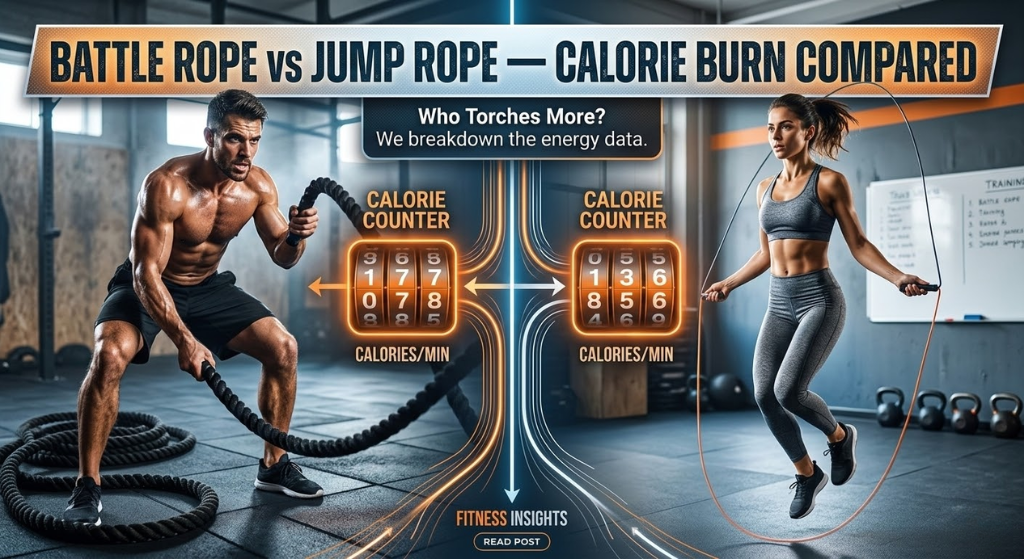
Battle Rope vs Jump Rope — Calorie Burn Compared (2026)
Both tools are cheap, compact, and brutally effective — but they burn calories in different ways, activate different muscle groups, and suit different training goals. We break down the real numbers: calories per hour, EPOC effect, muscle map, and which tool wins each category for home gym use.
The honest answer is that the jump rope burns more calories per hour at equivalent effort — it involves the whole body including the legs, which are the largest muscle groups. But calorie burn per hour is rarely the right question. Sustained duration, injury risk, skill floor, and what else you’re training are the variables that actually determine which tool produces better results for you over 8 weeks.
Quick Answer — Which Burns More?
⚡ The Direct AnswerJump rope burns more calories per hour than battle ropes at equivalent intensity — roughly 600–900 kcal/hr vs 400–600 kcal/hr for a 75–80 kg person at high effort. The lower body drives the difference: the legs are the largest muscle mass in the body, and jump rope activates calves, quads, and glutes throughout every rep. Battle ropes are primarily upper-body, which limits the total metabolic load per minute. However, battle ropes generate a significantly higher EPOC effect and greater muscular development in the shoulders and core — making total-day calorie burn closer than the during-session numbers suggest.
~500Kcal/hr — battle rope HIIT average for 80 kg person at high intensity
~750Kcal/hr — jump rope at 120+ skips/min for the same person
+50–150Additional kcal from EPOC afterburn — higher for battle ropes due to muscle recruitment pattern
Calorie Burn Numbers — The Full Data
All figures below are estimates for a 75–80 kg person working at the stated intensity level. Calorie burn scales with body weight — heavier individuals burn more, lighter individuals less. Figures represent the exercise period only; EPOC is covered in the next section.
🔥 Estimated Kcal Burned — 20-Minute Session
Battle Rope High HIIT
150–200 kcal
Battle Rope Moderate
90–120 kcal
Jump Rope Fast (120+/min)
220–280 kcal
Jump Rope Moderate (80/min)
140–180 kcal
Double-Unders Interval
190–250 kcal
Why Jump Rope Numbers Are Higher
The physics are straightforward. Calorie burn is proportional to the mass of muscle being contracted repeatedly against resistance. The legs — quads, hamstrings, calves, glutes — represent roughly 60% of total body muscle mass. Jump rope activates these continuously at high frequency. Battle ropes are predominantly shoulders, arms, and core, which represents a significantly smaller total muscle mass even when worked at maximum intensity.
This is not a flaw in battle rope training — it’s simply a different stimulus. The tradeoff is that the upper-body loading produces adaptation in areas that jumping cannot reach.
🔴 Battle Rope Calorie Profile
400–600 kcal/hr at genuine HIIT effort
Burns drop faster as shoulder fatigue accumulates — hard to sustain 60 min
High EPOC contribution from intense muscular recruitment pattern
Practical ceiling: 20–30 min is the realistic high-intensity window for most users
Calorie burn scales well with wave intensity — faster waves = meaningfully higher output
🔵 Jump Rope Calorie Profile
600–900 kcal/hr at 120+ skips/min sustained
More sustainable over 30–60 min once technique is established
Double-unders spike intensity sharply — closer to battle rope EPOC
Practical ceiling: 30–45 min feasible for intermediate users
Calorie burn advantage is larger at moderate pace; narrows at maximum effort
💡
The practical gap is smaller than the per-hour numbers suggest. Most people can sustain 25–30 minutes of battle rope HIIT before shoulder fatigue makes intensity unsustainable. Jump rope can be sustained longer — but many people (particularly adults returning to training) find the calf and ankle demand limits them to similar session lengths initially. A 25-minute battle rope HIIT session vs a 25-minute jump rope session will produce calorie burns within 20–30% of each other, not the 50% gap the per-hour figures imply.
EPOC & The Afterburn Effect
EPOC (Excess Post-Exercise Oxygen Consumption) is the elevated metabolic rate that persists after exercise ends — the body continuing to consume oxygen and burn calories to restore homeostasis, repair muscle tissue, and clear metabolic byproducts. It’s the mechanism behind the claim that HIIT “keeps burning calories for hours after you finish.”
🔴 Battle Rope EPOC
Higher EPOC per session than equivalent-duration jump rope at moderate intensity
Estimated 50–120 kcal of additional burn over 12–24 hours post-session
Driven by intense muscle recruitment in upper body and core — more fibres damaged, more repair cost
Lower muscle damage per session means faster recovery but reduced EPOC
More of the calorie burn is during the session; less redistributed to the recovery period
📐 EPOC VerdictBattle ropes produce a higher EPOC effect per session than equivalent-duration standard jump rope, closing the during-session calorie gap significantly. When you account for 12-hour post-session burn, a 20-minute battle rope HIIT session versus a 20-minute jump rope session at comparable effort may end up within 10–15% of total calorie expenditure. For double-unders specifically, EPOC is closer to battle ropes.
Muscle Activation — Where Each Tool Works
The calorie burn difference reflects a fundamental difference in where these tools develop the body. They are genuinely complementary — used together, they cover nearly the full muscle map.
🔴 Battle Rope — Primary Muscles
Shoulders (Deltoids)
High
Core / Obliques
High
Upper Back / Traps
High
Biceps / Forearms
High
Hips / Glutes
Med
Quads / Hamstrings
Low
Calves
Low
🔵 Jump Rope — Primary Muscles
Calves (Gastrocnemius)
High
Quads / Hamstrings
High
Glutes / Hips
Med
Core (Stabilisers)
Med
Shoulders (Rotation)
Low
Forearms / Wrists
Low
Upper Back
Low
The muscle maps make the complementary nature obvious: battle ropes address the upper body and core heavily while leaving calves and quads largely untrained; jump rope drills calves and legs while barely touching shoulders and upper back. If you train with a barbell for lower body (squats, deadlifts), battle ropes fill the conditioning gap without redundancy. If your programme is already upper-body heavy, jump rope adds lower-body conditioning without overlap.
At equivalent effort, jump rope burns approximately 30–50% more calories per hour than battle ropes. The mechanism is simple: the legs, which drive the majority of each jump, are the largest muscle groups in the body. No amount of upper-body intensity can fully close this gap. For pure calorie expenditure as a primary goal, jump rope is the more efficient tool.
🔴 Battle Rope Wins — EPOC & Afterburn
Higher Post-Session Calorie Burn
The intense upper-body muscular recruitment of battle rope training — particularly slam variations and heavy wave work — produces a significantly higher EPOC effect than standard jump rope. The shoulder stabilisers, rotator cuff, and core undergo meaningful micro-damage that requires metabolic energy to repair. This redistributes calories burned from the session period to the 12–24 hours following, partially closing the per-hour gap between the two tools when total daily expenditure is measured.
Battle ropes generate essentially no impact sound — the rope movement is silent and there is no foot strike on the floor. Jump rope produces consistent rope whip sound and foot impact, which is significant in apartments or rooms above other living spaces. For early morning or late evening training in a home with adjacent neighbours or family members, battle ropes are meaningfully quieter. This practical advantage often determines equipment choice for urban home gym users more than the calorie numbers do.
🔵 Jump Rope Wins — Space, Cost & Portability
Smallest Footprint, Lowest Price
A jump rope costs $15–40, fits in a pocket, and requires a 2 m × 2 m clear area to use. A battle rope costs $50–80 plus anchor hardware, needs 5 m × 2 m of clear floor, and requires a fixed anchor installation. For anyone working in a tight space, travelling frequently, or starting with a minimal budget, jump rope wins this category by a wide margin.
🤝 Tie — Fat Loss Over 8 Weeks
Both Produce Meaningful Results When Programmed Correctly
Despite the calorie-per-hour gap, both tools produce comparable fat loss results over an 8-week programme when training frequency and diet are matched. Jump rope’s higher session burn is partially offset by battle rope’s EPOC advantage and the muscular development that elevates resting metabolic rate. The tool that produces better fat loss is whichever one you actually use consistently — the one that fits your space, schedule, and training preferences.
Which Should You Buy?
🔴 Buy Battle Ropes If…
You already train lower body with a barbell (squats, deadlifts) and want upper-body conditioning without overlap
You train in an apartment or room above other people — silence matters
You want to build shoulder and upper back conditioning alongside fat loss
You have at least 5 m of clear floor space for a working zone
You have nagging ankle, knee, or calf issues that make repeated jump impact uncomfortable
You want something with zero skill barrier that’s hard from day one and stays hard
🔵 Buy Jump Rope If…
Maximum calorie burn per minute is your primary goal and your knees and ankles are healthy
You travel frequently or need something that fits in a bag
You have a tight budget — a good speed rope is $20–35, no anchor required
Your home gym space is limited to under 3 m in any direction
You want to develop lower-body power and coordination alongside conditioning
You’re willing to invest 2–3 weeks learning proper technique to unlock the full benefit
✅ Our RecommendationIf budget and space allow, own both. A 9 m battle rope (~$55) and a quality speed rope (~$25) together cost less than a single month of gym membership and cover nearly the full conditioning spectrum between them — upper body, lower body, core, power, and endurance. Use battle ropes on strength training days as a finisher; use jump rope on off-days for active recovery and lower-body cardio.
Neither tool targets belly fat specifically — spot reduction isn’t physiologically possible. Both tools contribute to overall calorie deficit which reduces body fat systemically, including abdominal fat. Battle ropes do produce higher core muscle activation (anti-rotation throughout every set), which develops and tones the abdominal muscles beneath fat. Jump rope burns slightly more total calories per session, which accelerates the deficit. Over 8–12 weeks with consistent training and a modest calorie deficit, both tools produce comparable reductions in body fat.
By raw calorie-per-session numbers, yes — jump rope burns more calories per session at equivalent effort. However, weight loss is determined over weeks and months, not individual sessions. Battle ropes’ higher EPOC contribution, the muscular development that elevates resting metabolic rate, and the fact that many people sustain rope training more consistently than skipping (due to lower skill demands) make the gap in real-world results narrower than the per-session numbers suggest. The better tool for weight loss is whichever you can do consistently for 8+ weeks.
Yes — they complement each other well in a single session. A common structure: 5 minutes jump rope as warm-up (elevates heart rate, activates lower body), then 15–20 minutes battle rope HIIT (upper body and core conditioning), then 3–5 minutes easy jump rope as cool-down. This covers both the lower-body aerobic pathway and the upper-body strength-endurance pathway in one session. Avoid doing both at maximum intensity back-to-back without rest — the combined shoulder and calf fatigue will degrade form in both.
Battle rope has a significantly lower skill barrier. Basic alternating waves can be executed correctly from the first session without prior training. Jump rope requires coordination development — tripping is common in the first 2–4 weeks, which disrupts training flow and makes high-intensity work difficult. For beginners who want to start producing results from session one without a learning curve, battle rope is the easier entry point. That said, jump rope technique is learnable within 2–3 weeks of dedicated practice and the effort is worth it given the calorie burn advantage.
Both tools develop cardiovascular fitness effectively, but through slightly different pathways. Jump rope develops aerobic base and cardiovascular endurance more efficiently — the sustainable duration and high frequency of the leg-driven movement is excellent for VO2 max development. Battle ropes are stronger for lactate threshold training — the rapid onset of shoulder fatigue forces the body to operate at high intensities for shorter periods with rest, which trains the body’s ability to clear lactic acid quickly. For pure aerobic fitness development, jump rope edges ahead; for high-intensity anaerobic capacity, battle ropes are comparable or better.
For HIIT training, buy a speed rope with ball bearings (not a cheap PVC rope with a basic swivel). Ball-bearing handles allow the rope to spin freely at high speed without resistance, which is essential for fast single-unders and eventually double-unders. Adjustable cable length is important — the rope should pass the floor with 20–25 cm of clearance when you jump. Budget: $20–40 covers quality speed ropes from reputable brands. Avoid very light wire cables if you’re on hard flooring — the snap on missed jumps is painful on bare ankles.
Use Both — They Fill Different Gaps
The question “which burns more calories” has a clear answer: jump rope, at equivalent effort and duration. But for most home gym users, that’s not the right question. The right question is which tool fills the gap in your current training — and for most people who already lift weights for lower-body development, battle ropes fill a conditioning niche that jump rope simply doesn’t cover.
If you’re choosing one: match your choice to your existing programme, available space, and noise constraints. If space and budget allow both, they cost less together than almost any other conditioning equipment and between them produce a conditioning stimulus that rivals tools costing ten times as much.