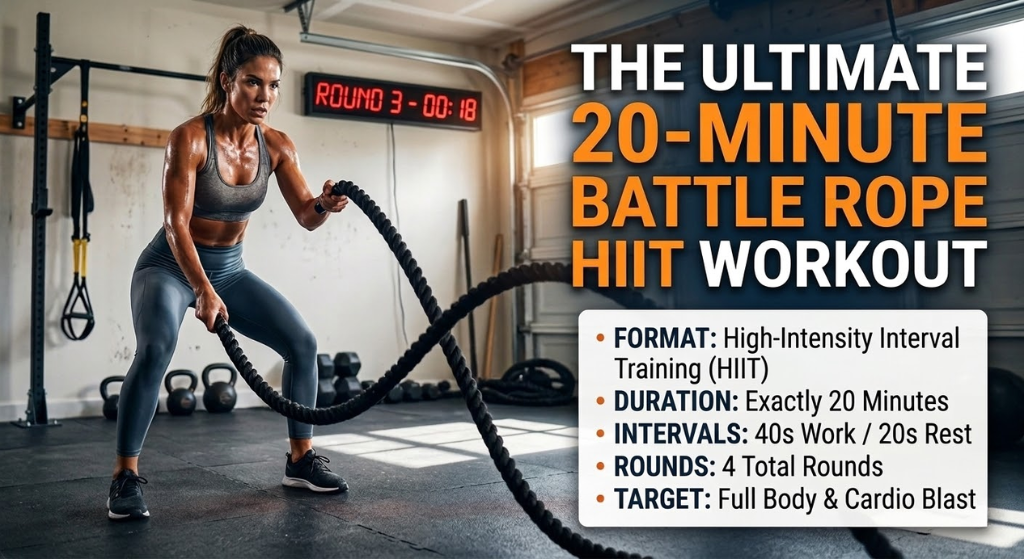
20-Minute Battle Rope HIIT Workout — Full Protocol (2026)
A complete, structured 20-minute battle rope HIIT session with exact intervals, exercise order, coaching cues, and an 8-week progression plan. Designed to maximise calorie burn and conditioning output in the shortest effective training window — from beginner-accessible to advanced.
Battle ropes are unusual among conditioning tools: they produce a cardiovascular response comparable to sprint intervals but require almost no skill to start and carry very little injury risk when used correctly. The challenge isn’t learning the movement — it’s structuring the work and rest correctly so the session actually drives adaptation rather than just creating fatigue.
This protocol is built around four phases with specific work-to-rest ratios for each. The 20-minute total includes warm-up and cool-down — the actual high-intensity work is 15 minutes, which is the sweet spot for rope conditioning before cumulative fatigue starts degrading movement quality.
20Total minutes — warm-up through cool-down
200–300Kcal burned per session for an average 80 kg person at high intensity
4Structured phases — warm-up, HIIT block, power finisher, cool-down
3 minWarm-UpSlow waves, joint priming, HR elevation to ~60%
⚡ The Science20 minutes of structured battle rope HIIT produces the same cardiovascular adaptation signal as 40–60 minutes of steady-state cardio — because the work-to-rest structure keeps heart rate in the 80–95% max zone during work intervals. Volume beyond 20 minutes in a single rope session primarily produces fatigue rather than additional adaptation, particularly in the shoulder stabilisers which are heavily loaded throughout.
The critical variable is work interval quality, not session length. A 20-second alternating wave sprint performed at genuine maximum speed produces a higher metabolic output than 2 minutes of moderate-pace waving. The protocol below is built around this principle: short, maximal work intervals with enough rest to actually recover and maintain quality.
EPOC (excess post-exercise oxygen consumption) — the elevated calorie burn that continues after the session ends — is significantly higher after high-intensity interval work than steady-state cardio. For a 20-minute HIIT session, the EPOC effect can add 50–100 kcal to the total burn over the following 12–24 hours.
Rope: 9 m × 38 mm polypropylene — the home gym standard. A 38 mm rope allows the wave speeds this protocol requires; 50 mm is appropriate only for intermediate-level weeks 5+.
Anchor: Fixed wall anchor, bolted squat rack, or floor plate. The anchor must not move under load — any shift disrupts wave mechanics and reduces intensity.
Working distance: Stand 4–4.5 m from the anchor. The rope should be taut but not rigid at the start of each set. Mark your position with tape if needed.
Flooring: Rubber gym matting (20 mm minimum) under your feet. Prevents slipping during lateral movements and protects the rope at the anchor contact point.
Timer: A countdown interval timer (Tabata Timer, HIIT Timer app, or similar) set to the work/rest periods specified below. Trying to count seconds manually breaks focus and degrades work quality.
Water: Within reach. Heart rate spikes are fast — 90 seconds in, most people are breathing hard. Sip during rest intervals.
⚠️
Skip the rope if: your shoulders or wrists are currently injured, you have an active rotator cuff strain, or you haven’t done any upper-body conditioning in 3+ months. Start with two weeks of lighter, longer-rest work before attempting this full protocol.
Rubber Gym Floor Tiles 20mm~$40–80 — RecommendedView on Amazon ↗
Phase 1 — Warm-Up (3 Minutes)
The warm-up has two jobs: elevate heart rate to approximately 60% max so the HIIT block starts from a primed state, and mobilise the shoulders, wrists, and hips that will be under load. Skip this and the first HIIT round will feel brutal — and injury risk in cold tissue is meaningfully higher.
← Scroll to see full table →
🔥 Phase 1 — Warm-Up
Duration 3:00
Intensity 40–60% Max
Goal Priming
Exercise
Work
Rest
Cue
Slow Alternating Waves50% speed — feel the rope load, not a race
30s
20s
Wrist neutral, thumbs up. Watch the wave reach anchor.
Arm Circles + Hip CirclesDrop rope, 10 arm circles each way + 10 hip circles
30s
15s
Full range of motion — not fast. Shoulder capsule priming.
Alternating Waves + SquatBuild to 70% speed while squatting continuously
30s
20s
HR should be elevated — ready to go hard. Check: are you warm?
💡
Warm-up check: At the end of the warm-up you should be lightly sweating, breathing noticeably harder than at rest, and your shoulders should feel loose. If not, add one more 30-second alternating wave set before moving to Phase 2.
Phase 2 — HIIT Block (12 Minutes)
Four rounds, three exercises per round, 30 seconds work / 30 seconds rest (1:1 ratio). This is the core of the session. The 1:1 ratio is the minimum rest needed to sustain quality across all four rounds — reducing rest further is only appropriate once this feels manageable across every round.
Target heart rate during work intervals: 85–95% max. If you can hold a conversation during work intervals, you’re not working hard enough. If you can’t recover in the 30-second rest, reduce wave speed (not rest duration) until fitness improves.
← Scroll to see full table →
⚡ Phase 2 — HIIT Block × 4 Rounds
Duration 12:00
Work:Rest 1:1 (30s/30s)
Target HR 85–95%
🔁 Round 1 — Foundation
Exercise
Work
Rest
Goal
Alternating WavesMaximum speed — arms, hip drive, continuous
30s
30s
Chase maximum wave frequency. Count waves if it helps focus.
Power from shoulder extension. Full range up and down.
Side-to-Side WavesBoth hands move laterally together — snake pattern
30s
30s
Equal power both directions. Obliques working, not just arms.
💤 Round 1 complete — 60 sec full rest before Round 2
🔁 Round 2 — Lower Body Integration
Exercise
Work
Rest
Goal
Alternating Waves + SquatContinuous squat while maintaining wave speed
30s
30s
Don’t let the squat slow the waves. Quad burn is the point.
Double WavesPower — same as Round 1 but now you’re fatigued
30s
30s
Maintain wave height. If it drops, shorten stride not speed.
Alternating Waves + Reverse LungeStep back into lunge, alternate legs, waves continue
30s
30s
Coordination challenge. Slow down if form breaks.
💤 Round 2 complete — 60 sec full rest before Round 3
🔁 Round 3 — Lateral Plane
Exercise
Work
Rest
Goal
Lateral Shuffle + WavesAlternating waves while shuffling L–R, 3 steps each
30s
30s
2 m side clearance needed. Agility + conditioning combined.
Circles — OutsideBoth hands make outward circles simultaneously
20s
20s
Rotator cuff + forearm. Controlled, not frantic.
Circles — InsideBoth hands make inward circles simultaneously
20s
20s
Opposite pattern from outside circles — shoulder health focus.
💤 Round 3 complete — 60 sec full rest before Round 4
🔁 Round 4 — Max Effort
Exercise
Work
Rest
Goal
Alternating Waves — ALL OUTFastest speed possible — this is the final push
30s
30s
Beat your Round 1 wave count. Leave nothing in reserve.
Alternating Waves + Squat JumpSquat, then explode up — maintain waves throughout
20s
40s
High-impact — land softly. Highest metabolic output exercise in the session.
Side-to-Side Waves — ALL OUTMaximum lateral speed — finish the block empty
30s
—
Final effort. Move directly to Phase 3 after 60 sec rest.
📐 Quality CheckIf wave height collapses in the final 10 seconds of any work interval, the rope is too heavy or rest is too short — not a reason to stop, but a reason to adjust next session. The goal is maximum quality repetitions, not white-knuckling through poor movement. Reduce wave speed before sacrificing form.
Phase 3 — Power Finisher (3 Minutes)
After the HIIT block, take a full 60-second standing rest. The power finisher uses slam-based movements at maximum single-effort output. These are different from the sustained-intensity work in Phase 2 — each rep is maximal power with full recovery between reps. This develops the explosive shoulder and upper-back strength that carries over to athletic performance and heavy pressing.
← Scroll to see full table →
💥 Phase 3 — Power Finisher
Duration 3:00
Work:Rest 1:4 (10s/40s)
Goal Max Power
Exercise
Work
Rest
Cue
Overhead SlamsBoth ends overhead simultaneously, slam to floor with max force
10s
40s
3–4 max-effort reps only. Quality over quantity — every rep full power.
Overhead SlamsSecond set — try to match or exceed rep 1 power
10s
40s
If power drops significantly, extend rest to 60s before set 3.
Overhead SlamsFinal set — leave everything here
10s
30s
3 sets done. Move directly to Phase 4 cool-down.
💡
Slam mechanics: Drive both arms overhead fully extended, then pull down hard through the shoulder extensors and lats — not just arm drop. The sound of the rope hitting the floor should be loud. If it’s quiet, you’re not generating full power.
Phase 4 — Cool-Down (2 Minutes)
Two minutes is sufficient for post-HIIT rope work. The goal is returning heart rate toward baseline and restoring shoulder range of motion that contracts under sustained load. Don’t skip this — the cumulative effect of cutting cool-downs is elevated DOMS and reduced range of motion in subsequent sessions.
🌿 Phase 4 — Cool-Down
Duration 2:00
Intensity 20–30% Max
Goal Recovery
Exercise
Work
Rest
Cue
Slow Alternating Waves25% speed — just keep the rope moving
30s
15s
HR descending. Breathe through the nose if possible.
Slow Outward CirclesLarge, slow circles — maximum shoulder range
20s
10s
Rotator cuff lengthening after sustained contraction.
Drop rope — Cross-Body Shoulder StretchPull each arm across chest, 20 sec per side
40s
—
Gentle tension only. Breathe out as you pull across.
Overhead Tricep Stretch + Wrist CirclesBoth arms, 15 sec each + 10 wrist circles each way
40s
—
Wrists take grip load throughout — don’t skip this.
8-Week Progression Plan
The protocol above is the Week 3–4 version — intermediate pacing with 1:1 work-to-rest. Below is the full 8-week progression: how to scale back if you’re starting from zero, and how to advance once this feels manageable.
← Scroll to see full table →
Weeks
Work
Rest
Rounds
Key Change
1–2
20 sec
40 sec
3
Learn movement quality. Never sacrifice form for speed. Total session ~16 min.
3–4
30 sec
30 sec
4
This protocol. 1:1 ratio, full 4 rounds, power finisher added.
5–6
35 sec
25 sec
4
Work increases, rest shortens. Add 50 mm rope option if 38 mm feels easy.
7–8
40 sec
20 sec
4–5
2:1 work-to-rest ratio. Add 5th round or extend power finisher to 4 sets.
Beyond 8
40 sec
20 sec
5
Upgrade rope to 50 mm for additional resistance without increasing volume.
💡
Progression rule: Only advance to the next week’s parameters when you can complete all rounds of the current level with consistent wave quality throughout every work interval — not just the first two rounds. If Round 4 looks significantly worse than Round 1, stay at the current level another week.
Yes — if intensity is correct. Research consistently shows that high-intensity interval work produces cardiovascular and metabolic adaptations equivalent to much longer moderate-intensity sessions. The key word is intensity: if you can complete this protocol comfortably, you need to increase wave speed or shorten rest — not add more time. When work intervals are genuinely maximal, 15 minutes of actual work is physiologically sufficient.
No — 3 sessions per week maximum, never on consecutive days. Battle ropes generate significant cumulative shoulder and forearm fatigue. The deltoids, rotator cuff, and forearm flexors are heavily loaded throughout every session. Training them again before recovery is complete produces diminishing returns and eventually overuse injury. 3× per week with at least one full rest day between sessions is optimal for adaptation. 4× is appropriate for advanced users who have built up over several months.
Approximately 200–300 kcal during the session for an average 75–85 kg person performing the protocol at genuine high intensity. Individual variation is significant — heavier individuals burn more, lighter individuals less, and fitness level affects efficiency. The EPOC effect (elevated metabolism post-session) adds a further 50–100 kcal over the following 12–24 hours. For a detailed comparison of battle rope calorie output against other tools, see the battle rope vs jump rope comparison.
Do 2–3 rounds and build up. It’s more productive to complete 2 rounds with excellent wave quality and full effort than 4 rounds where the final rounds are low-intensity shuffling. Start at Weeks 1–2 in the progression table (20 sec work / 40 sec rest, 3 rounds) until that feels manageable, then move to the full protocol. Most people can complete 3 quality rounds from the first session; the 4th round becomes accessible within 2–3 weeks of consistent training.
Yes, but sequence matters. Do strength training first, battle ropes second — never the reverse. Performing this HIIT protocol before a strength session will significantly compromise your pressing and overhead strength due to shoulder fatigue. As a post-strength finisher, 20 minutes of rope work is an excellent conditioning addition. Allow at least 15 minutes between the end of strength work and the start of the rope session for partial recovery of shoulder stabilisers.
A 9 m × 38 mm polypropylene rope is the correct specification for this protocol. The 38 mm diameter allows the wave speeds Phase 2 requires; 50 mm is too heavy for the lateral shuffle and lunge combinations at the work intervals specified. 9 m gives you 4.5 m of working distance — the minimum needed to generate clean, full-length waves. For a full breakdown of rope options and what to buy at each price point, see our guide to the best battle ropes for home gyms.
Train the Protocol, Then Progress It
The structure of this session — warm-up, four-round HIIT block, power finisher, cool-down — isn’t arbitrary. Each phase has a specific physiological purpose, and the sequencing ensures you hit maximum output during the HIIT block when the nervous system is primed but not yet fatigued.
Run this protocol consistently for 8 weeks following the progression table. By Week 8, the work-to-rest ratio will have shifted from 1:2 to 2:1 — an objective, measurable increase in conditioning capacity that maps directly to endurance on the wall, field, or court.