Quick Answer
⚡ The Short Version
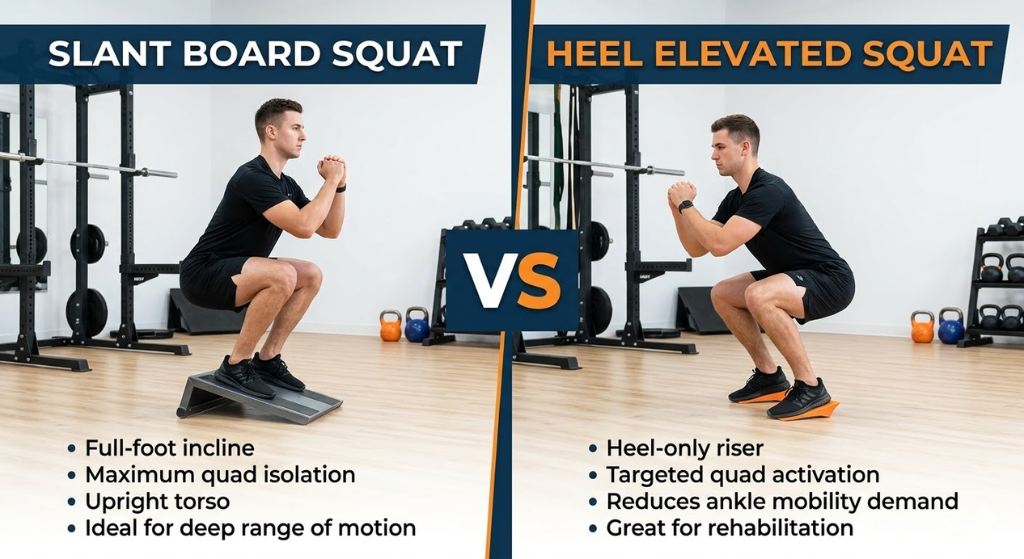
A slant board squat raises the heel via an angled inclined surface — the foot stays flat on the board, and the angle is consistent and controlled throughout the movement. A heel elevated squat (using plates, a wedge, or any raised surface under just the heel) creates an abrupt heel-to-toe height difference with a pressure point at the heel edge. Both increase quad activation and allow more upright torso positioning — but the slant board provides more consistent joint angles, greater stability, and better ankle mobility training over time. Plates and wedges are a valid short-term fix; a slant board is the better long-term tool.
What Each Method Actually Is
The terms are often used interchangeably online — but they describe meaningfully different techniques. Before comparing them, it’s worth being precise about what each method actually involves mechanically.
🟠 Slant Board Squat
- The entire foot rests flat on an inclined surface angled upward at the toe end — typically 15°–40°
- The heel is elevated relative to the toe because the entire board is tilted, not because only the heel is raised
- Foot contact pressure is distributed evenly across the full sole
- The ankle joint is pre-dorsiflexed at the start position, reducing the demand on ankle flexibility through the range of motion
- Consistent, measured angle — repeatable across every session
- Can be used for bilateral squats, single-leg work, step-ups, and calf stretching
🔵 Heel Elevated Squat
- Only the heel is raised — via plates, a wedge, or any rigid object — while the forefoot remains on the floor
- Creates a height differential between heel and toe, forcing the ankle into plantarflexion at the start
- Foot contact pressure concentrates at the heel edge and under the metatarsals
- The ankle is not pre-dorsiflexed — the heel elevation compensates for limited ankle mobility rather than training it
- Height depends on available plates or wedge thickness — less precise than a slant board
- Primarily used for bilateral squat variations; single-leg use is less stable
The distinction that matters most: a slant board trains the ankle through dorsiflexion under a controlled incline — the ankle still moves through its range during the squat. Heel elevation compensates for poor ankle dorsiflexion by changing the geometry of the problem rather than addressing it. Over time, these two approaches produce different long-term outcomes.
The Biomechanical Difference That Actually Matters
Both methods achieve the same immediate outcome — a more upright torso and greater knee travel over the toes — but they achieve it through different mechanical means, and those means produce different effects at the knee, hip, and ankle joints.
Torso Angle and Quad Loading
When the heel is elevated by any method, the centre of mass shifts forward, reducing the forward lean required to maintain balance over the base of support. This produces a more upright torso and shifts load from the posterior chain (glutes, hamstrings) toward the anterior chain (quads, VMO). Both a slant board and heel plates achieve this equally well at the same effective heel-height equivalent.
The difference in quad loading between the two methods at equivalent elevation heights is minimal in acute sessions. The long-term divergence comes from what happens to ankle mobility over months of use — which is where the two methods separate meaningfully.
Ankle Dorsiflexion: Training vs Compensating
Dorsiflexion (the movement of the shin toward the toes) is the limiting factor in most athletes’ squat depth. Inadequate dorsiflexion forces the heel to rise, the torso to lean forward, or depth to be cut short.
A slant board pre-positions the ankle in dorsiflexion at the start of the squat. As the athlete descends, the ankle continues to dorsiflex through a loaded range. Repeated training on a slant board progressively increases functional dorsiflexion range — the board teaches the ankle joint to move through depth under load.
Heel elevation under the heel only eliminates the need for dorsiflexion — it changes the squat geometry so the ankle never needs to travel as far. An athlete squatting on heel-elevated plates for months can become dependent on that elevation; their ankle mobility may not improve and may even decrease if they stop actively mobilising.
~10–15°Additional knee travel over toes unlocked by both methods at 20° incline / equivalent heel height
6–8 wksTypical timeframe to see measurable ankle dorsiflexion gains from consistent slant board use
0°Ankle mobility improvement typically produced by heel plate elevation alone — it compensates, not trains
Knee Joint Stress and VMO Activation
Both methods increase patellofemoral joint loading due to the greater knee-forward position. This is not inherently harmful — the patellofemoral joint adapts to load — but it is a relevant consideration for athletes with existing knee pathology. At matched elevation heights, peak patellofemoral stress is similar between methods.
VMO (vastus medialis oblique) activation is higher in heel-elevated and slant board squats than in flat-footed squats. The slant board provides a slight VMO advantage in some protocols due to the ability to achieve deeper dorsiflexion positions that maximally load the VMO at depth. For knee rehab and VMO isolation, the slant board is the preferred clinical tool — which is why physical therapists recommend it specifically. Read the full evidence base in our PT-Approved Slant Board Exercises guide.
The 6 Key Differences
Difference 1 — Ankle Mobility Outcome
🟠 Slant Board
🔵 Heel Elevated (Plates)
Trains ankle dorsiflexion through progressive loaded range. With consistent use, athletes need progressively less heel elevation as raw ankle mobility improves. Long-term fix.
Compensates for limited ankle dorsiflexion without training the joint. Mobility may stay the same or decrease without separate ankle work. Short-term workaround.
Difference 2 — Foot Pressure Distribution
🟠 Slant Board
🔵 Heel Elevated (Plates)
Entire foot is flat on the inclined surface. Pressure distributed evenly from heel to metatarsals. Stable and comfortable during long holds and high-rep sets.
Heel on a raised edge, forefoot on the floor. Pressure concentrated at the heel edge and under the ball of the foot. Can cause discomfort during long or heavy sessions.
Difference 3 — Stability and Platform Consistency
🟠 Slant Board
🔵 Heel Elevated (Plates)
Wide, non-slip, consistent surface. Same angle every rep. Equally stable for bilateral and unilateral work. Essential for single-leg exercises and rehab protocols.
Small, narrow contact surface under the heel. Less stable — especially for single-leg work. Plates can shift under load. Not suitable for precise rehabilitation exercises.
Difference 4 — Angle Control and Progression
🟠 Slant Board
🔵 Heel Elevated (Plates)
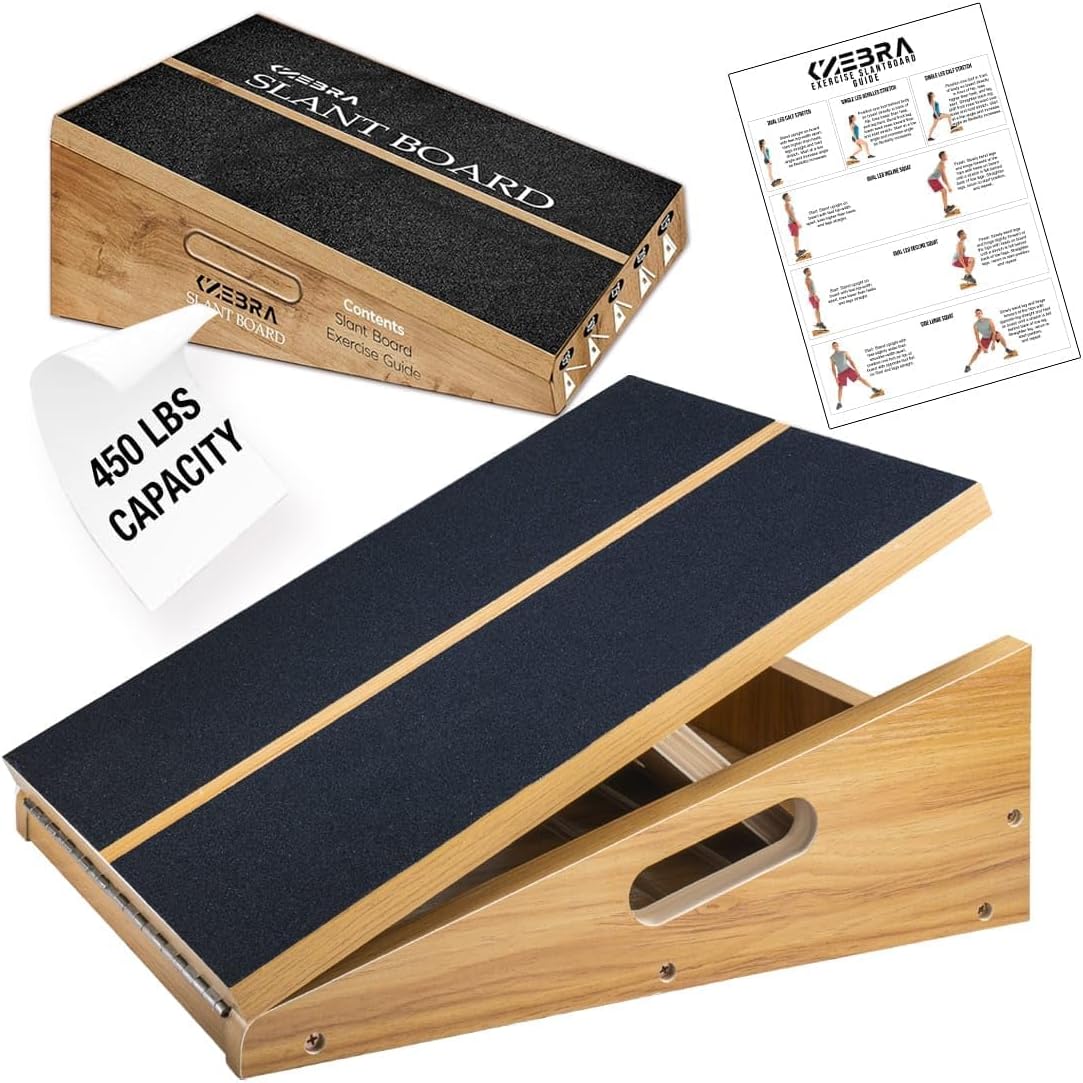
Precise, measurable angle settings (typically 15°, 20°, 25°, 30°, 35°). Allows systematic progressive overload by incrementally reducing the angle as mobility improves.
Limited to whatever heights available plates provide — typically 1cm, 2cm, 4cm, 5cm. No intermediate options. Can’t systematically decrease elevation in measured steps.
Difference 5 — Exercise Versatility
🟠 Slant Board
🔵 Heel Elevated (Plates)
Works for bilateral squats, split squats, step-ups, calf raises, calf stretching, and single-leg rehab exercises. A full rehabilitation and training tool in one piece of equipment.
Primarily useful for bilateral squat variations only. Not practical for single-leg work, calf raises, or rehabilitation exercises. Essentially a single-purpose workaround.
Difference 6 — Rehab Suitability
🟠 Slant Board
🔵 Heel Elevated (Plates)
PT-recommended for patellofemoral pain, Achilles tendinopathy, plantar fasciitis, and VMO rehabilitation. Prescribed in formal rehab programmes globally. Stable, precise, and progressable.
Not a rehab tool. Plates and wedges under the heel are a training aid — not a clinical instrument. Physical therapists use slant boards, not plates, in rehabilitation programmes.
Movement Comparison: Which Method Works for What
Not all squat and lower-body movements are equally served by both methods. Here’s the honest breakdown of where each tool excels, falls short, or simply can’t be used.
← Scroll to see full table →
| Movement |
Slant Board |
Heel Elevated (Plates) |
Notes |
| Bilateral squat (bodyweight) |
✓ Excellent |
✓ Excellent |
Both work equally well at matched elevation heights |
| Bilateral squat (loaded, barbell) |
✓ Excellent |
⚠ Adequate |
Slant board more stable under heavy load; plates can shift |
| Goblet squat |
✓ Excellent |
⚠ Adequate |
Slant board grip tape handles loaded holds better than narrow plate |
| ATG split squat |
✓ Excellent |
✗ Poor |
Single-leg on plates is dangerously unstable; slant board only |
| Heel elevated split squat |
✓ Excellent |
✗ Unstable |
Plates provide insufficient base for single-leg split stance |
| Petersen / Poliquin step-up |
✓ Yes (VMO Pro) |
✗ Cannot |
Requires a step platform — slant board with step function only |
| Calf raises |
✓ Excellent |
✗ Cannot |
Calf raise requires full heel-to-toe range on a flat surface |
| Calf / Achilles stretch |
✓ Excellent |
✗ Cannot |
Stretching requires controlled incline — plates serve no purpose here |
| Ankle mobility training |
✓ Trains mobility |
✗ Compensates only |
Core long-term difference between the two methods |
| Plantar fasciitis rehab |
✓ PT-recommended |
✗ Not suitable |
Controlled angle and even pressure essential for rehab protocols |
| Achilles tendinopathy rehab |
✓ PT-recommended |
✗ Not suitable |
Eccentric heel drop protocols require the slant board surface |
| Quick gym workaround |
⚠ Requires board |
✓ Immediate |
Plates available in any gym; slant board requires purchase |
💡
The single clearest takeaway from the table: heel-elevated plates can only do one thing — bilateral squat variations. A slant board does all of them, including the rehab and single-leg work that matters most for long-term knee health. If you’re already training with plates and want to understand what a board actually unlocks, see
Slant Boards: Squat Better, Fix Your Knees.
Which Is Actually Better?
The honest answer: for acute training performance in a gym session, they’re equivalent. A 10-plate heel elevation and a 20° slant board produce similar torso angles, similar quad activation, and similar squat depth in a single session. Neither is dramatically superior on the day.
The answer changes completely when you extend the timeframe to months.
🟠 Slant Board Wins For
- Long-term ankle mobility improvement — the board trains the joint; plates don’t
- Single-leg and unilateral work — stable surface essential for split squats and step-ups
- Rehabilitation — PT-prescribed for plantar fasciitis, Achilles, VMO, patellofemoral pain
- Structured progression — measurable angles allow systematic loading reduction over time
- Calf and Achilles loading and stretching — plates serve no function here at all
- Exercise variety — one board covers 12+ movements; plates cover 3
- Home gym use — compact, purpose-built, reusable for all lower body mobility work
🔵 Heel Elevation (Plates) Wins For
- Immediate access — plates are in every gym; no additional purchase needed
- Emergency workaround — useful when a slant board isn’t available and squat depth is compromised
- Zero cost — no equipment investment required if plates are already available
- Simple bilateral squat sessions — fully adequate for standard squat training when mobility is the only limiting factor
✓ Verdict
For home gym use, the slant board is the clear choice — it does everything heel elevation does for squats, plus ankle mobility training, rehabilitation, calf work, and single-leg exercises. Heel-elevated plates are a gym workaround that require no purchase — they’re useful precisely because they’re free and immediate. Once you own a slant board, there’s almost no scenario where plates under the heel are the better option.
When to Use Each Method
1
Use a Slant Board When: You’re Training at Home
For home gym training, a slant board is the correct tool in every scenario. The consistent angle, stable surface, and ankle mobility development make it the superior long-term investment. Start at 20°–25° for squat work, 15° for rehab stretching, and progress the angle downward as raw mobility improves. See the full equipment guide at
Best Slant Boards for Home Use.
2
Use Heel Elevation When: You Don’t Have a Board and Need to Squat Today
If you’re in a commercial gym, limited ankle dorsiflexion is preventing full-depth squats, and there’s no board available — use plates. This is the correct use case for heel elevation: an immediate workaround that fixes the mechanics for that session. Two 10kg plates or a pair of 2.5cm plates under each heel provides roughly the equivalent of a 15°–20° slant board inclination.
3
Use a Slant Board When: You’re Rehabbing a Knee, Achilles, or Plantar Issue
Plates are not a rehabilitation tool. Physical therapists prescribe slant board protocols specifically because the inclined surface and controlled angle enable exercises — eccentric heel drops, VMO isolation, controlled dorsiflexion loading — that cannot be performed safely on plates. If you’re managing a lower limb injury, a slant board is a clinical necessity, not a luxury. Full exercise list at
PT-Approved Slant Board Exercises.
4
Use Heel Elevation When: You’re Testing If the Issue Is Actually Ankle Mobility
A useful diagnostic: if your squat depth and torso angle improve dramatically when you put plates under your heels, ankle dorsiflexion is your limiting factor. Once confirmed, use the slant board to address that limitation systematically. If your squat doesn’t improve with heel elevation, the limiting factor is elsewhere — hip mobility, thoracic extension, or technique — and the board won’t fix it either.
5
Use a Slant Board When: You’re Doing Any Single-Leg Work
ATG split squats, Bulgarian split squats with elevated front foot, Petersen step-ups — all require a stable, wide platform. Plates under one foot during single-leg work are a fall risk, not a training aid. If your programme includes any unilateral lower-body movements with heel elevation, a slant board is required for safe execution.
Using Both in the Same Programme
The two methods aren’t mutually exclusive — and there’s a logical place for heel elevation within a slant board-based programme. Here’s how they fit together.
📋 How to Integrate Both Methods
- Use the slant board as your primary lower-body mobility tool at home. Daily or pre-session calf stretching, ankle mobilisation, and squat warm-ups should be done on the board. The controlled angle develops real mobility over time.
- Use heel elevation in the gym as a session workaround on days without a board. If you train at a commercial gym without a board and ankle mobility is your squat limiter, plates are the correct gym-floor solution for that session.
- Use the slant board to systematically reduce your required elevation. If you currently need 20° on the board to squat well, set that as your baseline. After 6–8 weeks of consistent ankle mobility work at 20°, try 15°. Progress toward eventually squatting well at flat — at which point the plates become unnecessary in any context.
- For rehab work, use the board exclusively. Do not attempt to replicate physical therapy protocols on plates — the instability introduces injury risk that negates the therapeutic benefit.
💡
The goal of slant board training is to need the slant board less. If your ankle mobility is genuinely improving from consistent board use, you should find over time that your flat squat gets deeper, your heel-elevated squat works at progressively shallower angles, and eventually, the heel elevation is no longer required. The board should be working itself out of a job — that’s the sign it’s working. Track your required angle every 4–6 weeks.
Ready to stop using plates and train with the right tool? These are the five Amazon-verified boards we recommend — ranked and tested in our full slant board review.
📖
Want the full breakdown of every board? We tested all five in depth — specs, grip, stability, and who each one is actually for.
Read the full review →
Frequently Asked Questions
Is a slant board better than heel elevated squats for building quad size?▾
At matched elevation heights, quad activation and hypertrophy stimulus are similar between slant board and heel-elevated squats in the short term. Over months, the slant board advantage emerges through exercise variety — the ability to do ATG split squats, step-ups, and deeper bilateral squats unlocks loading positions that increase total quad volume and VMO development significantly beyond what heel-elevated bilateral squats alone provide. For pure squat quad development, both work. For overall quad size across multiple movement patterns, the slant board wins by enabling more exercises.
What heel elevation height is equivalent to a 20° slant board?▾
This depends on foot length. For a standard adult foot length (approximately 26cm / size 9–10), a 20° incline produces roughly 9cm of heel elevation relative to the toe. In practical plate terms, that’s approximately two 45lb bumper plates or four standard 10kg plates stacked under each heel. However, the comparison isn’t exact — the slant board distributes that elevation across the full foot contact length, whereas plates concentrate it at the heel edge only. The effective “feel” is similar but not identical mechanically.
Can I use a slant board if I have knee pain?▾
In most cases, yes — and slant boards are often part of the solution for knee pain. For patellofemoral pain syndrome and VMO weakness, controlled slant board exercises are a primary rehabilitation tool. For Achilles and plantar fasciitis issues, the eccentric calf loading protocols done on a slant board are clinical standard of care. That said, individual presentations vary — not all knee pain has the same cause. If you’re experiencing acute knee pain, get a diagnosis before loading the joint. For specific exercise protocols, see
PT-Approved Slant Board Exercises. For the full case for slant boards in knee health, read
Slant Boards: Squat Better, Fix Your Knees.
Do elite powerlifters use slant boards or heel elevation?▾
Most elite powerlifters use heel elevation via lifting shoes rather than a slant board — specifically Olympic lifting shoes with a raised heel (typically 0.6″–0.75″ / 15–19mm) built into the shoe sole. This provides consistent heel elevation without requiring plates or a board, and is competition-legal. Slant boards are more common in the ATG, rehab, and sports performance communities than in competitive powerlifting. For strength athletes who don’t wear heeled shoes, plates are the gym-floor equivalent. Neither is “better” at the elite level — the choice depends on the athlete’s mobility requirements and programme structure.
Should I stop using heel elevation once I have a slant board?▾
Not necessarily — but you should use them for different purposes rather than treating them as interchangeable. The slant board should become your primary tool for home training, ankle mobility work, rehabilitation, and single-leg exercises. Heel elevation (plates or lifting shoes) remains a valid workaround in the gym when the board isn’t available. Over time, as ankle mobility improves through consistent slant board use, the need for heel elevation in the gym should decrease naturally. The goal is to eventually squat comfortably without any elevation — and the slant board is the most effective tool for reaching that point.
How long does it take to improve ankle dorsiflexion with a slant board?▾
Most athletes notice measurable improvement in 6–8 weeks of consistent daily or near-daily use — typically 2–3 minutes of loaded calf stretching on the board per session at minimum. The mechanism of change is a combination of calf and Achilles tendon elongation, joint capsule adaptation, and improved motor control through the dorsiflexion range. Progress isn’t linear — some athletes see rapid early gains followed by slower consolidation. Track your required slant board angle for a comfortable deep squat every 4 weeks. If you need 30° today and 25° works in 6 weeks, the board is doing its job.
The Right Tool for the Right Timeframe
Heel elevation and slant boards solve the same immediate problem — not enough ankle dorsiflexion to squat well — through different mechanisms, with different long-term outcomes. Plates are the correct immediate workaround in a gym without a board. A slant board is the correct long-term investment for home training, ankle mobility development, and any rehabilitation use.
The choice isn’t either/or — it’s understanding that plates fix today’s session, and the slant board builds the mobility that means you eventually don’t need the plates at all. If you haven’t already invested in a board for home use, see our full review of the best options available right now.
READY TO TRAIN?
See the best slant boards available on Amazon right now — tested and ranked.
Best Slant Boards →