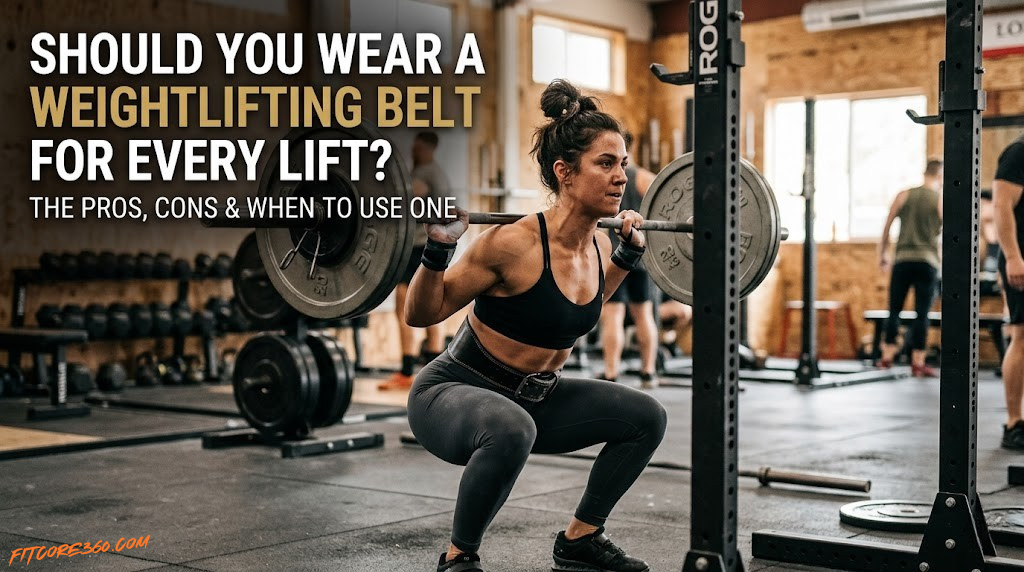
Should You Wear a Weightlifting Belt for Every Lift?
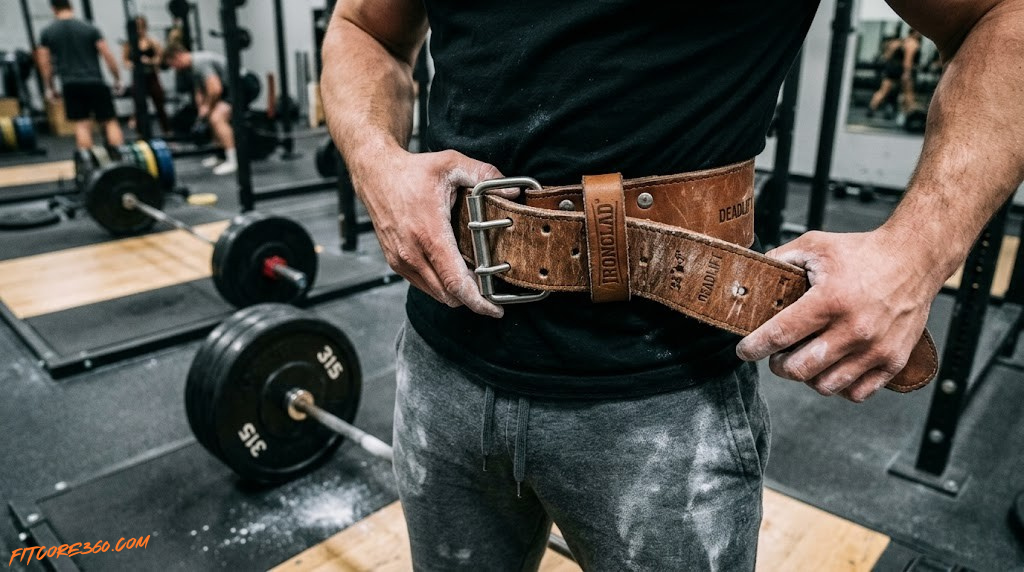
A quality belt is a tool — not a crutch. But only if you know when and how to actually use it.
Walk into any serious gym and you’ll see a spectrum. There’s the guy who wears a thick leather belt for warm-up sets on Romanian deadlifts at 135 lbs. There’s the woman who squats four plates raw, beltless, with flawless bracing. And then there’s everyone in between — confused, copying what they see, or going off advice that contradicts itself depending on which YouTube channel you watched last.
The question of whether to wear a weightlifting belt for every lift is one of the most misunderstood in strength training. The answer isn’t “yes, always” and it isn’t “no, belts make you weak.” The real answer is layered, and it depends on your training goal, your current level, the specific lift, the intensity, and whether you’ve actually built the foundational bracing mechanics that make a belt useful rather than a crutch.
This guide cuts through the noise. We’re going to explain exactly what a belt does (and doesn’t do), which lifts benefit from one, and how to structure your belt use intelligently so you get stronger — beltless and belted.
No — you should not wear a weightlifting belt for every lift. Belts are most beneficial for heavy compound lifts (squats, deadlifts, overhead press) at or above ~80% of your 1-rep max. Wearing one for everything undermines core development and proprioceptive feedback that makes you stronger long-term.
What a Belt Actually Does (And What It Doesn’t)
Before deciding when to wear a belt, you need to understand the mechanism behind it. Most gym-goers have a vague idea that “it supports your back” — which is partially true, but deeply incomplete as an explanation and leads to misuse.
A weightlifting belt doesn’t support your spine directly by wrapping around it. It doesn’t function like a back brace. What it actually does is provide a rigid external surface against which your abdominal muscles can brace.
The Valsalva Maneuver and Bracing
When you lift a heavy load, your best protection against spinal injury is intra-abdominal pressure — a technique that involves taking a deep breath into your belly (not your chest), holding it, and bracing your entire midsection as if you’re about to take a punch. This is called the Valsalva maneuver, and it temporarily converts your trunk into a rigid cylinder that protects the spine and transfers force efficiently.
Doing this without a belt means bracing against only the tension of your own abdominal wall. When you add a belt, you also have a hard external surface to push against — front, back, and sides. This allows you to generate significantly more intra-abdominal pressure than bracing alone, which translates to a more rigid torso and more protective support for the lumbar spine during maximal efforts.
Research has confirmed this. A frequently cited study published in the Journal of Strength and Conditioning Research found that wearing a belt can increase intra-abdominal pressure by 15–40% during heavy lifts. That is a meaningful physiological difference — especially at the loads that serious lifters move.
Studies show belts reduce spinal compressive forces, improve torso stiffness, and allow lifters to lift heavier loads safely during maximal efforts. However, the same research shows minimal benefit at submaximal loads (<80% 1RM), and potential reduction in muscle activation for core musculature during lighter training.
What a Belt Does NOT Do
- It doesn’t “fix” bad technique. A belt on a lifter who doesn’t know how to brace is almost useless — you’re just wearing an expensive accessory.
- It doesn’t prevent injury on its own. The mechanism requires correct use of the Valsalva maneuver and active bracing. Passive reliance on the belt without bracing confers minimal protection.
- It doesn’t make weak muscles strong. If your erectors, glutes, or core are underdeveloped, a belt won’t compensate for those deficits at the neurological level.
- It doesn’t “stabilize” smaller muscles. On isolation exercises — curls, lateral raises, leg extensions — a belt has functionally zero mechanical benefit.
- It doesn’t replace core training. This is the critical misunderstanding that leads to belt dependency, which we’ll address in detail later.

The gold standard in competition-legal leather belts. Consistent thickness, fast lever buckle, and builds to your body over months of use. Used by elite powerlifters worldwide.
🛒 Check Price on AmazonThe Science: Intra-Abdominal Pressure Explained
Intra-abdominal pressure (IAP) is the pressure inside the abdominal cavity — the space between the diaphragm and the pelvic floor. When you inhale deeply and brace your entire midsection, you compress the contents of this cavity, dramatically increasing pressure within it.
This matters for lifting because the spine is not a freestanding column — it’s suspended within a hydraulic-like trunk structure. When IAP is high, the trunk becomes more rigid and the compressive and shear forces on individual spinal segments are distributed across a larger area. This is your body’s natural mechanism for protecting the lumbar spine during intense physical effort.
How the Belt Amplifies IAP
The abdominal wall has a limited ability to contain pressure on its own — muscles can only contract so hard. When you wear a belt, you introduce a rigid boundary that the abdominals can push against, allowing greater pressure development than soft tissue alone can produce. Think of it like the difference between squeezing a balloon against open air versus squeezing it against a hard wall — the wall provides resistance that allows you to generate substantially more compressive force.
Electromyography (EMG) research shows that wearing a belt during squats and deadlifts increases activation of the rectus abdominis and lumbar erectors simultaneously — the body is bracing harder because it has something to brace against. At maximal or near-maximal loads, this translates to measurable increases in spinal stability and load-bearing capacity.
The Threshold Question: When Does IAP Benefit Actually Matter?
Here’s the nuance most people miss: the spinal protective benefit of a belt is most meaningful at high intensities — specifically, loads where your natural bracing capacity begins to approach its limit. Below approximately 75–80% of your 1-rep max, your trunk musculature is generally capable of generating sufficient IAP without assistance. Above that threshold — particularly in the 85–95%+ range — the additional IAP from a belt can make a meaningful difference in both safety and performance.
This is why coaches who understand the science recommend belt use for heavy working sets and maximal attempts, but not for warm-ups, lighter volume work, or accessory lifts. The physiological cost-benefit calculation simply doesn’t favor belt use at lower intensities.
“A belt doesn’t make you stronger. It allows you to express more of the strength you already have — but only if you’ve built the baseline first.”
When You SHOULD Wear a Weightlifting Belt
There are clear, well-supported situations where wearing a belt is the intelligent, performance-maximizing choice. Here they are, unambiguous and direct.
1. Heavy Compound Lifts at High Intensity
Any time you’re performing a barbell squat, deadlift, Romanian deadlift, rack pull, or any spinal-loading movement at 85% of your 1RM or above, a belt is appropriate. This is the scenario the tool was designed for. Your core is already working as hard as it physiologically can — the belt allows you to go beyond that ceiling safely.
2. Personal Record Attempts
Attempting a new 1RM or 3RM is the most obvious situation for belt use. The load is maximal by definition, and this is exactly when the difference between adequate and excellent spinal support matters most. Elite powerlifters — people who have trained their cores for years — still use belts on max attempts precisely because the physiological benefit is real and meaningful at those loads.
3. Competition and Tested Events
If you compete in powerlifting, Olympic weightlifting, or strongman, belt use during training that mirrors your competition setup is not only acceptable but recommended. You need to be adapted to lifting with a belt, and you need to know exactly how it changes your technique — particularly for the squat where a belt can alter your torso angle and bracing cues slightly.
4. High-Volume Accumulation Work Near Fatigue
When performing sets of 5+ reps at 75–85% intensity, particularly in the later sets of a high-volume session when your core muscles are beginning to fatigue, a belt provides additional safety margin. Injury risk spikes when volume-induced fatigue compromises bracing quality — a belt can maintain spinal stability even as your muscular endurance declines.
5. Overhead Press at Heavy Loads
Heavy overhead pressing creates significant lumbar extension stress — especially without perfect technique. Experienced pressers often use a belt for their top-end sets to reduce lumbar strain and allow a slightly more aggressive press without compromising low back positioning.
When You Should NOT Wear a Belt
This section is arguably more important than the previous one — because belt overuse is far more common than belt underuse in most commercial gyms. Understanding when to leave the belt in your bag is critical for long-term development.
1. Warm-Up Sets
Your warm-up sets exist for multiple purposes: raising core temperature, rehearsing movement patterns, and — critically — activating and strengthening the neuromuscular coordination of your core musculature. Strapping in from your first set at 45% of your max eliminates the proprioceptive training stimulus your core gets from bracing against lighter loads. Over months and years, this genuinely impairs beltless core strength development.
2. Isolation and Accessory Exercises
Curls, lateral raises, leg press, leg curls, cable flyes, tricep pushdowns, seated row — the list of exercises for which a belt is entirely useless is long. These movements either don’t involve significant axial spinal loading or occur in positions where IAP isn’t the limiting factor. Wearing a belt for these is purely aesthetic, not functional.
3. Light to Moderate Submaximal Work (Below 75–80% 1RM)
When your core is fully capable of generating adequate IAP on its own, the belt adds nothing mechanically. Worse, it reduces the training stress on your core stabilizers — which need progressive load just like your prime movers do.
4. Beginner Training (First 6–12 Months)
New lifters need to develop bracing mechanics and core strength before a belt becomes a legitimate tool. Using a belt before these foundations are in place is like using training wheels on a bicycle forever — you never develop the underlying skill. The first year should be dedicated to learning to brace properly, building core stability, and developing movement quality. This is the period that pays the highest dividend in long-term lifting ability.
5. Explosive and Athletic Movements
Olympic lifts, medicine ball throws, kettlebell swings, box jumps — movements that require rapid transitions through multiple planes don’t benefit from a belt and may actually be inhibited by the restricted range of motion a tight belt creates around the trunk.
6. Cardiovascular and Circuit Training
There is no logical argument for wearing a weightlifting belt during cardio, circuit training, or bodyweight conditioning. Beyond being unnecessary, wearing a belt during sustained cardio can restrict breathing patterns and impair performance.

The most popular belt at IPF World Championships. Perfectly consistent 10mm thickness with an ultra-fast lever mechanism. Built to last decades. Worth every penny for serious lifters.
🛒 Check Price on AmazonLift-by-Lift Breakdown: Belt or No Belt?
Rather than speaking in generalities, let’s go through every major gym exercise and give you a direct, evidence-based recommendation. This is the reference table you can actually use to structure your training.
| Exercise | Belt Recommended? | At What Intensity? | Why / Why Not |
|---|---|---|---|
| Back Squat | Yes | 85%+ 1RM working sets | High axial load, lumbar stress — belt meaningfully increases IAP |
| Front Squat | Optional | 85%+ only | Upright torso reduces need, but heavy loads still benefit |
| Conventional Deadlift | Yes | 85%+ 1RM | Peak lumbar load at liftoff — belt reduces spinal shear significantly |
| Sumo Deadlift | Yes | 85%+ 1RM | Same as conventional; slightly different stress pattern but still relevant |
| Romanian Deadlift (RDL) | Optional | Heavy working sets only | Lower absolute load but hip-hinge position stresses lumbar — use at heavier loads |
| Overhead Press | Optional | 85%+ for experienced lifters | Heavy loads create lumbar hyperextension stress — belt can help |
| Bench Press | No | N/A | Supine position — no meaningful spinal compression; belt irrelevant |
| Barbell Row | Optional | Heavier working sets | Hip-hinge position under load — moderate benefit at high intensity |
| Good Mornings | Yes | Any working weight | Extreme lumbar loading position — belt recommended at all working loads |
| Rack Pulls | Yes | All sets | Typically loaded heavier than full deadlift — belt appropriate |
| Leg Press | No | N/A | Spine fully supported by pad; belt useless |
| Bulgarian Split Squat | No | N/A | Unilateral — no meaningful axial spinal load from bar position |
| Hip Thrust / Glute Bridge | No | N/A | Supine-ish position, shoulder-supported — belt not relevant |
| Dumbbell Exercises | No | N/A | Load insufficient to justify; bracing from body alone is appropriate |
| Olympic Cleans / Snatches | Very Optional | Max attempts only | Belt can restrict turnover; most Olympic athletes prefer beltless |
| Pull-Ups / Chin-Ups | No | N/A | Hanging movement — belt provides no mechanical benefit |
| Farmer Carries | Optional | Heavy sets only | Axial load during walking; some benefit at maximal loads |
The Big Three: Specific Belt Guidance
Squat
Belt on for working sets ≥80% 1RM. Beltless warm-ups through at least 70%.
Deadlift
Belt on for all heavy pulls. Consider beltless work at 60–75% for core training.
Overhead Press
Experienced lifters: belt at top sets. Beginners: learn without one first.
Bench Press
No belt needed. Supine position means zero axial spinal loading.
RDL / SLDL
Belt optional — use at heavier loads (70%+ of conventional deadlift max).
Olympic Lifts
Mostly beltless. Belt only on absolute max attempts if competing.
For an in-depth look at accessory gear that complements your belt use, see our comprehensive guide to the best weightlifting belts for squats and deadlifts — covering everything from powerlifting-specific cuts to versatile gym belts.
The Belt Dependency Myth: Fact or Fiction?
You’ve heard it: “If you always wear a belt, your core will never get strong.” Or the opposite: “Belts don’t cause dependency — they’re just a tool.” Both of these statements, taken as absolute rules, are wrong. The truth is conditional, and getting it right matters.
The Actual Risk of Belt Dependency
Belt dependency is real, but it’s specifically the risk of overuse — not use per se. If you wear a belt for 100% of your barbell training, including all warm-up sets and submaximal work, you are consistently removing training stimulus from your core stabilizers. Those muscles — the transverse abdominis, internal obliques, multifidus — respond to progressive load just like any other muscle. If they’re never challenged without the belt’s external support, they won’t develop to their potential.
The consequence isn’t catastrophic weakness, but it does mean that when you lift without a belt — in real-world situations, recreational activity, or in a gym when you’ve forgotten yours — your beltless strength is disproportionately lower than your belted strength. That gap reflects undertrained core musculature.
What the Research Shows
Studies examining long-term belt use in trained lifters have found that strategic belt use — heavy sets belted, lighter work beltless — does not impair core muscle development when compared to beltless-only training. In fact, the heavier loads possible with belt use create more total mechanical stress on the entire posterior chain, including the spinal erectors, which may result in superior development despite the belt use.
The key phrase is “strategic belt use.” Athletes who belt every single set, including warm-ups and accessory work, consistently show worse beltless strength ratios and core endurance scores compared to those who use belts selectively. The tool is fine — the overuse pattern is the problem.
The Smart Protocol
Before any belt use, master the Valsalva maneuver, learn to brace your 360-degree trunk, and develop baseline core endurance through unloaded and lightly-loaded training.
Treat all sets below 75–80% of your working max as core training opportunities. These sets don’t need the belt, and they benefit you more without it.
Your heaviest 1–3 working sets per session are where the belt earns its place. Strap in, brace hard, and use the mechanical advantage where it matters most.
Plan specific training cycles or sessions where you squat and deadlift at moderate intensities without a belt. This keeps your beltless strength developing in parallel with your belted strength.
Dedicated core work — ab wheel rollouts, Pallof press, hanging leg raises, loaded carries — builds the foundation that makes your belt use more effective, not less necessary.
If you’re also using lifting straps, similar strategic thinking applies — our analysis of whether lifting straps hurt grip strength long-term covers the same dependency question in a different context.
Belt Types Compared: Which One Is Right for You?
Not all lifting belts are created equal. The type of belt you use matters — both for the training benefit and for your specific training goals. Here’s a breakdown of every major belt category.
Powerlifting Belt (10mm Leather)
Uniform thickness front and back (~10–13mm). Rigid, maximum support. Best for heavy squat and deadlift. Used at IPF, USAPL, and most federations. For serious strength athletes.
Tapered Belt (4″ Back / 2″ Front)
Wider in the back, narrower in front. More comfortable for everyday gym use. Less spinal support than uniform belt but allows greater range of motion at the hip crease. Versatile option.
Nylon / Velcro Belt
Lightweight, adjustable, budget-friendly. Good for CrossFit, metabolic conditioning, Olympic weightlifting. Not ideal for maximal powerlifting loads. More proprioceptive cue than structural support.
Olympic Weightlifting Belt
Narrower than powerlifting belts, typically 4″ wide max. Allows the hip-hinge and aggressive turnover positions required in the snatch and clean & jerk. Specialized for its purpose.
Lever Belt vs. Prong Belt: The Practical Question
Within the category of powerlifting belts, the most practical question is the buckle mechanism. Our detailed comparison of lever belt vs. prong belt goes deep on this — but here’s the summary:
| Feature | Lever Belt | Prong Belt (Single) |
|---|---|---|
| Speed of Use | ⚡ Very fast — one click on/off | Slower — thread prong each time |
| Tightness Consistency | Extremely consistent every set | Varies slightly by tightness |
| Adjustability Mid-Session | Requires screwdriver to change hole | Adjust freely between sets |
| Durability | High (lever can wear eventually) | Extremely high — simple mechanism |
| Competition Legal | Yes (most feds) | Yes (all feds) |
| Cost | Higher ($80–200+) | Lower ($40–150) |
| Best For | Powerlifting, heavy regular use | General strength, bodybuilders, varied training |
If you’re a dedicated powerlifter doing multiple heavy sets per session, a lever belt is worth the investment for its speed and consistency. If you do varied training — mixing heavy days with bodybuilding accessory work, conditioning, and other lifts — a single prong belt offers more flexibility.

Best-in-class nylon belt for general training. Double-back velcro, fast cinch, excellent fit for varied gym use including conditioning and CrossFit-style sessions.
🛒 Check Price on AmazonHow to Wear a Weightlifting Belt Correctly
This is where most gym-goers go wrong even after deciding to use a belt. Wearing it incorrectly dramatically reduces its effectiveness — and in some cases creates a false sense of security while doing nothing for spinal protection.
Belt Placement: Where It Goes on Your Body
The most common mistake is wearing the belt too low — positioned over the hip bones or lower like a fashion belt. This does nothing. The belt needs to be positioned over your lumbar spine and lower abdominals simultaneously — essentially straddling the natural waist, just below the ribcage and above the top of the hip bones (iliac crest).
For most people, this is approximately at the navel level or slightly below. The goal is to have the belt centered over the area you’re trying to brace — and that’s the entire midsection, not just the lower back.
How Tight Is Tight Enough?
You should be able to fit one to two fingers under the belt when relaxed, but when you brace hard and push your belly into it, the belt becomes genuinely tight. If you can’t generate any pressure against the belt even when bracing maximally, it’s too loose. If it’s so tight that taking a full diaphragmatic breath is impossible, it’s too tight — you won’t be able to perform a proper Valsalva, which defeats the entire purpose.
The belt tightens effectively when you inhale and brace. This is the mechanism. It should feel snug at rest and very firm under full brace — not painful, but solid and restrictive enough to push against.
The Correct Bracing Sequence with a Belt
Get set up under the bar before you brace. You can’t effectively hold a brace for 30 seconds while you’re adjusting your position.
Breathe into your diaphragm, letting your belly expand outward into the belt. Your chest should barely move. You should feel the belt tighten on all sides — front, back, and laterally.
Imagine someone is about to punch you in the stomach. Flex every muscle in your midsection — front, sides, and lower back — simultaneously. This is the Valsalva maneuver combined with active abdominal co-contraction.
Don’t release the brace mid-rep. On a deadlift, maintain it from liftoff to lockout. On a squat, maintain from unrack through descent and ascent. Release only at the top when the load is fully controlled.
At the top of each rep, take a new belly breath and re-brace. Never breathe and release pressure at the bottom of a squat or at the floor during deadlifts — this is when spinal loading is highest.
Many lifters brace against the belt correctly — but then exhale during the lift, releasing all IAP at the most critical moment. Never exhale during the sticking point of any heavy lift. Hold the brace from descent initiation to lockout on each rep. Breathing happens between reps, not during them.
If you’re also using wrist wraps or other supportive gear for your pressing work, the same principle applies — they’re tools that complement correct technique, not replace it. Our guide to best wrist wraps for bench press covers the parallel considerations for wrist support.
Beginner vs. Intermediate vs. Advanced: Different Rules
Belt use strategy should evolve as you advance as a lifter. What’s appropriate for a competitive powerlifter with 5 years of experience isn’t appropriate for someone six months into lifting. Here’s how to think about it at each stage.
| Level | Training Age | Belt Use Recommendation | Priority |
|---|---|---|---|
| Beginner | 0–12 months | Avoid or severely limit belt use. Learn to brace naturally. | Core development + technique |
| Early Intermediate | 1–2 years | Introduce belt for top sets only (85%+ 1RM). Keep all other work beltless. | Transition + bracing education |
| Intermediate | 2–4 years | Belt on working sets above 80% 1RM. Dedicated beltless sessions monthly. | Performance + core maintenance |
| Advanced | 4+ years | Belt for all heavy working sets. Programs include deliberate beltless phases. | Maximum performance + longevity |
| Competitor | Any | Belted in competition; training mirrors comp conditions for specific prep. Off-season includes beltless development work. | Competition performance |
For Beginners: Why the First Year Matters So Much
Your first year of serious lifting is the highest-adaptation period of your training life. Your nervous system is learning movement patterns, your connective tissue is adapting to load, and your core musculature — which was probably undertrained before you started lifting — is developing rapidly in response to novel stimulation.
Introducing a belt in this period blunts the core training signal on every set where you use it. More importantly, many beginners don’t yet know how to brace at all — they don’t know how to use a belt correctly — so the belt provides false security without the physiological mechanism that makes it protective. A beginner who doesn’t know how to brace wearing a belt is not safer; they’re wearing an accessory.
Spend your first year building bracing mechanics through direct core training, deliberate practice of the Valsalva maneuver under light loads, and developing movement quality. You’ll build a stronger foundation than lifters who belted up from day one, and when you do introduce a belt, you’ll use it far more effectively.
For Intermediate and Advanced Lifters
At this stage, the question isn’t whether to use a belt — it’s about optimizing belt use as one component of an intelligent programming strategy. Most intermediate lifters benefit from the following structure:
- Heavy days (≥80% 1RM): Belt for all working sets. Warm-ups beltless through approximately 70% of your working weight.
- Volume/hypertrophy days (65–80%): Consider beltless for most work, belt only for the heaviest sets in that block.
- Technique/deload days (<65%): Beltless entirely — these sessions are for quality, not load.
- One dedicated beltless session per training cycle: Builds raw beltless strength and maintains the motor patterns needed to lift safely without a belt in any context.

An affordable entry-level belt ideal for intermediate lifters making the transition to belt use. Good structure without the rigidity that requires adaptation time. A solid first belt.
🛒 Check Price on AmazonBuilding a Bulletproof Core Without a Belt
Whether you’re a beginner building your foundation, an intermediate lifter on a beltless training phase, or someone looking to genuinely strengthen the musculature that makes belt use effective — this section is essential.
A belt amplifies your core’s bracing capability. The only way to maximize that amplification is to have a strong, well-trained core to start with. Here are the exercises and approaches that develop beltless core strength most effectively for lifters.
Anti-Extension Core Training
The primary function of your core in heavy lifting is resisting extension — preventing the spine from hyperextending under load. Anti-extension exercises train exactly this quality:
- Ab Wheel Rollout: One of the most effective core exercises for lifters. Trains the anterior core’s ability to resist extension under a long lever arm.
- Plank Progressions: Standard plank → weighted plank → RKC plank → body saw plank. Progressive versions that develop genuine core stability rather than endurance tolerance.
- Dead Bug Variations: Excellent for developing contralateral coordination and anti-extension capacity at controlled tempos.
Anti-Rotation and Anti-Lateral Flexion
- Pallof Press: The foundational anti-rotation movement. Train it standing, kneeling, and in half-kneeling to cover multiple positions relevant to compound lifts.
- Suitcase Carry: Single-side farmer carry trains anti-lateral flexion — the ability to resist side-bending under load — which is critical for asymmetrical loading and real-world strength.
- Copenhagen Plank: Underrated for training the adductors and lateral core as a unit.
Heavy Compound Movements Done Beltless
There is no substitute for specific adaptation — the core gets strongest when it has to handle the specific demands of the lifts you’re training for. Regular beltless squat and deadlift sessions at 65–75% of your 1RM develop exactly the kind of core stability and IAP generation that translates directly to safer, stronger lifting at heavier loads.
For additional exercises that develop grip and upper body stability — qualities that complement strong core bracing — our guide to grip strength exercises for beginners vs. advanced covers a full progression of tools and methods. Similarly, if you’re focused on reducing grip fatigue so your core training can be the limiting factor (rather than your hands), see our breakdown of when to start using lifting straps.
Loaded Bracing Practice
One often-overlooked method: take your beltless warm-up sets and treat them as deliberate bracing practice. Before each beltless set, focus intensely on performing the perfect Valsalva, maintaining 360-degree pressure, and holding it through every rep. This transforms what are otherwise “just warm-up sets” into intentional core training.
The goal of dedicated core work isn’t to develop six-pack aesthetics — it’s to build the trunk stiffness and IAP generating capacity that makes every heavy lift more efficient and safer. Train your core with the same intention you train your main lifts: progressive overload, quality reps, purposeful programming.
Belt Buying Guide: What to Look For
If you’ve decided you’re ready to invest in a quality belt, here’s what the specification breakdown actually means and how to match it to your needs.
Thickness
Belts come in 10mm and 13mm thickness for leather powerlifting belts. 10mm is the standard and is approved for most powerlifting federations. It’s stiff enough for maximum support while being comfortable enough for most body types. 13mm offers more rigidity but requires a longer break-in period and can be uncomfortable for lifters with shorter torsos. Most lifters — including elite powerlifters — use 10mm.
Width
Powerlifting belts are typically 4 inches wide (the maximum allowed in most federations). This uniform width is critical — it means the belt provides equal support front, back, and side. Tapered belts are wider in the back and narrower in front — comfortable for everyday training but provide less abdominal support than a uniform 4″ belt.
Material
Full-grain leather is the gold standard — durable, moulds to your body over time, provides the most rigid external surface for bracing. Nylon is lighter, adjustable, faster to put on, and better suited for varied training. Suede falls in between — less rigid than leather but more comfortable. For pure strength training, leather wins. For mixed training, nylon is more practical.
Buckle Type
As covered earlier, lever vs. prong. Our full comparison at lever belt vs. prong belt breaks down every consideration. Short version: lever for dedicated powerlifters, prong for everyone else.
| Specification | Casual Lifter | Serious Strength Athlete | Competitive Powerlifter |
|---|---|---|---|
| Thickness | 6–8mm or nylon | 10mm leather | 10mm leather (IPF legal) |
| Width | 4″ tapered OK | 4″ uniform preferred | 4″ uniform (fed approved) |
| Material | Nylon or light leather | Full-grain leather | Full-grain leather — stiff |
| Buckle | Velcro or single prong | Single or double prong | Lever or single prong |
| Budget | $30–70 | $80–150 | $150–250+ |
| Examples | Dark Iron, Harbinger | Inzer, Titan, Pioneer | SBD, Rogue, A7 |
Sizing Your Belt
This is critical and frequently botched. Belt size is determined by your waist measurement at navel level — not your pants size or your general clothing size. Measure with a flexible tape measure and compare against the brand’s specific size chart (each brand’s sizing varies slightly). Most belts are sized in inches, and the sizing usually corresponds to where the prong sits in the middle holes of the belt — you want the option to go tighter or looser by one hole in either direction.
Measure your actual waist at belly-button level. If you’re between sizes, go with the smaller size for leather belts (they break in and stretch slightly). Go with the larger size for rigid, stiff competition belts where break-in is less pronounced.
For complementary gear that rounds out a complete strength training setup, our guides on best powerlifting shoes and best wrist wraps for bench press cover the other key pieces of competition-legal supportive equipment.
Frequently Asked Questions
Only if you overuse it. Wearing a belt for every single set — including warm-ups and submaximal work — reduces training stimulus on your core stabilizers, which can lead to underdevelopment over time. However, strategic belt use (heavy sets only, warm-ups beltless, occasional beltless training blocks) does not impair core development. The key is deliberate use rather than habitual use on everything.
Most coaches recommend introducing a belt at approximately 80–85% of your 1-rep max for compound lifts like squats and deadlifts. Below this threshold, your core should be capable of generating adequate intra-abdominal pressure without assistance, and the beltless training stimulus is more valuable than the marginal performance benefit a belt provides at lower intensities.
Generally, no — not for the first 6–12 months of training. Beginners need to develop bracing mechanics, core strength, and movement quality before a belt becomes a useful tool. Using a belt before these foundations are established doesn’t provide significant protection (because the user doesn’t know how to brace properly against it) and may blunt the core development that makes lifting safe long-term. Exceptions exist for beginners with pre-existing back injuries, in which case medical guidance should be sought.
No — there’s no meaningful mechanical reason to wear a belt for bench press. The supine position means the spine bears no significant axial (vertical) load during the movement. Intra-abdominal pressure plays a minor role in bench press stability, and it can be achieved through natural bracing against the bench without a belt. Some powerlifters wear a belt for competition bench primarily out of habit or for warmth, but it provides no evidence-backed benefit.
The belt should be positioned around your natural waist — at approximately navel level or slightly below it, above the top of your hip bones (iliac crest). It should cover both the lumbar spine in the back and the lower abdominals in front. Many lifters make the mistake of wearing it too low (like a pants belt over the hips), which dramatically reduces effectiveness. When you brace, you should feel pressure from the belt on your front, back, and both sides simultaneously.
You should be able to fit one to two fingers under the belt when relaxed. When you take a full diaphragmatic breath and brace maximally, the belt should feel genuinely firm and restrictive — you’re pushing against it. If you can barely feel it under maximum bracing, it’s too loose. If you can’t take a full belly breath at all, it’s too tight and will prevent the Valsalva maneuver from working correctly. The test: can you generate pressure against the belt on all sides when bracing hard? If yes, the tightness is correct.
For maximum strength performance (heavy powerlifting-style training), a 10mm full-grain leather belt is superior — it’s stiffer, provides more consistent resistance to brace against, and lasts decades. For versatile training that includes conditioning, metabolic work, Olympic lifting, and varied intensity, a quality nylon belt is more practical — it’s lighter, adjustable, faster to put on and off, and comfortable across a wider range of movements. Your training style should determine your belt material.
No — not in any meaningful sense. A belt doesn’t lift the weight for you; it allows you to safely express more of the strength you’ve built. Elite powerlifters, Olympic weightlifters, and strength coaches at every level use belts strategically. The same argument applied to belts could be made against lifting shoes, chalk, or competition-legal gear of any kind. What would be “cheating” is using a belt as a substitute for learning correct technique and building foundational core strength — which is why the “no belt until you’ve built the foundation” principle matters.
Used correctly, a belt does not cause hernias. Hernias are caused by increased intra-abdominal pressure that exceeds the structural integrity of the abdominal wall — but this risk applies to heavy lifting generally, not to belt use specifically. In fact, by providing an external surface that distributes intra-abdominal pressure more evenly, a belt may reduce hernia risk compared to maximal unbelted efforts. The greater risk factor for hernias is bearing down (Valsalva) without adequate core musculature to support the effort — which is a reason to build core strength, not avoid belts.
New leather belts — particularly stiff competition-grade belts — can be uncomfortable and may limit range of motion until they soften. To break one in: (1) wear it regularly during training sessions, including for lighter work, allowing your body heat to soften it; (2) bend it manually against your knee repeatedly to flex the leather; (3) apply a thin layer of leather conditioner (neatsfoot oil or similar) and work it into the leather; (4) store it rolled up rather than flat to maintain flexibility. Break-in typically takes 2–4 weeks of regular use for a 10mm belt.
For experienced lifters pressing at 85%+ of their 1RM, yes — a belt can meaningfully reduce lumbar hyperextension stress that accumulates during heavy overhead pressing. For beginners and intermediate lifters pressing at submaximal loads, no — learning to maintain a neutral lumbar spine through proper bracing, glute engagement, and rib-down positioning is more valuable at this stage. If you need a belt to avoid hyperextending your low back during overhead press, that’s a technical and mobility issue to address, not a permanent belt dependency to develop.
The Verdict: Train Smart, Belt Strategically
Wearing a belt for every lift isn’t smart training — it’s lazy habit. But avoiding belts entirely out of fear of “dependency” misses out on a genuinely useful tool that can extend your training career and help you push to levels you couldn’t safely reach otherwise.
The intelligent middle ground: build your foundation first. Learn to brace. Train your core like a prime mover. Then introduce belt use strategically — heavy sets, competition prep, max attempts — while keeping lighter work and warm-ups beltless to maintain the natural bracing strength that makes your belt use effective in the first place.
A belt is one of the most effective pieces of lifting equipment ever designed. Use it like a professional, not like a security blanket.