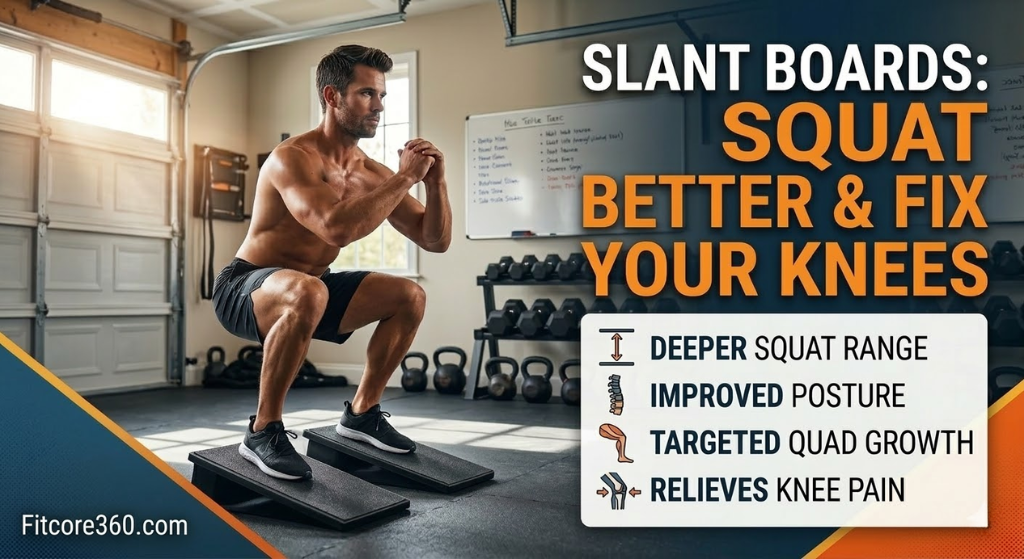
A slant board is one of the simplest tools in a home gym — a wedged platform that tilts your feet forward to improve ankle dorsiflexion, allow deeper squats, and rehabilitate chronic knee pain. This guide covers the science, the exercises, the right angle for your goal, and how to programme it into your existing training.
A slant board is a wedged platform — typically set at 15°, 20°, or 25° — that you stand on with your heels lower than your toes. This controlled incline replicates the effect of elevating your heels during a squat, but in a stable, repeatable, and adjustable way. The result is increased ankle dorsiflexion range, reduced posterior chain tension during deep knee bend movements, and a targeted loading environment for the knee and quad tendons.
🦵 Why It MattersAnkle dorsiflexion — the ability of the ankle to flex the shin forward over the foot — is the single most common mobility limitation preventing a full-depth squat. When the ankle can’t travel far enough forward, the body compensates: the heel rises, the torso tips forward excessively, or the knees cave inward. A slant board addresses this constraint directly, allowing the knee to travel over the toe without restriction. This unlocks squat depth, improves knee health, and allows targeted loading of the VMO and patellar tendon that most other tools cannot replicate.
15–25°Typical adjustable range — most training needs are met within this window
+40%Increase in VMO quad activation vs flat-floor squat at equivalent depth
8–12 wksTime to measurable improvement in patellar tendinopathy with consistent slant board loading
Unlike heel wedges or weight plates used as improvised elevation, a slant board provides a stable, non-slip surface at a consistent angle with enough width for single-leg work. The adjustable versions allow you to start at a lower incline and progressively reduce it as ankle mobility improves — something a fixed wedge or plate cannot do.
5 Key Benefits of Slant Board Training
📐
Unlocks Ankle Dorsiflexion
The incline compensates for limited ankle range of motion, allowing the knee to travel forward without the heel rising. With consistent use, passive ankle mobility improves through progressive tissue adaptation — the board is both a workaround and a long-term fix.
🏋️
Deeper Squat Immediately
Most users squat measurably deeper on their first session on a slant board — without any mobility work. The incline shifts the constraint from ankle range to quad strength, revealing how much depth was being limited by dorsiflexion rather than hip or spine mobility.
💪
Targeted VMO & Quad Loading
Slant board squats dramatically increase the knee-over-toe range, which shifts load onto the VMO (vastus medialis oblique) and patellar tendon. This targeted loading is the primary mechanism behind slant board use in patellofemoral pain and patellar tendinopathy rehabilitation.
🦵
Knee Tendon Rehabilitation
Heavy slow resistance on the patellar tendon — provided by loaded slant board single-leg squats — is the evidence-based treatment for patellar tendinopathy. The slant board creates the specific loading angle that maximises tendon stress at the insertion point while controlling descent speed.
🧘
Calf & Soleus Stretch
Standing on a slant board provides a sustained, low-intensity stretch to the gastrocnemius and soleus. 10–15 minutes of passive standing daily produces measurable improvements in calf flexibility over 4–6 weeks — without any active stretching protocol required.
⚡
Better Transfer to Sport & Lifting
Improved dorsiflexion and deeper squat mechanics translate directly to barbell back squat, front squat, Olympic lifting, running mechanics, and jumping. Athletes who address ankle mobility see immediate improvements in movement quality in all knee-dominant patterns.
How a Slant Board Improves Your Squat
The mechanics are worth understanding because they dictate how you should programme the tool. During a squat, the shin must travel forward over the foot — this forward shin travel is dorsiflexion. The further the knee can travel over the toe while the heel stays down, the deeper the squat can go without compromising torso position.
When ankle dorsiflexion is limited, one of three compensations occurs: heel rise (foot leaves the floor), forward torso lean (the centre of mass shifts forward to maintain balance), or knee cave (the knee collapses inward to find a different range). All three reduce the training value of the squat and increase injury risk over time.
💡
Test your dorsiflexion first. Stand 10 cm from a wall, feet straight, and try to touch your knee to the wall without your heel leaving the floor. If you can’t reach, ankle mobility is limiting your squat. If you can reach easily, the slant board is still useful for VMO loading and tendon work — but your squat depth limitation is coming from elsewhere (hip mobility or technique).
A slant board tilts the entire foot forward — effectively giving you the dorsiflexion range you don’t have yet. The heel sits lower than the toes, so the shin can remain upright while the knee still travels forward. This allows a mechanically sound deep squat position from session one, even in users with severely restricted ankles.
The Long-Term Adaptation Mechanism
Over weeks of consistent use, the sustained end-range loading of the ankle joint — and the regular stretching of the posterior chain during board standing — produce genuine tissue adaptation. Calf muscles lengthen, joint capsule mobility improves, and the nervous system becomes more comfortable at end-range positions. Used progressively, a slant board should make itself less necessary over time — the goal is to eventually squat at the same depth without the incline. The adjustable board is superior here: you can progressively reduce the angle as mobility improves.
The most compelling evidence for slant board use sits in the rehabilitation literature on patellar tendinopathy — chronic pain at the front of the knee where the patellar tendon attaches to the tibial tuberosity. This is the same knee pain common in runners, jumpers, cyclists, and anyone who squats heavily without adequate tendon conditioning.
The mechanism behind slant board loading for tendinopathy is heavy slow resistance (HSR): controlled, loaded eccentric and concentric contractions of the quad under high tension at the tendon insertion. The slant board creates the specific shin-forward position that maximises load on the patellar tendon during a squat, and the single-leg variation allows progressive overload in a way a flat-floor squat cannot match for isolated tendon loading.
📚 Research SummaryMultiple peer-reviewed studies support heavy slow resistance loading for patellar tendinopathy, with the slant board squat identified as a primary delivery mechanism. Protocols typically involve 3–4 sets of 6–15 reps at a 3-second lowering phase, 3 times per week, progressed over 12 weeks. Patients who completed HSR protocols showed equivalent or superior outcomes to surgery in long-term follow-up studies. This is not a marginal benefit — the evidence base is among the strongest in tendinopathy rehabilitation.
Patellofemoral Pain (Runner’s Knee)
Beyond tendinopathy, slant board training is widely used for patellofemoral pain syndrome (PFPS) — the umbrella term for pain around and behind the kneecap. The primary mechanism here is VMO strengthening. The VMO — the teardrop-shaped inner quad muscle — helps track the kneecap correctly within the femoral groove. Weakness or inhibition of the VMO allows the kneecap to track laterally, causing friction, inflammation, and the characteristic aching pain around the kneecap during stairs, squatting, and prolonged sitting.
⚠️
Slant board training is not a replacement for a clinical diagnosis. If you have acute knee pain, swelling, locking, giving way, or pain that has appeared suddenly following an injury, see a physiotherapist or sports medicine doctor before loading the joint. Slant board work is appropriate for chronic, activity-related knee pain — not acute or structural injuries. See our PT-approved exercise guide for specific rehabilitation progressions.
These exercises move from the most accessible (beginner-appropriate) to the most demanding. For rehabilitation, start at the top and progress only when you can complete the prescribed volume pain-free at a slow tempo. For general mobility and strength, pick the exercises that match your current training level.
01
Passive Standing Stretch
BeginnerMobility10–15 min dailyCalf / Soleus
Stand on the slant board at 15–20° with feet hip-width, bodyweight evenly distributed, for 10–15 minutes. No active squatting — just sustained end-range loading of the calf and ankle. This is the most underrated slant board use: the passive stretch alone produces significant flexibility gains with zero effort. Best performed first thing in the morning while doing another activity — reading, working at a standing desk, or watching video.
Keep weight through the whole foot — don’t let heels drop off the board. Keep knees soft, not locked.
02
Slant Board Bodyweight Squat
BeginnerStrength3 × 10–15 repsQuad / VMO
Feet hip-width on the board, toes forward or slightly out, squat as deep as possible while keeping chest tall. The incline will immediately allow a deeper position than flat-floor squats for most people. Focus on the knee tracking over the little toe and keeping the torso as upright as possible. Use a wall or TRX for balance if needed initially.
Aim to get the crease of the hip below the knee. If you’re used to parallel squats, this depth will feel very different on the quads — that’s normal and correct.
Stand on the board with your back against a wall and slide down to a 60–70° knee angle. Hold the position isometrically. Isometric loading has strong evidence for immediate pain reduction in tendinopathy — a 2015 study found 5 × 45-second isometric holds reduced patellar tendon pain by 44% acutely. This makes it the ideal starting point before progressing to dynamic loading.
The exact knee angle matters — 60–70° from full extension is the target. More than 90° (deeper) increases tendon load significantly; use this progression deliberately.
Hold a kettlebell or dumbbell at chest height and perform a deep squat on the slant board. The anterior counterweight helps maintain an upright torso and reinforces the correct depth cue. This is the best loaded squat variation for beginners and intermediate users — it’s self-correcting, safe, and allows progressive overload by increasing the load week to week.
Elbows inside the knees at the bottom, chest tall. The weight should prevent forward lean — if you’re still falling forward with a light weight, your mobility needs more passive work first.
Stand on one foot on the board, hold a wall or rack for balance, and lower as deep as possible on the working leg. This is the primary exercise in heavy slow resistance protocols for patellar tendinopathy. The single-leg loading creates the tendon stress required for structural adaptation. Begin with assisted balance and progress to unassisted, then add weight (goblet hold or weight vest) as strength improves.
3-second descent, 1-second pause at bottom, 2-second ascent. Tempo is what makes this therapeutic — rushing the descent removes the tendon adaptation stimulus.
06
Slant Board Lunge
IntermediateStrength3 × 10 each legQuad / Hip / Balance
Place the front foot on the slant board and rear foot on the floor. The elevated front foot dramatically increases the range of motion and anterior knee drive available in the lunge, creating a deep quad stretch-under-load that standard lunges rarely achieve. Particularly effective for addressing asymmetrical ankle mobility — useful when one ankle is significantly tighter than the other after injury.
Front knee should track to the little-toe side. Keep the torso upright — resist the urge to hinge at the hip to cheat depth.
Stand on the slant board and perform a slow calf raise — but use both legs to rise and only one leg to lower (3–5 second eccentric). The incline increases the stretch range available at the bottom of the movement, targeting the soleus specifically (the deeper calf muscle rarely addressed in standard calf raises). The single-leg eccentric loading is the evidence-based treatment for Achilles tendinopathy.
At the bottom of each rep, allow the heel to sink below the toe level — this full range is what differentiates board calf raises from floor work. Do not rush the lowering phase.
The angle you choose determines the degree of ankle compensation, the amount of anterior knee drive, and the overall difficulty of the movement. Higher angles are not always better — the goal is to use the minimum angle that allows the target movement and progressively reduce it as mobility improves.
📐 Slant Board Angle Guide
15°
Low Incline
Good baseline mobility. Progress target for users starting at higher angles. Passive stretching and light squats.
Mobility Maintenance
20°
Mid Incline
The most versatile working angle. Effective for goblet squats, single-leg work, calf raises, and most rehab protocols.
Sweet Spot
25°
High Incline
Maximal ankle compensation. Best for severely restricted ankles, introductory single-leg squats, and maximum VMO isolation.
Advanced / Rehab
← Scroll to see full table →
Goal
Recommended Angle
Best Exercise
Notes
Improve squat depth
20–25°
Goblet squat, BW squat
Start high, progressively reduce angle over weeks
Patellar tendinopathy
20–25°
Single-leg squat (HSR)
Higher angle = more tendon load. Progress load, not angle
Incline increases soleus stretch at bottom of range
Daily passive stretch
15–20°
Standing stretch
Higher angles may be uncomfortable for 10+ min standing
Loaded strength work
20°
Goblet squat, lunge
20° balances quad loading with balance stability
Olympic lifting prep
15°
Overhead squat, pause squat
Use as mobility warm-up, not primary training surface
How to Programme Slant Board Training
The slant board fits into an existing training programme as either a warm-up tool (passive standing + light squats before main lower body sessions), a rehabilitation protocol (specific HSR loading for tendinopathy, 3× per week), or a mobility finisher (passive standing or deep bodyweight squats at the end of a session). It does not need to be a standalone session — 10–15 minutes integrated into existing training is sufficient.
📅 Programming by Goal & Level
Level / Goal
Frequency
Volume
Progression
Beginner — Mobility
Daily passive standing (10 min) + 2× per week squat work
3 × 10–12 BW squats after standing
Reduce angle by 2.5° every 3–4 weeks as mobility improves
Intermediate — Strength
3× per week as warm-up to leg sessions
3 × 8–12 goblet squats; 2 × 8 lunges each leg
Add 2–4 kg load every 2 weeks; progress to single-leg
Patellar Tendinopathy
3× per week (not daily — tendons need 48hr recovery)
3–4 × 6–15 single-leg squats @ 3-sec eccentric
Increase load every 2 weeks; maintain tempo throughout
PFPS Rehab
Daily isometric holds + 3× per week dynamic work
3 × 45-sec wall holds; 3 × 12 BW squats
Add load only when pain-free at bodyweight for 2 weeks
Advanced — Lifting Prep
Every lower body session warm-up (5–10 min)
Passive standing 5 min + 2 × 10 deep squats with load
Use as prep tool; primary progression happens in main lifts
Who Needs a Slant Board?
✅ You’ll Benefit If…
Your heels rise when you try to squat to depth
You have chronic front-of-knee pain (patellar tendinopathy or PFPS)
Your squat looks much better with heels elevated on plates
You have tight calves that limit ankle range of motion
You’re a runner or cyclist with recurring knee complaints
You want to progress to deep front squats or Olympic lifting
You’re returning from ACL or knee surgery under physio guidance
You want to address VMO weakness causing kneecap tracking issues
⚠️ Approach with Caution If…
You have acute knee swelling or recent injury — get a diagnosis first
You experience sharp pain rather than dull tendon ache on loading
Your knee issues come from structural damage (meniscus tear, ligament) — load management varies
You have severe Achilles tendinopathy — high-load calf work requires a specific protocol
You’re post-surgical within 6 weeks — follow your physio’s return-to-load timeline
Yes — specifically for patellar tendinopathy and patellofemoral pain syndrome, which are the two most common causes of front-of-knee pain in active people. The mechanism is well-understood: the slant board creates the specific loading position that maximises patellar tendon stress during a squat, and heavy slow resistance on a chronically underloaded tendon is the primary driver of structural adaptation and pain reduction. Multiple randomised controlled trials support HSR protocols on the slant board for tendinopathy. For patellofemoral pain, the VMO-strengthening effect of deep slant board squats addresses the most common muscular cause of kneecap misdirection. Results are typically measurable at 8–12 weeks of consistent training.
Adjustable is almost always the better choice for home gym use. The ability to start at a higher angle (more ankle compensation, less restriction) and progressively reduce it as mobility improves is the correct therapeutic progression. A fixed 25° board remains at 25° forever — useful if that’s exactly what you need, but limiting if you’re using the board to actually improve your ankle range over time. The adjustable boards in the $40–70 range on Amazon are durable enough for regular home use and offer 5–7 angle settings. See our full breakdown at Adjustable vs Fixed Slant Boards.
For passive calf and ankle stretching, 10–15 minutes daily produces measurable flexibility gains over 4–6 weeks. This doesn’t need to be done all at once — cumulative daily standing (e.g., 5 min morning, 5 min evening) produces equivalent results to a single 10-minute session. The first few sessions may produce mild calf soreness or an intense stretching sensation — this is normal and reduces over the first week. If you feel sharp pain at the heel or in the ankle joint (not muscle tightness), reduce the angle or session duration. The passive standing component is one of the most underused applications of the board — it produces genuine mobility gains with zero active effort.
Yes, but with important caveats. Some powerlifters and Olympic weightlifters use slant boards or heel wedges under heavy barbell squats to compensate for ankle restriction while continuing to train at heavy loads. This is a legitimate short-term strategy. However, the slant board is most stable with bodyweight to moderate loads — at very high barbell loads, the rocking potential of the board on the floor introduces a stability variable. Most users performing heavy barbell squats on a board should ensure the board is non-slip, on rubber flooring, and that they’re comfortable with the movement pattern at lighter loads first. For home gym use, goblet squats and single-leg variations on the board are better choices than heavy barbell work.
They produce a similar mechanical effect — both tilt the foot forward to allow greater shin travel and deeper squat depth. However, a slant board offers meaningful advantages: it’s a stable, non-slip surface (weight plates on a gym floor shift); it provides a defined, reproducible angle (plates vary); it’s wide enough for single-leg work (plates are not); and adjustable boards allow progressive angle reduction as mobility improves. Weight plates under the heels are a valid emergency substitute — they are not a long-term training tool. See the full comparison at Slant Board Squat vs Heel Elevated Squat.
The quickest self-test: squat with your heels on a 25mm elevation (a thin plate or board) and see if depth improves immediately. If yes — your squat limitation is ankle dorsiflexion. If your squat doesn’t improve with heel elevation, the restriction is coming from hip mobility (tight hip flexors, limited hip external rotation) or technical issues (bracing, bar position). A second test: stand 10 cm from a wall and try to touch your knee to it without the heel lifting. If the knee can’t reach, ankle mobility is genuinely restricted. Many people have both ankle and hip restrictions simultaneously — the slant board addresses the ankle component, but hip mobility work will need to happen in parallel for full squat depth.
Start Simple — Stand On It Daily
The most common mistake with a slant board is overcomplicating the first few weeks. You don’t need a structured programme to get started. Put the board somewhere visible in your home gym or living space, stand on it daily for 10 minutes while doing something else, and add 3 sets of bodyweight squats at the end of each standing session. That’s it for the first two weeks.
The passive standing alone will begin improving calf flexibility. The bodyweight squats will start conditioning the quads and tendons in the new range. And in 4–6 weeks you’ll have a measurable baseline to build from — either towards progressive loading for strength and rehabilitation, or towards reducing the board angle as your ankles improve.