Overview: Two Fan Bikes, Two Very Different Philosophies
Fan bikes have a problem: they make you suffer in ways that treadmills and rowers simply can’t replicate. No adjusting resistance dials, no hiding behind a flywheel’s momentum — just you against a fan that gets harder the harder you push. It’s humbling, effective, and increasingly the centrepiece of every serious garage gym. And right now, two bikes dominate that space: the Rogue Echo Bike and the Assault AirBike.
Both are honest pieces of equipment. Both will leave you gasping. But they are not the same machine, and pretending otherwise does buyers a disservice. One is heavier, more precisely engineered, and costs significantly more. The other has a decade of CrossFit heritage, a more accessible price point, and a console that arguably tells you more useful things during a WOD. Choosing between them requires understanding not just what each bike is, but what kind of training you’re actually going to be doing.
This comparison digs into every meaningful difference — from frame construction and flywheel mechanics to console usability, noise levels, and long-term durability under commercial abuse. If you’re going to spend $700–$1,000 on a fan bike, you deserve a more honest answer than “they’re both good.”
The one-sentence answer: Buy the Rogue Echo Bike if budget isn’t your first filter and you value build quality and ride smoothness above all else. Buy the Assault AirBike if you want an industry-standard CrossFit tool that works hard for less money and has a proven service history.
Specs at a Glance
| Specification | Rogue Echo Bike | Assault AirBike Classic |
|---|---|---|
| Price (MSRP) | ~$945 | ~$699–$799 |
| Weight | 127 lbs | 99 lbs |
| Frame material | 6061 aluminum + steel | Steel |
| Drive system | Steel belt drive | Chain drive |
| Fan blades | 21 steel blades | 25 aluminum blades |
| Seat adjustments | Vertical + horizontal | Vertical only |
| Max user weight | 350 lbs | 350 lbs |
| Footprint (L×W) | 58.5″ × 23.8″ | 50.4″ × 23.1″ |
| Console display | LCD (calories, watts, mph, RPM, time, distance) | LCD (calories, watts, RPM, time, distance, targets) |
| Phone holder | Yes | Yes |
| Fan guard | Full steel cage | Plastic guard |
| Handlebar style | Fixed push-pull arms | Fixed push-pull arms |
| Warranty (frame) | 2 years | 2 years |
| Maintenance | Belt — virtually none | Chain — periodic lubrication |
| Made in | USA | USA |
Note on pricing: Rogue sells the Echo Bike exclusively through their own website, so there’s rarely a discount. The Assault AirBike is available through multiple retailers including Rogue, Amazon, and specialty fitness dealers, which means occasional price drops.
Build Quality & Frame Construction
This is where the Rogue Echo Bike justifies its price premium most convincingly, and where the gap between these two bikes is most concrete and measurable rather than subjective.
Rogue Echo Bike Frame
Rogue built the Echo Bike on a 6061 aluminum main frame — the same grade of aluminum used in aerospace and automotive applications — combined with steel where structural demand is highest. The result is a machine that weighs 127 pounds not because it’s bulky, but because its components are dense and precisely manufactured. Every weld is clean. The pedal cranks are machined, not cast. The steel belt guard and fan cage are finished to commercial-spec tolerances.
What this means practically: when you stand up and hammer the handlebars in the final ten seconds of a Tabata sprint, the Echo Bike doesn’t rock, creak, or flex. It feels anchored to the floor in a way that inspires confidence rather than anxiety. The rubber feet grip well on rubber flooring, and the footprint (58.5 inches long) means the bike stays planted during aggressive upper-body-only arm cycling — a movement that vibrates lesser machines considerably.
Assault AirBike Frame
The Assault AirBike is built from steel throughout, which sounds more robust on paper but in practice means it weighs 28 pounds less than the Echo Bike — and it feels lighter. The frame is solid and has proven itself over a decade of CrossFit box abuse, but there are areas where the construction shows its price point. The plastic fan guard is the most obvious: on the Echo Bike it’s a heavy steel cage; on the Assault, it’s injection-moulded plastic that flexes perceptibly if you push on it and would not survive a hard direct impact.
The Assault’s pedal cranks are also cast rather than machined, which is functionally adequate but represents a compromise in longevity under very high volumes of use. In a garage gym where the bike sees 4–5 sessions per week, this is unlikely to matter in the five-year window most buyers care about. In a commercial CrossFit box seeing 15–20 sessions per day, the Echo Bike’s machined components will outlast the Assault’s cast ones.
- 6061 aluminum primary frame — genuinely aerospace-grade
- Machined pedal cranks (not cast) — longer lifespan under high volume
- Heavy steel fan cage — survives commercial gym abuse
- Belt drive requires near-zero maintenance vs chain
- 127-lb weight means exceptional stability during sprints
- Rubber feet designed for rubber matting performance
- 127 lbs makes relocating it a two-person task
- Longer footprint (58.5″) requires more floor space
- Premium price may not be justified for home use only
- Belt drive means specialized replacement if it fails
- Lighter (99 lbs) — easier to move around a facility
- Proven 10+ years in CrossFit boxes globally
- Chain drive is simple to service yourself
- Smaller footprint is useful in tight gym spaces
- Steel frame is robust enough for serious training
- Plastic fan guard is not commercial-grade
- Cast pedal cranks vs machined — lower longevity ceiling
- More noticeable flex/rock during all-out sprints vs Echo
- Chain requires periodic cleaning and lubrication

Assault AirBike Classic — Check Current Price
The CrossFit-standard fan bike with a decade of track record. Available at multiple retailers, often at a lower price than Rogue’s direct offering.
Check Price on Amazon →Flywheel Design & Drive System: The Feel You’ll Live With Every Session
This is the section most bike reviews gloss over, and it’s the one that matters most to how the bike actually feels to ride. The flywheel and drive system determine the character of the resistance — whether pedalling feels smooth and progressive or clunky and jerky, whether the fan ramps up predictably or surges, whether the machine rewards smooth technique or just punishes you regardless.
Rogue Echo Bike: Steel Belt Drive
The Echo Bike uses a steel belt drive — not a rubber belt, not a chain, but a reinforced steel belt that runs with minimal stretch, virtually no maintenance requirement, and almost no mechanical noise contribution (the fan noise is the dominant sound either way). The flywheel itself is heavier than the Assault’s, which creates a sensation that experienced cyclists will immediately recognize: there’s more rotational inertia built into each revolution, which means the bike feels smoother at the top of each pedal stroke and doesn’t “die” immediately when you ease up — it carries a half-second of momentum before resistance drops.
The practical consequence is that the Echo Bike is more forgiving of slightly imperfect pedal technique. On the Assault, a choppy athlete who mashes rather than spins will feel the bike fight them; on the Echo, the heavier flywheel smooths out some of that roughness. For athletes who come from a cycling background, the Echo Bike feels more natural. For athletes from a pure CrossFit background who are used to the Assault’s feel, it takes a few sessions to adjust.
Assault AirBike: Chain Drive
The Assault AirBike uses a chain drive — the same principle as a bicycle. Chains work, they’re reliable, and they’re serviceable by anyone with a chain tool and 20 minutes. The downside is that chains require lubrication (roughly every 3–6 months depending on use volume), can develop slack over time, and add a small amount of mechanical noise to the ambient fan sound. None of these are serious issues, but they do require an active maintenance habit that belt drive systems don’t.
The Assault’s flywheel is lighter, which means the resistance ramp is more abrupt — sprint hard and you feel the fan immediately; ease up and resistance drops off faster. For Tabata training and very short sprint intervals where you want an immediate physiological response, some coaches actually prefer this characteristic. The Assault’s direct, immediate feedback suits athletes who’ve built their conditioning around its specific feel.
Maintenance reality: The Rogue Echo Bike’s belt drive essentially requires no routine maintenance beyond keeping it clean. The Assault AirBike’s chain should be wiped down and lubricated every 3–6 months. In a commercial setting, this is a meaningful operational difference. At home, it’s a 15-minute task twice a year.
| Drive Characteristic | Rogue Echo (Belt) | Assault AirBike (Chain) |
|---|---|---|
| Resistance onset | Progressive, smooth ramp | More immediate, abrupt |
| Flywheel inertia | Higher — more momentum carryover | Lower — drops off faster |
| Maintenance requirement | Near-zero | Chain lube every 3–6 months |
| Mechanical noise contribution | Minimal | Slight additional chain sound |
| Suitable for beginners | More forgiving of technique | More demanding |
| Suitable for CrossFit intervals | Excellent | Excellent |
Fit, Adjustability & Comfort: How Well Does Each Bike Fit Your Body?
Fan bikes are not known for luxury comfort — that’s not why anyone buys one. But adjustability matters enormously if you have multiple users in your household or if you’re outside the average height and limb-length profile.
Seat Adjustment: Echo Bike Wins Clearly
The Rogue Echo Bike has both vertical and horizontal seat adjustment. This is not a minor detail. Horizontal seat adjustment allows you to change the distance between your seat and the pedal at bottom stroke, accommodating not just different heights but different torso-to-leg ratios. If you have a long femur but a shorter torso — common in taller athletes — horizontal adjustment lets you find a position that actually suits your biomechanics rather than just your height.
The Assault AirBike has vertical seat adjustment only. For most athletes between 5’4″ and 6’2″, this is entirely adequate. For athletes at the taller end of that range, particularly those with proportionally long legs, the lack of horizontal adjustment can result in a knee-over-toe position that feels slightly off and may create hip flexor discomfort during longer sessions.
Handlebar Differences
Both bikes use fixed push-pull arm design — the arms drive forward and backward simultaneously with the pedal stroke, engaging upper body throughout. The Echo Bike’s handlebars are positioned slightly wider than the Assault’s, which some athletes (particularly those with broader shoulders) find more natural. The grip texture on the Echo Bike is also more substantial — rubberized with moderate knurling — compared to the Assault’s smooth rubber grip that can become slippery during extended sessions with sweaty hands.
Neither bike offers adjustable handlebars, which is worth noting. If you’re buying a fan bike expecting cycling ergonomics, you’ll be disappointed on both. These are conditioning tools, not comfort machines.
Pedals and Foot Retention
The Echo Bike ships with dual-sided pedals that accept standard cycling cleats on one side and flat platforms on the other. This is a genuinely useful feature — clip in for structured sprint work, flip to flat for circuit-style gym use where you’ll be on and off the bike quickly. The Assault AirBike’s standard pedals are flat only, with adjustable foot straps. For most CrossFit-style use, flat pedals with straps is entirely sufficient.
Console & Display: Which Bike Actually Tells You More?
Fan bike consoles are not complex by the standards of modern cardio equipment, and neither the Echo Bike nor the Assault AirBike will be winning design awards for their interfaces. But there are real functional differences that matter during actual training.
Assault AirBike Console: More Feature-Rich
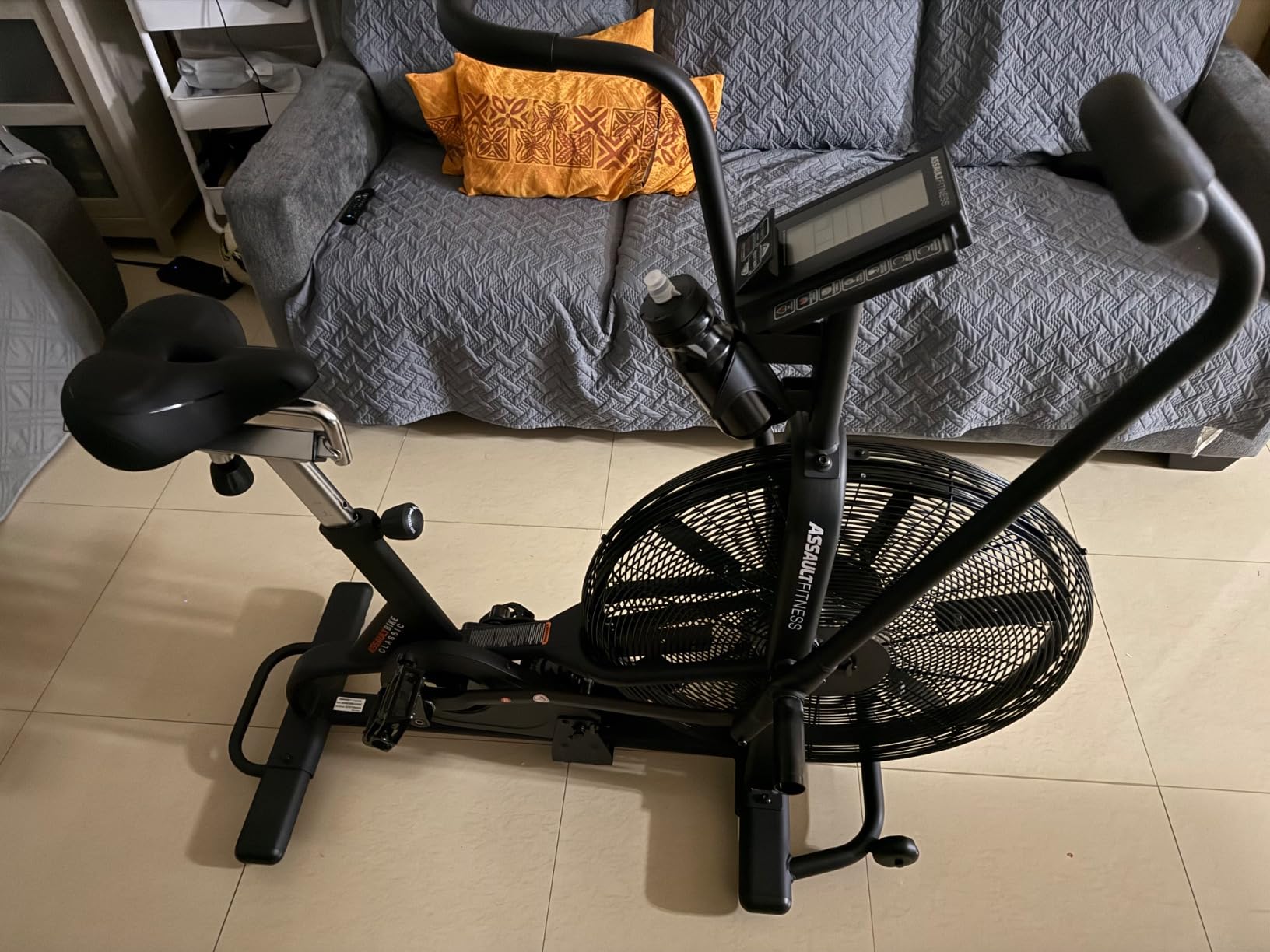
The Assault AirBike’s LCD console tracks more metrics in one display than the Echo Bike’s and, crucially, includes a target/goal feature that lets you pre-set a target for calories, distance, or time, then shows you real-time progress toward that target. For CrossFit WOD programming where you’re hitting a specific calorie target — “30 calories for time” — this is genuinely useful and directly affects how you pace your effort.
The Assault console also displays wattage prominently and with reasonable accuracy, which is important if you’re using power output as your primary training metric. Its interval timer is straightforward to program, and the console buttons are physical (not touch-sensitive), which means you can operate them with sweaty hands mid-session without requiring precision tapping.
Rogue Echo Bike Console: Clean but Limited
The Echo Bike’s console tracks calories, watts, miles per hour, RPM, time, and distance. It does all of these accurately. What it lacks is the Assault’s target-setting feature and the intuitive interval programming. You can use it as a straightforward training display, but if your programming revolves around calorie-based targets, you’ll find yourself watching the console more carefully — rather than having the bike track progress toward your goal for you.
Rogue has acknowledged the console is not the Echo Bike’s strongest feature, and there are third-party console upgrades available. But the fact that an $800+ bike ships with a console that is objectively less useful than its $700 competitor’s is worth noting before you buy.
Important for CrossFit athletes: If calorie-based targets are central to your training, the Assault AirBike’s console is meaningfully better. If you primarily train by time or use external coaching apps for pacing, the Echo Bike’s console is perfectly sufficient.
Noise & Vibration: The Real Apartment Gym Question
Let’s be direct: both bikes are loud. Fan bikes work by pushing air through a large-diameter fan, and that process produces significant airflow noise at high intensity. If you’re planning to use a fan bike in an apartment building with thin walls during normal daytime hours, you need to accept this fundamental reality. The question isn’t whether these bikes are quiet — they aren’t — but which one is less loud and less prone to adding mechanical noise on top of the unavoidable fan sound.
Rogue Echo Bike at Various Intensities
The Echo Bike’s heavier flywheel and belt drive contribute to a notably smoother mechanical baseline. At light-to-moderate intensities — warm-up pacing, aerobic base work, recovery rides — the Echo Bike is perceptibly quieter than the Assault because the drive system adds almost nothing on top of the fan noise. The sound is dominated by clean airflow rather than chain click or mechanical vibration.
At maximum sprint intensity, the fan noise on the Echo Bike is significant. However, because the flywheel is heavier and the frame is more massive, vibration transmission into the floor is slightly lower than the Assault. On rubber flooring, this difference is minimal. On a suspended wood floor — common in older homes — the Echo Bike’s lower vibration frequency is marginally more neighbour-friendly.
Assault AirBike Noise Profile
The Assault adds chain noise to its fan noise, and at high cadences this can create a distinct mechanical sound that’s audible even through headphones. Additionally, the Assault’s lighter frame transmits more vibration into the floor during aggressive sprints, which matters more in apartment settings than the airflow noise itself (since floor vibration travels through building structures in ways that airflow sound does not).
At moderate intensities, the Assault is louder than the Echo Bike. At maximum intensity, they’re both producing similar fan-dominated noise levels, with the Assault adding chain sounds that the Echo Bike doesn’t. For home users in noise-sensitive environments, the Echo Bike is the better choice.
Performance Feel: What It’s Actually Like to Train on Each
Specs and build quality matter, but the experience of training on a fan bike for hundreds of sessions comes down to feel — and feel is difficult to quantify but easy to recognize once you’ve spent real time on both machines.
The Echo Bike Experience
The Rogue Echo Bike rewards smooth, powerful cyclists. Its heavier flywheel means there’s a brief ramp-up period at the start of an effort — the first two or three pedal strokes are building rotational inertia, and then the fan engages fully. This isn’t a flaw; it mirrors the behavior of higher-quality cycling equipment generally and produces a more satisfying sensation of building into an effort. Athletes who come from a cycling or rowing background often adapt to the Echo Bike faster than those who’ve trained exclusively on fan bikes.
During longer efforts — 3-to-5-minute sustained intervals, for example — the Echo Bike is noticeably more comfortable. The seat is better padded, the handlebar grip is more substantial, and the smoother flywheel reduces the mechanical feedback that can become irritating at moderate intensities over time. If you’re doing aerobic base work or threshold training on a fan bike rather than pure sprint conditioning, the Echo Bike is the better tool for those longer durations.
The Assault AirBike Experience
The Assault is more immediate and more unforgiving. There’s minimal flywheel buffer between your input and the fan resistance — push the pedals and the fan engages almost instantly. For short, violent efforts — 10-to-20-second all-out sprints, Tabata work, short-interval conditioning — this immediacy is actually advantageous. You don’t spend two pedal strokes building momentum; you’re immediately fighting maximum resistance.
This is why the Assault became the CrossFit standard. Most CrossFit fan bike work is short, intense, and programmed around quick transitions — you need a machine that responds without lag, that you can jump on and immediately generate maximum output. The Assault delivers this better than the Echo Bike for this specific application.
Rating Comparison
Durability, Maintenance & Warranty: The Long Game
A fan bike at this price point is a long-term investment, and durability matters in ways that extend beyond the initial quality impression.
Rogue Echo Bike Durability
The Echo Bike is designed for commercial facility use, and it shows. The steel belt drive is the primary long-term advantage — belts don’t stretch the way chains do, don’t require lubrication, and fail much more rarely than chains in high-use commercial environments. The machined pedal cranks and heavy flywheel bearings are rated for dramatically higher use cycles than the Assault’s comparable components. In CrossFit boxes that track equipment lifecycles, the Echo Bike reliably outlasts the Assault when both see equivalent training volumes.
The 2-year warranty matches the Assault, but Rogue’s actual customer service experience is consistently rated better across gym equipment communities. Replacement parts are available, clearly priced, and Rogue typically fulfills warranty claims faster than most competitors.
Assault AirBike Durability
The Assault AirBike has proven durability over a decade — there are original Assault bikes from 2012–2014 still operational in CrossFit boxes globally with nothing beyond regular chain maintenance. The most common failure points are chain wear (requiring replacement every 1–3 years at high commercial volumes), console buttons becoming unresponsive after heavy use, and seat adjustment bolts loosening. None of these are serious mechanical failures — they’re normal wear items that are cheap and easy to service.
The plastic fan guard is the one component that will fail before the bike itself and is worth checking periodically. A cracked guard is a safety issue and a warranty item; don’t ignore it.
Maintenance schedule for Assault AirBike: Chain lubrication every 3–6 months, check/torque seat and handlebar bolts every 3 months, inspect fan guard for cracks annually, replace chain every 1–3 years depending on use volume.
Rogue Echo Bike — The Premium Build Choice
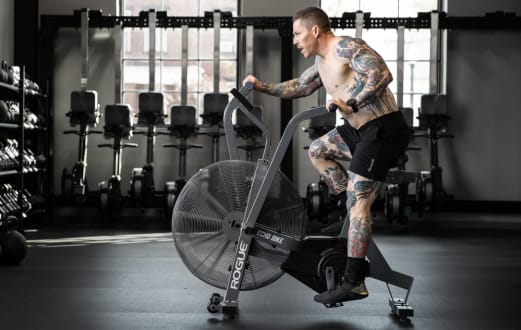
If you’re investing in a fan bike meant to last 10+ years under serious training volume, the Echo Bike’s build quality and belt drive justify the price premium. Built in the USA, backed by Rogue’s customer service reputation.
Check Price →Price, Value & Long-Term Cost of Ownership
The Rogue Echo Bike costs approximately $250–$300 more than the Assault AirBike at MSRP. Whether that’s a reasonable premium depends entirely on your training context, budget flexibility, and how long you plan to keep the bike.
Total Cost of Ownership Analysis
| Cost Factor | Rogue Echo Bike | Assault AirBike |
|---|---|---|
| Purchase price | ~$945 | ~$699–$799 |
| Annual chain maintenance | $0 | ~$15–20 (lube/tools) |
| Chain replacement (per 2 yrs, high use) | $0 | ~$30–50 |
| Console replacement (if needed) | ~$80 | ~$60 |
| Estimated 5-yr total cost | ~$1,025 | ~$850–$970 |
| Estimated resale value (5 yrs) | ~$500–$650 (holds value well) | ~$300–$450 |
| Net 5-yr cost of ownership | ~$375–$525 | ~$400–$670 |
When you factor in resale value — and the Rogue Echo Bike holds its value exceptionally well in the used market — the total cost of ownership gap between these two bikes over 5 years narrows considerably. Athletes who buy quality and maintain it well frequently find the Echo Bike’s resale value alone justifies the purchase premium.
Resale tip: Both bikes retain value better than most fitness equipment because they are genuinely limited to two major manufacturers in this category. If you ever want to sell, Rogue Echo Bikes consistently sell used for $500–$700 on Facebook Marketplace and gym equipment resale sites. Assault AirBikes sell for $300–$500. Both are excellent compared to treadmills or ellipticals that lose value rapidly.
Who Should Buy the Echo Bike vs the Assault AirBike?
- You’re 6’0″+ and want the best seat adjustability
- You prioritize ride smoothness for longer aerobic sessions
- You’re equipping a commercial CrossFit box at premium level
- You want near-zero maintenance for 5+ years
- You come from a cycling background and want familiar flywheel feel
- Noise and vibration are concerns in your training environment
- You want maximum resale value if you ever sell
- You want dual-sided cleat/flat pedals
- Budget is your primary decision filter
- You want calorie-target programming on the console
- Short, violent intervals and WOD-style CrossFit are your main use
- You’re outfitting a facility where the familiar interface matters
- Floor space is tight and you need a smaller footprint
- You need to move the bike frequently (28 lbs lighter)
- You want multiple retail purchasing options and sales
- You want a proven 10-year track record in the CrossFit space
Head-to-Head by User Type
| User Type | Recommended Bike | Reason |
|---|---|---|
| Home garage gym, general fitness | Echo Bike | Better long-term investment; smooth ride for varied workouts |
| CrossFit affiliate gym (high volume) | Echo Bike | Superior commercial durability and maintenance profile |
| CrossFit athlete, WOD-specific training | Assault AirBike | Immediate response and target console suit WOD programming |
| Budget-conscious buyer | Assault AirBike | $250 less upfront; solid value at its price point |
| Tall athlete (6’2″+) | Echo Bike | Horizontal seat adjustment provides better biomechanical fit |
| Rehabilitation/low-intensity work | Either | Both work equally well for light-load fan bike rehab protocols |
| Apartment/shared building | Echo Bike | Lower mechanical noise and vibration transmission |
| Competitor buying first fan bike | Assault AirBike | Lower risk entry point; industry-standard interface |

Assault AirBike Classic — The Battle-Tested Option
A decade of CrossFit heritage, immediate sprint response, target console, and a price point that’s $250 less than the Echo Bike. The right choice for WOD-focused training and budget-conscious buyers.
Check Price on Amazon →Final Verdict: The Honest Answer
Both bikes are excellent. Both will make you stronger, fitter, and significantly more humble about your cardiovascular capacity. But they are not interchangeable, and choosing between them without understanding the real differences is how people end up with regret at $700–$950.
The Rogue Echo Bike wins on build quality, flywheel smoothness, adjustability, noise level, and long-term durability. If you’re going to own this bike for 10 years and train on it seriously, the Echo Bike is the better tool. It will still be performing perfectly when most competing machines have needed multiple component replacements.
The Assault AirBike wins on immediate sprint response, console features, footprint, weight, price, and heritage. If budget is genuinely your first filter, if WOD-style calorie-target programming matters to you, or if you’re in a CrossFit box where the Assault interface is what your coaches and athletes already know — the Assault is not a compromise. It’s a legitimate professional conditioning tool at a lower price.
Our recommendation comes down to one question: Are you buying this bike for the next 2–3 years, or for the next 10? For 2–3 years, the Assault AirBike is the better value. For 10 years, the Rogue Echo Bike’s total cost of ownership and durability story makes the premium worthwhile.
Ready to Decide?
Whether you’re going Rogue or going Assault, both bikes will demand everything you have — the fan doesn’t lie and neither does your cardiovascular system. Make the choice that fits your budget, your training style, and your long-term goals, then get on and get to work.