How Much Does a Trap Bar Weigh? The Complete Breakdown by Type, Brand, and Load
If you have ever walked up to a hex bar at your gym, grabbed the handles, and wondered whether you were about to pull 45 pounds or 65 pounds off the floor before a single plate went on, you are not alone. Trap bar weight is one of the most misunderstood numbers in strength training, and it genuinely changes how you should program your deadlifts, farmer’s carries, and shrugs. This guide breaks down exactly how much a trap bar weighs, why that number is not fixed the way an Olympic barbell’s is, and how to figure out your specific bar’s weight in seconds.
Quick Answer — How Much Does a Trap Bar Weigh?
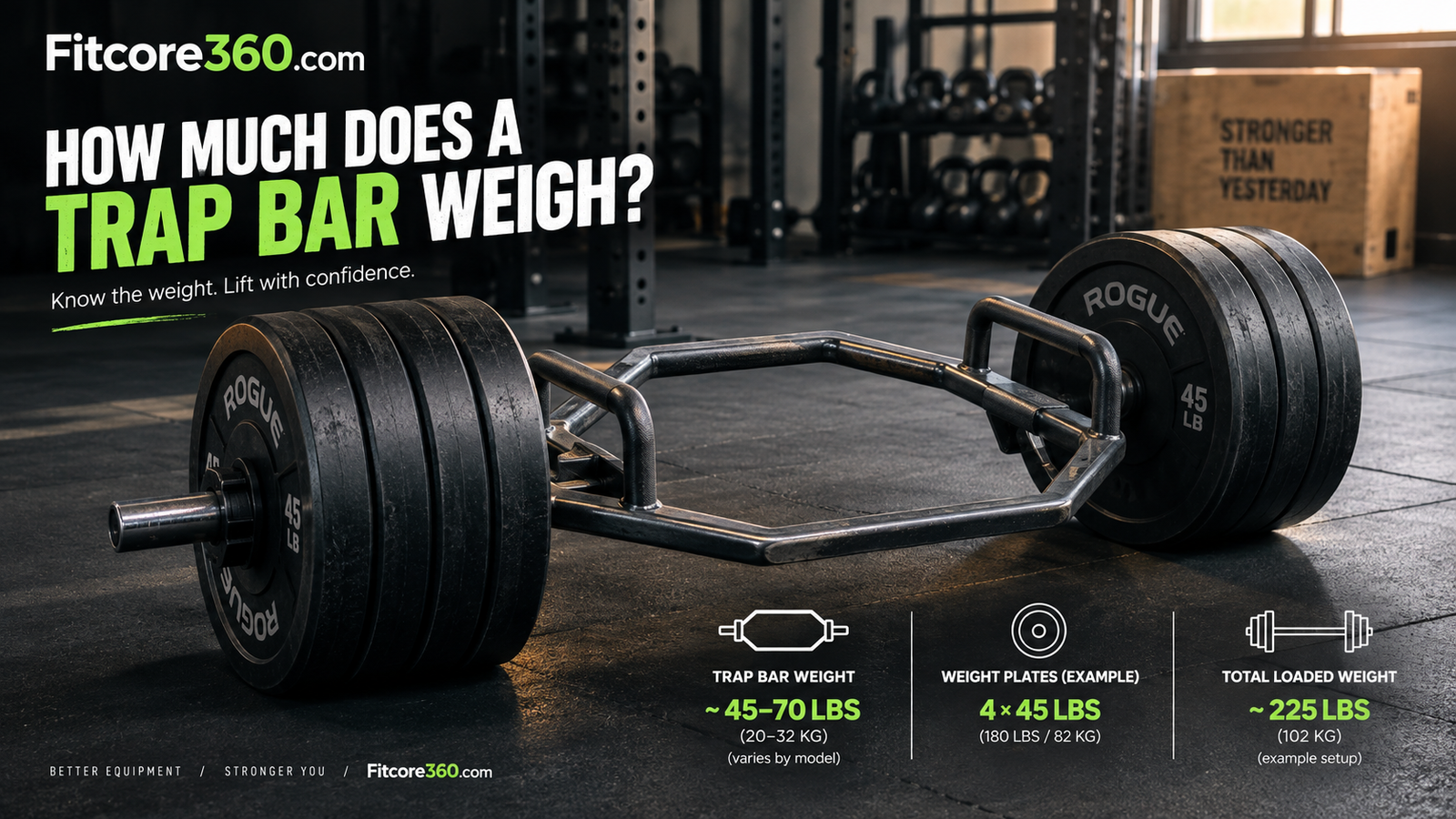
Most standard trap bars (also called hex bars) weigh between 45 and 65 pounds, with 55 pounds being the most common figure manufacturers quote. Open trap bars with taller, step-through frames tend to run heavier, often landing between 60 and 75 pounds, while compact or travel-style trap bars can weigh as little as 30 to 40 pounds. Unlike an Olympic barbell, which is standardized at 45 pounds (20 kg) across nearly every reputable brand, trap bar weight is not standardized at all — it depends on steel gauge, handle design, sleeve length, and overall frame size. Always check the manufacturer’s listed weight rather than assuming 45 pounds, because loading a trap bar as if it weighs the same as a standard barbell is one of the most common calculation errors lifters make.
1. Standard Trap Bar Weight Explained
When people ask how much a trap bar weighs, they are usually picturing the same mental math they use with a standard Olympic barbell: grab the bar, assume it is 45 pounds, add plates, done. Trap bars do not work that way. The hexagonal or diamond-shaped frame that gives the trap bar its name requires significantly more steel than a straight barbell, and that extra material adds weight before you ever touch a plate. Most manufacturers land somewhere in the 45 to 65 pound range for a standard trap bar, but the spread is wide enough that guessing can throw off your training numbers by 15 pounds or more.
The reason the range is so wide comes down to construction. A trap bar frame is essentially two parallel handle sections welded or bolted into a hexagonal steel loop, with sleeves extending outward on either side to hold plates. Every one of those components adds mass: the thickness of the tubing, the length of the sleeves, the diameter of the handles, and whether the bar includes raised or low handle options (many modern trap bars offer two handle heights, which adds even more steel). A budget trap bar built from thinner tubing might weigh 44 pounds, while a premium powerlifting-style trap bar with reinforced welds and dual handle heights can tip past 70 pounds before any plates are loaded.
For home gym owners, this matters more than it might seem. If you are following a percentage-based program that assumes a 45-pound bar, and your trap bar actually weighs 65 pounds, your effective working weight is off by nearly 20 pounds on every single set. Over a training cycle, that discrepancy compounds into inaccurate progress tracking, mistimed deloads, and confusion when you try to compare your trap bar numbers to your straight-bar deadlift numbers.
| Trap Bar Category | Typical Weight Range | Most Common Weight |
|---|---|---|
| Budget/entry-level trap bar | 40 – 50 lbs | 45 lbs |
| Standard gym trap bar | 50 – 60 lbs | 55 lbs |
| Open/step-through trap bar | 60 – 75 lbs | 65 lbs |
| Compact/travel trap bar | 30 – 40 lbs | 35 lbs |
| Competition/powerlifting trap bar | 55 – 70 lbs | 62 lbs |
If you are shopping for your first bar and want a detailed breakdown of one of the more popular options on the market, our Titan Trap Bar review covers exact shipping weight, sleeve length, and how it compares to competitors in this price range.

Looking for a reliable trap bar for home training? Check current pricing, verified weight specs, and customer reviews before you buy.
Check Price on Amazon2. Trap Bar vs Olympic Barbell Weight
An Olympic barbell is one of the few pieces of gym equipment with a genuinely standardized weight. A men’s Olympic bar weighs 45 pounds (20 kg), and a women’s Olympic bar weighs 33 pounds (15 kg), across virtually every reputable manufacturer worldwide. That standardization exists because Olympic barbells are governed by competition specifications set by international weightlifting federations, and gyms, coaches, and lifters have collectively agreed to build around that number for decades.
Trap bars have no equivalent governing body. There is no federation dictating that a trap bar must weigh exactly 45 pounds, so manufacturers are free to build whatever frame size, steel gauge, and handle configuration they think will sell. This is why you will see trap bars advertised anywhere from 33 pounds on the ultra-light end to over 80 pounds for oversized, dual-handle competition models. The lack of a fixed standard is the single biggest reason so many lifters are surprised the first time they load a trap bar and it feels heavier — or lighter — than they expected.
Olympic Barbell Weight
- Standardized at 45 lbs (men’s) / 33 lbs (women’s)
- Consistent across nearly all brands and gyms
- Easy to calculate loaded weight instantly
Trap Bar Weight
- No industry-wide standard
- Ranges from roughly 33 lbs to 80+ lbs
- Must be checked per model before programming
This distinction is especially important if you train at a commercial gym with multiple trap bars from different manufacturers, or if you are comparing your home gym numbers to what you lifted at a different facility. The bar itself is not a constant, so treat every trap bar as its own variable until you confirm the actual number.
3. Why Trap Bar Weight Varies So Much
Several design factors independently push a trap bar’s weight up or down, and understanding them helps explain why two bars that look nearly identical in photos can differ by 15 or 20 pounds in real life.
Steel Gauge and Tubing Thickness
Thicker-walled steel tubing is more durable and typically rated for a higher maximum load, but it also weighs more. Budget bars often use thinner tubing to hit a lower price point, which is part of why cheaper trap bars tend to weigh less than premium versions.
Frame Size and Shape
A larger hexagonal or diamond frame gives taller lifters more clearance and a more natural pulling angle, but more frame means more steel. Open trap bars in particular, which allow you to step through the front rather than stepping over the back, require significantly more welded tubing and consistently weigh more than closed-hex designs.
Handle Configuration
Many modern trap bars include two sets of handles at different heights — a low set for a deeper hip hinge similar to a conventional deadlift, and a high set that reduces range of motion for taller lifters or those working around mobility limitations. Every additional handle bar welded into the frame adds a few pounds.
Sleeve Length and Diameter
Longer sleeves allow you to load more plates for advanced lifters, but longer, thicker sleeves add weight compared to shorter sleeves built for lighter home use.
Coating and Finish
Chrome plating, cerakote finishes, and powder coating all add negligible but nonzero weight compared to raw or black oxide finishes. This factor is minor compared to the others, but it is part of why manufacturer-listed weights sometimes differ by a pound or two from bar to bar within the same product line.
| Design Factor | Effect on Weight |
|---|---|
| Thicker steel tubing | +3 to +8 lbs |
| Open/step-through frame | +8 to +15 lbs |
| Dual handle heights | +2 to +5 lbs |
| Extended sleeve length | +2 to +6 lbs |
| Heavy coating/finish | +0.5 to +1.5 lbs |
4. Open Trap Bar vs Hex Trap Bar Weight
Trap bars generally fall into two structural categories, and the difference between them has a direct and predictable impact on weight.
Closed hex trap bars use a fully enclosed hexagonal frame. You step over the back rail to get into position, which some lifters find awkward, especially with limited ankle or hip mobility. Because the frame is a single closed loop, it typically uses less total steel than an open design, keeping the weight in the 45 to 60 pound range for most models.
Open trap bars remove one side of the hex, creating a U-shaped or diamond-shaped opening you can step directly through from the front. This is more comfortable for a wider range of body types and mobility levels, but the open design requires additional reinforcement to maintain structural rigidity where the closed loop would normally provide strength. That reinforcement is why open trap bars almost always weigh more than their closed counterparts, often by 10 to 15 pounds.
Closed Hex Trap Bar
- Lighter frame, usually 45–60 lbs
- More compact for storage
- Simpler, often cheaper construction
Open Trap Bar
- Heavier frame, usually 60–75 lbs
- Easier entry/exit, better for mobility limitations
- Bulkier footprint for storage
For a side-by-side look at how several popular models compare on frame type, weight, and price, see our full guide to the best trap bars currently on the market.
5. How to Find Your Bar’s Exact Weight
Rather than estimating, there are three reliable ways to confirm exactly how much your trap bar weighs.
- Check the manufacturer’s product page or manual. Reputable trap bar brands list the exact bar weight in the product specifications, usually alongside maximum weight capacity and sleeve length. This is the fastest and most accurate method if you know the model name.
- Look for stamped or printed markings on the bar itself. Many trap bars have the weight laser-etched or printed near the handles or center of the frame, similar to how Olympic barbells are often stamped with their weight and load rating.
- Weigh it yourself on a bathroom or platform scale. If documentation is unavailable — common with older or secondhand bars — set the empty bar on a standard bathroom scale, or if it is too large to balance, weigh yourself holding the bar and subtract your own body weight. This method is not lab-precise, but it will get you within a pound or two, which is close enough for programming purposes.
If you train at a commercial gym, it is worth doing this once for every trap bar available on the floor, since it is common for larger facilities to stock two or three different models with different weights side by side.

Not sure of your bar’s exact weight? A simple platform scale takes the guesswork out of every home gym calculation, not just your trap bar.
Check Price on Amazon6. Calculating Total Loaded Weight
Once you know your bar’s actual weight, calculating your total loaded weight is simple arithmetic, but it is worth walking through carefully since this is where most tracking errors happen.
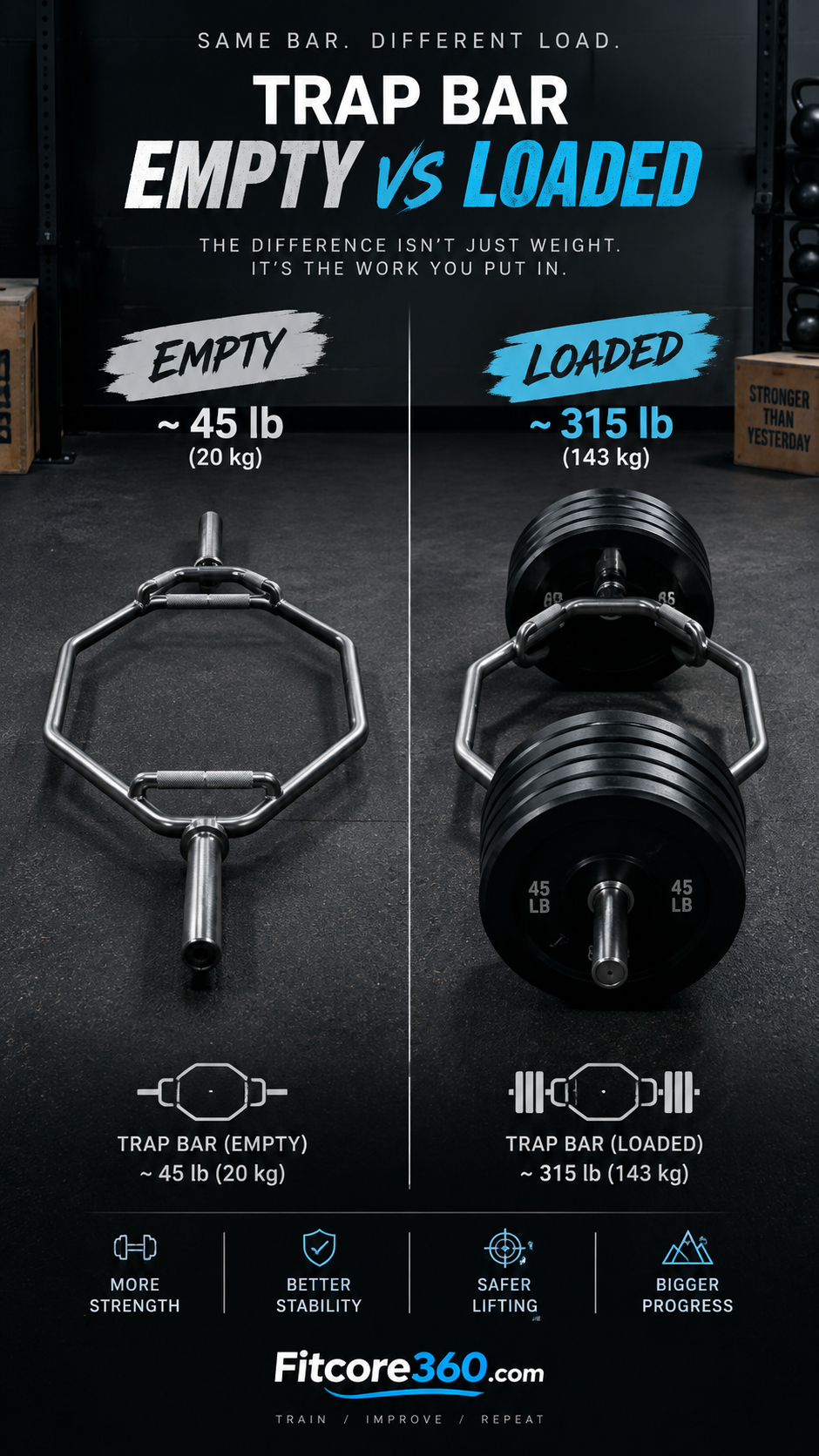
Formula: Bar weight + (weight per plate × number of plates on each side × 2) = Total loaded weight.
For example, if your trap bar weighs 55 pounds and you load two 45-pound plates per side, the math looks like this: 55 + (45 × 2 × 2) = 55 + 180 = 235 pounds total. Compare that to the same math on a standard 45-pound Olympic bar with the same plates: 45 + 180 = 225 pounds. That ten-pound gap is invisible unless you know your trap bar’s real weight, and it is enough to matter for anyone chasing a specific competition total or tracking progressive overload closely.
| Bar Weight | Plates Loaded (per side) | Total Loaded Weight |
|---|---|---|
| 45 lbs | 2 × 45 lb plates | 225 lbs |
| 55 lbs | 2 × 45 lb plates | 235 lbs |
| 65 lbs | 2 × 45 lb plates | 245 lbs |
| 55 lbs | 3 × 45 lb plates | 325 lbs |
| 65 lbs | 4 × 45 lb plates | 425 lbs |
If you regularly switch between a straight bar and a trap bar in the same training block, it is worth keeping a small note on your phone or whiteboard with the exact weight of each bar you use. It takes ten seconds and eliminates an entire category of tracking errors.
7. Trap Bar Weight and Deadlift Programming
Trap bar deadlifts are already biomechanically different from conventional deadlifts — the more upright torso angle and centered load path typically allow lifters to move more total weight with less lower back strain. Layer an unpredictable bar weight on top of that, and program design gets messy fast if you are not accounting for it.
If your program calls for percentage-based loading (working at 70% of your one-rep max, for example), your one-rep max needs to be calculated using the actual bar weight you tested with. If you tested your trap bar max assuming a 45-pound bar but your bar is actually 65 pounds, every subsequent percentage calculation will be off, and you risk either under-training by leaving weight on the table or over-training by loading heavier than your program intends.
This matters even more for lifters who log workouts in an app or spreadsheet that auto-calculates total volume. Volume tracking (sets × reps × weight) is a cornerstone of most intermediate and advanced programming, and a 20-pound error per set compounds significantly across a training week.
Best Practices
- Confirm bar weight before your first max-effort session
- Note the exact bar weight in your training log
- Recalculate percentages if you switch trap bars
Common Pitfalls
- Assuming every bar weighs 45 lbs
- Mixing numbers from different gym bars
- Comparing trap bar totals directly to straight bar totals
Grip also plays a role here. Because trap bar handles sit closer to the body, many lifters can pull more weight before grip becomes the limiting factor compared to a conventional deadlift. If grip is holding you back regardless of bar type, our breakdown of how grip strength improves deadlifts and pull-ups covers training strategies that carry over directly to trap bar work.
8. Trap Bar Weight Considerations for Beginners vs Advanced Lifters
The right trap bar weight depends heavily on your training experience and goals, and a bar that feels ideal for one lifter can be a poor fit for another.
Beginners
New lifters generally benefit from a lighter, closed-hex trap bar in the 45 to 55 pound range. A lighter frame is easier to maneuver in and out of position while you are still building comfort with the hip hinge pattern, and a shorter sleeve length keeps loaded plates closer to the body for better balance while learning.
Intermediate Lifters
As technique solidifies and loads increase, the exact bar weight matters less than having accurate numbers for programming. This is the stage where confirming your bar’s real weight becomes important, since intermediate lifters are often the ones running structured percentage-based programs.
Advanced and Competitive Lifters
Advanced lifters moving serious weight often prefer heavier-gauge trap bars — even open-frame designs in the 60 to 75 pound range — because the reinforced steel that adds weight also adds durability and stability at higher loads. A bar that flexes or feels unstable under 400+ pounds is a safety concern, and the added weight of premium construction is a worthwhile tradeoff at that level.
| Lifter Level | Recommended Bar Weight | Recommended Frame Type |
|---|---|---|
| Beginner | 45 – 55 lbs | Closed hex |
| Intermediate | 50 – 60 lbs | Closed hex or open |
| Advanced/Competitive | 60 – 75 lbs | Open, reinforced frame |

Pulling heavier loads on the trap bar? A quality lifting belt adds core stability as your numbers climb.
Check Price on Amazon9. Best Trap Bars by Weight Class
If you are shopping specifically based on bar weight — whether you want the lightest option for a garage gym with space constraints or the heaviest, most reinforced frame for serious loading — it helps to shop by category rather than by brand name alone.
Lightest Options (30–45 lbs)
Compact and travel-style trap bars prioritize portability over maximum load capacity. These are a strong fit for home gyms with limited storage or lifters who need to transport equipment regularly.
Mid-Range Standard Bars (50–60 lbs)
This is the sweet spot for most home gym owners and general strength training. Enough steel for durability and higher weight capacity without becoming unwieldy to load and unload.
Heavy-Duty and Open Frame Bars (60–75+ lbs)
Built for serious loading and easier entry, these bars trade portability for stability and comfort at heavier weights. Our detailed Titan Trap Bar review breaks down where one popular mid-to-heavy option lands on this spectrum, including exact shipping weight and real-world loading capacity.
For a full side-by-side comparison across price points, frame types, and weight capacities, our best trap bars roundup is the most complete resource on the site for narrowing down a specific model.
10. Trap Bar Weight, Portability, and Storage
Bar weight is not just a training variable — it directly affects how practical a trap bar is for your specific space. A 75-pound open-frame trap bar is significantly harder to lean against a wall, hang on a rack, or move between rooms than a 35-pound compact model, and this is a factor that is easy to overlook when comparing specs on a product page.
If you train in a garage gym or a shared space where equipment needs to be moved or stored between sessions, weigh the tradeoff carefully. A heavier bar that never leaves a dedicated home gym corner is a non-issue. That same bar becomes a genuine hassle if you are sliding it under a bed or carrying it up a flight of stairs after every workout.
For lifters actively building out a full home setup and thinking through equipment weight and footprint more broadly, our home gym setup guide covers space planning for larger equipment like trap bars, and our best all-in-one home gyms roundup is worth a look if you are trying to consolidate several pieces of equipment into a smaller footprint.
11. Common Mistakes with Trap Bar Weight
- Assuming every trap bar weighs 45 pounds. This is by far the most common error, carried over from years of Olympic barbell training where 45 pounds is a safe default assumption.
- Not re-checking bar weight after switching gyms or bars. Different facilities often stock different trap bar models, and carrying over an old bar-weight assumption to a new bar leads directly to programming errors.
- Comparing trap bar totals directly to conventional deadlift totals without context. Trap bar deadlifts typically allow heavier loads due to the more favorable leverage, so a direct number comparison without accounting for bar weight and movement pattern differences is misleading.
- Ignoring weight capacity limits. A bar’s total weight includes both frame weight and maximum safe loading capacity. Exceeding the rated capacity, especially on lighter, thinner-gauge bars, is a safety risk independent of the bar’s own weight.
- Skipping the sleeve length check when buying a heavier bar. A heavier bar does not automatically mean more plate capacity — always confirm sleeve length against your actual plate collection before assuming you can load your target weight.
12. Long-Term Maintenance and Weight-Related Considerations
A trap bar’s weight generally stays constant for the life of the bar, but a few maintenance-related factors are worth knowing about, especially for anyone buying secondhand or maintaining a bar for years of heavy use.
Rust and corrosion on uncoated or poorly maintained steel can add a negligible amount of surface weight over time, though this is rarely enough to affect training math. More relevant is wear at the sleeves and welds under repeated heavy loading — a bar that has taken years of 400+ pound loading sessions should be inspected periodically for stress cracks near the welds, particularly on open-frame designs where the structure carries more stress without the support of a fully closed loop.
If you are buying a used trap bar and the original weight specification is unavailable, weighing it yourself before your first heavy session is worth the five minutes it takes, both for programming accuracy and as an opportunity to inspect the frame, sleeves, and welds for any signs of fatigue.
Good Maintenance Habits
- Wipe down after sweaty sessions to prevent corrosion
- Store indoors or under cover if possible
- Periodically inspect welds on heavily used bars
Warning Signs
- Visible rust buildup at welds or sleeves
- Noticeable flex or wobble under normal loads
- Cracking paint or coating at stress points
Frequently Asked Questions
Does every trap bar weigh 45 pounds like an Olympic barbell?
No. Unlike Olympic barbells, which are standardized at 45 pounds, trap bars vary widely in weight, typically ranging from about 33 to 80 pounds depending on frame size, steel gauge, and design.
What is the average weight of a trap bar?
Most standard trap bars fall between 50 and 60 pounds, with 55 pounds being one of the most commonly cited weights across mid-range models.
Why do open trap bars weigh more than closed hex trap bars?
Open trap bars remove one side of the hexagonal loop to allow step-through entry, which requires additional reinforcement elsewhere in the frame to maintain structural rigidity, adding extra steel and weight compared to a fully closed design.
How can I find out exactly how much my trap bar weighs?
Check the manufacturer’s product listing or manual, look for a weight stamp or etching on the bar itself, or weigh it directly on a bathroom or platform scale if no documentation is available.
Is a heavier trap bar better for building strength?
A heavier bar is not inherently better for building strength — total loaded weight matters far more than the bar’s own contribution. However, heavier-gauge bars are often more stable and durable under very heavy loads, which matters more for advanced lifters.
Can I use a trap bar’s weight the same way I use a barbell’s weight in a program?
Only if you confirm the exact bar weight first. Percentage-based programming and volume tracking both rely on accurate bar weight, so plugging in an assumed 45-pound figure for a trap bar that actually weighs 55 or 65 pounds will skew your numbers.
Do trap bars come in a women’s or lighter standardized version like Olympic bars?
No. There is no widely adopted lighter “women’s” trap bar standard the way there is with Olympic barbells (33 lbs). Some brands do offer smaller-frame or lighter trap bars marketed for general or beginner use, but there is no formal industry standard.
Why does my gym’s trap bar feel heavier than the one I use at home?
Different trap bar models weigh different amounts, so it is common for a commercial gym’s bar and a home gym bar to differ by 10 to 20 pounds, even if they look similar at a glance.
How much can a trap bar hold in total weight?
Maximum loading capacity varies by model and is separate from the bar’s own weight, typically ranging from around 400 pounds on lighter, entry-level bars to 1,000+ pounds on reinforced competition-style frames. Always check the manufacturer’s rated capacity.
Should beginners worry about trap bar weight when starting out?
Beginners should at least confirm the approximate weight of whatever bar they are using so that early strength benchmarks and progress tracking are accurate from the start, even if the exact number matters less at very light training loads.
Does trap bar weight affect how much I can lift compared to a straight bar deadlift?
The trap bar’s own weight is a small factor compared to the movement pattern itself. Most lifters can move more total weight on a trap bar deadlift than a conventional deadlift due to the more favorable leverage and centered load path, independent of the bar’s own weight.
Is it worth buying a lighter trap bar for a small home gym?
If storage space and portability are priorities, a lighter, compact trap bar in the 35 to 45 pound range is a reasonable tradeoff, especially for lifters who are not yet loading extremely heavy weights where frame stability becomes a bigger concern.
Conclusion
There is no single answer to how much a trap bar weighs, and that is exactly the point. Where an Olympic barbell gives you a reliable 45-pound constant across almost any gym in the world, trap bar weight shifts with frame design, steel gauge, and handle configuration, typically landing somewhere between 45 and 65 pounds for standard models and stretching wider at the extremes. The fix is simple: confirm your specific bar’s weight through the manufacturer’s spec sheet, a stamped marking, or a quick scale check, and use that real number in your programming rather than defaulting to barbell math. Get that one detail right, and every set, percentage calculation, and progress log you build around your trap bar training will actually reflect what you are lifting.
Ready to find a trap bar that fits your space, goals, and target weight range? Start with our best trap bars guide to compare top models side by side.