Best Home Gym Flooring: The Complete Buyer’s Guide to Protecting Your Floors and Your Gear
Choosing the right flooring is one of those decisions that quietly determines whether your home gym feels like a professional training space or a rattling, squeaky, floor-damaging mess. Here’s everything you need to know before you buy.
Table of Contents
- Why Home Gym Flooring Actually Matters
- Types of Home Gym Flooring Materials
- What to Look For Before You Buy
- Top-Rated Flooring Picks, Part 1
- Top-Rated Flooring Picks, Part 2
- Full Comparison Table
- EVA Foam vs. Rubber vs. Basic Mats
- Planning Coverage for Your Room
- Installation and Setup Tips
- Flooring for Heavy Weights & Power Equipment
- Flooring for Cardio Machines, Balance & Mobility Work
- Cleaning, Maintenance & Longevity
- Budget vs. Premium: What’s Actually Worth It
- FAQs
- Final Verdict
Why Home Gym Flooring Actually Matters
It’s easy to treat flooring as an afterthought when you’re building a home gym setup. Most people spend weeks researching a rack, a barbell, or a bench, then throw down whatever mats show up first in a search result. That’s a mistake, and it usually becomes obvious the first time a dumbbell slips out of your hand or a kettlebell corner meets bare concrete.
Good flooring does three jobs at once. First, it protects the surface underneath — concrete, hardwood, tile, or laminate — from dents, cracks, and scuffs caused by dropped weights and dragged equipment. Second, it protects your equipment and your joints by absorbing impact instead of transferring every ounce of force straight back up through the frame of your rack or the soles of your shoes. Third, it dampens noise, which matters enormously if you’re training in an apartment, a garage attached to a bedroom wall, or a basement below a nursery.
There’s also a psychological element that doesn’t get talked about enough. A properly floored space simply feels more like a real gym. It changes how seriously you treat your training, and it reduces the small frictions — a rug that bunches under a treadmill belt, a mat that slides during burpees — that quietly discourage consistency.

Types of Home Gym Flooring Materials
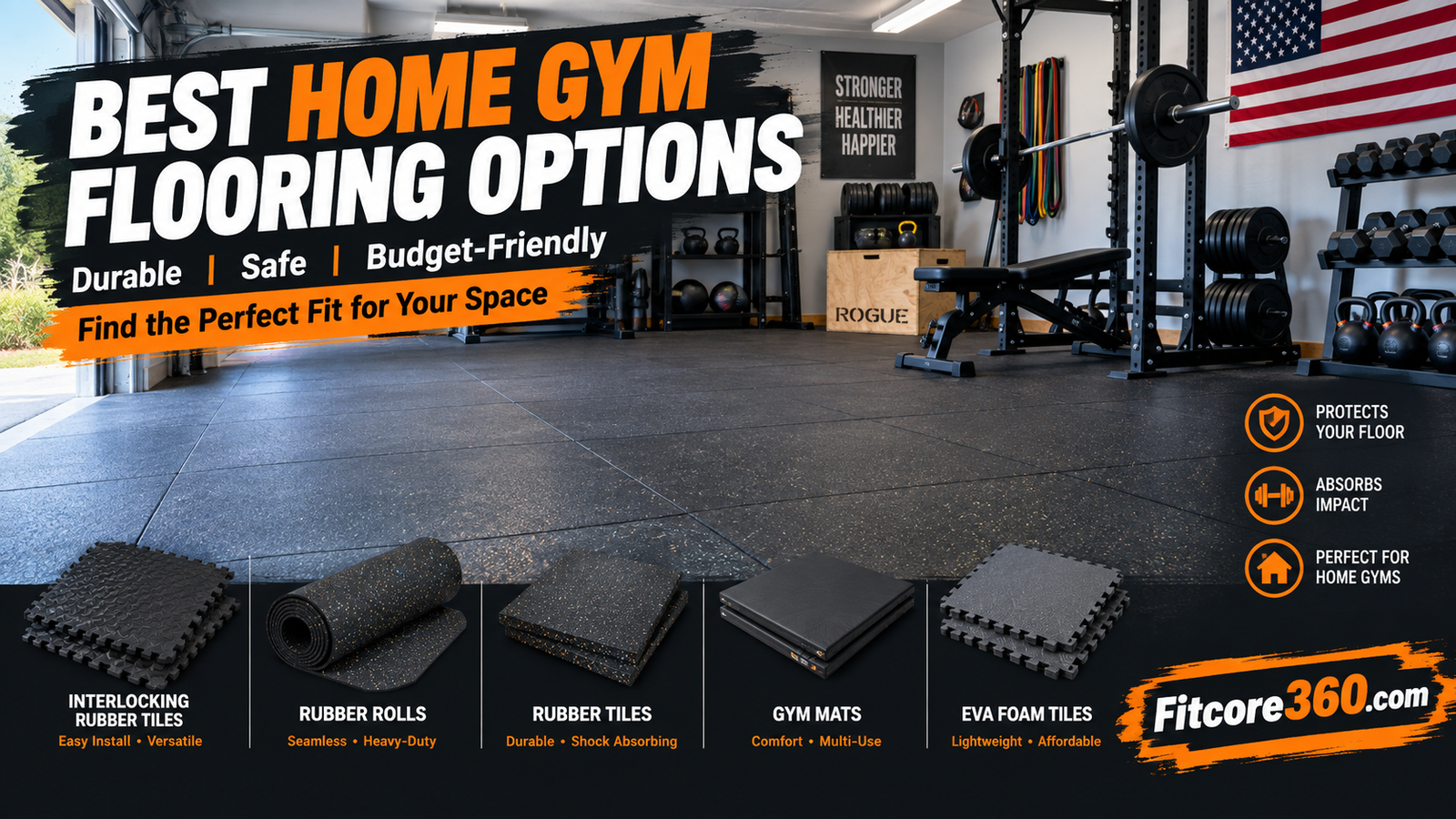
Not all “gym flooring” is built the same, and the category gets muddier the more you shop. Broadly, home gym flooring falls into five families, each suited to a different kind of training.
1. EVA Foam Interlocking Tiles
Ethylene-vinyl acetate (EVA) foam is the material behind most puzzle-piece mats. It’s lightweight, inexpensive, easy to cut around corners, and genuinely comfortable underfoot for bodyweight work, yoga, and stretching. Its weak point is density — EVA compresses more than rubber under heavy, repeated impact, so it’s a poor long-term choice directly beneath a squat rack or an Olympic platform.
2. Rubber Flooring (Rolls, Tiles, or Mats)
Rubber is the gold standard for anywhere heavy weights get dropped. It’s denser, heavier, and far more resistant to permanent compression than foam. Rubber comes in interlocking tiles, straight-edge tiles that butt together, and large rolls that are ideal for covering big, uninterrupted areas like a full garage floor.
3. Horse Stall Mats
Technically an agricultural product, thick rubber stall mats have become a favorite budget hack for garage gyms because a single ¾-inch mat can handle enormous impact for a fraction of the price of “gym-branded” rubber. The tradeoff is weight (they’re heavy to move and cut) and a strong rubber smell that can take weeks to off-gas.
4. Foam or Cushioned Yoga-Style Mats
Thinner cushioned mats are built for comfort during floor work rather than impact protection. They’re excellent for stretching, yoga, and light bodyweight circuits, but they’re not a substitute for foam or rubber under equipment.
5. Turf
Athletic turf strips are increasingly common in home gyms that include sled pushes, battle ropes, or agility drills. Turf isn’t a flooring solution for the whole room on its own — it’s usually combined with rubber tiles around the perimeter.

What to Look For Before You Buy
Before you add anything to your cart, run through these six factors. Skipping any one of them is how people end up re-flooring their gym twice.
Prioritize These
- Thickness matched to your training style
- Density, not just thickness — thin dense rubber can outperform thick soft foam
- Interlocking edges for a stable, gap-free surface
- Low odor / low VOC off-gassing
- Easy spot-cleaning and washability
- Enough material to cover your actual floor plan, with a margin
Watch Out For
- Cheap foam under a squat rack or heavy dumbbells
- Mats sized only for the exact footprint of one machine
- Unfinished edges that curl up over time
- Strong rubber odor with no ventilation plan
- Assuming thin yoga mats can double as impact protection
- Ignoring subfloor type (carpet, tile, hardwood all interact differently with mats)
If you’re still finalizing the rest of your room, it’s worth reading through a broader home gym setup guide before locking in flooring, since layout decisions — where the rack goes, where cardio equipment sits, how much open floor you need for stretching — directly affect how much flooring you need and where the thicker protective sections should go.

Top-Rated Flooring Picks, Part 1
ProsourceFit Puzzle Exercise Mat
This ½-inch EVA interlocking tile set has stayed a fixture in home gyms for years, and it consistently shows up in Amazon’s Sports & Outdoors best-seller data. Each tile connects via a puzzle-piece edge, so you can configure coverage to match an oddly shaped room, and the borders are removable for a clean finished edge along the walls.
Pros
- Comfortable underfoot for bodyweight and stretching work
- Very budget-friendly per square foot
- Simple to cut and configure around posts or corners
Cons
- Not ideal directly beneath heavy barbell drops
- EVA foam compresses over years of heavy use
BalanceFrom Puzzle Exercise Mat
Very similar in concept to the ProsourceFit option, BalanceFrom’s interlocking EVA foam tiles are designed specifically for home workout areas where the priority is comfort and floor protection rather than heavy impact absorption.
Pros
- Lightweight and easy to install solo
- Good cushioning for yoga, HIIT, and stretching
- Often sold in larger multi-tile packs
Cons
- Thinner tiles show wear faster under weight racks
- Seams can separate slightly with heavy foot traffic
BalanceFrom Rubber Floor Mat
When the priority shifts from comfort to protection, this heavy-duty rubber-style mat is built for exactly that. It’s the category you want directly under a rack, a deadlift zone, or anywhere dumbbells routinely get dropped rather than set down.
Pros
- Genuinely handles dropped weight without denting
- Dense enough to resist long-term compression
- Reduces noise transfer significantly compared to foam
Cons
- Heavier and less flexible to cut than foam
- Higher price per square foot than basic foam tiles

Top-Rated Flooring Picks, Part 2
Amazon Basics Exercise/Yoga Mat
For anyone whose “home gym” is really a corner of a bedroom used for yoga, stretching, and light bodyweight circuits, this is a sensible entry point. It’s currently listed among Amazon’s fitness best sellers, and it does exactly what a light-duty mat should do without overcomplicating the purchase.
Pros
- Very inexpensive
- Easy to roll up and store
- Comfortable for floor-based movement
Cons
- Not designed for weights or equipment
- Limited coverage area per unit
SUPERJARE Interlocking Foam Floor Mats
Another strong entry in the EVA foam category, these tiles are aimed squarely at home gyms and general exercise spaces, giving you a comfortable, easy-to-clean surface without the cost of rubber.
Pros
- Good cushioning underfoot
- Simple interlocking installation
- Reasonably priced for the coverage provided
Cons
- Same long-term compression limits as other EVA products
- Not recommended under heavy fixed equipment
Marcy Interlocking EVA Foam Flooring
Marcy’s modular workout flooring is built with home-gym setups specifically in mind, and the interlocking design makes it easy to size coverage exactly to your available space rather than being locked into a fixed rectangular mat.
Pros
- Flexible sizing for irregular rooms
- Consistent tile thickness for an even surface
- Straightforward to expand later if you add equipment
Cons
- Foam-based, so not ideal for heavy drop zones
- Edge pieces sold separately in some bundles

Full Comparison Table
Here’s how the most popular options stack up side by side, based on material, thickness category, and the type of training each is genuinely built for.
| Product | Material | Best For | Heavy Weight Rated | Ease of Install |
|---|---|---|---|---|
| ProsourceFit Puzzle Exercise Mat | EVA Foam | General home gym floor protection | Moderate | Very Easy |
| BalanceFrom Puzzle Exercise Mat | EVA Foam | Workout comfort, stretching, HIIT | Moderate | Very Easy |
| BalanceFrom Rubber Floor Mat | Rubber | Weightlifting, dropped weights | High | Moderate |
| Yes4All Interlocking Foam Mats | EVA Foam | Custom room shapes and layouts | Moderate | Very Easy |
| Amazon Basics Exercise/Yoga Mat | Foam | Yoga, stretching, light workouts | Low | Very Easy |
| SUPERJARE Interlocking Foam Mats | EVA Foam | General home gym use | Moderate | Very Easy |
| Marcy Interlocking EVA Foam Flooring | EVA Foam | Modular full-room coverage | Moderate | Very Easy |

EVA Foam vs. Rubber vs. Basic Mats: Which Wins for You?
The honest answer is that most well-equipped home gyms end up using a combination rather than picking one material for the whole room. EVA foam wins on comfort, price, and ease of cutting around obstacles — it’s the right call for stretching zones, cardio corners, and general walking-around space. Rubber wins decisively anywhere impact is a factor: under a rack, around a deadlift platform, or beneath anything that gets dropped rather than placed. Basic cushioned mats are really a separate category altogether, meant for a single person’s floor routine rather than shared gym flooring.
If your training leans heavily toward barbell work, don’t let a lower price tag on foam tiles talk you into using them where rubber belongs. If your training leans toward bodyweight conditioning, mobility, or light dumbbell work, foam is genuinely the more comfortable and more practical daily surface.
Planning Coverage for Your Room
Measure before you buy — this sounds obvious, but it’s the single most common mistake in flooring purchases. Measure the full usable floor area, not just the footprint of your equipment, and add a buffer of at least 12–18 inches around any rack or bench so you have room to step, load plates, and move safely.
If you’re combining flooring with a larger equipment plan, it helps to finalize your gear list first. A all-in-one home gym tends to have a fixed footprint that’s easy to measure around, while a modular setup with a separate rack, bench, and trap bar station benefits from mapping out zones on paper first — a lifting zone, a cardio zone, and an open floor zone — before ordering tiles.

Installation and Setup Tips
Most interlocking flooring is designed for a no-tools installation, but a few habits make the finished result noticeably more professional and longer-lasting.
- Let rubber tiles or mats acclimate flat in the room for 24–48 hours before locking the seams together — this reduces long-term curling.
- Start from a corner and work outward in straight rows rather than starting from the center.
- Stagger seams away from high-traffic walking paths where possible.
- Use edge/border strips on any foam tile system to prevent lifting at transitions to bare floor.
- Ventilate the room well during the first week to speed up off-gassing of rubber odor.
Flooring for Heavy Weights & Power Equipment
If your setup includes a squat rack, an Olympic platform, or heavy dumbbells that occasionally get dropped rather than lowered, treat that zone as a separate flooring decision entirely. This is where rubber — ideally ¾-inch or thicker — earns its higher price. Thin foam simply cannot absorb repeated high-force impact without permanently compressing within a matter of months.
This also matters for accessories that live in that same zone. If you’re using a trap bar, heavy training sandbags, or you train in powerlifting shoes with minimal cushioning, the flooring underneath becomes part of your joint protection, not just your floor’s protection. Pair dense rubber with proper lifting gear — a quality lifting belt and solid wrist wraps — and the whole setup works together instead of one weak link undoing the rest.
Flooring for Cardio Machines, Balance & Mobility Work
Cardio equipment has completely different flooring needs than a lifting zone. A treadmill needs a firm, stable, non-slip surface — soft foam can actually cause a treadmill to rock slightly during use, which isn’t ideal for the machine’s motor or your stride. A rowing machine similarly benefits from a flat, low-compression surface so the rail stays level throughout the stroke, and the same logic applies to a home elliptical. If you’re deciding between cardio formats, it’s worth comparing a fan bike against an air bike before finalizing your floor plan, since bike footprints and vibration levels differ.
Balance and mobility work is the opposite case — here, a slightly softer, higher-friction surface is actually preferred. If your routine includes balance board training or slant board work, a firm EVA foam base gives you enough grip and stability without the excessive softness of a yoga-style mat.

Cleaning, Maintenance & Longevity
Foam and rubber flooring both hold up well with minimal upkeep, but they’re not identical. EVA foam tiles can be wiped down with a damp cloth and mild soap; avoid soaking the seams, since water can seep between interlocking edges and encourage mildew if the room isn’t well ventilated. Rubber flooring is more forgiving — it can handle a full mop or even a light hose-down if it’s in a garage, and a rubber-safe cleaner will keep it from developing a dull, chalky surface over time (a natural byproduct of rubber aging called “blooming”).
Rotate high-traffic tiles occasionally if your budget allows for spares, and replace any foam tile that’s developed a permanent compression dent before it becomes a tripping hazard.
Budget vs. Premium: What’s Actually Worth It
At the budget tier, EVA foam interlocking tiles like the ProsourceFit or BalanceFrom foam options give you the most coverage per dollar and are genuinely sufficient for general home gym use, cardio corners, and stretching areas. At the premium tier, dense rubber flooring costs more per square foot but pays that back in durability under heavy lifting, better noise dampening, and a longer usable lifespan before anything needs replacing.
The smartest budget allocation for most home gyms isn’t “cheap everywhere” or “premium everywhere” — it’s premium rubber in the lifting zone and budget-friendly foam everywhere else. That approach protects the areas that take real punishment while keeping the total cost reasonable.

Frequently Asked Questions
How thick should home gym flooring be?
For general use, ½ inch is usually enough. For anywhere weights get dropped, aim for ¾ inch or thicker in dense rubber.
Can I put gym flooring over carpet?
Yes, though interlocking tiles will feel slightly less stable on plush carpet. A firm low-pile carpet works better than thick padding underneath.
Will rubber flooring smell?
Most rubber products have a noticeable smell out of the box that fades significantly within one to three weeks with good ventilation.
Is EVA foam safe under a squat rack?
It can protect the floor from light contact, but it’s not the right choice for the actual lifting platform or drop zone — use rubber there instead.
How do I stop interlocking tiles from separating?
Use border/edge strips around the perimeter and make sure the subfloor is flat and clean before installation.
Do I need flooring under a treadmill or elliptical?
A thin, firm mat helps with noise and floor protection, but avoid anything too soft, which can destabilize the machine.
How much flooring do I need for a garage gym?
Measure your full usable floor space and add roughly 10–15% extra for cutting waste and future expansion.
Can I mix foam and rubber flooring in the same room?
Yes, and it’s actually the most cost-effective approach — rubber under equipment, foam everywhere else.
How long does gym flooring typically last?
Quality EVA foam lasts several years under normal use; dense rubber can last well over a decade even under heavy lifting.
Does gym flooring reduce noise for downstairs neighbors or bedrooms?
Thicker rubber significantly reduces impact noise, though it won’t fully eliminate it — combining rubber with an underlayment helps further.
Is it worth buying gym-branded flooring versus horse stall mats?
Stall mats are a strong budget option for pure impact protection, but gym-branded interlocking tiles are easier to install, cut, and finish neatly.
Final Verdict
There’s no single “best” flooring for every home gym — there’s only the best flooring for what you actually do in that room. If your training is general fitness, stretching, and light dumbbell work, an EVA foam interlocking system like the ProsourceFit or BalanceFrom foam tiles will serve you well for years at a fair price. If barbell training and dropped weights are part of your routine, invest in dense rubber flooring under that specific zone even if you keep foam everywhere else.
Whatever you choose, buy enough to cover your actual usable space with a margin, plan for the zone that takes the most impact separately, and don’t let a lower sticker price on foam talk you into using it somewhere rubber belongs.
Shop Home Gym Flooring on Amazon